
Далайн гүнээс олдсон үл мэдэгдэх биетийг эрдэмтэд аварга том далайн цэцгийн хаягдал арьс болохыг тогтоолоо.
2023 оны наймдугаар сарын 30-нд NOAA-ийн алсын удирдлагатай хөлөг Аляскийн булангийн 3,300 метрийн гүнээс алтлаг өнгөтэй, бөмбөгөр хэлбэртэй хачирхалтай биетийг илрүүлжээ. Ойролцоогоор 10 см хэмжээтэй, нэг нүхтэй уг биетийг судлаачид дээжлэн авч Смитсоны хүрээлэнгийн Байгалийн түүхийн үндэсний музейд хүргүүлсэн байна. Анхны шинжилгээгээр дотоод бүтэц нь тодорхойгүй, микроскопоор харахад эслэг бүтэцтэй байсан нь эрдэмтдийн таамаглалыг сорьсон юм.
Судлаачид эхний ээлжид ДНХ-ийн кодчилол хийсэн боловч биетийг бүрхсэн бичил биетүүдийн генетик мэдээлэл саад болсон тул үр дүн гараагүй. Улмаар бүхэл геномын дараалал тогтоох аргыг ашигласнаар уг биет нь Relicanthus daphneae хэмээх хоёр метр хүртэл урт тэмтрүүлтэй, далайн гүний аварга цэцгийн “кутикула” буюу гуужсан гадна бүрхүүл болохыг баталжээ. Мөн биетээс илэрсэн “спироцист” хэмээх хатгуур эсүүд нь энэхүү амьтны бүлэгт хамаардаг болохыг нь нотолсон байна.
Relicanthus daphneae нь ихэвчлэн 2,400–4,400 метрийн гүнд, гидротермаль нүхний ойролцоо амьдардаг. Эрдэмтдийн таамаглаж буйгаар, энэ нь амьтны биеийн гадна бүрхүүлээ хаясан үлдэгдэл эсвэл нөхөн үржихүйн явцад үлдсэн хэсэг байж болзошгүй юм. Хэдийгээр үхэжсэн эд эс боловч ийм төрлийн хитинээр баялаг хаягдал нь далайн гүний бичил биетүүдэд тэжээл болж, экосистемийн азотын эргэлтэд чухал үүрэг гүйцэтгэдэг болохыг судалгаа харуулжээ.
Дэлгэрэнгүйг эх сурвалжаас харах
↓Эх сурвалжийг нээх ↓
On August 30, 2023, NOAA’s remotely operated vehicle Deep Discoverer was cruising roughly 3,300 meters below the surface in the Gulf of Alaska when its floodlights caught something unusual: a smooth, dome-shaped mass glowing pale gold against the rock.
About 10 centimeters across with a single hole near its base, the object sat tightly fixed to the seafloor and showed no resemblance to anything the science team could place. “I don’t know what to make of that,” one researcher said on the live broadcast. “I just hope when we poke it, something doesn’t decide to come out. It’s like the beginning of a horror movie.”
The team collected the orb using the ROV’s robotic arm and sent it to the Smithsonian Institution’s National Museum of Natural History. Nearly three years later, NOAA confirmed that the object is a cuticle: a shed outer coating left behind by Relicanthus daphneae, a giant deep-sea anemone whose tentacles can stretch more than two meters in length. The identification came through whole-genome sequencing after standard DNA tests failed, and the findings have been posted as a preprint on bioRxiv.
Why Standard DNA Tests Failed
Researchers expected a quick result. Allen Collins, zoologist and director of NOAA Fisheries’ National Systematics Laboratory, noted that his team regularly processes hundreds of specimens and assumed the orb would follow the usual pattern. Initial examination found no recognizable internal anatomy. Under a microscope the specimen appeared as a fibrous, multilayered mass with no obvious structures to anchor an identification.
The first round of DNA barcoding came back inconclusive. The orb was densely colonized by microscopic organisms whose genetic material overwhelmed any signal from the target animal. Collins noted the case ultimately required morphological, genetic, deep-sea, and bioinformatics expertise to resolve.

The team shifted to whole-genome sequencing, stripping out contamination until a single species profile emerged. Mitochondrial genome comparisons then confirmed the orb matched a known R. daphneae reference sequence at very high similarity.
Stinging Cells Pointed to a Cnidarian
While the genetics work was underway, a structural clue helped narrow the search. Lab scientist Abigail Reft identified the fibrous mass as packed with spirocysts, a specialized type of stinging cell found only within Hexacorallia, the cnidarian class that includes stony corals and sea anemones. Their presence confirmed the object came from that specific branch of animal life.

The spirocysts were also notable for their size, ranking among the largest ever measured for a deep-sea cnidarian. That detail aligned closely with what is known about R. daphneae, which carries unusually large adhesive spirocysts on its tentacles, thought to help it seize sizable prey. The physical evidence pointed consistently toward the same animal before the genetic results were finalized.
What the Living Animal Looks Like
The cuticle itself looks nothing like the creature that produced it. The living Relicanthus daphneae is pale pink to purplish-red, with a column diameter that can reach up to one meter and thin, tapered tentacles up to roughly two meters long. Adults anchor on basalt near hydrothermal vents, manganese nodule fields, and cold seeps at depths spanning approximately 2,400 to 4,400 meters.
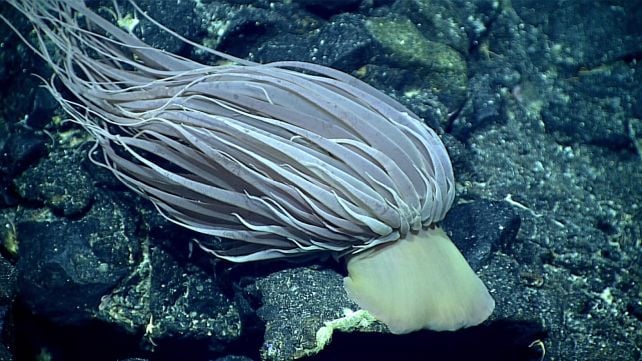
First described from the East Pacific Rise in 2006, the species was moved into its own genus in 2014. A January 2025 record in the Journal of the Marine Biological Association, led by Dalhousie University researcher Monika Neufeld, extended its known range to the Indian Ocean and captured the first direct footage of the animal feeding: a tentacle coiling around a live shrimp and tightening to prevent escape.
A Shed Skin or an Abandoned Reproductive Attempt
The cuticle is a thin, multilayered outer coating secreted by some anemones from their surface tissues. Its main structural component is chitin, the same tough polysaccharide found in beetle shells and fungal cell walls. Collected specimens of R. daphneae rarely carry one intact, which suggests the animal detaches from it as it moves, leaving the structure behind while the rest of the body migrates elsewhere.
The researchers also raise a second possibility. Certain sea anemones reproduce asexually through pedal laceration: the animal abandons the lower portion of its body and moves away, leaving a stump that can regenerate into a new polyp. The golden orb’s central opening and fibrous internal structure could mark the remnant of an incomplete version of this process. Whether R. daphneae uses pedal laceration has not yet been confirmed.
Even as dead tissue, the shed cuticle appears useful to the surrounding environment. The density of microorganisms found colonizing the orb before it reached the lab suggests these cast-off skins create small-scale hotspots of microbial activity on the deep-sea floor. In an ecosystem where energy is scarce, chitin-rich debris feeds the nitrogen cycle and can sustain bacterial communities for extended periods.
Enjoyed this article? Subscribe to our free newsletter for engaging stories, exclusive content, and the latest news.

