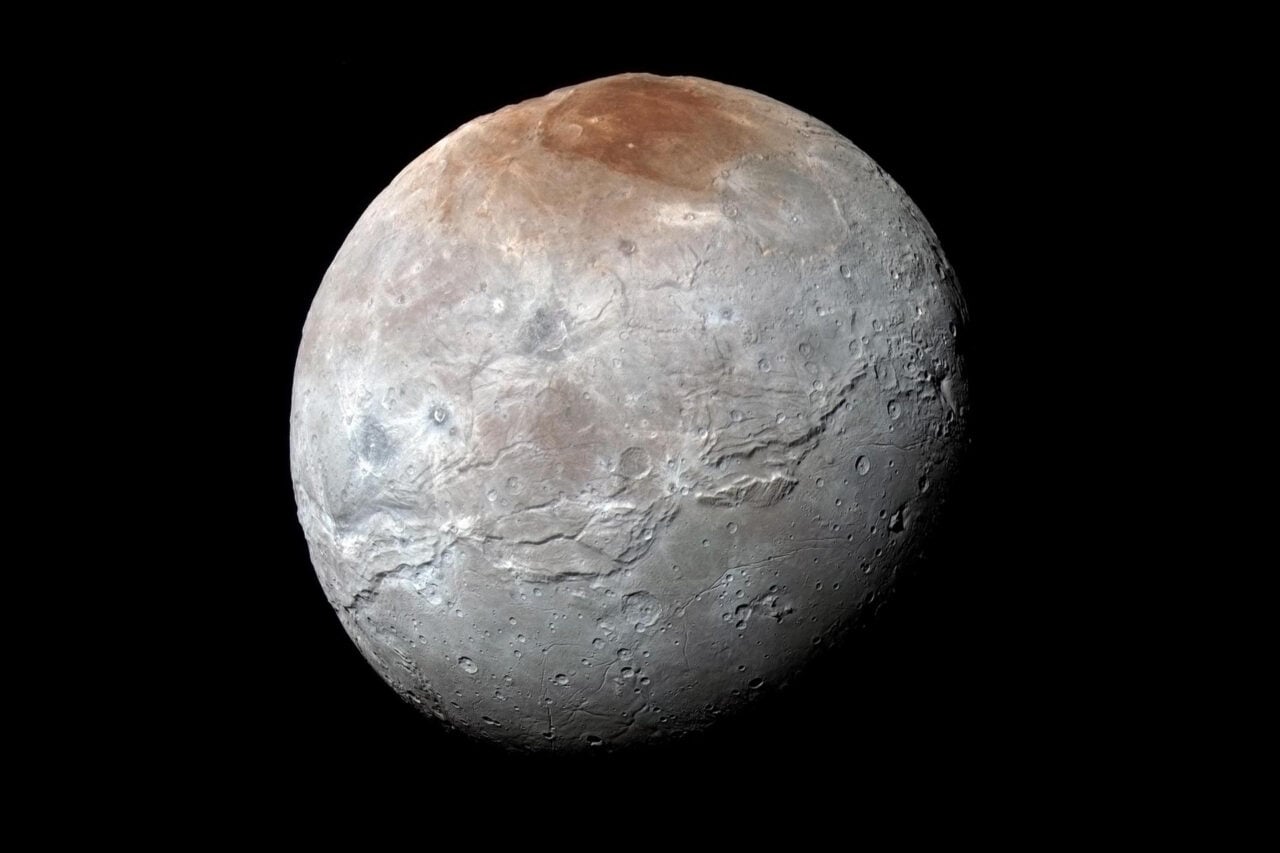
Шинэ судалгаагаар Харон сарны геологийн тогтоц нь түүний эргэлтийн хурд өнгөрсөн хугацаанд хэрхэн өөрчлөгдсөнийг хадгалан үлдээсэн болохыг илрүүлжээ.
Nature Communications сэтгүүлд нийтлэгдсэн судалгаагаар Плутоны хамгийн том дагуул болох Хароны эргэлтийн хурд удааширч байсныг тогтоов. Швейцарын ETH Zurich сургуулийн судлаач Ханжан Чэнь тэргүүтэй багийнхан NASA-гийн New Horizons хөлгийн цуглуулсан мэдээлэлд үндэслэн энэхүү дүгнэлтэд хүрсэн байна. Тэдний боловсруулсан загварчлалаар Хароны эргэлтийн хугацаа урьд нь 14.3 цаг байсан бол одоо 153.3 цаг болж сунасан болохыг харуулжээ.
https://www.nature.com/articles/s41467-026-75069-7
Судлаачид Хароны хойд хэсэгт орших Оз Терра уулархаг бүс нутгийн гадаргууг шинжилж, 200 км орчим үргэлжлэх өндөрлөгүүдийн тогтоцыг судалжээ. Тэдгээр тогтоц нь зөвхөн тектоникийн суналтаар тайлбарлахад хүндрэлтэй байсан бөгөөд эргэлтийн хурд саарах явцад үүссэн даралтаар тайлбарлах нь илүү оновчтой гэж үзсэн байна. Энэхүү үйл явц нь сарны мөсөн бүрхүүлийн зузааныг өөрчилж, гадаргуу дээрх одоогийн нуруудыг бий болгосон гэж таамаглаж байна.
Энэхүү судалгаа нь Хароны геологийн түүхийн талаарх бидний ойлголтыг эрс өөрчилж байна. Ханжан Чэнь энэ нь сониуч занд хөтлөгдсөн судалгаа төдийгүй мөсөн дагуулуудын анхны орбитын болон дулааны төлөв байдлыг геологийн бичлэгээс нь таньж мэдэх шинэ арга барил болно гэж онцоллоо. Ийнхүү Харон нь нарны аймгийн захын бүс дэх дагуулуудын хувьслыг судлах чухал талбар болж байна.
Дэлгэрэнгүйг эх сурвалжаас харах
Эх сурвалжийг нээх ↓
The solar system’s icy moons are natural labs for astronomy’s most fascinating discoveries. And Charon, Pluto’s largest moon, is no exception. According to a new study, this icy world might redefine how scientists understand the evolution of satellites in the outer solar system.
In a paper published today in Nature Communications, researchers present new evidence that Charon’s rotation is slowing down, with the record of this change preserved in the moon’s geological features. Using observations collected during NASA’s historic New Horizons flyby of the Pluto system, the team built a modeling system to assess how despinning—a process in which tidal forces alter an object’s shape and internal temperature—affected Charon’s overall geology. The analysis suggested that Charon’s rotation period used to be around 14.3 hours—significantly shorter than its current period of about 153.3 hours.
“This study drastically changed our understanding of the geologic history of Charon,” Hanzhang Chen, the study’s first author and a postdoctoral researcher at ETH Zurich in Switzerland, told Gizmodo.
Spinny round things
In the paper, Chen and colleagues explained that it’s challenging to study the geologic and thermal evolution of planetary bodies in the solar system. Landscapes constantly shift on objects with active atmospheres, such as Pluto or Titan. On the other hand, bodies without atmospheres are either subjected to heavy cratering, like Callisto or Ceres, or experience frequent tectonic changes due to tidal dissipation, such as Enceladus or Europa, according to the paper.
After New Horizons’s flyby of Pluto and its neighbors in 2015, scientists reported that Charon wasn’t as worn out from atmospheres (which it doesn’t have) or asteroid attacks as other icy moons. What’s more, its craters appeared to be more than four billion years old. In other words, Charon was a promising candidate to investigate the earliest days of icy satellites.
Rewinding the clock
Previous work suggested that Charon experienced global extension accompanied by cryovolcanism, according to the paper. While studying Oz Terra—a mountainous region in northern Charon—Chen and colleagues found some landforms that were “hard to explain by extension,” he said. Specifically, the highlands, which extended about 124 miles (200 kilometers), tended to stretch in the east-west direction. To Chen, a field structural geologist, that seemed more consistent with rotational flattening.
“So we looked into a compressional origin for these features and found a plausible dynamic origin,” he explained.
The team developed a model to assess whether compression caused by despinning could better explain the geological evolution of Oz Terra and confirmed that its analysis aligned nicely with New Horizons data. The modeling results also indicated that Charon’s ice crust shell used to be around 19 to 22 miles (30 to 36 kilometers) thick, but the shell gradually grew thinner via despinning, pressuring Charon’s faultlines and creating the ridges we see today.
In the earliest moments
If so, Charon’s initial rotation period would have added up to around 14.3 hours, the paper added. This also suggests that Charon had a “cold start,” and its particular shape was continuously influenced by the residual stress of despinning, the paper explained. But of course, planetary evolution is a complex process with many factors involved. There’s more work to be done in terms of painting a fuller picture of Charon’s evolution, the researchers concluded.
“It’s a curiosity-driven study,” Chen added. And even if it doesn’t end up being the right answer, the model should still provide a “new approach to infer the initial orbital and thermal states of icy satellites from their geologic records,” he said.

