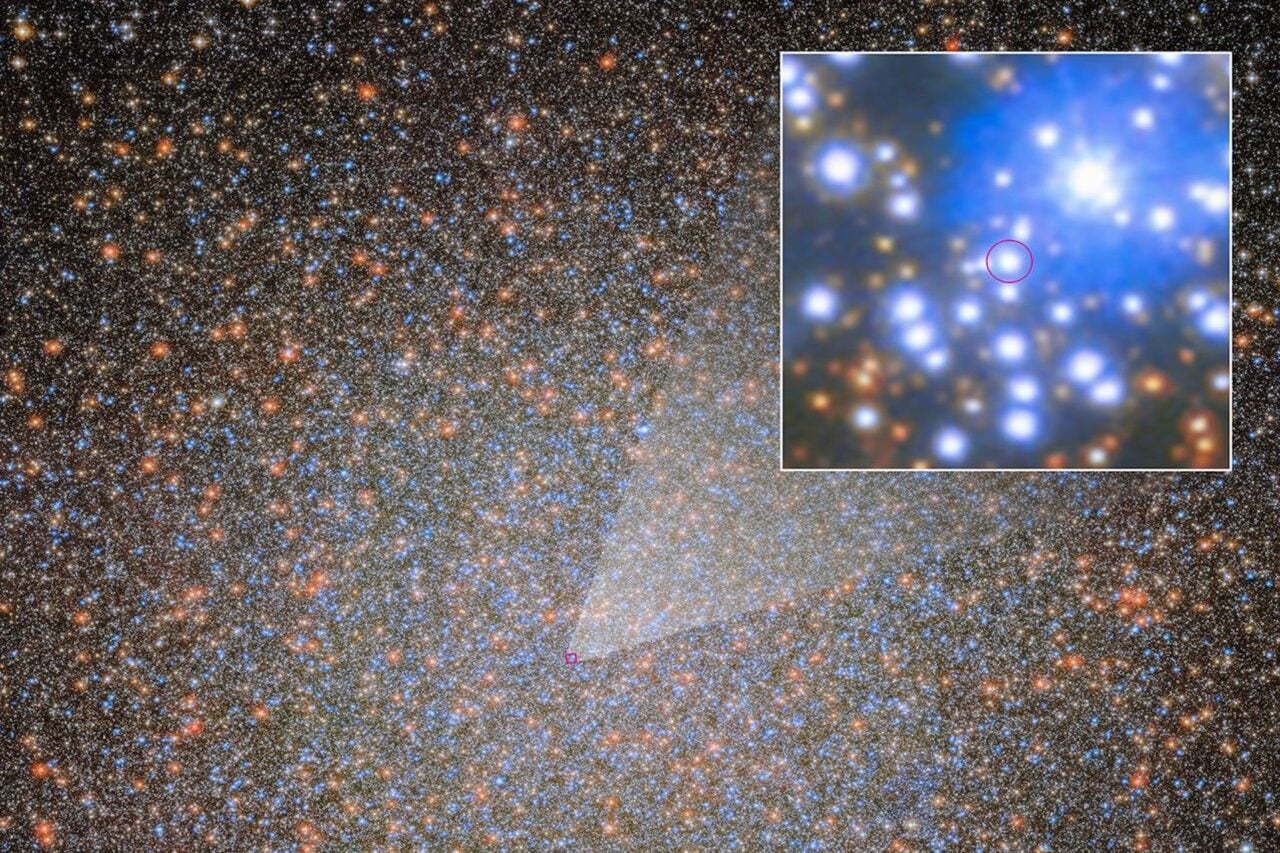
Одон орон судлаачид 18,000 гэрлийн жилийн зайд орших Омега Центаври оддын бөөгнөрлөөс урьд өмнө нь олдоогүй байсан хар нүхийг анх удаа нээв.
Эрдэмтэд Хаббл сансрын дурангийн 2002-2023 оны хооронд цуглуулсан архивын өгөгдөл болон Жэймс Вэбб дурангийн хэт улаан туяаны хэмжилтийг ашиглан 20 жилийн турш нэгэн одыг ажиглажээ. Уг од нь Нарнаас 4.5 дахин их масстай, үл үзэгдэх биетийг тойрон эргэж байсныг тогтоосон бөгөөд уг биет нь нейтрон од байх боломжгүй тул одод-массын хар нүх (oMEGACat BH-2) болох нь батлагдсан байна. Энэхүү одны хар нүхийг тойрох хугацаа нь 94 жил бөгөөд энэ нь одоогоор мэдэгдэж буй хамгийн урт хугацаатай хар нүхний хос систем юм.
Ютагийн их сургуулийн судлаач Анил Сэтийн тайлбарласнаар, металл багатай орчинд ийм хэмжээтэй хар нүх үүсэх нь одон орон судлалын хувьд гэнэтийн бөгөөд сонирхолтой нээлт болжээ. Ерөнхийдөө металл багатай оддын үлдэгдэл нь илүү том хар нүх үүсгэдэг гэж таамагладаг байв. Судалгааны багийнхан энэ хос систем нь анхнаасаа хамт байгаагүй, харин Омега Центаври бөөгнөрлийн дотор бие биеэ олсон байх магадлалтай гэж үзэж байна.
https://iopscience.iop.org/article/10.3847/2041-8213/ae7a5c
Энэхүү нээлт нь сансар огторгуйн таталцлын долгионыг ойлгоход чухал ач холбогдолтой юм. Омега Центаври шиг оддын бөөгнөрөл нь хар нүхнүүд нэгдэж таталцлын долгион үүсгэдэг гол цэгүүдийн нэг гэж үздэг. Судлаач Мэтью Уайтекэрын хэлснээр, тус баг цаашид Хаббл болон Жэймс Вэбб дуранг ашиглан бусад бөөгнөрлүүдээс ижил төстэй системийг эрэн хайх ажлаа үргэлжлүүлэхээр төлөвлөж байна.
Дэлгэрэнгүйг эх сурвалжаас харах
Эх сурвалжийг нээх ↓
Astronomers charted a star’s path over 20 years as it circled an invisible object that was rather hefty. The mysterious object was found to be a stellar-mass black hole, one of 10,000 that may be lurking within a crowded cluster of stars.
Located around 18,000 light-years from Earth, Omega Centauri is a massive globular cluster filled with 10 million gravitationally bound stars. The cluster should have a large population of black holes born in the aftermath of exploding stars, and yet astronomers have found little to no evidence for them.
The case has puzzled astronomers for decades, but now they may finally have their first clue to Omega Centauri’s missing black holes. In a new study published in The Astrophysical Journal Letters, scientists say they’ve found the first of thousands of black holes in Omega Centauri.
Missing in action
To help solve the mystery of the missing black holes, a team of astronomers scoured through archival data collected by the Hubble space telescope that spanned from 2002 to 2023. The astronomers also pulled in Webb near-infrared data to improve precision of their measurements.
In doing so, the team located a star orbiting around an object that appeared to be a black hole. The object was dubbed oMEGACat BH-2, a tiny black hole that’s just 4.5 times the mass of the Sun. By constraining the mass of the object, the astronomers were able to determine that it is too heavy to be a neutron star.
“Its mass is much lower than would be expected in a metal-poor environment like Omega Centauri. This is surprising and exciting,” Anil Seth, a researcher at the University of Utah and co-author of the study, said in a statement. “We now know that a metal-poor star is able to form a black hole like this, and we need to figure out how that happens.”
Metal-poor stars contain fewer heavy elements and therefore lose less mass over their lifespan compared to metal-rich stars like our Sun. Therefore, the collapse of these metal-poor massive stars tends to result in larger black holes.
A long-winded binary pair
Using the combined Hubble and Webb data, the team behind the study was also able to track the star’s path as it orbited its black hole companion. During its closest approach to the black hole, the star moved the fastest across the sky.
The team determined that the star orbits oMEGACat BH-2 over a period of 94 years, making it the longest orbital period for a black hole binary ever known. The pair’s long orbital period provides clues to its origin story, suggesting that the star and black hole did not start out together but rather found one another in the Omega Centauri cluster.
The recent findings could help scientists better understand gravitational waves, microscopic ripples in the fabric of spacetime caused by the most massive events in the universe. “It’s important to understand black hole populations in globular clusters because there’s uncertainty about their physics and formation,” Seth said. “More specifically, understanding the process of forming black holes and then dynamically forming binaries is vital, because it affects our ability to interpret and understand gravitational wave events. Environments like Omega Centauri are the primary places where we think binaries are merging and creating these waves.”
Based on their calculations, the researchers estimate that a system like oMEGACat BH-2 will survive for less than a billion years before it is torn apart by encounters with nearby stars. That’s a short blip compared to the age of the cluster, estimated at approximately 12 billion years old.
Having found the first of many black holes in Omega Centauri, the team of astronomers is ready to look for more. “With Hubble and Webb, we can continue to look at Omega Centauri and expand our search for similar systems within other clusters,” Matthew Whitaker, a researcher at the University of Utah and lead author of the paper, said in a statement.

