Хятадын баруун хойд нутгаас 385 сая жилийн тэртээх Дунд Девоны үед хамаарах, өмнө нь бүртгэгдсэнээс 65 сая жилээр илүү эртний хувны хэлтэрхийнүүдийг судлаачид илрүүлжээ.
Хятадын Шинжлэх ухааны академийн палеонтологич Чихан Луо тэргүүтэй эрдэмтэд “Science Advances” сэтгүүлд нийтлүүлсэн судалгаандаа энэхүү нээлтийг танилцуулсан байна. Тэд 10 кг нүүрсний давхаргаас 0.1-1.5 мм хэмжээтэй 241 ширхэг хувны хэлтэрхийг олсон бөгөөд хэт ягаан туяаны тусламжтайгаар ялган авчээ. Химийн нарийвчилсан шинжилгээгээр эдгээр нь шилмүүст модны төрлийн давирхай болохыг тогтоосон байна.
Энэхүү нээлт нь үрийн ургамал үүсэхээс ч өмнө судалт ургамлууд нарийн бүтэцтэй давирхай ялгаруулдаг байсныг баталж байна. Давирхай нь тухайн үеийн ургамлуудад гал түймэр, мөөгөнцрийн халдвар болон хортон шавжаас хамгаалах чухал дасан зохицол болж байсан бололтой.
Эрдэмтдийн үзэж буйгаар, эртний ургамлууд модлог эд, навч, гүн үндэс зэрэг шинж чанараа хөгжүүлж байсан энэ үе нь дэлхийн хуурай газрын экосистем бүрэлдэхэд чухал үүрэг гүйцэтгэжээ. Цаашид Девоны үеийн нүүрслэг давхарга болон тунамал чулуулгуудад хийх судалгаагаар үүнээс ч эртний хув олдох боломжтой гэж судлаачид дүгнэв.
Дэлгэрэнгүйг эх сурвалжаас харах
↓Эх сурвалжийг нээх ↓
We tend to think of tree resin as an ancient, fragrant defense against munching insects – one that fends off pests and scabs over the wounds left by their voracious mandibles.
But a new discovery suggests that these viscous secretions emerged in a very different world from the one our minds conjure when we think of amber – one without dinosaurs and even before insects had become major plant grazers.
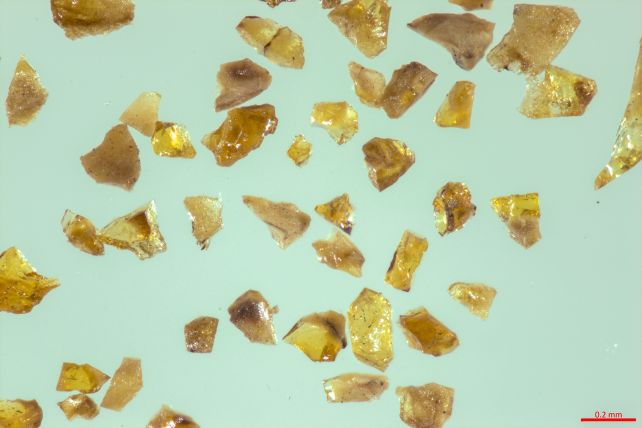
In a bed of coal in China’s far northwest, paleontologists have found hundreds of microscopic fragments of amber that date back to the Middle Devonian, 385 million years ago – some 65 million years earlier than the previous record holder, and 150 million years before the first dinosaurs.
“The importance is not simply that the record is older,” paleontologist Cihang Luo, of the Chinese Academy of Sciences and first author of the new study published in Science Advances, told ScienceAlert.
“The previous confirmed amber record came from the Late Carboniferous and was probably associated with seed plants. Our amber comes from the Middle Devonian, before seed plants had emerged and diversified.
“This means that a non-seed vascular plant was already capable of producing chemically complex terpenoid resin.”
Amber is one of the icons of prehistory.
It’s made of tree resin that has hardened and fossilized over millions of years, turning into a glorious, warm-hued gemstone.
But it’s not just a pretty face. Amber can preserve, often in perfect detail, the minutiae of the world that existed when it oozed out of the tree it came from – from plant matter like pollen, to the invertebrates trapped when engulfed, even vertebrates such as reptiles and tiny dinosaurs (or parts of them).
Such specimens are highly prized by paleontologists for what they can tell us about prehistoric ecosystems, but there’s a lot more amber can tell us – namely, about the evolution of plants.
This discovery, in particular, changes our understanding of how early plants evolved the ability to produce resin.
“It provides a direct fossil benchmark showing that sophisticated resin biosynthesis had appeared much earlier than previously demonstrated,” Luo said.
“Resin production may have been another important innovation – alongside the evolution of trees, wood, leaves, and deeper root systems – that helped early vascular plants survive and expand across terrestrial environments.”
The ancient resin wasn’t discovered as gleaming, gold-hued nuggets like you might see set in a silver pendant, or gracing the pages of a paleontology journal.
The researchers discovered it as 241 tiny fragments ranging from just 0.1 to 1.5 millimeters (0.004 to 0.059 inches) across, recovered from 10 kilograms (22 pounds) of coal from the Hujiersite Formation in the country’s far northwest.
These pieces were so tiny they had to be located with ultraviolet light, which made them fluoresce against the surrounding rock.
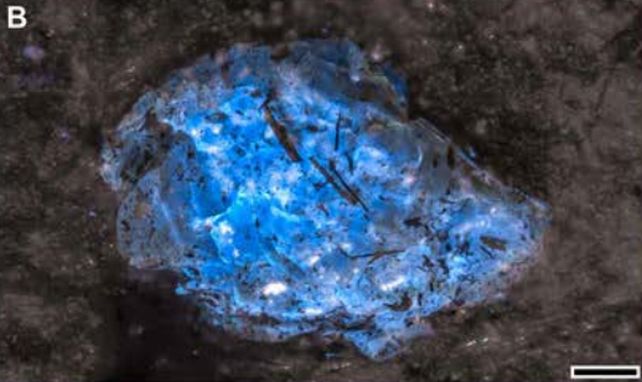
That rock had already been confidently dated to 385 million years ago. The question was – what was the fluorescing material?
“Our first reaction was excitement, followed immediately by caution,” Luo explained.
“An amber identification at approximately 385 million years old would be extraordinary, so we initially treated the particles simply as resin-like organic material rather than assuming that they were genuine amber.”
They subjected the material to a battery of chemical tests.
Only once they had conducted optical tests, infrared spectroscopy, and mass spectrometry were the researchers confident that their grains had the chemical hallmarks characteristic of conifer-type resins.
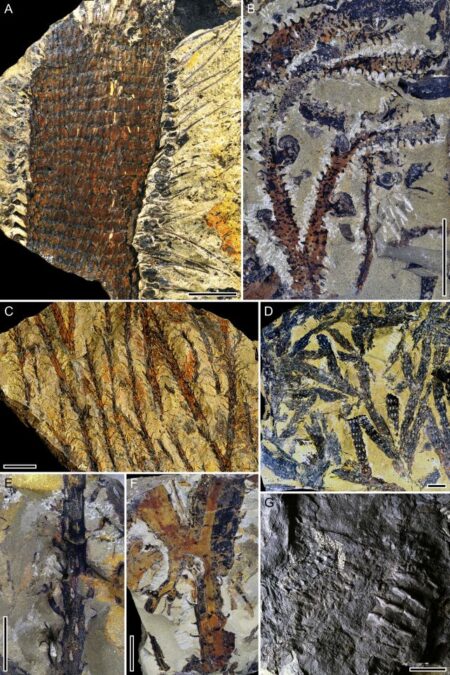
The scientists were unable to ascertain exactly what family of extinct trees produced the resin, but they think there was enough danger in the ecosystem for the plants to need defensive capabilities.
Before insects became major plant grazers, wildfires and parasitic fungi may already have been dangerous enough to favor resin production.
It was an adaptation that would prove remarkably enduring.
“The amber-bearing coal indicates a wet, organic-rich, coal-forming environment, probably with patchy stands of early vascular vegetation. Fungi and terrestrial arthropods were already present, but the terrestrial food webs were much less complex than those of later forests,” Luo told ScienceAlert.
“It was a critical period when plants were becoming taller, developing wood and deeper roots, and transforming the physical structure of the continents. These tiny amber particles formed during that major ecological transition.”
There’s good reason to believe, Luo noted, that there may be even older ambers out there.

Molecular studies show that plants likely had the genes for making resin chemical compounds called terpenes much earlier than the Middle Devonian.
Related: Mysterious Giants Could Be a Whole New Kind of Life That No Longer Exists
And the researchers also note in their paper that the size of the grains is typical for amber from the Paleozoic Era, which encompasses the Middle Devonian but stretches further back, as far as 540 million years ago.
So it’s possible that other ancient ambers may have already been unearthed and are awaiting just the right sequence of tests to reveal themselves.
“The most promising places to search would be Early Devonian organic-rich coals, coaly shales, and fine-grained sediments that preserve abundant plant cuticles and have experienced relatively low thermal alteration,” Luo explained.
“Early amber was probably microscopic, highly localized, and easily confused with other organic matter, which may explain why it has been overlooked.
“Combining ultraviolet screening, careful microscopic extraction, infrared spectroscopy, and organic geochemical analysis may reveal still older records.”
The discovery has been published in Science Advances.
This article was fact-checked by Rachel Garner and edited by Clare Watson. While we pride ourselves on our process, we are only human. If you spot a mistake, please let us know.