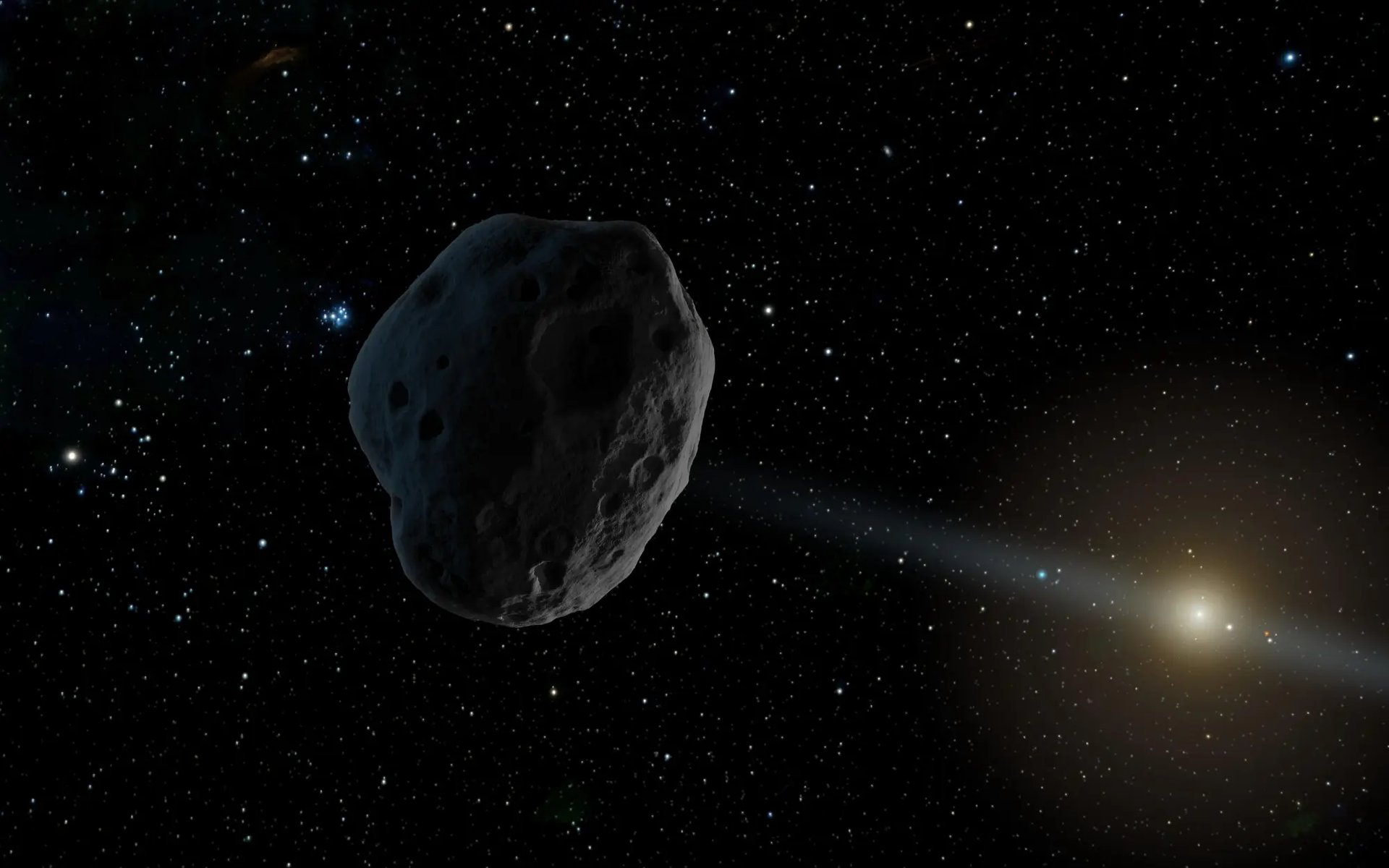
Эрдэмтэд олон жилийн турш астероид хэмээн ангилж ирсэн 1998 SH2 биетийг үнэн хэрэгтээ сүүлт од болохыг тогтоожээ.
NASA-гийн Тийрэлтэт хөдөлгөөний лабораторийн эрдэмтэн Давид Фарноккиагаар ахлуулсан баг 1998 SH2 хэмээх 380 метрийн голчтой биетийг судалж, түүнийг “хар сүүлт од” болохыг илрүүлжээ. Одон орон судлалд сүүлт од нь хий, тоосны бүрхүүл буюу “кома”-гаараа астероидоос ялгардаг ч, зарим тохиолдолд энэ бүрхүүл нь маш бүдэг байдаг тул ялгахад хүндрэлтэй байдаг. 2025 оны наймдугаар сард уг биет Дэлхийд ойртох үед радар ажиглалтад огт бүртгэгдээгүй нь эрдэмтдийн анхаарлыг татсан байна.
https://www.youtube.com/embed/afmz_RF2fLw
Бразилийн одон орон судлалын төв уг биетийг олж харах үед тэрээр тооцоолсон байршлаасаа 190 км-ийн алсад байжээ. Уг хазайлт нь таталцлын бус нөлөөлөл, тухайлбал, биетийн доторх мөс хайлж хий ялгарснаас үүдэлтэй “outgassing” үзэгдэлтэй холбоотой гэж эрдэмтэд үзсэн байна. Канадын Франц-Хавай болон “Very Large Telescope” дуран авайг ашиглан хийсэн ажиглалтаар биетийн цөмөөс 20 орчим нуман секундээр сунаж тогтсон бүдэг сүүл байгааг баталжээ.
https://www.youtube.com/embed/2gYkN3p24Ao
Энэхүү судалгаа нь астероидын шинж чанарыг байршлын өөрчлөлтөөр нь урьдчилан таамаглаж, дараа нь бодитоор баталсан анхны тохиолдол болж байна. Одоогоор Дэлхийд аюул учруулж болзошгүй 285 орчим “хар сүүлт од” бүртгэгдээд байгаа бөгөөд тэдгээр нь хий ялгаруулах үедээ хөдөлгөөний замнал нь урьдчилан таамаглашгүй өөрчлөгддөг нь эрсдэлтэй юм. Иймд эрдэмтэд 1998 SH2 биетийг P/1998 SH2 хэмээн сүүлт одны ангилалд давхар бүртгэж, аюултай биетүүдийн хөдөлгөөнийг сайтар хянах шаардлагатайг онцолж байна.
Дэлгэрэнгүйг эх сурвалжаас харах
Эх сурвалжийг нээх ↓
Our ability to track and visualize small rocks in space is still improving. And occasionally we’ll find a space rock that will remind us of that fact. One such rock is detailed in a new paper, led by Davide Farnocchia of NASA’s Jet Propulsion Laboratory, and recently published in Nature Astronomy, where the research team discovered what they thought was a normal, run of the mill asteroid, was actually a “dark comet”.
The line between asteroids and comets has always been a little blurry, but astronomy textbooks usually differentiate them by showing that a comet has a “coma” – a halo of gas and dust surrounding it – whereas an asteroid does not. But in some cases, the coma that would differentiate between one categorization and the other is so small or faint it’s almost impossible to see.
The asteroid 1998 SH2 is a perfect example of this blurry line. Astronomers have been aware of it for almost 3 decades, and it was consistently imaged and its orbital path precisely calculated for years. Then, in August 2025, the 380m rock was making a (very safe) pass nearby the Earth at a distance of about 0.02 AU, and a team of astronomers were looking to do some additional observations of it with the 70-meter DSS-14 radar antenna at the Goldstone Observatory. But when the time came, there was absolutely no trace of the asteroid in the observatory’s radar data.
Fraser discusses the difficulties of landing on a comet.
It wasn’t until August 31st that the missing asteroid was finally spotted by the Southern Observatory for Near Earth Asteroids Research Wykrota-Centro de Estudos Astronômicos de Minas Gerais observatory in Brazil. It was a whopping 153 arcseconds (190 km) away from where it should have been based on the orbital dynamic calculations. While that might not seem like much in the grand scheme of the cosmos, it’s a pretty massive position error for an astrometry calculation, and would have explained why the DSS-14 antenna completely missed it.
So why would a space rock not be where it’s supposed to be? While the Yarkovsky effect was considered, the detected non-gravitational perturbations were ten times larger than the maximum possible acceleration compatible with that effect for an object of this size. This discrepancy immediately implied something else was going on, and Dr. Farnocchia and his team thought they knew what – outgassing.
Outgassing occurs when a comet approaches close to the Sun and the temperature inside the rocky body elevates to a point that liquids inside of it start to sublimate. Occasionally, these gases build up enough pressure to break out of their rocky prison and blow some of the rocks away from the surface, creating a halo of dust surrounding the comet – it’s coma. But 1998 SH2 wasn’t a comet, and shouldn’t have any outgassing, right?
Fraser talks about how we need to find potential dangerous asteroids.
To answer that question, the researchers turned to some other powerful telescopes – the Canada-France-Hawai’i Telescope (CFHT) and the Very Large Telescope. Using these two behemoths, they stacked multiple long-exposure images of the object, and eventually resolved the faint glow of a cometary tail, extending about 20 arcseconds away from the nucleus.
There were a couple of nuances to the tail itself. The majority of the dust grains appeared to be around 400 micrometers across, and the dust seemed to be released between August 29 to September 7, 2025. However, the activity actually peaked several weeks after its perihelion, signifying that the ice driving the outgassing was probably buried deep in the object’s surface.
This paper therefore marks a major first. It’s the first time the cometary nature of an object was predicted based on its positioning, and then confirmed afterwards via observation. But perhaps more importantly, it draws attention to the potentially hazardous nature of “dark comets”, especially those that travel near Earth itself.
There are around 285 near-Earth objects that are classified as “potentially hazardous asteroids” (PHAs) that have comet-like orbits. The risk lies in what might happen if one of these PHAs starts outgassing similar to 1998 SH2. While our orbital mechanics simulations can accurately mimic gravitational pulls of planets, moons, and other asteroids, as well as the very faint Yarkovsky effect, outgassing is a much more chaotic and random process.
Simulating it is near impossible without an accurate map of the interior of the rocky body, which is essentially non-existent for almost all near-Earth asteroids. The best we can do is continue to track these PHAs closely, and adjust any orbital dynamics simulations based around any observed but unexpected accelerations. As the authors point out, the ultimate purpose of this paper is to stress the necessity of closely following the orbital trajectories of any potentially hazardous space rock, no matter its classification. And, also, to get a dual-classification for 1998 SH2 itself, which is now also known as comet P/1998 SH2.
Learn More:
NASA – NASA Study Finds Near-Earth Asteroid Is Actually Comet
Dr. Farnocchia et al – Non-gravitational acceleration indicative ofcometary activity of near-Earth object

