
Компьютерийн шинжлэх ухааны судлаач Энди Адамацки Brachythecium rutabulum хэмээх хөвдний төрөл дээр судалгаа хийж, тэдгээрийн цахилгаан идэвхжилийг хянасан байна. Лабораторийн нөхцөлд электродууд ашиглан хийсэн ажиглалтаар хөвд нь зүгээр нэг энгийн ургамал бус, харин хоорондоо холбогдсон динамик систем болох нь тодорхой болов.
Судалгааны үр дүнд хөвдний хэсгүүдэд хурдан осцилляцийн импульс, хэмнэлт хэлбэлзэл болон мэдрэлийн эсийн үйл ажиллагаатай төстэй удаан давалгаанууд ажиглагджээ. Эдгээр дохио нь хөвдний бөөгнөрөл даяар тархаж, тодорхой хэв шинжийг бүрдүүлж байсан нь тэднийг мэдээлэл дамжуулах чадвартай болохыг харуулж байна.
Хөвд нь судаслаг системгүй, үндэсгүй, энгийн бүтэцтэй боловч энэхүү цахилгаан дохиоллын систем нь тэднийг хүрээлэн буй орчинтойгоо харилцан үйлчлэлцэхэд тусалдаг байж болзошгүй юм. Хэдийгээр судалгааны зарим хязгаарлалт байгаа ч энэхүү нээлт нь хөвд ургамлыг био-мэдрэгч болон тооцооллын системд ашиглах боломжийг нээж өгч байна.
Royal Society Open Science сэтгүүлд нийтлэгдсэн уг судалгаа нь ургамлын ертөнцийн нууцлаг, нарийн төвөгтэй үйл явцыг ойлгоход чухал ач холбогдолтой юм. Хөвд ургамал нь байгалийн шалгарлаар хөгжсөн, эрчим хүчний хэмнэлттэй биологийн сүлжээ байж болохыг судлаачид онцолжээ.
Дэлгэрэнгүйг эх сурвалжаас харах
↓Эх сурвалжийг нээх ↓
Mosses are some of the earliest plants that appeared in the fossil record, but they’re anything but simple.
A new study, published in Royal Society Open Science, reveals that moss cushions produce surprisingly complex electrical activity, with patterns that undulate across the velvety patch in dynamic waves.
The study’s sole author, Andy Adamatzky, is actually a computer scientist, whose fascination with unconventional ‘computing’ systems like slime molds, crowds, and mycelium networks has now led him to a new subject: the humble moss, Brachythecium rutabulum.
“Plants and bryophytes display diverse forms of electrical activity, yet the organization of endogenous signals in mosses has received little attention,” Adamatzky writes in his new paper.
His findings suggest that “moss cushions behave as spatially distributed excitable systems potentially capable of coordinating and integrating electrical signals across both space and time.”
Moss cushions are actually many individual clones of the same teensy tiny plant.
If you look really, really closely at a mat of moss, you can see it is made up of simple, minute leaves on stems, similar to those of their larger plant relatives.
But the stems of mosses are actually much less useful at moving water and nutrients around the body of the plant.
Mosses actually never developed the vascular systems that we see in other more complex plants, which is why they cannot grow much taller than a few centimeters. Their leaf-like structures are just one cell thick; they don’t even have roots.
But that doesn’t mean they’re not potentially capable of transmitting information across the colony by other means.
For the study, Adamatzky collected cushions of the common moss species B. rutabulum from natural outdoor environments in North Somerset in the UK.
Back in the lab, he poked electrodes into the moss clumps to track any electrical activity that might be passing across this soggy green matrix.
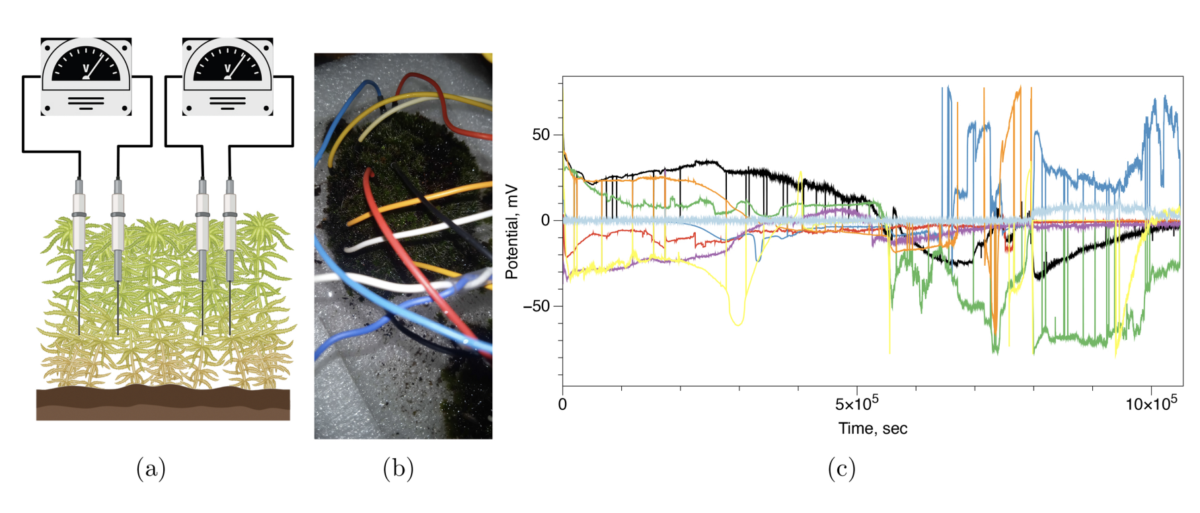
Like many plants, moss lives life in slow motion, so to get on its level, Adamatzky recorded its electrical behavior across multiple days.
This revealed “a rich repertoire of electrical events, including components consistent with both physiological activity and slower drift-related processes: fast oscillatory spikes, slower rhythmic fluctuations and very slow depolarization waves,” he reports.
“In addition to these described classes, we also observed spikes resembling high-amplitude action potentials and neuron-like spike trains.”
Some of the moss’s electrical waves were rapid, while others undulated slowly. They tended to spread across the entire cushion rather than remaining confined to a particular region, and followed patterns across different timescales.
These findings suggest that “moss behaves as a dynamic, interconnected system rather than a collection of independent cells.”
There are a few limitations here.
For one, there were no negative control recordings, using the same electrode method on an inert substrate (rather than living moss) to rule out electrical signals being the result of something other than the moss – the instruments, for example.

Secondly, using moss collected from nature also brings an element of chaos: it’s unclear in this study whether some contamination, mixed levels of hydration, or other factors might have influenced the flow of electricity.
Much more detailed research is needed before we will know whether mosses could actually act as “responsive sensory networks or distributed biocomputing substrates”, as Adamatzky proposes in his paper.
Related: Moss Survived 9 Months in The Vacuum of Space
“This multi-layered organization supports the emerging view that moss can serve as a naturally evolved, energy-efficient living substrate for biohybrid
sensing and unconventional computation.”
But even just knowing more about what these little green plants are getting up to, in the cracks and crevices of the world around us, is cause for wonder.
The research was published in Royal Society Open Science.
This article was fact-checked by Michael Irving and edited by Rebecca Dyer. While we pride ourselves on our process, we are only human. If you spot a mistake, please let us know.

