Шинэ судалгаагаар хөгшрөлтийн бүх процессыг зогсоосон ч хүний бие дэх ДНХ-ийн санамсаргүй мутацийн хуримтлал нь амьдрах хугацаанд биологийн хязгаар тогтоодог болохыг тогтоожээ.
Skolkovo Institute of Science and Technology-ийн судлаач Дмитрий Крюков тэргүүтэй баг хөгшрөлтөд нөлөөлдөг биологийн процессуудыг үнэлэх математик загварчлал боловсруулсан байна. “npj Aging” сэтгүүлд нийтлэгдсэн уг судалгаагаар хэрэв хүн хөгшрөлттэй холбоотой бүх өвчнөөс ангид байлаа ч эсийн хуваагдал бүрд үүсдэг ДНХ-ийн санамсаргүй алдаанууд хуримтлагдсаар биеийн үйл ажиллагааг доголдуулдаг болохыг харуулжээ. Энэхүү загварчлалын үр дүнд хүний дундаж наслалт 146-194 жилийн хязгаартай байх магадлалтай гэж тооцоолсон байна.
Судлаачдын тайлбарласнаар, арьс, элэг зэрэг эд эрхтэн эсээ байнга нөхөн төлжүүлдэг тул мутацид тэсвэртэй байдаг бол зүрх, тархины эсүүд нөхөн төлжих чадвар багатай тул мутацийн нөлөөнд илүү өртдөг ажээ. Энэхүү судалгаа нь хөгшрөлтийн шалтгааныг тодорхойлох анхны алхам бөгөөд зөвхөн мутациар хязгаарлагдахгүй, бусад олон хүчин зүйл амьдрах хугацаанд нөлөөлдгийг онцолсон байна.
Тус багийнхан энэхүү загвар нь хөгшрөлтийн механизмыг ойлгох, цаашлаад эрүүл урт наслах арга замыг олоход чиглэсэн суурь судалгаа гэдгийг тэмдэглэжээ. Гэсэн хэдий ч энэ нь зөвхөн математик тооцоолол бөгөөд бодит туршилтын үр дүн биш гэдгийг судлаачид анхааруулж байна. Ирээдүйд хөгшрөлтийн бусад хүчин зүйлсийг нэгтгэн судалснаар илүү цогц онолыг боловсруулах шаардлагатай байгаа юм.
Дэлгэрэнгүйг эх сурвалжаас харах
↓Эх сурвалжийг нээх ↓
When the iconic rock band Queen asked, “Who wants to live forever?” the question was rhetorical, but for many people, the answer was “Yes”.
Well, a new study suggests immortal life may be scientifically impossible, even if we somehow found the perfect anti-aging medicine.
If scientists managed to overcome every other aspect of aging, humans still couldn’t live forever, the new research shows. Random DNA mutations would continue accumulating in our cells until the body could no longer function.
Simulations conducted by a team at the Skolkovo Institute of Science and Technology in Russia suggest this process could impose a fundamental limit on human lifespan, with most people living no longer than about 150 to 190 years under this optimistic scenario.
That’s roughly double humans’ current longevity, of about 79 years in fortunate circumstances, but it’s still a hard limit on the human lifespan.
But rather than predicting how long humans might live, the researchers say their framework offers a new way to measure the contribution of different biological processes to aging.
“We thus present a robust framework for evaluating the impact of somatic mutations on aging and propose a novel approach to modeling aging,” they write in a paper published in npj Aging.
The researchers say this framework could help scientists estimate how much different biological processes contribute to aging, potentially helping identify which mechanisms should be prioritized in efforts to slow it.
As we age, our risk of certain diseases escalates exponentially. Cancer, heart disease, and dementia are some of the most common ailments – and causes of death – among the elderly.
Aging isn’t just about disease, though. Over the course of a lifetime, our DNA gradually accumulates random mutations. Every time a cell divides, tiny mistakes can arise in our DNA. Our bodies are great at repairing this damage – but not perfect.
Over time, these somatic mutations build up. Most are harmless, while a few can contribute to diseases such as cancer.
But even if cancer and every other age-related disease could somehow be prevented, the mutations would continue accumulating, gradually impairing how well our cells function, according to the new analysis.
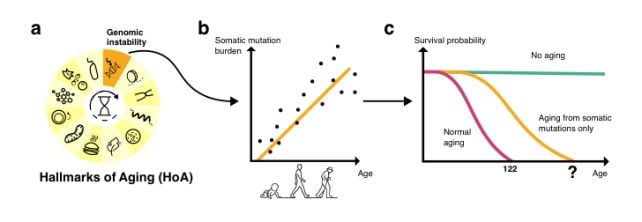
Led by computational biologist Dmitrii Kriukov, the researchers asked a deceptively simple question: If every other hallmark of aging could somehow be removed, would random DNA mutations alone still limit how long humans can live?
This wasn’t a prediction of how long people will live in the future.
Instead, it was a thought experiment designed to estimate the upper limit that somatic mutations alone might impose to improve our approach to understanding aging.
The researchers built a mathematical model that systematically quantified how the DNA mutation rate impacts the body’s major organs, and used this information to calculate the lifespan of a human population free of age-related disease.
The answer was surprisingly optimistic – at least compared to current human longevity.
Depending on the model, the median lifespan ranged from 146 to 194 years.
A few exceptional individuals might theoretically live much longer, but no one would live forever.
“This is a mathematical estimate (though careful), not experimental data,” Kriukov notes.
The maximum lifespans calculated are “not a verdict of inevitability”, he says, “but it does highlight that somatic mutations, while surprisingly weak as a standalone aging driver, may become critical when combined with other mechanisms”.
Interestingly, the researchers found that some cells are more hardy than others. Many tissues, such as the skin and liver, constantly replace old cells with new ones, and can theoretically continue this replenishment for a very long time.
Other vital organs are less resilient. Cells in the heart and brain are largely irreplaceable, so they continue to accumulate mutations as the years mount up. It’s these long-lived cells that impose the strictest limitations on lifespan, the team found.
The research made another interesting observation.
The idea that accumulating DNA mutations might be the fundamental cause of aging has been debated for decades and forms the basis of the somatic mutation theory of aging.
Previous studies have shown that mutations build up throughout life, but the question of whether they alone could explain aging has remained controversial.
The work of Kriukov and his team suggests that somatic mutations are likely only part of the aging story. If mutations alone set a median lifespan of around 156 years, and humans currently live much shorter lifespans, then other factors must be imposing limits too.

The finding reinforces an increasingly common view that aging is complicated, with many contributing factors – and that identifying and understanding those individual factors could be key to happy, healthy later lives.
Related: New ‘Mutation Hotspot’ Discovered in The Human Genome
The researchers are careful to note that their work is only part of the overall picture, and solving this problem will likely require collaboration across many fields.
“Our work provides a critical first step towards dissecting aging into quantifiable mechanistic components,” they write.
“Ultimately, incorporating other major aging factors could pave the way to a comprehensive, mechanistic theory of aging. Achieving it would require coordinated efforts across multiple research groups – a challenging but increasingly attainable prospect in the near future.”
The findings have been published in npj Aging.
This article was fact-checked by Clare Watson and edited by Peter Dockrill. While we pride ourselves on our process, we are only human. If you spot a mistake, please let us know.

