Манай нарны аймаг Сүүн зам галактикийн спираль хэлбэрт гар болон бүтэц дундуур дайран өнгөрөх үйл явц нь дэлхийн эх газрын царцдас үүсэлд нөлөөлсөн байж болзошгүй гэсэн шинэ судалгаа гарчээ.
Австралийн Көртин их сургуулийн геологич Крис Киркландаар ахлуулсан эрдэмтдийн баг дэлхийн эртний чулуулгуудад хадгалагдсан циркон талстуудыг судалснаар энэхүү дүгнэлтэд хүрсэн байна. Нарны аймаг галактикийн нягтаршил ихтэй бүсүүдээр дайрах үед таталцлын хүчний нөлөөгөөр Оортын үүлнээс асар том биетүүд татагдан орж ирж, дэлхий болон сар луу хүчтэй мөргөлддөг байна. Ийм давтамжтай тохиох сансрын мөргөлдөөнүүд нь дэлхийн анхны тогтвортой эх газрын царцдас буюу өнөөгийн тивүүдийн үндэс суурь бүрэлдэхэд чухал үүрэг гүйцэтгэсэн байх магадлалтай аж.
Судлаачид дэлхийн 11 өөр бүсийн эртний чулуулгаас авсан циркон талстуудын гафни болон хүчилтөрөгчийн изотопын өгөгдлийг галактикийн спираль гар дайран өнгөрсөн хугацаатай харьцуулан судалжээ. Үр дүнд нь дэлхийн царцдас үүссэн үеүд болон сансрын биетүүдийн мөргөлдөөний оргил үе нь галактикийн бүтэцтэй дамжин өнгөрөх хугацаатай давхцаж байгааг илрүүлсэн байна. Энэхүү судалгаа нь дэлхийн геологийн хөгжил нь зөвхөн манай гарагийн дотоод үйл ажиллагаа төдийгүй сансрын уудам орчинтой салшгүй холбоотой байж болохыг харуулж байна.
Гэсэн хэдий ч судлаачид энэхүү таамаглалыг бүрэн нотлохын тулд Ангараг гараг болон Сарны эрдсийн бүтэц дэх ижил төстэй ул мөрийг цаашид нарийвчлан судлах шаардлагатай гэдгийг онцолжээ. Энэхүү сонирхолтой судалгааны үр дүн “Earth and Planetary Science Letters” сэтгүүлд хэвлэгдсэн байна.
Дэлгэрэнгүйг эх сурвалжаас харах
↓Эх сурвалжийг нээх ↓
In the beginning, there was moosh.
At the dawn of the Solar System, young Earth was little more than a squishy ball of half-molten rock. Somehow, over hundreds of millions of years, parts of that rocky soup thickened into the first continents – the foundations of every landscape we know today.
Most scientists think the answer lies entirely beneath our feet, in the restless geology of our own planet.
But according to a team led by geologist Chris Kirkland of Curtin University in Australia, Earth may not have worked alone.
They argue that the growth of the continents was influenced by something far bigger: the Solar System’s long journey through the Milky Way’s spiral arms.
It’s an audacious idea – but one the researchers say is etched in some of Earth’s oldest minerals, tiny crystals of zircon that formed billions of years ago.
“Geology has perhaps drawn the boundary around the Earth system too tightly,” Kirkland told ScienceAlert.
“The real question is not whether Earth is connected to the wider galaxy, but whether those connections left a geological signal strong enough for us to detect.”
Earth’s history did not unfold in a vacuum.
As the Solar System orbits the center of the Milky Way every 250 million years or so, it repeatedly passes through the galaxy’s slower-moving spiral arms roughly every 150 to 200 million years – denser galactic structures where gas and dust accumulate, and new stars are born.
Those encounters may not have left Earth unscathed.
The Solar System is surrounded by the Oort Cloud, a vast spherical shell of icy bodies extending thousands of times farther from the Sun than Pluto. Many of the Solar System’s long-period comets are thought to originate there.
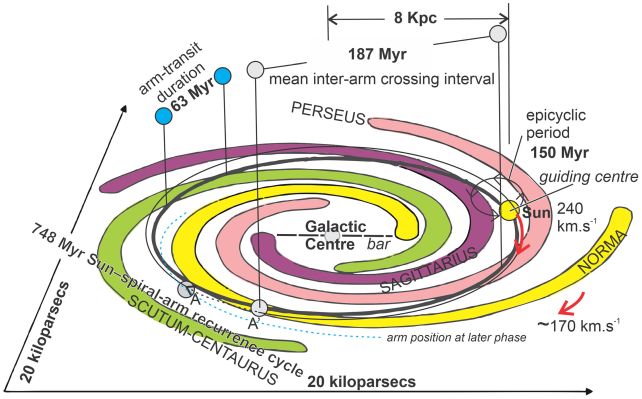
As the Solar System moves through the galaxy’s spiral arms, gravitational interactions could dislodge Oort Cloud objects and send them hurtling towards the inner Solar System to become comets.
The researchers argue that these giant impacts could have helped create the first stable fragments of continental crust – the “seeds” from which today’s continents eventually grew.
“Extraordinary perhaps, but not especially implausible once the records begin to align,” Kirkland said.
“We took it seriously when independent datasets started pointing in the same direction: recurring shifts in zircon hafnium isotopes across several Archean cratons, changes in zircon oxygen-isotope distributions, and peaks in terrestrial and lunar impact ages during predicted spiral-arm passages.”
Earth retains very little record of its infancy. Between erosion, crustal recycling, and other geological processes, most of the ancient crust has been worn away or changed beyond recognition.
One exception is an extremely durable mineral called zircon. In certain ancient rock formations, tiny crystals of zircon endure, carrying within them isotopic records of the chemical environment where they formed.
By measuring subtle changes in the isotopes of elements such as hafnium and oxygen inside the crystals, geologists can reconstruct when and how continental crust evolved in a specific location.

Kirkland and his colleagues became intrigued when similar isotope patterns began to emerge in multiple, widely separated cratons – the dense, ancient ‘backbones’ of the continents.
“We cannot examine an individual zircon age peak and simply label it ‘impact’. Mantle overturns, plumes, subduction and continental collisions can all produce major changes in zircon isotope records,” he explained.
“The distinction instead comes from the wider pattern. An internally driven event should reflect the geological evolution of a particular region. An external trigger has the potential to affect several widely separated cratons at broadly the same time and to coincide with independent evidence of increased bombardment on both Earth and the Moon.”
The team compiled zircon records from 11 Archean cratons around the world, specifically homing in on the hafnium and oxygen atoms trapped inside the crystals. Hafnium isotopes can reveal episodes of new crust formation, while oxygen isotopes preserve clues about crustal reworking and the involvement of surface-altered material.
“Extraordinary perhaps, but not especially implausible once the records begin to align.” – geologist Chris Kirkland
The researchers then compared those records with the timing of predicted spiral arm crossings, as well as independently dated impact records from Earth and the Moon.
“For this study, one only has to step outside at night and look at the Moon,” Kirkland said.
“Its battered surface is a vivid record of the bombardment endured by the inner Solar System. Earth experienced that same impact environment, but erosion, tectonics and crustal recycling have erased much of the physical evidence.”
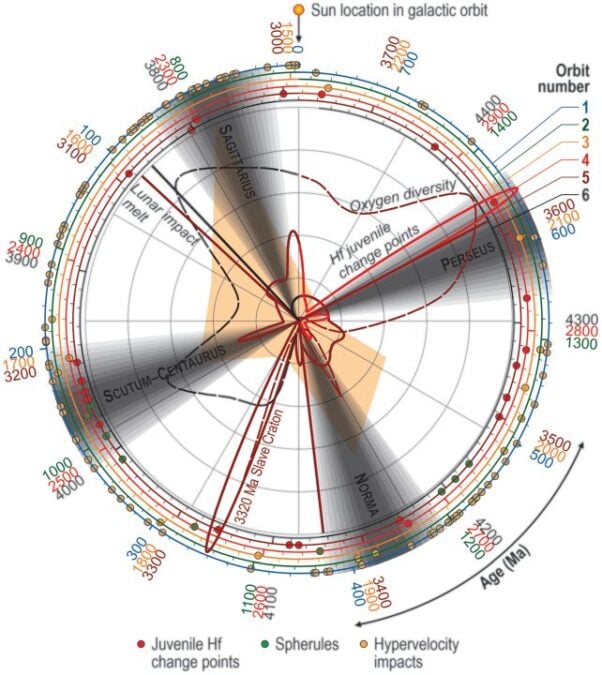
Taken together, these disparate records revealed recurring episodes of continental crust formation and increased bombardment that repeatedly coincided with the predicted timing of the Solar System’s passage through the Milky Way’s spiral arms.
The researchers stress that their findings do not prove a connection between spiral-arm crossing and continental evolution.
Reconstructing Milky Way orbits billions of years into the past is extremely complicated, Kirkland noted, and the delivery of comets from the Oort Cloud can be unpredictable. Other geological processes may also have influenced the zircon crystals.

However, as a recent paper co-authored by Kirkland found, most of the energy reaching early Earth came from bombardment rather than internal geological activity – a finding consistent with the idea that impacts could have played a major role in shaping the young planet.
Related: World’s Oldest Known Asteroid Crater Is 3 Billion Years Old, Study Confirms
Confirming this model would likely involve looking beyond Earth to see if the same time signature appears in the mineral record of bodies such as Mars and the Moon.
But perhaps it would not be surprising to find it.
“If changing Galactic environments can help trigger star formation, it would be surprising if the Solar System’s repeated passage through those environments had no effect at all,” Kirkland said.
“The scientific question is whether those effects were strong enough to leave a detectable geological record on Earth.”
The research has been published in Earth and Planetary Science Letters.
This article was fact-checked by Rachel Garner and edited by Peter Dockrill. While we pride ourselves on our process, we are only human. If you spot a mistake, please let us know.