Нью-Йоркийн их сургуулийн геологич Майкл Рампино сүүлийн 260 сая жилийн турш бүртгэгдсэн 89 томоохон геологийн үйл явдалд статистикийн шинжилгээ хийжээ. Үүнд далайн амьтдын масс устал, хүчилтөрөгчийн дутагдал, галт уулын хүчтэй дэлбэрэлт, далайн түвшний өөрчлөлт зэрэг үзэгдлүүд багтсан байна. Судалгаагаар эдгээр үйл явдал дунджаар 27.5 сая жилийн давтамжтайгаар давтагддаг, илүү сул нөлөө бүхий 8.9 сая жилийн хоёрдогч мөчлөгтэй болох нь илэрчээ.
Энэхүү тогтмол давтамжийн шалтгааныг эрдэмтэд одоогоор бүрэн тайлаагүй байгаа ч хэд хэдэн таамаглал дэвшүүлж байна. Нэгдүгээрт, дэлхийн мантийн эргэлт, тектоник хавтангийн хөдөлгөөн болон галт уулын идэвхжил зэрэг дэлхийн гүний үйл явц нь хоорондоо холбоотой байж, гадаргын өөрчлөлтөд нөлөөлдөг байж болзошгүй. Мөн дэлхийн гадаргуу дээрх мөс, тунадасны хуваарилалт нь царцдас болон мантийн ачааллыг өөрчилж, улмаар геологийн үйл явцыг өдөөдөг байх магадлалтай юм.
Зарим судлаачдын үзэж буйгаар нарны аймаг сүүн замын төв хэсгийг тойрон эргэхдээ галактикийн хавтгайг дайран өнгөрдөг нь дэлхийн геологийн үйл явцтай давхцаж байж болох талтай. Энэхүү сансрын гаралтай нөлөө нь сүүлт оддын хөдөлгөөнд нөлөөлж, дэлхий дээр астероид унах магадлалыг нэмэгдүүлдэг байж болзошгүй гэж үздэг ч энэ нь одоогоор батлагдаагүй таамаглал юм.
Хэдийгээр геологийн түүхэн дэх ийм урт хугацааны мөчлөгийг тогтоох нь маш төвөгтэй бөгөөд маргаантай сэдэв хэвээр байгаа ч Майкл Рампиногийн судалгаа нь дэлхийн геологийн үйл явдлуудыг цогц байдлаар ойлгох шинэ боломжийг нээж байна. Хэрэв энэхүү давтамж ирээдүйн судалгаагаар батлагдвал дэлхийн түүхэн дэх томоохон сүйрлүүд нь тусгаарлагдсан үйл явдлууд бус, манай гарагийн урт хугацааны хөгжлийн нэг хэсэг болох нь тогтоогдох юм.
Дэлгэрэнгүйг эх сурвалжаас харах
↓Эх сурвалжийг нээх ↓
Mass extinctions. Giant volcanic eruptions. Oceans suddenly deprived of oxygen.
At first glance, Earth’s biggest geological disasters seem to have little in common beyond their sheer scale.
But for decades, scientists have wondered whether these seemingly unrelated events might actually follow a hidden rhythm stretching back hundreds of millions of years.
The possibility that Earth’s geological history follows a long-term rhythm has been debated for decades.
The idea dates back to studies published in the 1980s, when researchers first proposed that mass extinctions and other major geological events might recur at regular intervals. Earlier studies identified similar periodic patterns, but the idea has remained controversial.
Now, an analysis published in Evolving Earth revisits that evidence using updated geological timescales and statistical methods.
The analysis concludes that the evidence for a roughly 27.5-million-year geological cycle has continued to strengthen, suggesting many of Earth’s largest upheavals may be linked by long-term processes rather than representing isolated catastrophes.
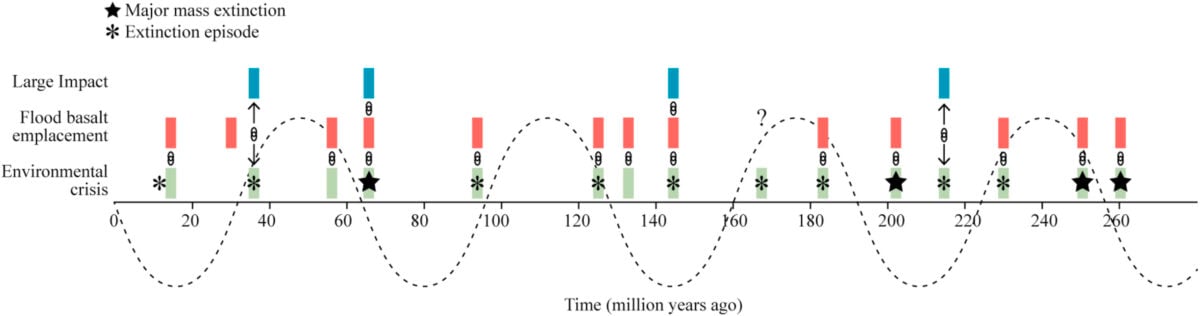
Drawing on previously published geological datasets, New York University geologist Michael Rampino re-examined 89 major geological events spanning the past 260 million years using updated geological ages and statistical analyses.
The dataset includes marine mass extinctions, oceanic anoxic events, continental flood-basalt eruptions, sea-level fluctuations, terrestrial tetrapod extinctions, changes in seafloor spreading rates, and pulses of intraplate volcanism.
Together, these records reveal a dominant periodicity of approximately 27.5 million years, alongside a weaker cycle of around 8.9 million years.
Rather than proposing that one geological catastrophe directly causes another, the new analysis suggests that multiple Earth systems may periodically respond to the same underlying processes operating over tens of millions of years.
Exactly what those processes are remains uncertain.
The analysis also explores possible drivers of this long-term rhythm.
One possibility lies deep within Earth itself.
The planet’s mantle is constantly circulating through convection, albeit at an almost unimaginably slow pace. Periodic changes in mantle convection, or the initiation of mantle plumes, could influence volcanism, plate tectonics, mountain building, and other large-scale geological processes.
Because these systems are closely interconnected, disturbances originating deep within Earth could eventually ripple through the planet’s surface, oceans, climate, and biosphere.

Another hypothesis focuses on interactions between Earth’s surface and interior.
Long-term orbital variations influence climate and sea level, periodically redistributing enormous amounts of water, ice, and sediment across the planet. Rampino discusses the possibility that these changing surface loads subtly modify stresses within Earth’s crust and upper mantle, potentially influencing tectonic and volcanic activity over geological timescales.
Rampino also considers possible influences beyond Earth, an idea he has been weighing up since the 1980s.
As the Solar System orbits the center of the Milky Way, it oscillates above and below the galaxy’s mid-plane, with the timing of these passages aligning with that of Earth’s major upheavals. These crossings, other researchers have suggested, could also gravitationally perturb comets in the distant Oort Cloud, increasing the likelihood of large asteroid impacts.
Another, even more speculative, hypothesis suggests that if dark matter is concentrated near the galactic plane, a fraction of it could occasionally be captured by Earth.
Over millions of years, this process could generate small amounts of internal heat, potentially influencing geological activity.
At present, however, there is no direct evidence supporting either mechanism, so they remain very controversial.
Large asteroid impacts are discussed separately in the paper. Although they were not included in the statistical analysis of the 89 geological events, the timing of several of Earth’s largest known impact craters appears broadly consistent with the proposed 27.5-million-year rhythm, as Rampino has discussed in earlier papers.
Rampino suggests this correspondence may warrant further investigation, but stops short of claiming a causal relationship.
Whether the apparent cycle reflects a genuine feature of Earth’s history remains an open question.

Finding periodic patterns across hundreds of millions of years is inherently challenging.
Geological records are incomplete, the ages of ancient events become increasingly uncertain farther back in time, and statistical analyses can sometimes identify apparent cycles that disappear as additional evidence accumulates.
Rather than claiming to have settled the debate, Rampino concludes that the proposed 27.5-million-year periodicity has persisted despite decades of increasingly refined geological timescales and expanding datasets.
Though because the idea runs counter to long-accepted interpretations of the nature of the geologic record, it will likely remain contested.
Related: A Force From The Milky Way May Have Shaped The Continents on Earth
If, however, the pattern is confirmed by future research, Earth’s greatest geological upheavals may not simply represent isolated catastrophes scattered through deep time.
Instead, they could reflect recurring expressions of long-term processes that have shaped our planet for hundreds of millions of years.
“While these ideas are still mostly outside the mainstream of current geological thinking,” Rampino concludes, “they could be the first steps in an important conceptual breakthrough in the Earth sciences, which recognizes the global correlation of major geologic events, the generally periodic nature of the multi-million-year geologic record, and astronomical connections that could more firmly place our planet in its true cosmic setting.”
The findings are reported in Evolving Earth.
This article was fact-checked by Clare Watson and edited by Clare Watson. While we pride ourselves on our process, we are only human. If you spot a mistake, please let us know.

