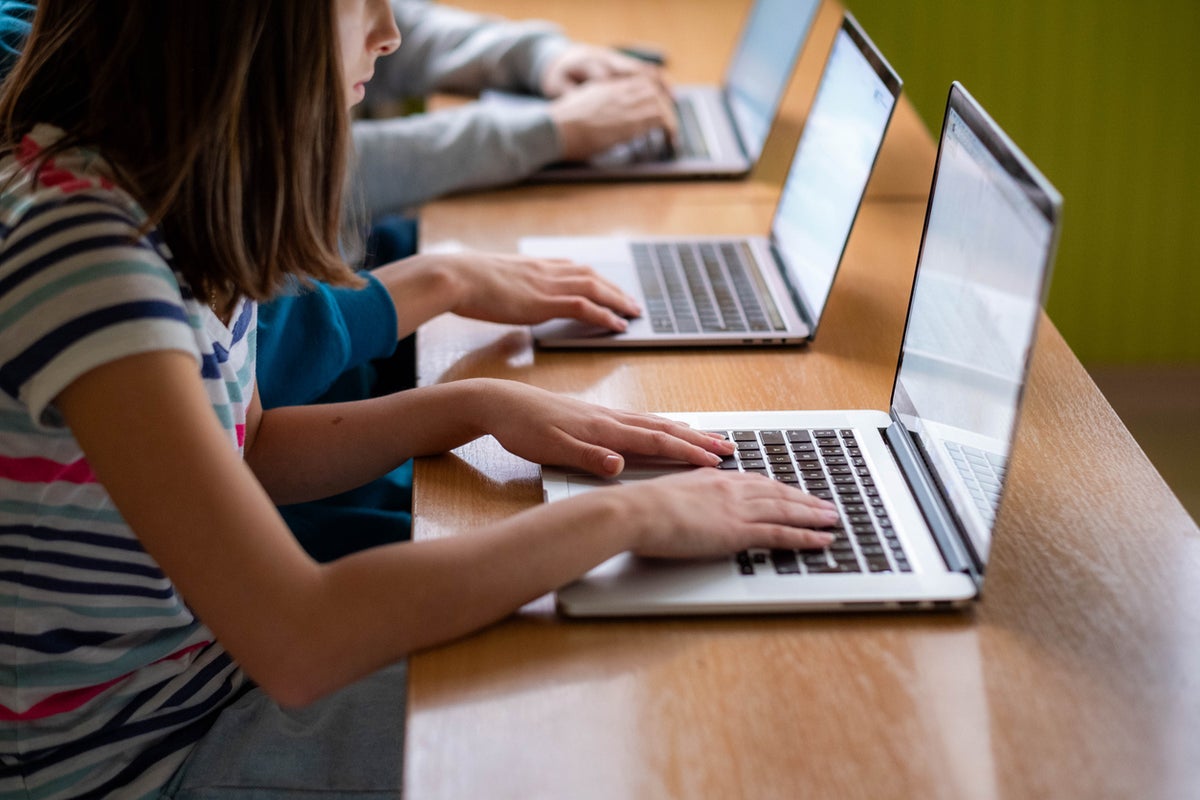
АНУ-ын сургуулиуд хичээлийн үйл явцад цахим төхөөрөмж ашиглах бодлогоо эргэн харж, сурагчдын дэлгэцийн өмнө өнгөрөөх цагийг хязгаарлах арга хэмжээ авч эхэллээ.
Коронавируст халдварын цар тахлын үед сургалтын үйл ажиллагааг цахим хэлбэрт шилжүүлэх зайлшгүй шаардлага тулгарч байсан бол өдгөө олон сургууль технологийн зохистой хэрэглээг тогтооход анхаарч байна. 2026 оны долдугаар сарын байдлаар АНУ-ын 17 мужийн хууль тогтоогчид анги танхим дахь дэлгэцийн хэрэглээг зохицуулах асуудлыг хэлэлцэж, үүнээс зургаан муж шинэ хууль батлаад байна. Тухайлбал, Айова муж бага ангийн сурагчдын цахим сургалтын цагийг хязгаарласан бол Юта муж цэцэрлэгээс гуравдугаар анги хүртэлх сурагчдад нэг сурагчид нэг төхөөрөмж ногдуулах журмыг хоригложээ.
Лос-Анжелес хотын сургуулийн дүүрэг 2026 оны зургадугаар сард цэцэрлэгээс нэгдүгээр ангийн сурагчдын хичээлийн цагаар дэлгэц ашиглахыг бүрмөсөн хориглосон шийдвэр гаргав. Мөн Жоржиа мужийн Мариетта хотын сургуулиуд хичээлийн хэрэглэгдэхүүн болгон ашиглахаас бусад тохиолдолд сурагчдын зөөврийн компьютерыг хаалттай байлгах бодлого баримталж байна. Энэхүү өөрчлөлт нь технологийг сургалтын үйл явцыг орлох бус, харин дэмжих хэрэгсэл болгон ашиглах зорилготой юм.
Боловсролын салбарын судлаачид технологийн хэрэглээг зөвхөн цаг хугацаагаар хэмжих бус, сурагчдын хөгжил, шүүмжлэлт сэтгэлгээ, асуудал шийдвэрлэх чадварт хэрхэн нөлөөлж буйг чухалчлах нь зүйтэй гэж үзэж байна. Судалгаагаар сурагчид цахим контентыг идэвхгүй хүлээн авахаас илүүтэйгээр, мэдээлэлд дүн шинжилгээ хийх, загварчлах, хамтран ажиллах зэргээр технологийг идэвхтэй ашиглах үед сурлагын амжилт өндөр байгааг тогтоожээ. Иймд сургуулиуд насны онцлогт тохирсон, боловсролын тодорхой үр дүнд чиглэсэн технологийн хэрэглээг төлөвшүүлэхийг зорьж байна.
Дэлгэрэнгүйг эх сурвалжаас харах
↓Эх сурвалжийг нээх ↓
<![CDATA[{"className":"sc-1ge0fwe-0","newsletterData":{"pianoFieldName":"receiveEveningHeadlinesUSNews","regTitle":"Evening Headlines","subscriptionGroup":"us_evening_headlines","subscriptionGroupId":"4326e634-422a-4447-8e1e-604a937cd3b5","type":"daily_news","pathPrefix":["/us","/news/world/americas","/news/world/americas/crime"],"title":"The latest headlines from our reporters across the US sent straight to your inbox each weekday","mobileTitle":"Your briefing on the latest headlines from across the US","imageSrc":"https://static.independent.co.uk/static-assets/images/newsletters/usEveningHeadlines1_1.png","label":"I would like to receive morning headlines Monday – Friday plus breaking news alerts by email“,”newsletterKey”:”receiveEveningHeadlines”,”regSourceSection”:”Americas”,”regSourceNewsletter”:”NSC”},”isClimate”:false}]]>
When the COVID-19 pandemic forced in-person classroom instruction to go virtual, students suddenly needed to have their own laptops or tablets in order to interact with teachers and complete assignments.
Most states used federal pandemic funding to address the digital divide. This refers to the gap between students and families who had their own tablets, computers and high-speed internet, and those who did not.
While most schools resumed in-person classes by 2021, many of them continued to rely heavily on online platforms and apps to help their students do their work.
cookie.trim() === ‘__DEBUG__=true’)) { console.log(‘Ad logs: “mpu1”, injectedAtParagraph: 3’); }]]>
Today, however, more and more schools are reconsidering how technology fits into teaching and learning, with many districts establishing clearer expectations about when technology should be used, for what purpose and at what ages.
So far, as of late July 2026, lawmakers in at least 17 states had introduced or debated legislation addressing classroom screen time or student use of digital devices. Six states had already enacted new laws, while others had considered or failed to pass similar measures.

Iowa, for example, passed a law that limited digital instruction for elementary students. Maine’s legislation did not put specific screen time limits in place but approved a study on the impact of classroom technology.
cookie.trim() === ‘__DEBUG__=true’)) { console.log(‘Ad logs: “taboola-carousel-thumbnails”, injectedAtParagraph: 6’); }]]>
Instead of treating screens as the default tool for instruction, some schools are directing teachers to use laptops only when the technology adds clear instructional value.
Passive consumption or purposeful use?
The Los Angeles Unified School District is one example of a school district that is shifting away from technology in the classrooms.
cookie.trim() === ‘__DEBUG__=true’)) { console.log(‘Ad logs: “mpu2”, injectedAtParagraph: 8’); }]]>
In June 2026, Los Angeles approved a policy that eliminates in-school screen use for students in preschool through first grade. It also established screen time limits for older students.
Los Angeles is also moving away from sending school-issued devices home with every student. Instead, elementary students can use shared classroom devices, and families can then opt in for take-home devices in older grades.
cookie.trim() === ‘__DEBUG__=true’)) { console.log(‘Ad logs: “mpu3”, injectedAtParagraph: 10’); }]]>
The Marietta City Schools district in Georgia is another example. The district adopted a policy in July 2026 that calls for device screens to be “closed by default” and used only when they serve a clear instructional purpose.
At the state level, a July 2026 law in Utah prohibits 1-1 device-per-student ratios for students in kindergarten to third grade. There are some exceptions to this policy, such as when students are taking state standardized tests.
In other states, lawmakers are considering similar laws that would restrict screen time for young students or limit the use of school-issued devices during the school day.
How students use screens matters
What makes these developments notable is not any single policy but how quickly the conversation around education and technology has changed.
The American Academy of Pediatrics recommends looking beyond the number of minutes children spend on screens each day. Instead, parents and educators could consider the quality of digital experiences and what screen use may be displacing.
Janice Mak is a Clinical Assistant Professor of Computer Science Education and Educational Technology at Arizona State University. This article was first published by The Conversation and is republished under a Creative Commons licence. Read the original article .
Technology can support learning when it is intentionally integrated into instruction, while excessive or passive screen use that displaces sleep, physical activity, play or face-to-face interactions may negatively affect children’s health and well-being.
This distinction between passive consumption and purposeful use is increasingly shaping school policy. Updated policies also reflect an emerging emphasis on age-appropriate screen use, student well-being and ensuring that technology can support, rather than replace, direct instruction and student collaboration.
While newer state and local screen-time policies vary, a common through line is that students’ ages matter when it comes to using technology.
For older students, technology may remain central to learning, particularly when students are using it to program, analyze data, model complex systems and critically evaluate information. Younger children, meanwhile, should have sufficient opportunities for play, conversation, writing, movement and hands-on, “unplugged” learning, without screens.
Teachers can still prepare students for a digital world
As a member of the National Academies consensus committee examining the future of data and computing education in K-12 schools, I have spent the past two years asking a simple question: What do today’s students need to know about the technologies that increasingly shape their lives?
Our March 2026 report shows that students need to learn more than how to use a laptop or an artificial intelligence chatbot. Our research found that they should also understand how data is collected and used, how AI and other computing systems work, how technology affects people and society, and how to use these tools to solve real problems.
The issue, according to our findings, is not whether students spend more or less time using technology. It is whether the time they spend with technology helps them build understanding, solve problems, think critically and make informed decisions.
A growing body of research arrives at the same conclusion we reached: Students learn the most when they actively use technology to investigate questions, analyze information and solve problems – not when they passively consume digital content.
My 2024 research also shows that technology was most valuable when students used it to investigate scientific questions, test ideas, create models, work with classmates and explain their reasoning.
The technology itself was not what improved learning. What mattered was how teachers used it to engage students in deeper thinking.
The next critical question
For decades, there was a race to get classrooms hooked up to the latest educational technology.
Now, some schools are doing the opposite. This reversal may represent an overdue correction after years of assuming that more technology automatically equated to better learning.
But I think the next chapter should not be defined by counting minutes of screen time. Instead, policymakers, educators and technology developers should consider the more critical question of what kinds of digital experiences are actually worth students’ time.

