
Израиль улсад гэр бүлээрээ зугаалж явсан бяцхан охин Дундад хүрэл зэвсгийн үед хамаарах ховор олдвор олсон нь археологийн судлалд чухал хувь нэмэр болов.
Гурав настай Зив Ницан гэгч охин гудамжны хайрга дундаас уг жижиг чулууг олж, гэр бүлийнхэндээ үзүүлснээр уг олдвор илэржээ. Израилын Антикийн газрын мэргэжилтнүүд уг биет болох 3800 жилийн настай скарабей сахиусыг Дундад хүрэл зэвсгийн үеийн Ханаанчуудын соёлд холбогдуулан тогтоожээ. Тел Азека толгодын орчмоос олдсон уг жижиг олдвор нь Египет болон Ханааны соёлын хоорондын холбоог харуулах Египетийн эртний уламжлалаар бүтээгдсэн аж.
Сахиус нь аргал хорхойг дүрсэлсэн хэлбэртэй бөгөөд эртний Египетэд уг шавьжийг нарны хөдөлгөөн, бүтээл болон шинэчлэлттэй холбон үздэг байв. Ийм төрлийн жижиг биетүүд нь хувийн сахиус төдийгүй шавар дээр дарж тамгалах зориулалттай тамга болон ашиглагдаж байжээ. Израиль Музейн эртний сахиус болон тамганы мэргэжилтэн Дафна Бен-Тор уг олдворууд тухайн үед тамга болон сахиус гэсэн давхар үүрэг гүйцэтгэж байсныг тайлбарласан байна.
Уг олдвор ямар нэгэн битүүмжилсэн малтлагын давхаргаас бус гадаргуугаас олдсон тул археологичид хэлбэр дүрс, хийц загварыг нь ижил төстэй олдворуудтай харьцуулах буюу типологийн аргаар он цагийг нь тогтоожээ. Тел Азека толгод нь эртний худалдаа, аялал жуулчлал болон цэргийн замуудын огтлолцол дээр оршиж байсан бөгөөд өмнө нь Египет болон Ханааны холбогдолтой олон олдвор илэрч байсан түүхтэй. Уг сахиусыг Израилын Антикийн газарт хүлээлгэн өгсөн бөгөөд Иерусалим дахь Израилын Археологийн үндэсний кампуст олон нийтэд дэлгэхээр төлөвлөжээ.
Дэлгэрэнгүйг эх сурвалжаас харах
↓Эх сурвалжийг нээх ↓
Ziv Nitzan was walking with her family along a gravel-covered trail in Israel when one stone caught her attention. The 3-year-old picked it up, brushed away the sand, and carried it to her older sister, Omer. Nothing about the family outing suggested that the small object in Ziv’s hand had survived from a city built thousands of years before the modern path crossed the hill.
“Out of the 7,000 stones around her, she picked up one stone,” Omer said in a translated video released by the Israel Antiquities Authority. “Then she brushed off the sand and saw that something was different about it.” As described in Live Science’s report on the discovery, the family examined what they first called a “beautiful stone” and reported it to archaeological authorities.
Specialists later identified the object as a 3,800-year-old scarab amulet from the Middle Bronze Age. The small, beetle-shaped artifact was Canaanite, but its design came from an ancient Egyptian tradition that spread across the eastern Mediterranean. Found at Tel Azekah, it joined a collection of Egyptian and Canaanite objects already recovered from one of the most important Bronze Age settlements in the Judean Lowlands.
A Small Object From a Fortified Canaanite City
Ziv found the scarab in March while her family was visiting the archaeological mound, which lies about 45 kilometers from Tel Aviv and 30 kilometers from Jerusalem. The hill rises above the Shephelah, also called the Judean Lowlands, where ancient roads connected the Mediterranean coast with the Judean Hills and linked Beth Shemesh with Lachish. Its position gave the settlement a wide view over routes used by travelers, traders, and armies.
The Lautenschläger Azekah Expedition’s history of the site explains that Azekah developed into a strongly fortified urban center during the Middle Bronze Age, roughly 2000 to 1550 BCE. The city continued into the Late Bronze Age before suffering destruction and abandonment. Later communities returned to the mound, leaving remains from the Iron Age, Persian, Hellenistic, Roman, and Byzantine periods.
:focal(960x549:961x550)/https://tf-cmsv2-smithsonianmag-media.s3.amazonaws.com/filer_public/cc/1a/cc1aadbc-f623-46aa-9073-3f31487ba0c6/488304083_961777846130367_8014253517763028580_n.jpg)
Archaeologists have worked at Azekah for years, documenting fortifications, buildings, pottery, amulets, and other traces of its long occupation. Oded Lipschits, a Tel Aviv University archaeologist who directs the excavation, said the newly identified object joined an established group of Egyptian and Canaanite finds from the site. Its recovery from the trail added another artifact to a landscape already known for material from several ancient cultures.
Why Ancient People Carried Scarab Amulets
The artifact was shaped to resemble a sacred scarab beetle, particularly the dung beetle. Ancient Egyptians watched these insects form and roll balls of dung across the ground. They connected that behavior with the sun’s daily movement across the sky, while the beetle became associated with creation, renewal, and Khepri, an Egyptian god linked with the rising sun.
That symbolism turned the scarab into one of the most familiar forms in ancient Egyptian material culture. Small versions could be worn, carried, placed in graves, or kept in homes and public buildings. The curved upper side represented the beetle, while the flatter underside could hold carved names, symbols, figures, or short messages.

Some scarabs also functioned as stamp seals. Pressing the engraved base into clay left an impression that could mark or secure an object. Daphna Ben-Tor, an expert on ancient amulets and seals associated with the Israel Museum, explained their dual role: “Scarabs were used in this period as seals and as amulets.” Her academic work on Egyptian and Canaanite scarabs examines how these small objects moved between cultures and changed over time.
The Israel Museum’s scarab collection includes examples made from materials such as glazed steatite and faience. Steatite is a soft stone that can be carved before receiving a hard glazed coating. Faience is a manufactured material made largely from crushed quartz and finished with a bright, glasslike surface. Both materials allowed craftspeople to produce small, durable objects with carefully worked designs.
Egyptian Forms Became Part of Canaanite Life
The scarab shape originated in Egypt, but not every example found in Canaan was imported from the Nile Valley. Local craftspeople also made Canaanite scarabs, borrowing Egyptian forms and symbols while producing objects for communities in the Levant. Specialists compare their shape, material, carving style, and inscriptions to determine where and when particular designs circulated.
Azekah has produced other objects connected with Egypt, including scarabs and amulets found during excavation. The expedition’s overview of Tel Azekah places these discoveries within the settlement’s wider Bronze Age history. Ziv’s scarab entered that archaeological record even though it was found loose on a surface trail rather than inside a sealed excavation layer.
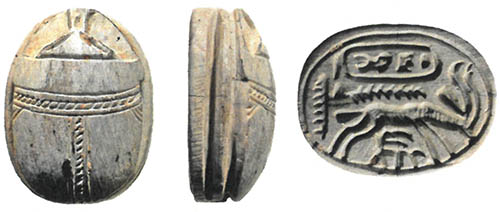
Because the object was not recovered from a documented room or soil layer, its age came from comparison with similar artifacts. Archaeologists call this typological dating, which means identifying an object by comparing its form, decoration, and manufacturing style with securely dated examples. A separate report of the Bronze Age scarab discovery also described the artifact as a Canaanite object dating back approximately 3,800 years.
The artifact belongs to a period when fortified Canaanite cities maintained contact with Egypt through trade, travel, artistic designs, and administrative practices. Scarabs appeared across the region as personal amulets and practical seals. At Tel Azekah, the newly found object sits alongside a larger group of Egyptian and Canaanite artifacts recovered from the mound.
Tel Azekah Carries Several Layers of History
The hill is also associated with the biblical account of David and Goliath, which places opposing armies in the area around Azekah. The scarab predates the period traditionally connected with that narrative by several centuries. Its archaeological setting belongs instead to the earlier world of Bronze Age Canaanite cities, long before Azekah became a Judean stronghold.
Azekah later appeared in accounts of military campaigns against Judah and remained occupied during several later historical periods. That long sequence means objects separated by centuries can occur within the same archaeological landscape. Controlled excavation allows researchers to distinguish those periods by recording the exact soil layers, walls, floors, and nearby objects associated with each find.
Ziv’s family handed the Bronze Age seal to the Israel Antiquities Authority so it could be documented and preserved. The artifact was scheduled for display with other Egyptian and Canaanite finds at the National Campus for the Archaeology of Israel in Jerusalem.
Enjoyed this article? Subscribe to our free newsletter for engaging stories, exclusive content, and the latest news.

