
Шинэ судалгаагаар макака сармагчингууд өнцөг булантай болон дугуй дүрсүүдийг “кики”, “боуба” гэх утгагүй үгстэй хүний адил холбодог болохыг илрүүлжээ.
Сингапур улсын Мандай зэрлэг амьтны нөөц газрын есөн сармагчин оролцсон туршилтаар судлаачид тэдэнд дугуй болон өнцөг булантай таглаатай хоёр аяганд хоол нууж дасгалжуулжээ. Улмаар туршилтын явцад “боуба” эсвэл “кики” гэсэн үгийг давтан тоглуулахад сармагчингууд ямар нэгэн тусгай зааваргүйгээр дугуй дүрс бүхий таглааг “боуба” авиатай, өнцөг булантай таглааг “кики” авиатай зөн совингоороо зөв тааруулж сонгосон байна. Статистикийн шинжилгээгээр энэхүү сонголт нь санамсаргүй байдлаас хамаагүй өндөр буюу дугуй дүрс сонгох магадлал боуба авианы үед бараг зургаа дахин өндөр болохыг харуулжээ.
Уг судалгааны үр дүнг bioRxiv платформд урьдчилсан байдлаар нийтэлсэн бөгөөд одоогоор эрдэм шинжилгээний хяналтад ороогүй байна. Гэсэн хэдий ч энэхүү олдвор нь хэл яриа үүсэхэд нөлөөлдөг суурь холбоо хамаарал нь зөвхөн хүнд байдаг төдийгүй бусад дээд зэрэглэлийн амьтадтай хуваалцдаг алс холын өвөг дээдсээс уламжилж ирсэн танин мэдэхүйн онцлог байж болохыг харуулж байна. Судлаачид энэхүү дүрс болон авианы холбоо хамаарал нь сруутан амьтдын дунд хэр өргөн тархсаныг тодруулахаар цаашид судалгааг үргэлжлүүлэх шаардлагатайг тэмдэглэжээ.
Дэлгэрэнгүйг эх сурвалжаас харах
↓Эх сурвалжийг нээх ↓
If I told you the shapes below had names – one is called ‘Bouba’, the other ‘Kiki’ – which would you think is which?
If you named the spiky shape ‘Kiki’, and the rounder shape ‘Bouba’, you are in good company.
This fascinating psychological experiment was first conceived in the 1920s, and most people who are asked this question – regardless of the language or alphabet they use to speak or write – agree that Kiki is spiky, and Bouba is round.
Now, a new experiment suggests that even macaque monkeys appear to make the same association between these shapes and sounds.

Nine monkeys that live at the Mandai Wildlife Reserve in Singapore were involved in the experiment: eight long-tailed macaques (Macaca fascicularis) and one southern pig-tailed macaque (Macaca nemestrina).
First, the researchers had to train the monkeys to participate in the experiment.
To do this without introducing bias, they had each monkey stand in front of two cups with food hidden below a lid. One lid was blank, while the other featured a shape that combined both spiky and rounded elements, a kind of Bouba-Kiki hybrid.
At this stage, no sound was played.
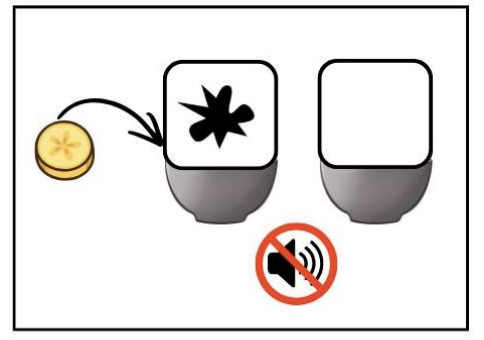
Once the monkeys learned that the cup with the shape contained food, they proceeded to the real test.
Here, they were presented with two cups covered by lids with either the spiky or round shapes typical of the Bouba/Kiki experiment.
In this test, a recording of either the word ‘Bouba’ or ‘Kiki’ was played repeatedly in the background.
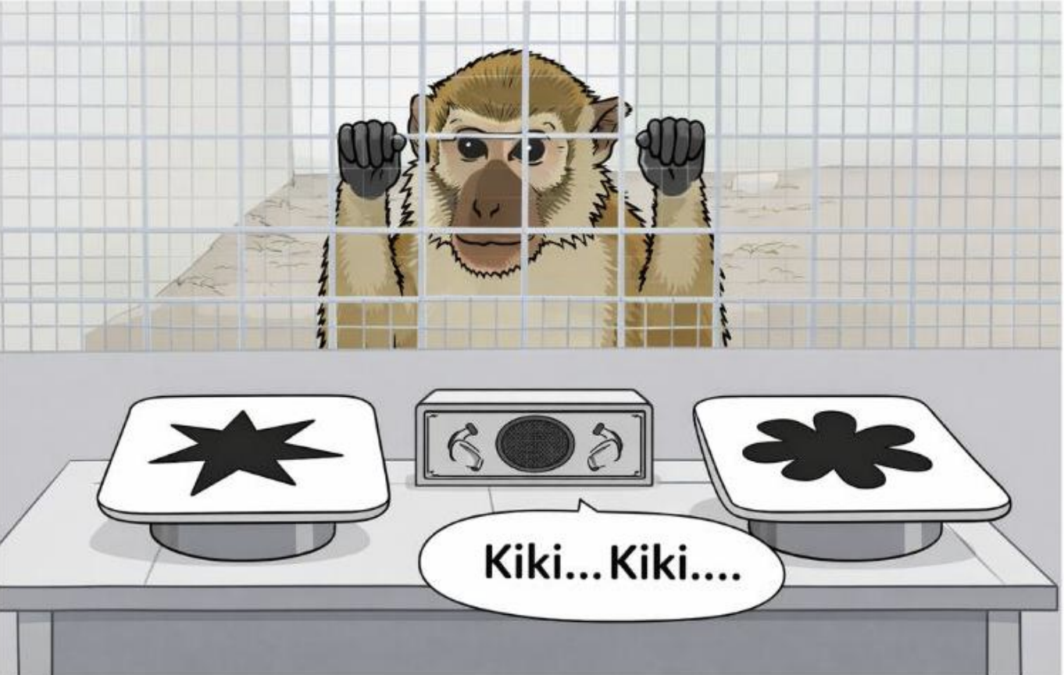
“Each monkey completed 24 trials divided into short blocks of three, with the position of the round and spiky shapes, as well as Bouba and Kiki playback, counterbalanced between trials,” the authors explain.
This experimental design allowed them to see which choice monkeys make in the presence of these particular sounds, though they had not been trained that any particular response was ‘correct’.
The results were remarkably similar to those from experiments in humans. In most instances, the monkeys spontaneously selected the lid with the round shape when they heard ‘Bouba’, and the lid with the spiked shape when they heard ‘Kiki’.
Statistical analysis revealed these selections occurred at rates above what we would expect from random chance.
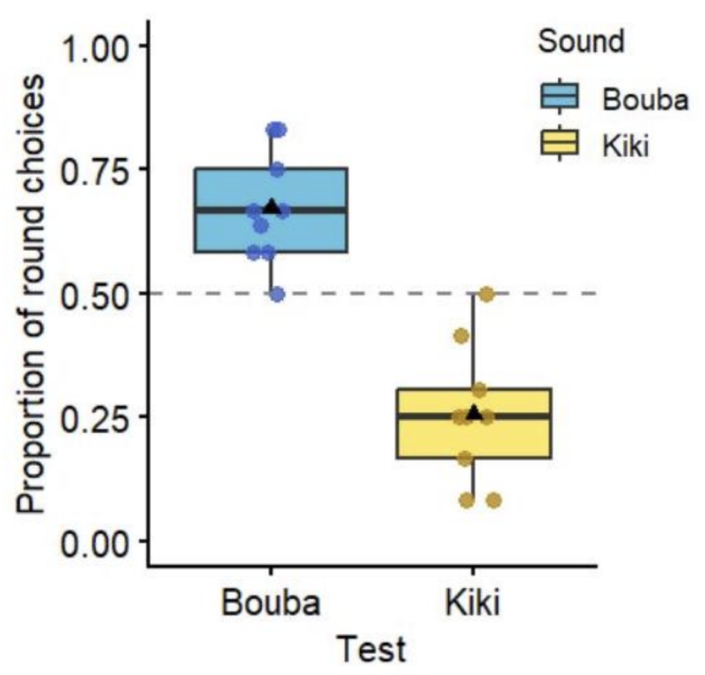
“Consistent with these condition-specific effects, the odds of choosing the round shape were nearly six times higher in Bouba than in Kiki trials,” the authors note.
Further studies with more test subjects will be needed to get a clearer picture of this phenomenon, and it’s important to note this research has not yet been through the scientific process of peer review.

However, it’s an early sign that there might be something deeply innate in the associations we use to create language that may be shared between humans and other primates.
Related: The Only Thing Separating Monkey Geometry Skills From Ours Might Be Formal Education
“These findings are consistent with the idea that at least some crossmodal correspondences may rest on ancient perceptual biases inherited from a distant common ancestor, rather than having evolved only within humans,” the authors write.
The evidence, they add, “shifts the evolutionary question away from whether the effect is uniquely human, and toward how broadly distributed across vertebrates these perceptual mappings are.”
The research has not yet been peer-reviewed or published in a scientific journal. However, a preprint is available on bioRxiv.
This article was fact-checked by Rachel Garner and edited by Michael Irving. While we pride ourselves on our process, we are only human. If you spot a mistake, please let us know.


