Украйны зүгээс явуулж буй нисгэгчгүй онгоцны кампанит ажлын улмаас ОХУ-ын хамгийн том цахим жижиглэн худалдаалагч Wildberries компани агуулахынхаа 27 орчим хувийг алдаад байна.
Долдугаар сарын 18-наас эхэлсэн энэхүү довтолгооны улмаас Санкт-Петербург хот орчим болон Тверь, Тула мужуудад байрлах 14 агуулах үйл ажиллагаа явуулах боломжгүй болжээ. Энэ нь тус компанийн нийт агуулахын талбайн 1.5 сая ам метр талбайг хаммарч байгаа бөгөөд сэргээн босгоход 105 тэрбум рублийн зардал гарах тооцоо гарсан байна. Мөн тус платформоор дамжуулан худалдаа эрхэлдэг худалдаачдын бараа материал устаж, 214.9 тэрбум рублиэс 279.6 тэрбум рубль хүртэлх хохирол учирч болзошгүйг шинжээчид онцолжээ.
Тус компанийн гүйцэтгэх захирал Татьяна Ким болон ОХУ-ын засгийн газар хохирсон худалдаачдад санхүүгийн тусламж үзүүлэх арга хэмжээг судлахаа мэдэгдсэн байна. Шинжээчдийн дүгнэлтээр энэхүү халдлага нь ОХУ-ын өргөн хүрээтэй эдийн засагт ноцтой аюул учруулахгүй ч тус компанийн логистикийн сүлжээг тасалдуулж, хүргэлтийн хугацааг удаашруулах эрсдэлтэй аж. Wildberries өргөн хүрээний өрсөлдөөнт зах зээл дэх байр сууриа хадгалахын тулд Казахстан улсад нэмэлт агуулахын хүчин чадал хайж эхэлжээ.
Дэлгэрэнгүйг эх сурвалжаас харах
↓Эх сурвалжийг нээх ↓
A wave of Ukrainian drone attacks has knocked out more than a quarter of Wildberries’ warehouse capacity, threatening to disrupt the logistics network behind Russia’s largest online retailer and inflict billions of dollars in losses on the company and its sellers.
Analysts say the attacks are unlikely to pose a serious threat to Russia’s wider economy. But a prolonged campaign could drive up Wildberries’ costs, delay deliveries and weaken its grip on a fiercely competitive market that has expanded rapidly since Western brands left Russia following the invasion of Ukraine.
The campaign, which began on July 18, has repeatedly targeted facilities where merchants’ goods are stored before being shipped to customers. The latest attacks on Tuesday and Wednesday hit Wildberries facilities near St. Petersburg and in the Tver and Tula regions.
Wildberries said in June that it operated 209 logistics sites with a combined area of more than 5.6 million square meters.
By Monday, attacks had put 14 warehouses covering more than 1.5 million square meters out of operation, according to an estimate by the investigative outlet Vyorstka. That is equivalent to about 27% of the company’s total warehouse space.
Wildberries is privately held, meaning there is no share price through which to gauge investor reaction. The company has also not published a comprehensive estimate of the damage caused by the strikes.
Early assessments cited by Russian media nevertheless suggest that the financial impact could be substantial.
Tatyana Kim, the CEO and co-founder of Wildberries.
Wildberries Press Service via REUTERS
The most immediate expense is the damage to Wildberries’ warehouses. Forbes Russia cited analysts who estimated that rebuilding the facilities could cost about 70,000 rubles ($861) per square meter.
Applying that estimate to the 1.5 million square meters of affected warehouse space cited by Vyorstka would put the potential rebuilding bill at 105 billion rubles ($1.29 billion).
That would be a significant, though likely manageable, cost for the retailer. RWB, the combined Wildberries and Russ group, reported a net profit of 175 billion rubles ($2.15 billion) in 2025.
But the attacks are also creating indirect costs.
The loss of conveniently located warehouses is likely to force Wildberries to reroute deliveries, use longer logistics chains and secure replacement storage.
Owners of available warehouses in Russia have reportedly been reluctant to lease them to the company, prompting Wildberries to explore additional storage capacity in neighboring Kazakhstan, the Kommersant newspaper reported.
The increased risks could also push up rental and insurance costs, although the overall financial impact is difficult to calculate.
A potentially more serious problem is the destruction of goods belonging to merchants that use the platform.
Forbes Russia estimated sellers’ potential losses at between 214.9 billion and 279.6 billion rubles ($2.64 billion-$3.44 billion). The calculation was based on compensation paid after a 2024 fire at Wildberries’ 112,000-square-meter warehouse in St. Petersburg, when sellers received almost 35 billion rubles ($431 million) for destroyed stock.
Wildberries CEO Tatyana Kim said that even though the company was not legally required to compensate sellers for goods destroyed in this summer’s drone attacks, it was discussing ways to provide them with financial assistance.
Even if Wildberries pays partial compensation, the losses could slow activity on the platform by leaving some sellers unable to replace their stock and continue trading.
For its part, the Russian government said it was preparing measures to support affected sellers. The RBC business news outlet reported that these could include compensation based on the cost of the goods destroyed.
If the government were to cover losses near the midpoint of Forbes Russia’s estimate, compensation could cost about 250 billion rubles ($3.08 billion). That would be significant but not transformative for the wider economy.
Russia’s original 2026 budget envisaged a deficit of 3.79 trillion rubles ($46.6 billion), equivalent to 1.6% of gross domestic product. An additional 250 billion rubles would increase the deficit target by about 6.6%, to roughly 4.04 trillion rubles ($49.7 billion), or around 1.7% of GDP.
The ultimate cost will depend largely on how long the attacks continue, how many more warehouses are damaged and how quickly Wildberries can restore or replace its lost logistics capacity.
Satellite imagery shows smoke rising from a Wildberries facility in St. Petersburg. Planet Labs PBC via REUTERS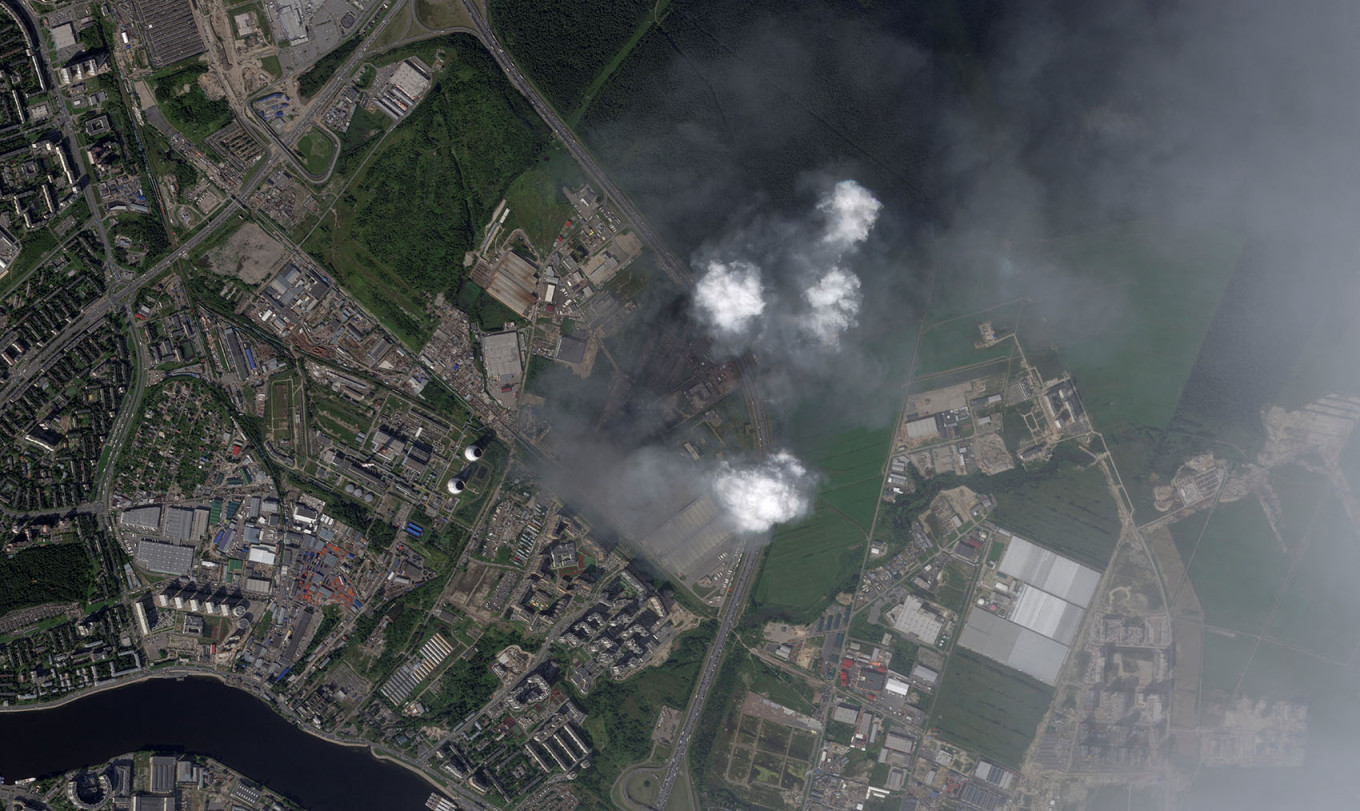
Wartime growth
Russia’s online retail sector has thrived since the full-scale invasion of Ukraine.
After Western brands left the Russian market in 2022, local sellers rushed to fill the gap with domestic and Chinese alternatives.
Online marketplaces such as Wildberries — often described as Russia’s answer to Amazon — gave them a platform to reach customers across the country.
As a result, Wildberries’ gross merchandise value, which measures the total value of goods and services sold through the platform, nearly tripled from 844 billion rubles ($10.4 billion) in 2021 to 2.5 trillion rubles ($30.8 billion) in 2023.
After the company merged with outdoor advertising group Russ in 2024, the combined group, RWB, reported turnover of 6.1 trillion rubles ($75 billion) in 2025.
The attacks on Wildberries’ warehouses and distribution network now threaten to disrupt that rapid growth.
A prolonged campaign could also erode the company’s market share, which is forecast to reach 45% of Russian online marketplace turnover in 2026, compared with 32% for its closest rival, Ozon.
Still, analysts say the attacks are unlikely to paralyze the Russian economy at their current scale.
Economist Dmitry Nekrasov said the attacks could cause serious problems for sellers and create damaging optics for the Kremlin, but were unlikely to pose a significant threat to the economy or even the retail sector because the market remained highly competitive.
“Let us assume that the total losses, including warehouses that may still be destroyed, reach 200 billion rubles. That is slightly less than 0.1% of Russia’s GDP,” he said in a recent interview with the Zhivoy Gvozd YouTube channel.
And unlike attacks on oil refineries, whose effects can spread to other sectors, the strikes on Wildberries were unlikely to cause cascading disruption across the wider economy, he said.
“It [Wildberries] has competitors and there are many smaller players in the market… There is therefore little scope [for these attacks to cause] broader economic disruption,” he said.
A Message from The Moscow Times:
Dear readers,
We are facing unprecedented challenges. Russia’s Prosecutor General’s Office has designated The Moscow Times as an “undesirable” organization, criminalizing our work and putting our staff at risk of prosecution. This follows our earlier unjust labeling as a “foreign agent.”
These actions are direct attempts to silence independent journalism in Russia. The authorities claim our work “discredits the decisions of the Russian leadership.” We see things differently: we strive to provide accurate, unbiased reporting on Russia.
We, the journalists of The Moscow Times, refuse to be silenced. But to continue our work, we need your help.
Your support, no matter how small, makes a world of difference. If you can, please support us monthly starting from just $2. It’s quick to set up, and every contribution makes a significant impact.
By supporting The Moscow Times, you’re defending open, independent journalism in the face of repression. Thank you for standing with us.
Continue

Not ready to support today?
Remind me later.
×
Remind me next month
Thank you! Your reminder is set.
We will send you one reminder email a month from now. For details on the personal data we collect and how it is used, please see our Privacy Policy.

