Бактери болон архей гэсэн амьдралын үндсэн хоёр шугам бодисын солилцооны нууцыг бие даан нээж, амьд бус төлөвөөс амьд больсон байж болзошгүйг шинэ судалгаа харууллаа.
“Science Advances” сэтгүүлд нийтэлсэн уг судалгаагаар эрдэмтэд бактери болон архей үүсэхэд нөлөөлсөн химийн урвалын дарааллыг судалжээ. Амьдрал үүсэх явцад бодисын солилцоог явуулахад шаардлагатай ферментүүд анхнаасаа байгаагүй бөгөөд эхэн үедээ байгаль орчин дахь эрдэс металлууд катализаторын үүрэг гүйцэтгэж байсан аж. Дюссельдорфийн их сургуулийн биологич Вильям Мартин болон түүний багийнхан эсийн хамгийн анхны өвөг болох LUCA буюу бүх эсийн нийтлэг өвөг нь бодисын солилцооны урвалын тал хувийг л бие даан гүйцэтгэх ферменттэй байсныг тогтоожээ. Үлдэгдэл урвалыг тухайн орчны эрдэс металлууд дэмжиж байсан бөгөөд цаг хугацааны явцад прото-эслүүд өөрийн гэсэн ферменттэй болж, гадны металлын хамаарлаасаа ангижирсан байна.
Судалгааны багийн гишүүн Наталья Мрнавац бактери болон архейн өвөг дээдэс ижил төстэй бодисын солилцооны урвалыг явуулахын тулд өөр бүтц бүхий ферментүүдийг бие даан хөгжүүлснийг онцолжээ. Энэхүү параллель буюу зэрэгцээ хувьсал нь чөлөөтэй амьдрах чадвартай бактери болон архей тусдаа үүсэх нөхцөлийг бүрдүүлсэн байж магадгүй юм. Түүнчлэн судалгааны баг АТФ буюу энергийн эх үүсвэр байхгүй байсан эхэн үеийн нөхцөлд гидротермаль цоргонд байдаг фосфит нь органик нэгдлүүдтэй урвалд орж фосфоржилтын урвалыг түргэн хугацаанд явуулах боломжтойг тогтоосон нь эртний хувьслыг ойлгоход дөхөм болжээ.
Хэрэв энэхүү олдвор цаашдын судалгаагаар батлагдвал амьдралын модны бүтцийг шинэчлэх шаардлага үүсэж магадгүй юм. LUCA-г бүх амьдралын “их бие” гэж үзэхийн оронд амьд болохоосоо ч өмнө үндэснээсээ салсан хоёр өөр бие даасан эх үүсвэр байсан байж болзошгүй аж.
Дэлгэрэнгүйг эх сурвалжаас харах
↓Эх сурвалжийг нээх ↓
The fact that you, or I, or any living creature, is here at all is a series of astonishing strokes of luck stretching back more than 4 billion years.
One of the biggest hurdles was the very first one: How did life emerge from a primordial soup of stuff that very much wasn’t alive?
A radical new study, published in Science Advances, suggests that this unlikely threshold may actually have been crossed not once, but twice.
Two of the main lineages of life – bacteria and archaea – may have independently figured out the secrets of metabolism that upgraded them from non-living to living, according to the new study, which focused on the most rudimentary set of chemical reactions thought to enable this transformation.
“The surprise is that the enzymes that catalyze those reactions are not conserved across the evolutionary divide that separates bacteria and archaea,” says William Martin, a biologist at Heinrich Heine University Düsseldorf in Germany.
“The new data leave only one conclusion. The bacterial and archaeal lineages made the transition to the free-living state independently. Only free-living cells are alive.
“Let’s call it by name: we are looking at one origin of the genetic code, but two origins of life.”
That’s a huge claim to make, especially when defining what life even is can be surprisingly tricky.
Generally speaking, life is considered matter that responds to its environment, takes in energy, grows, and reproduces itself.
That sounds like it should cover the basics, but even that broad a statement is imperfect. After all, viruses can do most of those, but aren’t traditionally considered ‘alive’.
One aspect of life that is universal – and which viruses lack – is metabolism, the collection of chemical reactions that organisms use to make molecules that are vital for their everyday functioning.
Enzymes are the workhorse proteins that act as catalysts for these reactions in organisms, but that raises a weird chicken-and-egg question.
Enzymes themselves are products of chemical reactions – so how did the first lifeforms begin metabolizing things, including making enzymes, without the help of other enzymes?
The answer, it seems, lies in their surroundings.
It’s generally believed that the first life arose in extremely reactive environments, such as hydrothermal vents. Metals that naturally occur in these places could have been the first catalysts for metabolism, converting compounds like hydrogen gas, ammonia, and carbon dioxide into other useful molecules.
“Almost everything about the origin of metabolism is debated, including the roles of energy, genetics, autocatalysis, phosphate, cofactors, cyanide, CO2, and water,” Martin and colleagues write in their paper.
“Yet on one aspect all will agree: the ~400-reaction network that converts H2, CO2, NH3, H2S and phosphate into amino acids, bases and cofactors cannot have arisen in an instant.
“Its emergence from spontaneous environmental reactions had to traverse intermediate states of assembly, which have previously been elusive.”
The researchers investigated the protein structures of core metabolic enzymes in the genomes of bacteria and archaea, and developed a method and algorithm to order them in complexity. From there, they could determine which ones evolved in which order, and put together a rough timeline.
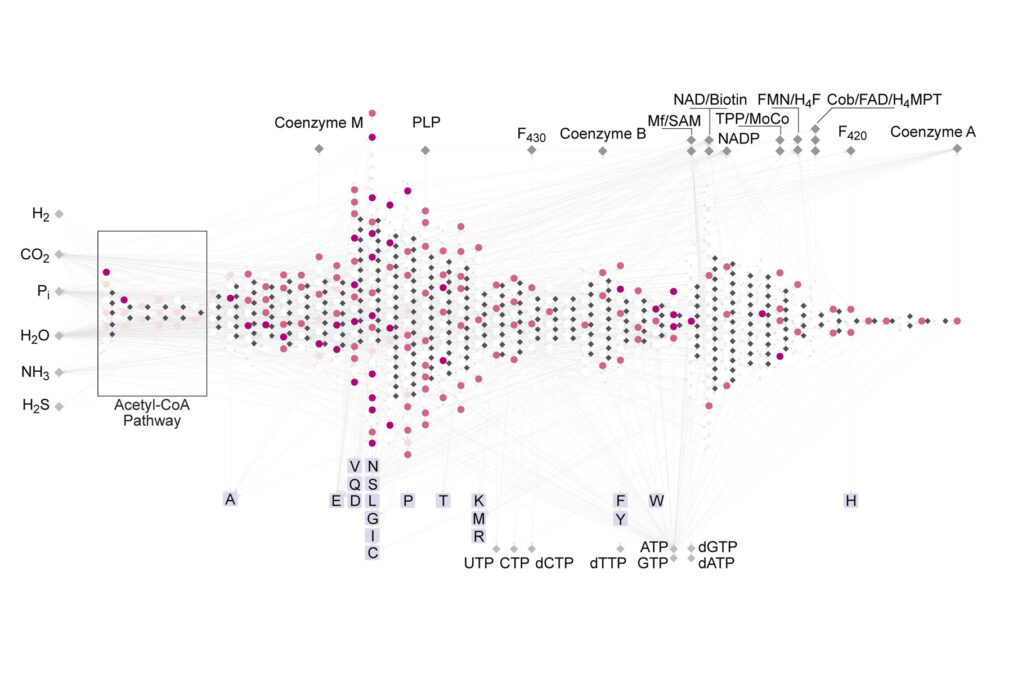
“We found that the last universal ancestor of all cells, LUCA, possessed enzymes for only about half of the reactions of metabolism,” says Martin.
“The other half was catalyzed by metals in the environment where LUCA arose.”
The team found that there were likely four different phases in the development of catalysis (enzyme-driven reactions). The first relied solely on metals in the environment.
Once enough of the useful molecules built up, the not-quite-living-yet proto-cells (which included LUCA) could start developing their own enzymes that performed some of the functions of those metal catalysts.
Over time, later proto-cells developed more and more enzymes, reducing their dependency on external metals, until they no longer needed them at all. Only at that point would they be considered ‘free-living cells’.
Importantly, the researchers say, this didn’t occur until after bacteria and archaea had separated. These two branches figured out their own ways to tackle the same problems.

“We can see cases where the ancestors of bacteria and archaea independently evolved structurally distinct enzymes to catalyze the same essential metabolic reaction,” says Natalia Mrnjavac, a biologist at Heinrich Heine University Düsseldorf.
“Such parallel inventions could have paved the way to the independent emergence of free-living bacteria and archaea.”
The study may also plug another gap in our understanding of the origins of life.
A molecule called ATP is now a vital energy source to fuel metabolism – but it’s also made by enzymes, and wasn’t available in prebiotic chemistry. The researchers say they identified an alternative.
“When we react phosphite, a form of phosphorus that naturally occurs in hydrothermal vents, with organic compounds, we get metabolic phosphorylation reactions overnight in water,” says Manon Schlikker, a molecular evolutionary scientist at Heinrich Heine University Düsseldorf.
“Phosphite and palladium replace ATP and enzymes; it’s amazing, and it makes early evolution a lot easier to grasp.”
Yet critical to chemical reactions is the medium in which they occur, and scientists still don’t have a clear idea about that. Was it water, or a sticky goo?
Related: All Life on Earth Shares an Ancestor – And Some of Our Genes Predate It
If the findings are backed up with further research, it seems that the tree of life, as we picture it, may need an update. We tend to think of LUCA as the ‘trunk’ of the tree, with all the other lifeforms, past and present, branching off from there.
But perhaps there were two completely separate trunks, which first diverged at the roots, before they were even technically alive.
The research was published in the journal Science Advances.
This article was fact-checked by Clare Watson and edited by Rebecca Dyer. While we pride ourselves on our process, we are only human. If you spot a mistake, please let us know.

