
АНУ-ын үндэсний цэцэрлэгт хүрээлэнгийн экс хөтөч Мелисса Далли түүхэн үзмэрүүдийг устгаж буйг эсэргүүцэн дурсамжийн хуудас тарааж, бие даасан мэдээлэл хүргэх аялал хийж байна.
АНУ-ын холбооны агентлагуудаас түүхэн үзмэр, тайлбар самбаруудыг шинэчлэх, цэгцлэх бодлого баримталсны улмаас Grand Teton National Park зэрэг байгалийн цогцолборт газруудаас түүхэн холбогдолтой зарим самбарууд хасагджээ. Үүнийг эсэргүүцсэн Үндэсний цэцэрлэгт хүрээлэнгийн экс ажилтан Мелисса Далли уг шийдвэрийг түүхийн дурсамжийг хязгаарласан хэрэг хэмээн үзэж, Америкийн 433 гаруй хүрээлэнг хамарсан боловсролын хөдөлгөөнтэй нэгдэн сайн дураар ажиллаж байна. Тэрээр өнгөрсөн дөрөвдүгээр сараас эхлэн 18 хүрээлэнгээр зочилж, байхгүй болсон самбаруудын текст болон холбогдох мэдээллийг аялагчдад тараах болжээ.
Аялагчид болон жуулчид зарим төвүүдэд алга болсон самбарын оронд өөрсдөө гэрэл зураг, мэдээлэл байрлуулж, санал бодлоо хуваалцах самбар үүсгэсэн нь олон нийтийн оролцоог нэмэгдүүлсэн байна. Далли энэхүү үйл ажиллагаагаа үргэлжлүүлж, устаж үгүй болж буй түүхэн баримтуудыг бүртгэх цахим хэрэгсэл бүтээхээр төлөвлөжээ. Байгалийн үзэсгэлэнт газруудаар аялах явцдаа тэрээр түүхэн үнэнийг хадгалахын төлөө дуу хоолойгоо хүргэсээр байна.
Дэлгэрэнгүйг эх сурвалжаас харах
↓Эх сурвалжийг нээх ↓
In July, former National Park Service (NPS) ranger Melissa Dalley stood in a visitor center in Grand Teton National Park, next to a wall where a sign used to be, handing strangers a piece of paper with the missing words on it.
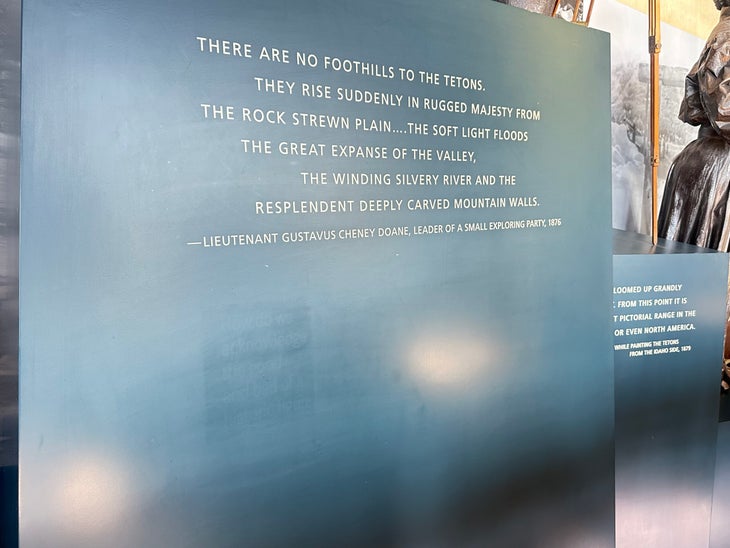
“You could clearly see the ghost of the sign,” Dalley told Outside. “The language was still imprinted on the plinth.”
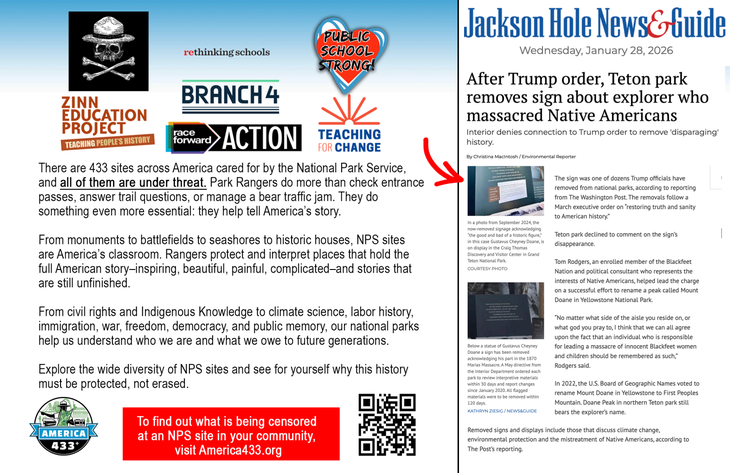
The display she is referring to was once mounted beneath a statue of Gustavus Cheyney Doane, a 19th-century U.S. Army officer who explored parts of the Teton region and took part in the killing of more than 170 Piegan Blackfeet. Dalley documented the now-missing sign, and is sharing its information with visitors.
Since April 2026, she has visited 18 parks, handing out such flyers.
Dalley, 49, was a park guide at Martin Van Buren National Historic Site, an NPS-managed location in upstate New York for four years until she quit in 2026. She is now a volunteer organizer with America 433+, an education coalition named for the 433 sites in the NPS system. The group is petitioning Congress to stop what it calls the censorship of American history.
“I determined that I could serve the Park Service much better right now from the outside,” she said. “I wouldn’t be muzzled, and I wouldn’t face retaliation.”
Her decision to leave the NPS came a year after President Trump signed a March 2025 executive order directing federal agencies to review how the country’s past is presented at Park Service-managed sites. Secretarial Order 3431 followed in May of that year, requiring the agency to remove content that “inappropriately disparage[s] Americans past or living” and to emphasize instead the beauty and grandeur of the landscape.
According to Dalley, the Doane at Grand Teton was one of dozens of signs the NPS said it has since removed.
Did You Notice a Sign Missing?
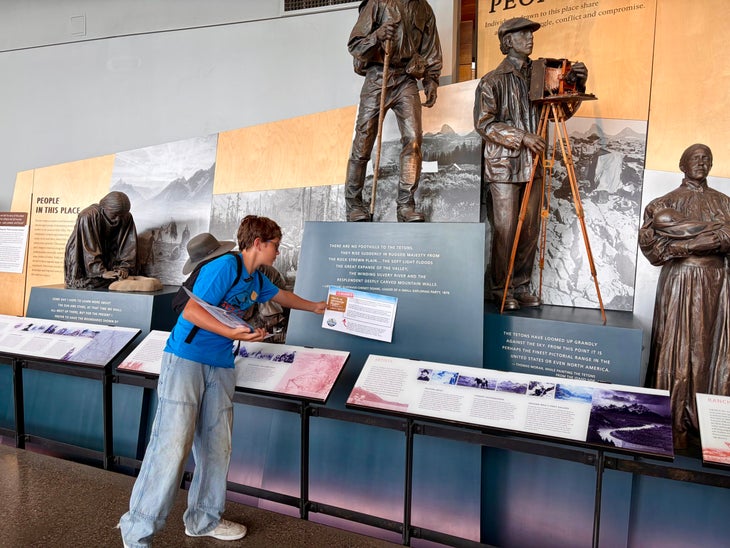
Dalley’s usual process involves standing near a removed sign and waiting for a visitor to stop and read the panels still posted. Then, she approaches them.
“Hey, I see you’re reading these signs. Did you notice there was one missing? And here it is,” she says, handing them a copy of the sign’s text.
Dalley is a member of the Resistance Rangers, a volunteer collective of off-duty and former employees. The mostly anonymous group was formed in response to the February 14, 2025 firing of some 1,000 workers across all 433 NPS sites. The courts ordered their reinstatement in March, but thousands more left voluntarily over the following months through buyouts and early retirements.
Her work isn’t affiliated directly with the group, but she says that around that time, rangers across the country were having a version of the same conversation.
“We were all talking about what’s our red line? What is the thing that is going to push us past our ability to tolerate? Because we all felt compromised morally and ethically,” Dalley said. The sign removals were her red line.
How the Signs Came Down
By June 2025, park employees placed notices asking visitors to report signage they found negative about American history. Staff was required to flag their own materials. The first wave of removals began that September, and includedsigns referencing climate change, slavery and the massacre of Native Americans, among other topics.
That’s when Dalley started tracking the removals herself. Soon, people at other parks began contacting her, and she became a hub of information. Sites that had never had reason to talk to each other were now comparing notes, from Alaska to Guam, she said.
“People began to see the scope of it,” Dalley told
Outside. “We could just start banging our drums and talking about it and trying to get the public to care.”
Visitors Jumped In with Sharpies
In early 2026, Dalley drove west from New York, stopping at parks along the way. In May, she went to the President’s House in Philadelphia, the site that memorializes the enslaved people held by George Washington, where she had once given tours.
She found that visitors had filled in missing information themselves, taping up photographs of the removed signs and printed articles describing the removals. Someone had strung up a roll of butcher paper with a Sharpie hanging from it, asking passersby to share their feelings on the perceived censorship. People from around the world responded in writing.
“Basically, the public took on the mantle of what the Park Service should be doing,” she said. “They just spontaneously, grassroots, recreated an audience-centered interpretation.”
She continued her mission with a Juneteenth teach-in at Harpers Ferry National Historical Park in West Virginia, then again at Grand Teton and Glacier National Parks while on vacation with her family.
Creating a Framework for Others to Follow
Some information is available only on NPS signs, Dalley said, while other details exist primarily in the institutional knowledge that park rangers have built over decades.
“There is an irreparable loss associated with some of this information being censored,” she said. Signs at NPS sits also help visitors connect with the place where a historical event occurred, at a moment when they’re most likely to care, regardless of whether the “given history is flattering to Americans.”
Dalley said her dedication to the mission of preserving the past is to inspire others to do the same.
“I’m just one person, and I’ve been able to figure a lot of this out,” she adds. Next, Dalley plans to build a downloadable toolkit to catalogue removed signs. “Being a park ranger unlocked something in me,” she said. “I miss it so much.”
For now, she’s sharing American history, standing next to the empty space where a sign used to be.
The post Former Ranger Melisa Dalley Left the National Park Service. Now She Gives Rogue Tours They Can’t Control. appeared first on Outside Online.


