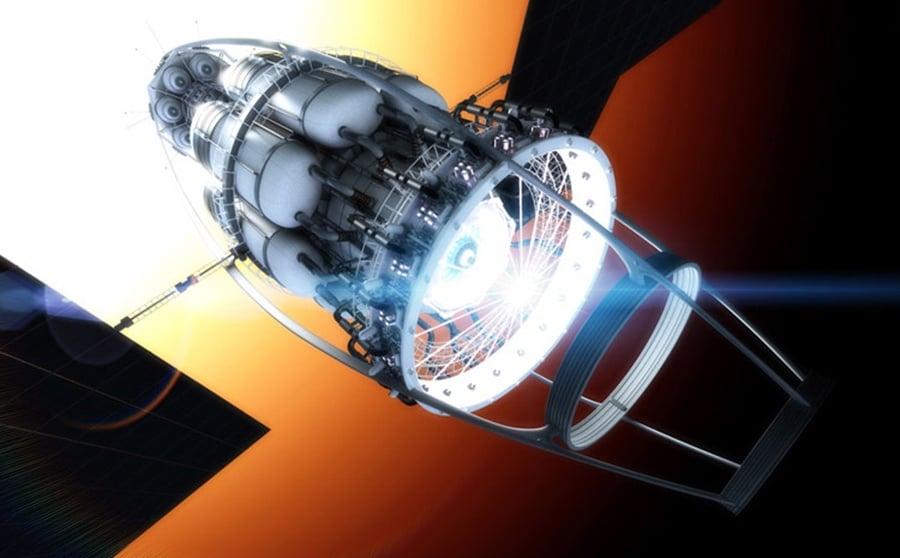
Од хоорондын аялалд антиматерийг ашиглах нь онолын хувьд хамгийн өндөр үр ашигтай хөдөлгүүрийн шийдэлд тооцогдож байна.
Бодис ба антиматерийн харилцан устгал (annihilation) нь термоядерын бөмбөгтэй дүйцэхүйц асар их энерги ялгаруулдаг бөгөөд энэхүү үйл явцаар үүссэн пион болон муон бөөмсийг соронзон хушуугаар чиглүүлэн тийрэлтэт түлхэлт үүсгэх боломжтой юм. Энэхүү үзэгдлийн үндэс нь 1928 онд Пол Диракийн томьёолсон квант физикийн онолтой холбоотой бөгөөд хожим 1932 онд Карл Андерсон позитроныг, 1955 онд Эмилио Сегрэ, Оуэн Чемберлен нар антипротоныг тус тус нээснээр шинжлэх ухааны бодит үндэслэл нь бүрджээ.
Одоогийн байдлаар антиматерийн хөдөлгүүрийг үндсэн гурван төрөлд ангилан судалж байна. Үүнд: өндөр хурдны бөөмсийг ашигладаг “Beam-Core” пуужин, устгалын явцад ялгарах дулаанаар түлшийг халаах дулааны пуужин, болон антиматерийг ашиглан цөмийн хайлалтыг идэвхжүүлэх микро-хайлалтын системүүд багтдаг. Эдгээр загвар нь химийн түлшнээс 10 тэрбум дахин их энерги гаргах чадвартай боловч бодит аялалд ашиглахад асар их хэмжээний антиматерийг хадгалах, үйлдвэрлэх технологийн хүндрэл тулгарч байна.
Нэг грамм антиматерийг үйлдвэрлэхэд дэлхийн нийт дотоодын нийт бүтээгдэхүүний тал хувьтай тэнцэхүйц 62.5 их наяд долларын өртөг шаардагдах ба одоогийн технологиор үүсгэсэн энерги нь гарах үр дүнгээсээ давж байна. Мөн түүнийг аюулгүй хадгалах, сансарт нөөцлөх асуудал нь шийдвэрлэхэд тун бэрхшээлтэй хэвээр байгаа юм. Хэдийгээр эдгээр концепц нь ойрын оддын системд хүрэх хамгийн хурдан арга гэж үзэгддэг ч одоогоор зөвхөн онолын түвшинд байгаа бөгөөд технологийн болон эдийн засгийн хувьд хэрэгжих боломжгүй байна.
Дэлгэрэнгүйг эх сурвалжаас харах
Эх сурвалжийг нээх ↓
Welcome back to our series on Interstellar Travel, where we examine concepts that have been proposed since the dawn of the Space Age. In our previous installments, we examined the earliest concepts to emerge during the Cold War that attempted to leverage nuclear power to reach the nearest stars in our galaxy. We then addressed those that attempted to utilize nuclear fusion for propulsion. These proposals paralleled developments in nuclear weapons, beginning with fission and progressing to thermonuclear devices.
Today, we will look at one of the more exotic proposals for achieving interstellar spaceflight: matter-antimatter annihilation. For fans of science fiction, the idea is certainly a familiar one. In addition to the Star Trek franchise, it is featured extensively in the writings of such hard science fiction authors as Alastair Reynolds, Robert L. Forward, James S.A. Corey, and Cixin Liu. As a relative newcomer to the advanced theoretical propulsion game, it should come as no surprise that it is treated as a serious prospect for interstellar travel in the future.
The fundamental concept is quite simple. For every particle of matter, there is a corresponding antiparticle with the same mass, but opposite charge and magnetic moment. For hydrogen atoms, composed of a single proton and electron, there are anti-hydrogen atoms composed of an antiproton and positron (a positively-charged electron). When a particle and antiparticle come into contact with each other, they annihilate each other, releasing as much energy as a thermonuclear bomb.
The reaction also releases showers of secondary particles (pions and muons) that travel at one-third the speed of light. These could then be channeled through magnetic nozzles to generate thrust.
Discovery
The concept of negative particles had been entertained by scientists during the late 19th century and would eventually be discovered through research into the emerging field of quantum physics. In 1928, British physicist Paul A.M. Dirac applied Einstein’s Special Theory of Relativity to explain the behavior of electrons in magnetic and electric fields. A relativistic interpretation of Schrödinger’s wave equation for electrons predicted the possibility of antielectrons.
However, the implications of Dirac’s own equations did not emerge until Robert Oppenheimer’s seminal paper, “On the Theory of Electrons and Protons,” was released in 1930. It was here that Oppenheimer drew on Dirac’s equation to argue for the existence of positrons. In 1932, Carl D. Anderson proved the existence of positrons when he observed them in cosmic rays by passing them through a cloud chamber, for which he won the 1936 Nobel Prize in physics.
By 1955, Emilio Segrè and Owen Chamberlain and their colleagues confirmed the existence of antiprotons using the high-energy Bevatron accelerator at the Lawrence Berkeley Radiation Laboratory, for which the two shared the 1959 Nobel Prize in physics. From the 1990s onward, researchers at the European Organization for Nuclear Research (CERN) began creating and trapping antihydrogen atoms for longer and longer periods (now in the 1000’s of seconds).
Propulsion Concepts
Based on the many proposals made since the mid-20th century, antimatter propulsion can be grouped into three categories. First, there are Beam-Core Rockets proposals, where matter-antimatter annihilation produces charged pions or high-energy photons that are directed through magnetic nozzles to achieve relativistic speeds (a fraction of the speed of light). In 1953, German physicist Eugene Sänger made the first recorded proposal of a photon rocket where energetic gamma-rays from electron-positron annihilation would be used to generate thrust.
Known as the Sänger Photon Rocket, the gamma-rays would be reflected by an electron gas mirror. Unfortunately, the electron-gas mirror would need to have a density only seen in white dwarf stars to reflect the high-energy gamma rays. In addition, Sänger’s concept emerged before the discovery of the antiproton.
The next major proposal came from the work of American physicist and SF author Robert Forward in 1985. In a paper titled “Antiproton Annihilation Propulsion,” he proposed how proton-antiproton annihilation could produce charged fragments of protons (pions) which would then be directed by a magnetic field. Based on various simulations conducted in the 1980s, scientists estimate that velocities of about 0.33 to 0.58 the speed of light could be achieved.
In 2001, researchers Dr. Darrel Smith and Jonathan Webby from the Embry-Riddle Aeronautical University (ERAU) in Arizona released a report detailing their own concept for a photon rocket. The ship would weigh 400 metric tons (441 US tons), carry 170 metric tons (187 tons) of antimatter, and could reach 0.5 the speed of light, reaching Proxima Centauri in a little over 8 years.
Next came the work of NASA Jet Propulsion Laboratory (JPL) scientist Robert Frisbee, who described a new concept for antimatter propulsion in a 2003 paper, “How to Build an Antimatter Rocket for Interstellar Missions.” Addressing the issue of storage and radiation products, he proposed using frozen hydrogen and magnetically levitated balls of anti-hydrogen in near-absolute-zero temperatures. According to his calculations, velocities of 0.5 c would be possible, but would require 815,000 metric tons (900,000 US tons) of antimatter fuel.
Second, there are proposals that fall into the category of Thermal Rockets, where matter-antimatter annihilation superheats a conventional working fluid (like hydrogen) to produce high-thrust exhaust for interplanetary missions. A classic example was presented by Friedwardt Winterberg in a 2011 paper, “Matter-Antimatter GeV Gamma Ray Laser Rocket Propulsion,” where he described generating a very high electron-positron current in an ambiplasma of hydrogen-antihydrogen.
This would generate a magnetic field that constricts rapidly (“pinch discharge”), causing the ambiplasma to collapse to ultrahigh densities. This would trigger intensely rapid annihilation, with the resulting gamma-ray particles focused into a tight gamma-ray laser beam that pushes against the chamber’s magnetic fields to provide thrust. Based on various proposals, a specific impulse of between 1020 and 7,140 seconds could be achieved, and velocities of 10 to 70 km/s (6.2 to 43.5 mps), or 36,000 to 252,000 km/h
(22,370 to 156,585.5 mph). Too slow for interstellar voyages, but capable of reaching Mars in just 9 days.
Third, there are Antimatter-Catalyzed Microfission-Fusion (ACMF) concepts, in which tiny amounts of antimatter are used to spark nuclear fusion reactions, yielding high thrust. By injecting antiprotons into pellets of deuterium and Uranium 235, particles of matter and antimatter are compressed to the point where annihilation occurs. This releases tremendous amounts of energy (pions and gamma rays) that rapidly heat and compress the fuel.
This leads to localized bursts of microfission/fusion events, producing charged particles that are converted by magnetic nozzles into thrust. The concept has been extensively studied at Pennsylvania State University for realizing interplanetary missions. According to a 2006 study by NASA Institute for Advanced Concepts (NIAC), physicist Steven D. Howe presented a variant on the ACMF system for realizing rapid transits to Mars.
According to his calculations, an Antimatter Driven Sail system could achieve an Isp of 1470 seconds, or an exhaust velocity of 14,400 m/s (8,948 mps), or 51,850 km/h (32,218 mph), reducing transit times to Mars to just 45 days.
Pros & Cons
The advantages of antimatter propulsion are considerable, especially where energy levels and energy efficiency are involved. For example, matter-antimatter annihilations are capable of producing an estimated 1010 Megajoules (MJ) per kilogram of antimatter. This is about 10 billion times what is possible using chemical combustion, 1000 times more than nuclear fission concepts, and 300 times more than nuclear fusion. Pound for pound, this class of ship would be the fastest and most fuel-efficient ever conceived.
Whereas conventional rockets require tons of chemical propellant to launch a small payload to its destination, an antimatter engine could do the same with just a few milligrams (or even nanograms) of fuel. Unfortunately, for interstellar missions, the amount of antimatter needed is multiplied exponentially (as is the cost). According to a report prepared by Robert Frisbee for the 39th AIAA/ASME/SAE/ASEE Joint Propulsion Conference and Exhibit, a two-stage antimatter rocket would need over 815,000 metric tons (900,000 US tons) of fuel to make the journey to Proxima Centauri in approximately 40 years.
This raises the first major stumbling block, which is the cost of producing antimatter. According to official estimates, it would take 9 × 10¹³ joules (25 x 106 kilowatt-hours) to produce a single gram of antimatter. However, due to the limitations of current particle accelerators, producing a single gram would actually require an order of magnitude more energy, which works out to 2.5 × 10¹⁶ kilowatt-hours. Since the energy density of 1g of antimatter is 1.8 x 10¹⁴ joules of energy, this means that it takes more energy to produce antimatter than what is released through annihilations.
According to the most conservative cost estimates, producing 1g of antimatter would also cost $62.5 trillion, over half the world’s GDP. At present, the amount of antimatter created by major particle physics facilities (like CERN and the former Tevatron at Fermilab) adds up to less than 20 nanograms (20 billionths of a gram).
A possible solution was proposed by researchers Gerald P. Jackson and Elaine T. Marshall of Hbar Technologies, LLC in a 2005 NIAC study, “Antimatter Harvesting in Space.” In their paper, Jackson Marshall demonstrated how antimatter could be harvested within the Solar System (rather than in particle accelerators). This was followed by Dr. Richard Obousy of Icarus Interstellar in 2011, who proposed an in-situ refueling concept known as the Vacuum to Antimatter-Rocket Interstellar Explorer System (VARIES).
As he described it, a VARIES ship would rely on large lasers (powered by enormous solar arrays) that would create particles of antimatter when fired at empty space. Like the Ramjet concept, this proposal solves the problem of carrying propellant, but would still be prohibitively expensive to build based on current technology. It is also unclear, based on current science, whether it would be possible to produce enough antimatter to power the ship, and the annihilations would pose a high risk of radiation exposure.
The other stumbling block for matter-antimatter propulsion is the extreme difficulty of storing antimatter. The traditionally proposed method of storing it as plasma has come to be seen as too power-intensive and too low in density. Frisbee’s proposal addressed this problem (see above), but required an incredibly long and thin spacecraft design to accommodate the system. The conceptual two-stage design proposed by Frisbee was thousands of kilometers long (comparable to a planet), and only a few meters wide.
Other proposals that involve frozen pellets of antihydrogen require that antiprotons be cooled, bound to positrons, and captured. This is a significant challenge that has only been accomplished in the lab for only a few atoms. The cost of building the necessary systems for trapping electrically charged frozen antihydrogen pellets would also be prohibitively expensive based on our current capabilities.
In summary, it is clear that antimatter propulsion has significant potential for sending future missions to nearby stars. However, the key word here is “future,” as there is no practical way to realize it using our current technology and methods. The technical challenges are monumental and the costs astronomical. Like many of the concepts explored so far, there may come a day when the technology and cost environment will make antimatter feasible.
In the meantime, there are more practical methods that could be created in the near future (which we will explore in the next installment) and some even more exotic ideas that continue to inspire hope (in our final installment).
Further Reading:
Sources:
–Antimatter Propulsion. Dr. Mike LaPointe, NASA Marshall Space Flight Center
–Rethinking Antimatter Rockets – Paul Glister, Centauri Dreams
–On the Theory of Electrons and Protons – Oppenheimer, J. R. Physical Review 35 (5): 562–63 (1930)
–Propulsion by light: visions of the German pioneer Eugen Saenger – Bohn, Willy L. Proceedings of the SPIE, Volume 5777, p. 986-992 (2005)
–Antimatter Driven Sail for Deep Space – Dr. Steven D. Howe, IEEE (2003)
–Antimatter Harvesting in Space
–Vacuum to Antimatter-Rocket Interstellar Explorer System (VARIES) – Obousy, R. Journal of the British Interplanetary Society, vol. 64, p. 378-386 (2011)


