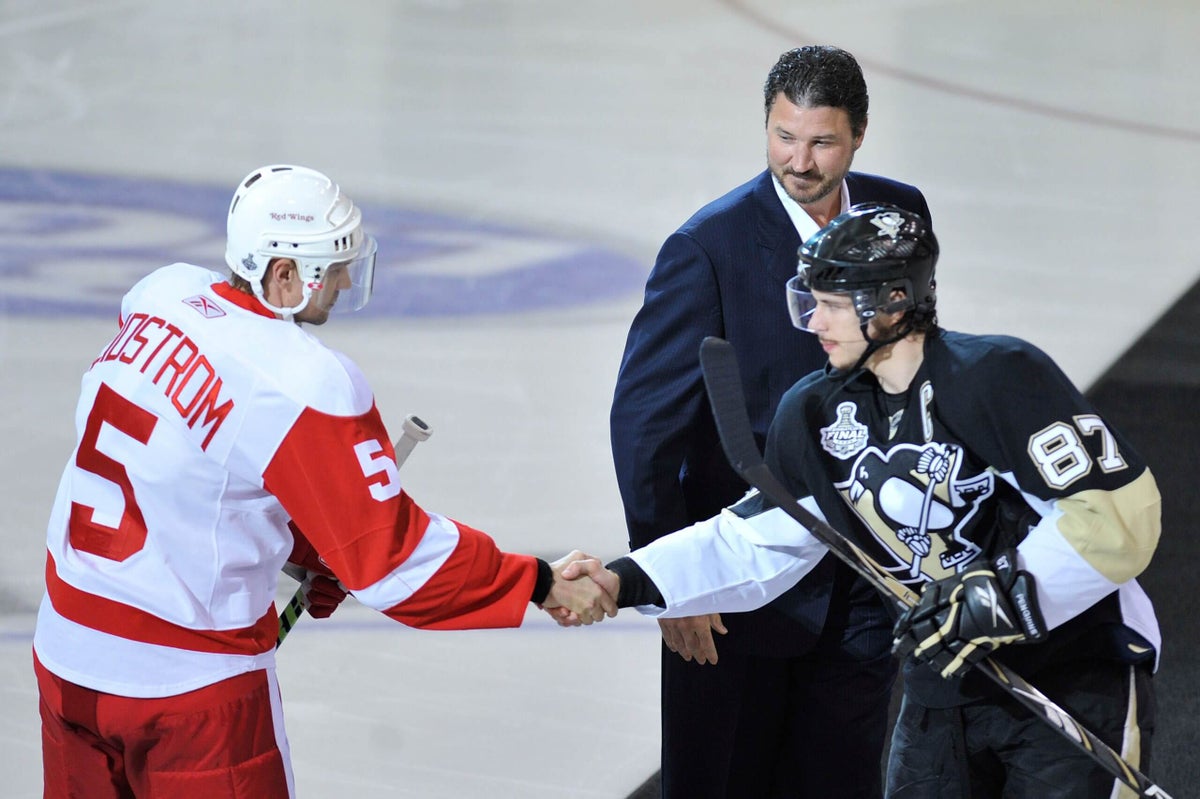
Stanley Cup-ийн аварга болсон түүхэн амжилтаар нь NHL-ийн шилдэг тоглогчдыг баг болгон хувааж, хүчний харьцааг тодорхойлж байна
NHL-ийн 1967 оны өргөтгөлийн үеэс хойшхи түүхэн дэх шилдэг тоглогчдыг аварга авсан тоогоор нь ангилан 20 хүний бүрэлдэхүүнтэй багууд байгууллаа. Тоглогчдыг 12 довтлогч, зургаан хамгаалагч, хоёр хаалгач гэсэн бүтэцтэйгээр хуваарилсан бөгөөд идэвхтэй карьераа үргэлжлүүлж буй 35-аас дээш насны тамирчдыг энэхүү жагсаалтад багтаав.
Stanley Cup хүртэж байгаагүй одод болон цөөн хэдэн удаа түрүүлсэн тоглогчдыг нэгтгэсэн багуудын бүрэлдэхүүнд Хенрик Лундквист, Шей Уэбер, Эрик Карлссон зэрэг туршлагатай тамирчид багтлаа. Мөн Алекс Овечкин, Рэй Бурк, Марио Лемье, Бобби Орр зэрэг алдартай тамирчдыг тэдний аварга авсан тоонд нь үндэслэн тус тусын багт хуваарилсан юм.
Сидни Кросби, Патрик Кейн, Мартин Бродер нарыг багтаасан гурван удаагийн аварга тоглогчдын баг нь бүрэлдэхүүний хувьд хамгийн хүчтэй өрсөлдөгчдийн нэг болж байна. Харин Уэйн Гретцки, Майк Босси, Никлас Лидстрём, Патрик Руа зэрэг дөрөв болон түүнээс дээш удаа түрүүлсэн одод нэгдсэн баг нь бат бөх хамгаалалт, хаалгачийн найдвартай ажиллагаагаараа бусдаасаа ялгарч байна.
Дэлгэрэнгүйг эх сурвалжаас харах
↓Эх сурвалжийг нээх ↓
After a summer spent on failed GM theories, contrarian takesand blockbuster alternate history, we’re going to keep today’s post nice and simple. It’s an idea that’s been sent in by a few of you over the years, most recently reader Stephen C., and I’ll admit to being surprised we haven’t done it already.
Let’s make some all-time rosters based on how many Stanley Cup titles a player won.
That’s it. Just a nice fastball over the heart of the plate to take a swing at. We’ll go through the best players, check how many Cup titles they’ve won, and assign them to that team. Then we see which one is best, and then ideally spend the rest of the day arguing about it in the comment section.
But first, a few ground rules™:
- Each team gets a 20-man roster of 12 forwards, six defensemen and two goalies. We’ll try to keep centers and wings in their proper slots, although we’ll assume some of these guys can play out of position.
- For this exercise, “all-time” will go back to the start of the expansion era in 1967. Winning the Stanley Cup in a league with only six teams was just a completely different sort of challenge.
- The one place this gets tricky: active players. It’s more fun to include a few names from today, but it would be weird to put Connor McDavid on Team No Cups when he still has time to win a few. So, my compromise will be that we can use active players whose careers are close to over, which we’ll define as 35 or older.
Can the Sedins change the Canucks’ culture?
Sean Gentille and Thomas Drance
Let’s see where this takes us…
Team No Cups
We’ll start with some good news, at least as far as the DGB Research Department is concerned: We’ve already got this one.
Back in 2021, we had a post where we pitted a team of stars who never won the Cup against one made up of players who won the Cup on multiple teams. Somewhat surprisingly, Team Multi Cups pulled off the upset. That might not bode well for Team No Cups in today’s competition, but it means our roster-building work is already done.
Well, mostly. In the five years since that post, we’ve had a few players call it quits without ever claiming their ring. So while we’ll start with that 2021 roster, and you can go back and reread that post to get the logic behind the picks, we’re going to need to make a few adjustments.
Specifically, we can ditch the weak-ish third defense pairing of Doug Wilson and Randy Carlyle for recent Hall of Famer Shea Weber and Erik Karlsson, who’s still active but meets our 35-plus criteria. And while Curtis Joseph should be in the HHOF himself, he’s going to lose his spot on Team No Cup to Henrik Lundqvist, who wins a coin-flip battle for the job with Carey Price.
And then there’s Joe Thornton, who absolutely has to be on the team. Looking at the forwards already in place, Thornton is going to end up bumping a Sedin. But which one? I went back and forth on the answer for a while before realizing we didn’t need one — they’re twins, after all, and nobody can tell them apart. We’ll assign one roster spot to their particular genetic makeup and then let them figure out who plays when.
All told, here’s what our updated roster looks like:
Team No Cups
| W | C | W |
|---|---|---|
|
Jarome Iginla |
Joe Thornton |
Marcel Dionne |
|
Cam Neely |
Adam Oates |
Paul Kariya |
|
Mike Gartner |
Gilbert Perreault |
Eric Lindros |
|
Pavel Bure |
Dale Hawerchuk |
Sedin |
| D | D | G |
|---|---|---|
|
Brad Park |
Börje Salming |
Roberto Luongo |
|
Shea Weber |
Erik Karlsson |
Henrik Lundqvist |
|
Mark Howe |
Phil Housley |
Not bad. And given how the rest of history’s greatest players will be sliced and diced onto different teams, quite possibly the favorite. But let’s give them some competition.
Team One Cup
With no disrespect to the collection of OGWAC legends we just saw, truly great players are supposed to win at least one Stanley Cup. But how many of them win exactly one? Let’s find out.
Our 35-plus rule for active players helps us right away, as we can start with history’s greatest goal scorer in Alexander Ovechkin. And if he needs occasional offensive support, we also have wing options like 684 goals of Teemu Selänne and 668 goals of Luc Robitaille. Mix in Lanny MacDonald and Martin St. Louis, and firepower from the wings won’t be an issue.
Unfortunately, we don’t have a truly elite offensive center to work with those guys. Patrice Bergeron and Doug Gilmour are excellent two-way threats, and Mike Modano won’t be out of place, but we’re not as deep down the middle as Team No Cup. We may get future reinforcements from Nathan MacKinnon, but for now he’s too young.
We do make some of that back on the blue line, where we can start with Ray Bourque and Al MacInnis and then turn to Chris Pronger and Zdeno Chára, who might need a full cleanup crew after every shift. But we run into another issue in goal, where our options get thin enough after Eddie Belfour that we’re left choosing between the brief peak of Tim Thomas or the longevity of Mike Richter.
We end up with plenty of star power, especially on the wings and the top four, plus a checking line that should be just about impossible to score against. Is it enough to compete?
Team One Cup
| W | C | W |
|---|---|---|
|
Alexander Ovechkin |
Doug Gilmour |
Teemu Selänne |
|
Luc Robitaille |
Mike Modano |
Martin St. Louis |
|
Dave Andreychuk |
Marc Savard |
Lanny McDonald |
|
Henrik Zetterberg |
Patrice Bergeron |
Rod Brind’Amour |
| D | D | G |
|---|---|---|
|
Ray Bourque |
Al MacInnis |
Eddie Belfour |
|
Chris Pronger |
Zdeno Chára |
Tim Thomas |
|
Rod Langway |
Brian Leetch |
It’s not a perfect team. I’m not sure it’s even better than Team No Cups. And in theory, that bodes poorly for our next few teams, since winning multiple Cup titles is harder than winning just one. Or at least, it’s supposed to be. Does that logic apply to the true stars? Let’s find out.
Team Two Cups
It doesn’t take long to realize we’re going to be loaded up front. The early ’90s Penguins offer us both Mario Lemieux and Jaromír Jágr, and we give them 740 goals’ worth of third wheel in Brett Hull. That unit is so stacked that it somehow bumps 1970s scoring king Phil Esposito down to the second line, where he gets two 1990s legends to work with. Oh, and good luck even touching the puck when that fourth line is out there. The forwards are stacked.
We get off to an arguably even better start on the blue line, where we can drop Bobby Orr onto the first pair. But that’s where this juggernaut-in-the-making starts to lose some steam. A search through the modern era’s other top retired defensemen doesn’t dig up all that many two-time winners. It almost gets comical, as we find ourselves debating names such as Rob Ramage and Marty McSorley while wondering whether we can just triple-shift Orr.
Luckily for Team Two Cups, our 35-plus active-player rule somewhat saves them because it offers access to Victor Hedman and Drew Doughty, among others. That allows us to ice a functional group, and no blue line with Bobby Orr can be all that bad, but this is a weak spot.
Will it matter? Maybe not, because having Dominik Hašek between the pipes should help clean up any mistakes on the back end. The backup spot is a bit trickier, as Andrei Vasilevskiy isn’t old enough and Sergei Bobrovsky will just have to get bumped up to Team Three Cups next spring, but we ultimately end up just fine there, too.
Team Two Cups
| W | C | W |
|---|---|---|
|
Jaromír Jágr |
Mario Lemieux |
Brett Hull |
|
Joe Sakic |
Phil Esposito |
Ron Francis |
|
Steven Stamkos |
Bobby Clarke |
Bill Barber |
|
Pavel Datsyuk |
Peter Forsberg |
Anže Kopitar |
| D | D | G |
|---|---|---|
|
Bobby Orr |
Sergei Zubov |
Dominik Hašek |
|
Drew Doughty |
Victor Hedman |
Bernie Parent |
|
Alex Pietrangelo |
Ryan McDonagh |
Our theory that this would get tougher as we went didn’t really hold up with Team Two Cups. But spoiler alert, it’s about to get blown out of the water in our next section.
Team Three Cups
I’ll admit, I went into this assuming Team Three Cups would be our toughest entry to fill out. Not many players win the Cup three times, and many of the ones who do go on to win even more. How many guys are going to wind up with exactly three?
More than I thought, and you’re probably already ahead of me on how this is going to shake out. Team Three Cups gets to start with the core of the 2010s Blackhawks, and then combine that with the cap-era Penguins, so we’re already building around names such as Sidney Crosby and Patrick Kane. Then we get a big chunk of the pre-cap Red Wings dynasty that didn’t all stick around for that fourth Cup in 2008, including Steve Yzerman and Sergei Fedorov. And then we get to turn to the pre-cap Devils, who give us Martin Brodeur in goal and let us start our blue line with Scott Stevens.
We admittedly start to get into slimmer pickings around the edges of the roster, and this team would be in trouble if we started to add press box depth. (Although that would get Phil Kessel on the team, which has me considering it.) But as far as finding 20 guys to build a roster around, this one ends up being shockingly good.
Team Three Cups
| W | C | W |
|---|---|---|
|
Steve Yzerman |
Sidney Crosby |
Patrick Kane |
|
Marián Hossa |
Evgeni Malkin |
Sergei Fedorov |
|
Brendan Shanahan |
Joe Nieuwendyk |
Mark Recchi |
|
Guy Carbonneau |
Jonathan Toews |
Igor Larionov |
| D | D | G |
|---|---|---|
|
Chris Chelios |
Scott Stevens |
Martin Brodeur |
|
Duncan Keith |
Brent Seabrook |
Marc-André Fleury |
|
Kris Letang |
Brian Rafalski |
Other than realizing that my Marc-André Fleury pick may have just summoned the Chris Osgood zealots, I like this team a lot.
Team Four or More Cups
I originally was going to try to ice a Team Four Cups, but the forwards end up being Wayne Gretzky and Mike Bossy, and then you’re digging through the old Islanders dynasty to find guys to play with Kris Draper, Craig MacTavish and Chris Kunitz. So, instead, we’re going to group everyone who has won the Cup four or more times into one final squad. Is that an unfair advantage? Maybe, but we’re feeling generous.
Even with the added leeway, the forwards are a bit of a project. We end up relying on the 1970s Habs dynasty for a big chunk of our spots, with the 1980s Oilers helping out. We end up finding Hall of Famers for almost every spot, but it’s admittedly the weakest forward group we’ve had yet, by some distance.
But then, something weird happens: As far as building from the net out, we’re actually in great shape. We have a goaltending duo that can compete with any of them, and almost certainly the best one-through-six blue line of this entire exercise. Apparently that old saw about building from the net out does have some truth to it, because you can win a lot of Cups with the right guys back there.
Team Four or More Cups
| W | C | W |
|---|---|---|
|
Mike Bossy |
Wayne Gretzky |
Guy Lafleur |
|
Mark Messier |
Bryan Trottier |
Jari Kurri |
|
Steve Shutt |
Jacques Lemaire |
Glenn Anderson |
|
Bob Gainey |
Clark Gillies |
Claude Lemieux |
| D | D | G |
|---|---|---|
|
Nicklas Lidström |
Denis Potvin |
Patrick Roy |
|
Larry Robinson |
Paul Coffey |
Ken Dryden |
|
Larry Murphy |
Scott Niedermayer |
That’s a fascinating group. It’s also hard not to notice that only Nicklas Lidström and Scott Niedermayer were especially productive into the cap era. With 32 teams and more on the way in the middle of the parity era, it may be a while before this team sees any reinforcements.
And the winner is…
Up to you, of course.
(And I’m offering a prize: one Internet Fist Bump in the comment section to anyone who wants to find a coach and GM for each of these squads.)

