
Даниел К. Иноуэгийн нарны дуран авайг ашиглан хийсэн судалгаагаар нарны титэм яагаад хэт халуун байдгийн шалтгааныг тайлбарлах шинэ механизм илрүүллээ.
Хавай дахь Даниел К. Иноуэгийн нарны дуран авайг (DKIST) ашиглан эрдэмтэд нарны гадаргуу дээрх соронзон орон мушгирах үзэгдэл болон нарны титмийн өндөр температурыг холбох механизмыг олж илрүүлжээ. Кельвин-Гельмгольцын тогтворгүйжил (KHI) хэмээх энэхүү үзэгдэл нь шингэн эсвэл хийн давхаргууд өөр өөр хурдтайгаар зэрэгцэн хөдлөх үед үүсдэг эргүүлэг юм. Эрдэмтдийн таамаглаж буйгаар, нарны гадаргуу дээр байнга тохиолдох эдгээр эргүүлэг нь соронзон шугамуудыг мушгин “сүлжих” нөхцөлийг бүрдүүлж, улмаар тэдгээр нь тасрах үедээ их хэмжээний энерги ялгаруулан нарны титэмийг халаадаг байна.
Судлаачид DKIST-ийн өндөр нарийвчлалтай дүрслэл болон нарны фотосферийн физик загварчлалыг харьцуулан судалсны дүнд соронзон бүсүүдийн ирмэг дагуу эгнэн байрлах олон арван эргүүлэг бүхий бүтцийг илрүүлжээ. Энэхүү ажиглалт нь нарны буцалж буй гадаргуу буюу грануляци нь соронзон бүтэцтэй харилцан үйлчлэлцэж, KHI үүсэх нөхцөлийг бүрдүүлж байгааг баталж байна. Энэ нь олон арван жилийн турш эрдэмтдийн толгойг гашилгаж ирсэн, нарны титмийн температур яагаад сая градус хүрдэг тухай нууцыг тайлахад чухал алхам боллоо.
National Solar Observatory-ийн эрдэмтэн Томас Риммелегийн үзэж буйгаар, KHI нь нарны титмийн халалтын механизмын нэг хэсэг байх өндөр магадлалтай юм. Энэхүү үзэгдэл нь соронзон болон соронзон бус плазмыг хольж, соронзон оронгийн тархалтыг идэвхжүүлдэг байна. Цаашид DKIST-ийн тусламжтайгаар уг процессыг илүү нарийвчлан судалснаар нарны гадаргуугаас титэм рүү шилжих энергийн хэмжээг тодорхойлж, сансрын цаг уурын өөрчлөлтөд үзүүлэх нөлөөг илүү сайн ойлгох боломжтой болох юм.
Дэлгэрэнгүйг эх сурвалжаас харах
Эх сурвалжийг нээх ↓
Scientists using the Daniel K. Inouye Solar Telescope (DKIST) in Hawai’i have found a mechanism occurring on the Sun’s surface that they think is supplying heat to our star’s outer atmosphere. The process, called a Kelvin-Helmholtz Instability (KHI), could well be the root cause of a phenomenon that builds up from the solar surface and heats the coronasphere. This discovery may well also explain the fundamental physics of similar activity at other stars.
Many of us have seen similar “instabilities” in clouds here on Earth. The phenomenon occurs when fluids move past each other at different velocities. That motion creates a “shear” zone, which spins small disturbances into vortices. They frequently show up on the cloud zones on Jupiter, showcasing the fluid dynamics at work in that atmosphere. KHI activity also shows up in regions of the solar system where the solar wind interacts with planetary magnetospheres. So, it’s a well-studied phenomenon.
Wave clouds from Kelvin-Helmholtz instabilities forming over Mount Duval, NSW in Australia. Courtesy GRAHAMUK, via Creative Commons Attribution-Share Alike 3.0 Unported
How KHI Affects the Sun
It turns out the solar surface is a good spot for these vortices to occur. They very likely play a huge part in heating the regions where they occur, as well as the outer atmosphere, through a phenomenon related to “flux braiding.” That occurs when magnetic fields on the Sun get twisted up around each other. As the lines are twisted tighter and tighter, they start to destabilize. Eventually, those solar braids snap, and then reconnect. That process is called magnetic reconnection, and we also see it when comet plasma tails get entwined along field lines in the solar wind. When the braids break on the Sun, there’s a release of energy that sends heat into the atmosphere. The braids mainly exist on the surface, where the temperatures range around 5,800 K (10,000 F). The atmosphere (the corona) is thinner, and you’d think it would be cooler. Yet, the corona regularly measures upwards of a million degrees Kelvin (just under 2 million degrees F). Solar physicists have worked for decades to understand why the big temperature difference exists.
The braids may provide the answer, but it’s not completely clear to solar physicists what “turns them on.” Certainly there’s enough motion in the solar plasma to affect the field lines. However, the braids happen constantly, and that requires a constant underlying process. This is where the Kelvin-Helmholtz Instabilities come in. Since they occur constantly and all over the Sun, they could be a hidden process that keeps creating and twisting the magnetic field line braids. A constant stream of energy from the actions set in motion by the KHI effects could go a long way toward explaining the high temperatures in the outer solar atmosphere.
Studying the Sun Using DKIST
The team of scientists used the DKIST facility to gather high-resolution images and data of the solar surface where the vortices take place. Then, they analyzed the images and compared them with sophisticated computer simulations of the solar photosphere created with a highly specialized code. The simulations combine basic physics equations that describe what’s happening in the Sun’s atmosphere and are an important tool in the interpretation of scientific data. The simulations allow the scientists to “see” things that are hard or impossible to measure directly by observation, giving insight into processes that would otherwise stay hidden.
Now, the “hidden” processes have been revealed by the DKIST images: dozens of vortex-like structures lined up along the edges of the magnetic regions on the Sun. They occurred in the simulations as well as in the images, showing a clear correlation with KHI occurrences. The study shows that the Sun’s constantly bubbling surface, which we see as granulation, interacts with magnetic structures to create areas where neighboring layers move at different speeds, providing the conditions necessary to trigger KHI.
“It is very exciting to see that the highest-resolution observations of the solar photosphere revealed a new dynamical regime in the form of KH vortices at the edges of magnetic field concentrations,” said Matthias Rempel, a senior scientist at the High Altitude Observatory, where the computer simulations were created. “These observations also provide the highest resolution validation of solar magnetohydrodynamic simulations to date, and the agreement in physical details is impressive.”
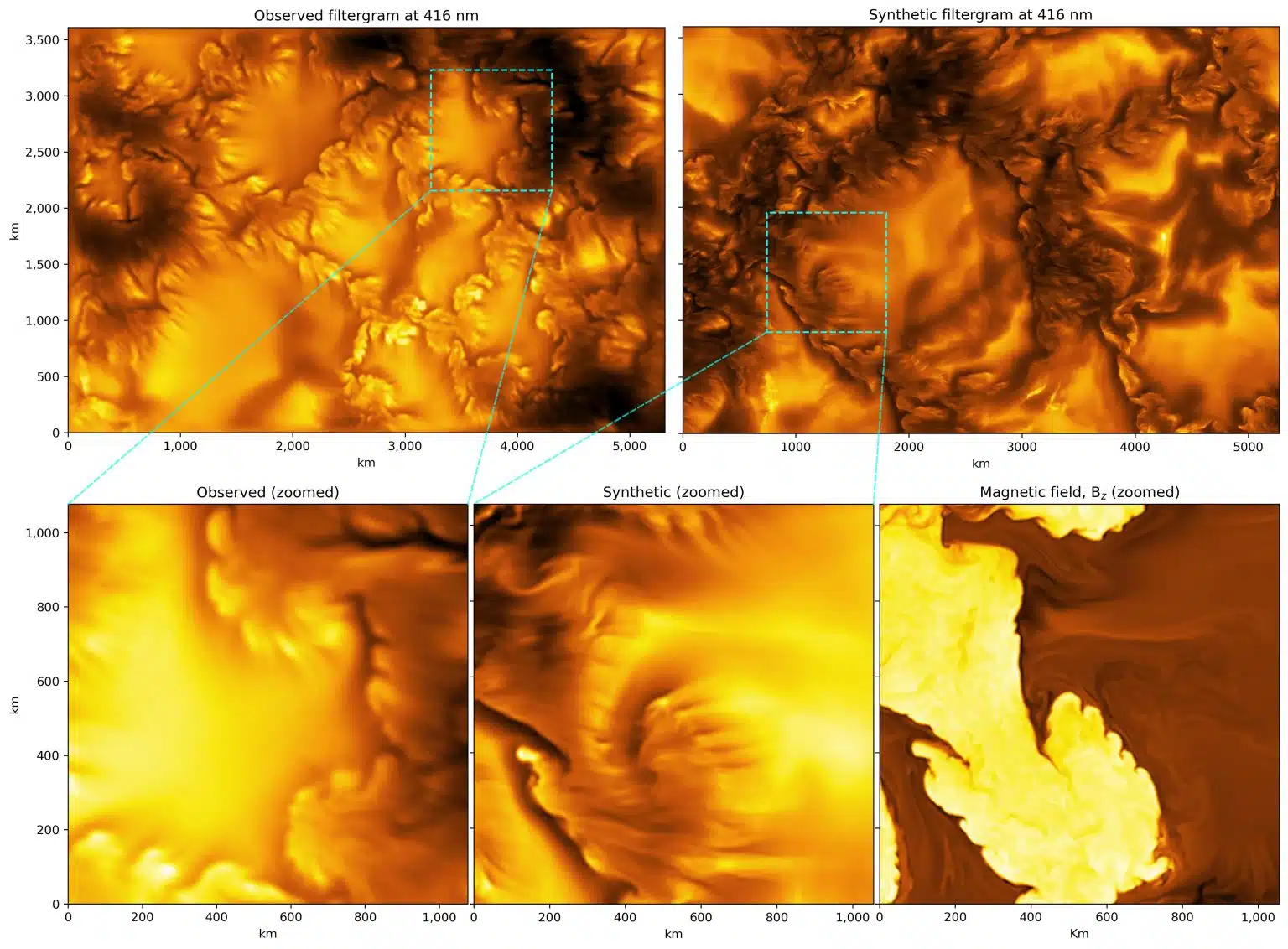
A side-by-side comparison of a real observation from the Inouye Solar Telescope (top left) and a synthetic image generated by state-of-the-art, physics-based computer simulations (top right). The remarkable agreement between the two allows scientists to confirm the origin of the Kelvin–Helmholtz instability, a universal physical phenomenon that occurs when adjacent layers of fluid or gas move at different speeds, creating swirling patterns at their interface. A simulated map of the Sun’s surface magnetic field (bottom right) confirms that these processes physically bend and deform the boundaries of the magnetic elements. Credit: NSF/NSO/AURA/HAO
Solving the Solar Heating Mystery?
According to Thomas Rimmele of the National Solar Observatory (which operates DKIST), the discovery of the KHI events explains a lot. ”Kelvin-Helmholtz instability is likely a mechanism that contributes to the heating of the outer atmosphere,” he said, “and is part of the solution of the longstanding enigma of why stars have a million degrees Kelvin hot corona.”
Not only do the KHI regions provide a constant basis for flux braiding that ultimately provides continual heating of the corona, but it also mixes magnetized and non-magnetized plasma on the Sun. That has the immediate effect of spreading out the magnetic fields throughout the regions. The next steps are to isolate and study the KHI on the solar surface using future observing runs on DKIST. This should give solar physicists a good idea of the amount of energy the KHI-braiding process moves from the surface to the solar atmosphere. It should also provide new insight into the magnetic fields behave in the lower atmospheric regions, as well as ongoing solar effects on the rest of the Solar System, according to Jacqueline Keane of the NSO.
“To understand the dynamic space weather that affects Earth, we have to see the small-scale processes driving it. For decades, seeing these vortices at such tiny scales remained elusive,” she explained. “By pairing a massive four-meter mirror with state-of-the-art optics and instruments, the NSF Inouye Solar Telescope delivers the resolving power needed to reveal these ultrafine details for the first time, enabling discoveries that were once beyond our reach.”
For More Information
NSF Inouye Solar Telescope Enables Major Discovery of a Hidden Solar Process
Ubiquitous Kelvin–Helmholtz Instabilities Driving Plasma Mixing on the Sun

