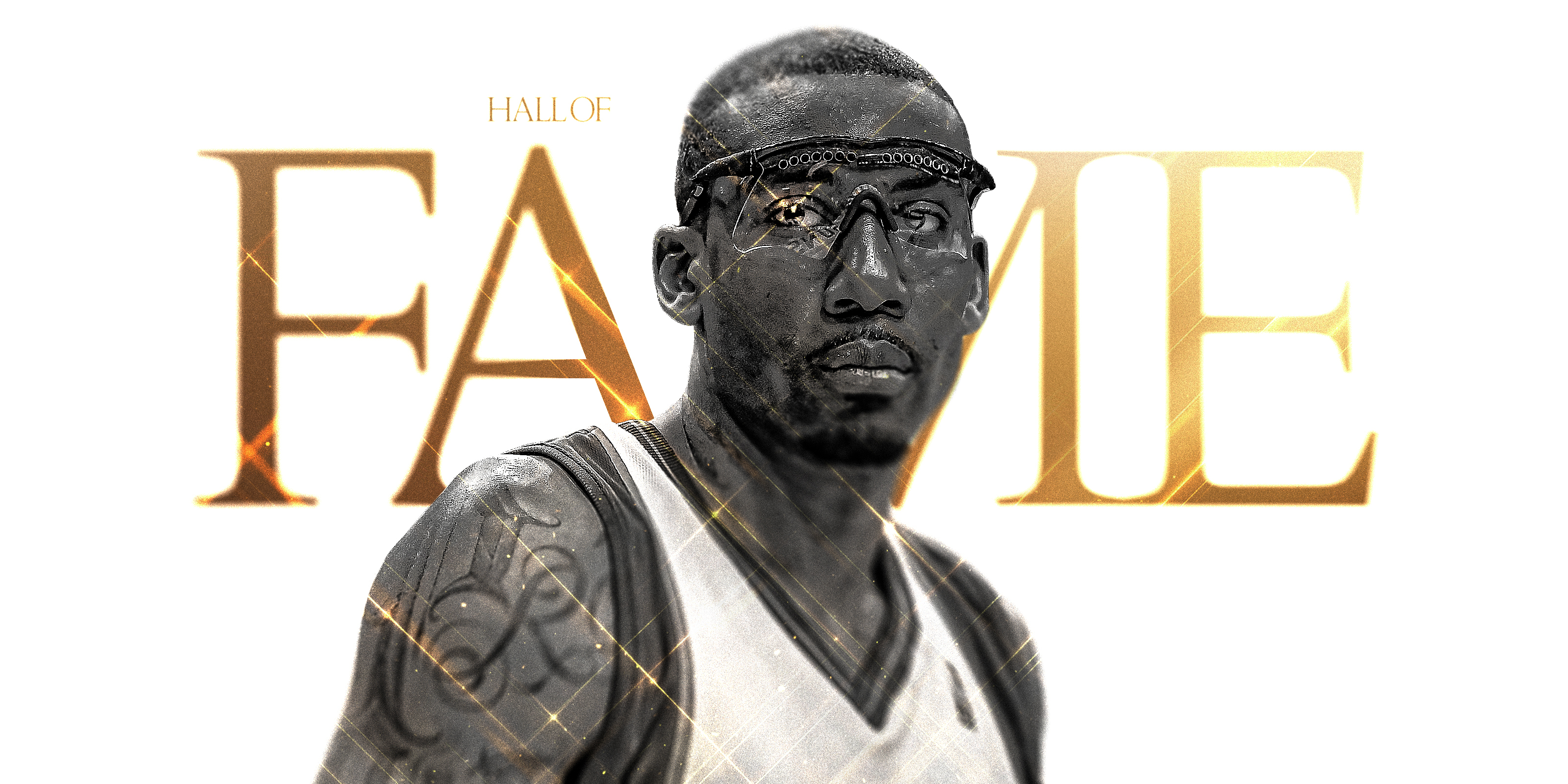
Зургаан удаагийн бүх оддын тоглогч Амаре Стадемайр сагсан бөмбөгийн түүхэн дэх хамгийн хүчирхэг довтлогчдын нэгээр тодорч, Спрингфилд хотноо алдаршуулах танхимд залах ёслолдоо оролцохоор боллоо.
Финикс Санс багийн дасгалжуулагч асан Майк Д’Антони Амаре Стадемайрын тоглолтыг үзэх нь цэвэр таашаал байсан хэмээн дурсав. Стадемайр цагариг дээрээс довтлохдоо бусад тоглогчдоос тэс өөр, гайхалтай хүч чадлыг харуулдаг байсан нь түүнийг 2026 оны Naismith Memorial Basketball Hall of Fame-ийн гишүүнээр сонгогдох үндэслэл болжээ. Тэрээр 6 фут 10 инч өндөр, 245 фунт жинтэй, зургаан удаагийн бүх оддын тоглогч, таван удаагийн All-NBA шигшээ багийн гишүүн байв.
Флорида мужийн Лэйк Уэйлс хотод өссөн Стадемайрын замнал амаргүй байсан ч тэрээр өсвөр насандаа Флорида мужийн шилдэг тоглогчоор нэрлэгдэж, улмаар 2002 оны NBA Draft-д Финикс Санс багт ес дэх сонголтоор орсон юм. Тэрээр NBA-д анх хөл тавьсан жилээ Yao Ming болон Caron Butler нарыг ардаа орхин 2002-03 оны улирлын шилдэг шинэ тоглогчоор тодорсон анхны ахлах сургуулиас шууд драфтлагдсан тоглогч болсон билээ.
Стадемайр Стив Нэштэй хоршин “Seven Seconds or Less” буюу долоон секунд эсвэл түүнээс бага хугацаанд довтолгоог дуусгах Финикс Санс багийн гайхалтай системд гол үүрэг гүйцэтгэсэн юм. Хэдийгээр 2005 онд өвдөгний хүнд гэмтэл авч, мэс засалд орсон ч тэрээр эргэн ирж, дараагийн жилүүдэд өндөр түвшний тоглолтоо хадгалсаар байв. Тэрээр карьерынхаа туршид 15,000 оноо, 6,000 самбараас бөмбөг авалт, 1,000 дамжуулалт, 1,000 хаалт хийсэн NBA-ийн түүхэн дэх 36 тоглогчийн нэг болсон юм.
Нью-Йорк Никс багт тоглож байхдаа тэрээр хотын сагсан бөмбөгийн найдвар хэмээн нэрлэгдэж байсан ч бэртэл гэмтлийн улмаас оргил үе нь дуусгавар болсон. Гэсэн хэдий ч тэрээр 2016 онд NBA-ийн карьераа өндөрлөж, хожим нь Израиль, Хятад болон Big3 лигт тоглосны дараа дасгалжуулагчийн ажилд хүч үзсэн билээ. Стадемайр өөрийн хүсэл мөрөөдөл болсон алдаршуулах танхимд залуу насандаа тавьсан зорилгоо биелүүлж байна.
Дэлгэрэнгүй эх сурвалжийг харах
Эх сурвалжийг нээх ↓
What sprung to mind, for Mike D’Antoni, was laughing. The feeling of watching Amar’e Stoudemire doing what he could do — what seemingly only he could do — and being overcome by an involuntary physical expression of pleasure.
So many times, I would come to the timeout and just giggle,” Stoudemire’s former head coach told reporters this spring. “The rim is still shaking [after] how hard he just dunked the basketball, and guys are like … they’re stunned. I’m looking like, ‘Oh my gosh.'”
“He was incredible,” D’Antoni said.
Stoudemire was incredible: a 6-foot-10, 245-pound elevating-and-detonating marvel, a six-time All-Star and five-time All-NBA selection. His journey began in Lake Wales, Florida, in 1982, and will bring him this weekend to Springfield, Massachusetts, where he’ll be enshrined as a member of the Naismith Memorial Basketball Hall of Fame’s Class of 2026. (As luck would have it, D’Antoni will join him.)
To get from Lake Wales to Springfield … well, that’s something of a miracle.
“This is a small town, but Lincoln Avenue is just like any bad area you’d find in an inner city,” former police officer and Lake Wales High School junior varsity basketball coach Burney Hayes told the New York Times in 2012, after the death of Stoudemire’s older brother, Hazell Jr. “See it, want it, name it, you can have it on Lincoln Avenue. Shoot dice, gambling, drugs, prostitution, all of it. You get caught there, you might never get out.”
Stoudemire grew up in Lake Wales cutting grass with his dad, Hazell Sr., who owned a lawn care company. Hazell Sr. died when Amar’e was just 12 years old after suffering a heart attack. His last words to his son: “The skies are the limit for you.”
Few men that big have ever soared through the sky so breathtakingly, gotten off the floor so easily, punished the rim so violently. The nickname STAT — an acronym for “Standing Tall and Talented” — seemed apt, but also scarcely seemed to cover it. Even the skies couldn’t limit Amar’e.
Nor, for that matter, could the myriad ground-level concerns that Stoudemire faced throughout tumultuous teenage years that saw him enroll in six high schools, as his mother and older brother, among other would-be guardians and authority figures, spent time in jail, bouncing in and out of his life. That tumult limited Stoudemire to just two full seasons of high school ball. But he proved to be an overwhelming force in them, particularly as a senior, when he averaged more than 29 points, 15 rebounds and six blocks per game en route to earning recognition as Florida’s Mr. Basketball and a selection to the McDonald’s All-American Game.
He was the top prospect in the class of 2002, committing to join John Calipari in Memphis. His recruitment became a saga, though, with questions about his eligibility, stemming from claims that his mother, Carrie, had received benefits that would be considered impermissible. In 2001, Carrie told HBO’s “Real Sports” that Nike executive George Raveling had sent her money and gifts.
Stoudemire ultimately decided to enter the 2002 NBA Draft, looking to break into the professional ranks just one year after fellow highly touted high school big men Kwame Brown, Tyson Chandler and Eddy Curry. None of them lived up to the admittedly vaulted billing of previous preps-to-pros sensations Kevin Garnett and Kobe Bryant during their rookie seasons.
All three would go on to spend more than a decade in the NBA, with Chandler — an All-Star, All-NBA selection, three-time All-Defensive teamer, the 2011-12 Defensive Player of the Year and a 2011 NBA champion — enjoying the best career of the bunch. After comparatively quiet and underwhelming rookie seasons, though, the shadow of that 2001 trio led to some skepticism about how Stoudemire might translate to the next level. In his pre-draft workout with the Suns, he reportedly fired up airball after airball.
“We were trying to figure out if it’s nerves, technique — what could it be?” Suns executive Bryan Colangelo told Jonathan Abrams for his 2016 book, “Boys Among Men.” “What it came down to was he had never really been coached or taught or put through the rigors of a true, fundamental exercise on his shot and technique.”
That stuff, the Suns figured, they could teach. The stuff that he came into the gym with, though? That, you couldn’t.
“He may have been raw, but you don’t see many raw guys like that,” then-Suns owner Jerry Colangelo told Mark Heisler of the Los Angeles Times. “He just stood out like a diamond.”
Even diamonds, though, need polishing.
“He couldn’t shoot. Couldn’t play defense,” D’Antoni told Heisler. (In fact, Stoudemire would continue to insist, even deep into his NBA career, that he’d never really been taught to play defense — a claim at which D’Antoni understandably bristled.)
“Other than that,” D’Antoni quipped, “he was pretty good.”
Good enough for the Suns to reportedly hide him away from other interested teams at the top of the draft. Good enough for Phoenix to use the No. 9 pick in that draft on him. (The preceding four selections — Nikoloz Tskitishvili, Dajuan Wagner, Nenê and Chris Wilcox — just barely combined to score more points than Stoudemire in their NBA careers.)
Good enough to walk into the NBA and average 13.5 points and 8.8 rebounds in 31.3 minutes per game as a 19-year-old who’d only started playing organized ball five years earlier. And good enough to beat out No. 1 pick Yao Ming and former UConn standout Caron Butler to win 2002-03 Rookie of the Year — making him the first high school draftee voted the league’s best first-year player.
“Once he learns the game, it’s over with,” teammate Stephon Marbury said after a late December loss to the Timberwolves that saw the rookie Stoudemire hang 38 and 14 on a defense led by Garnett. “He’s right now by far the best player I’ve ever seen come out of high school. It’s amazing how strong and dominant he is.”
Stoudemire’s sheer physicality and explosive athleticism immediately translated, leading to all manner of emphatic and remarkable finishes. What he didn’t know yet didn’t matter as much as the innate gifts that few others possessed; no less an evaluator of interior dominance than Shaquille O’Neal said at the 2003 All-Star Game, “I have seen the future of the NBA, and his name is Amar’e Stoudemire.”
But while Stoudemire’s individual ascent continued, averaging more than 20 points and nine rebounds per game as a sophomore, a Suns team that made the playoffs in his first year fell to just 29 wins in his second. Head coach Frank Johnson was fired 21 games into Year 2, replaced by elevated assistant D’Antoni, who promptly set about instituting a new fast-paced offensive system.
Marbury was traded to his hometown Knicks in a deal that shaved some $29 million off Phoenix’s books, allowing the Suns to offer a six-year, $65 million contract to Mavericks point guard Steve Nash. Dallas, concerned about how the about-to-be-30-year-old Nash’s ailing back would age over the course of the deal, declined to match it.
Their partnership was the heartbeat of what would become one of the most explosive, efficient and transformational offenses in NBA history. The “Seven Seconds or Less” attack was predicated on hunting opportunities for early offense — shots that came before the shot clock reached 16. It required high-level, quick-trigger shooters on the wing, ready and willing to bomb away when the ball got to them on the perimeter.
What it demanded, though, was a big man — Stoudemire, shifted from power forward to center with do-it-all-should-be-Hall of Famer Shawn Marion sliding from small forward up to playing the small-ball 4 — who moved off the block and up to the top of the floor, where he would set screens for the ball-handler, dive hard to the rim and force the defense to make a decision. (Amar’e, whose high school testing reportedly revealed him to possess “an extremely high I.Q.,” was brilliant at finding just the right angles to both free up Nash and put himself in perfect position to attack.)
If help defenders stuck with their men on the perimeter, Nash could play cat-and-mouse with the retreating big man, either creating his own shot — a high-value proposition for a multiple-time 50-40-90 club member — or threading a pocket pass for the rolling and incredibly soft-handed Amar’e to hammer it home. If they sunk into the paint to take away Stoudemire’s roll, Nash would just fire the ball out to a waiting shooter for an open 3. That’s the thing about picking your poison: No matter what, you wind up dead.
“Steve and Amar’e, that pick-and-roll duo, is probably one of the best,” D’Antoni recently told reporters. “You’ve got [John] Stockton and [Karl] Malone. You have different ones through the ages. But nobody could catch a ball better than Amar’e rolling to the basket. He was like a vacuum cleaner, and no one could throw it better than Steve.”
Stoudemire averaged 26 points per game on 55.9% shooting in that first season with Nash, earning the first All-Star and All-NBA selections of his career as the Suns roared to a league-best 62 wins and the NBA’s No. 1 offense. While they’d fall in the Western Conference finals, Stoudemire shined in defeat, averaging 37 points per game against Tim Duncan’s eventual champion Spurs; the future that Shaq had prophesied, it seemed, was upon us.
The future rarely arrives just as you’d envisioned it, though, and never quite as neatly. Just eight days after signing a $73 million contract extension, Stoudemire underwent microfracture surgery on his left knee — a devastating blow and a procedure that had waylaid a number of stars before him. He’d return in late March, but after three games where nothing felt right, he’d miss the rest of the season and Phoenix’s playoff run.
Stoudemire’s absence, combined with trades to move starting swingmen Joe Johnson and Quentin Richardson, meant the 2005-06 Suns would look very different from their predecessor — a journey that Sports Illustrated legend Jack McCallum chronicled in his 2006 book, “Seven Seconds or Less: My Season on the Bench with the Runnin’ and Gunnin’ Phoenix Suns.” They still won 54 games with the NBA’s No. 1 offense, but fell once again in the conference finals — this time to Nash’s old mates in Dallas, with Dirk Nowitzki scoring 50 points in the pivotal Game 5.
When he came back from microfracture surgery, the dreaded procedure that had stripped the athleticism away from a slew of young stars in the 1990s, the still-just-24-year-old Stoudemire didn’t merely survive. He thrived, playing 79 or more games in three of the next four seasons and averaging 22.6 points and nine rebounds per game on 56.8% shooting in that span.
Post-microfracture Amar’e didn’t have quite the same bounce he did prior the procedure, but he added wrinkles and nuance to his offensive repertoire, evolving into a more complete player. Over the years, he’d develop his face-up game and midrange jumper; he’d build out a back-to-the-basket repertoire, becoming one of the many big men to make the pilgrimage to Houston to learn the low-post arts at the pivot feet of the master, Hakeem Olajuwon.
“Man … the last man standing. A lot of guys didn’t come back from it,” Stoudemire told Ethan Skolnick of the Miami Herald back in 2016, referencing former superstars like Chris Webber, Jamal Mashburn, Penny Hardaway and Tracy McGrady. “Guys never fully recovered from microfracture. I persevered.”
Even as Stoudemire returned to perennial All-Star and All-NBA territory, though, the Suns could never break through. A 61-win Phoenix side fell again to the Spurs in 2007, a.k.a. the Robert Horry Hip Check Series, which saw Stoudemire and Boris Diaw suspended for Game 5 after leaving the bench following Horry’s attack on Nash.
The following season saw then-Suns general manager Steve Kerr make a fundamental stylistic pivot, trading Marion to the Miami Heat for a 35-year-old Shaq in an effort to add more size and defensive heft to a team that had long been light on both. The move didn’t pan out, as the Suns — again — fell to the Spurs. D’Antoni left, with creative differences leading him to opt for a new challenge in New York. An ill-fitting slow-down stint with Terry Porter didn’t go well, as the Suns missed the playoffs for the first time in five years; a return to pace-pushing under Alvin Gentry led to a return to form in a 54-win 2009-10 campaign and an exorcism of a second-round sweep of the hated Spurs, but once again fell short of a bid for a championship, with the Kobe-Pau Lakers knocking Phoenix off in the conference finals en route to a title.
As the years wore on, trade talks increased. One widely reported deal would’ve landed Amar’e in Golden State in 2009, with an exciting young rookie named Stephen Curry headlining the package heading back to Phoenix. Stoudemire was also a reported target of the Cleveland Cavaliers in 2009, as they hoped to build a champion around LeBron James, and of the Miami Heat as they tried to put All-Star talent around Dwyane Wade.
None of those deals came to fruition, leading to Stoudemire hitting unrestricted free agency in the vaunted summer of 2010, when the New York Knicks — flush with cash after years spent clearing the books in an attempt to woo premier free-agent talent — signed him to a five-year deal worth nearly $100 million and hoped to pair him with James or Wade. They would, of course, wind up teaming together in Miami, joining Chris Bosh as the core of a revamped Heat team that would make four straight NBA Finals appearances and win two NBA championships.
Stoudemire, for his part, would begin the task of trying to bring the Knicks back to respectability mostly alone. And you know what? For a second there, he was actually doing it.
Before Carmelo Anthony’s homecoming, before the rush of Linsanity, before the brief fantastic flirtation with unicorns, before Tom Thibodeau turned “ICE” into fire and Julius Randle announced “we here,” and more than a decade before Jalen Brunson finished the job in San Antonio, it was Stoudemire who stepped forth as “the man saving New York basketball, once and for all.”
The Suns belonged to Nash, and Stoudemire wanted the burden of leadership, the New York spotlight … and the nine-figure payday that Phoenix, among other teams, were reluctant to give him due to the troublesome state of his surgically repaired left knee, which was deemed uninsurable. The Knicks, destitute since the dawn of the century under James Dolan’s leadership, were willing to guarantee that creaky hinge, in the hopes that Stoudemire would remain upright long enough for his talent to deliver the franchise from its prolonged desperation.
Stoudemire slotted right back into the No. 1 scoring role for D’Antoni, pairing with point guard Raymond Felton in the pick-and-roll, averaging 26.1 points, 8.6 rebounds and 2.7 assists per game in his first 53 games in New York — a brilliant start that elevated a scrappy young Knicks team featuring the likes of Danilo Gallinari, Wilson Chandler, Toney Douglas, Landry Fields and Timofey Mozgov to a 28-26 record at the All-Star break. And the city loved him.
“He’s like Ewing in the ’90s,” Knicks legend Walt “Clyde” Frazier told Lee Jenkins of Sports Illustrated for a 2011 feature. “He’s a rock star, and he hasn’t even won anything yet.”
As it turned out, he wouldn’t. On the other side of the All-Star break, New York traded most of those scrappy young pieces to the Denver Nuggets for Anthony, in the belief that pairing two superstar scorers would give the Knicks the firepower they needed to stand toe-to-toe with the likes of the Bulls, Celtics and Heat. But the tandem never really clicked. New York would finish the 2010-11 season at 42-40, in sixth place in the East, earning a first-round matchup with the Celtics; Stoudemire was brilliant in a Game 1 loss, hurt himself before Game 2, and was a shell of himself the rest of the way, as the Knicks suffered a sweep.
Stoudemire never returned to the level that made him the toast of the town in that first season in New York. Knee and back injuries cost him significant time over the next three seasons; his minutes and production dwindled, as did his primacy in an organization increasingly built around Anthony.
He was largely a bystander as the Knicks found their most significant success in a decade, playing just over 700 total minutes in the 54-win 2012-13 season. Despite his best efforts to get healthy and remake his game to fit in, his most notable moment over the rest of his Knicks tenure was likely the regrettable incident in which he mangled his hand punching a fire extinguisher case in frustration during New York’s 2012 first-round playoff series against the LeBron/Wade/Bosh Heat. After the Knicks sunk back below .500 under Mike Woodson, and with the team cratering at the start of the disastrous Derek Fisher era, they bought out the remainder of Stoudemire’s contract; he’d spend the next two years in reserve roles in Dallas and Miami as he neared the end of the line.
After retiring from the NBA as a member of the Knicks in 2016, Stoudemire continued his playing career in Israel, China and in the Big3 before finally hanging up his high-tops in 2020. He briefly joined the coaching ranks alongside longtime pick-and-roll partner Nash during his tenure in Brooklyn. He continued to explore the worlds of art, wine (including bathing in it), fashion, acting, religion and writing, both children’s books and cookbooks — expressions of both the vast array of interests and his energetic pursuit of them that made him someone who was always more than merely a human highlight reel.
Stoudemire would go on to finish as the highest-scoring member of the 2002 draft class, with more total win shares than any other player selected. He’d also finish second in rebounds and total value over replacement player (VORP), behind only Carlos Boozer. He is one of 117 players in NBA history to make at least a half-dozen All-Star teams, one of 84 players ever to make at least five All-NBA teams, and one of just 36 players to score at least 15,000 points, grab 6,000 rebounds, dish 1,000 assists and block 1,000 shots in his career.
Twenty-one of those 36 players are already enshrined in Springfield. Several others who are still active (James, Kevin Durant, Giannis Antetokounmpo, Anthony Davis) will join them as soon as they’re eligible.
You don’t reach that kind of company, and establish yourself as one of the great big men of a decade littered with them, without incredible God-given ability and the ability to persevere through hardship. Stoudemire’s final few years in the NBA didn’t shine as brilliantly as his first few; even so, he wound up taking his rightful place among the game’s all-time brightest stars.
“I’m actually very proud of my career,” Stoudemire told Andscape’s Marc J. Spears in 2016. “In my career, I’ve had some ups and downs. But I’m thankful that what I put into this game helped me achieve what I was able to accomplish. Hopefully, that gives me a bid into the Hall of Fame. That was my goal as a teenager, was to become a Hall of Famer.”
He achieved it. From Lake Wales all the way to Springfield, Amar’e Stoudemire has lived a dream that not even the skies could limit. When the story’s that incredible, sometimes all you can do is laugh.

