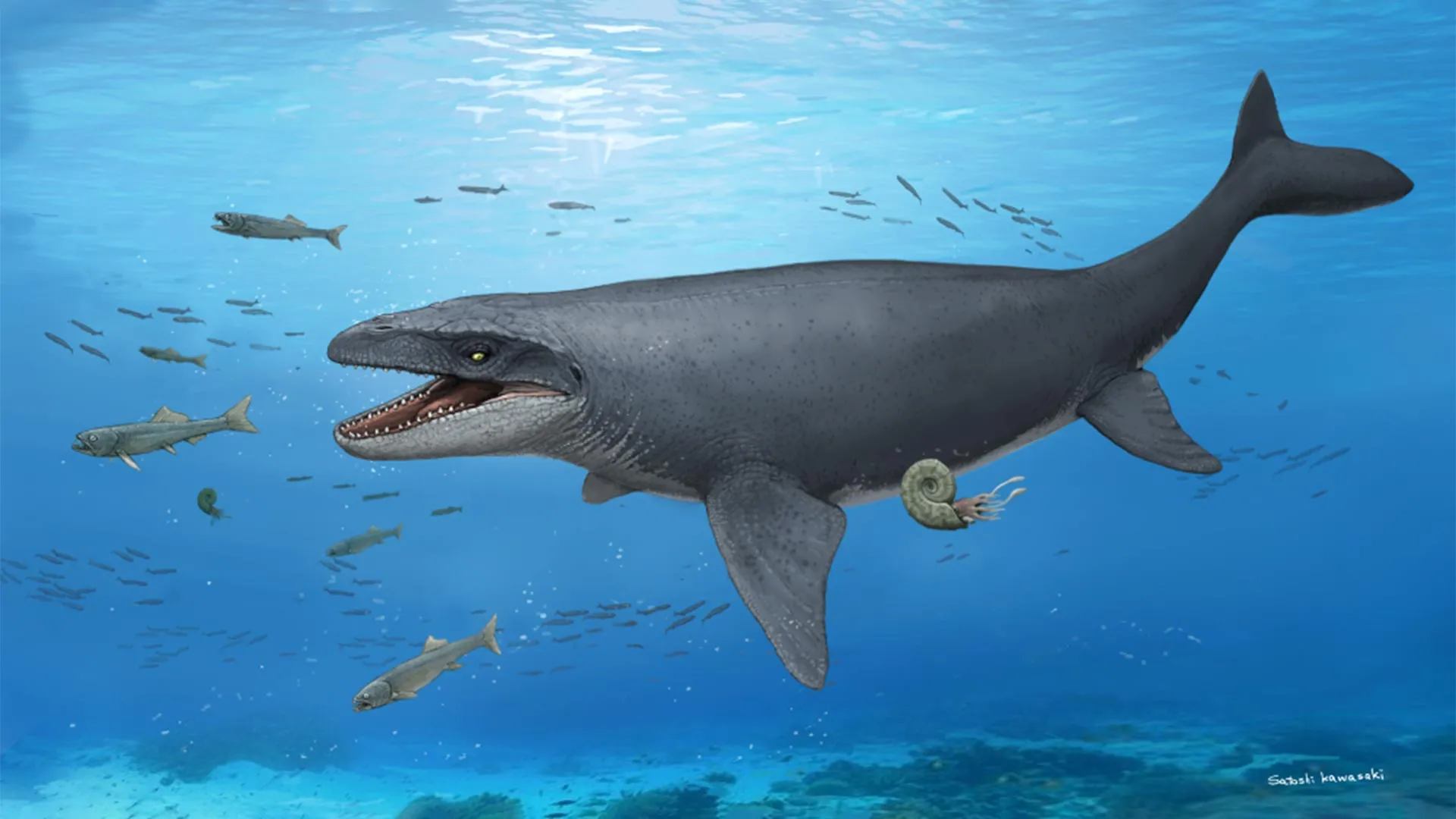
Осака мужийн музейн архивт хадгалагдаж байсан эртний далайн хэвлээр явагчийн чулуужсан олдвороос шинжлэх ухаанд өмнө нь бүртгэгдээгүй байж болзошгүй яснууд олдлоо.
Окаямагийн Шинжлэх ухааны их сургууль болон бусад байгууллагын судлаачид 1990-1992 оны хооронд Осака мужийн Каизука хотоос олдсон мозаврын үлдэгдлийг дахин шинжилжээ. Тухайн үед бүрэн гүйцэд цэвэрлээгүй байсан чулуулгийн хэсгүүдээс судлаачид гучин жилийн дараа дөрвөн ширхэг яс олсон байна. Эдгээр олдворын дотор мозаврын дээд эрүүний урд талын яс буюу “premaxilla” багтаж байгаа бөгөөд энэ нь Японд олдсон мозаврын чулуужсан яс дундаас анх удаа батлагдсан тохиолдол юм.
Судлаачид тархины хайрцагны ойролцоох “basisphenoid” ясыг мөн нарийвчлан судалжээ. Тус яс нь эвэр мэт цухуйсан бүтэцтэй, доод талдаа ховилгүй зэрэг өмнө нь мэдэгдэж байсан мозавруудад ажиглагддаггүй өвөрмөц шинжүүдийг агуулж байна. Энэхүү анатомийн ялгаа нь уг олдвор шинжлэх ухаанд шинэ зүйлд хамаарах магадлалтайг харуулж байна.
Олон улсын хэмжээнд мозаврын анатомийн мэдээлэл болон харьцуулсан олдворуудын сан сүүлийн хэдэн арван жилд баяжсан нь энэхүү нээлтийг хийхэд чухал үүрэг гүйцэтгэжээ. Анх олдсон үедээ хангалттай харьцуулах материалгүй байсан тул эдгээр ясны ач холбогдлыг тодорхойлох боломжгүй байв.
Энэхүү судалгааны үр дүнг 2026 оны зургаадугаар сарын 27-нд Осакагийн Метрополитан их сургуульд болсон Японы Палеонтологийн нийгэмлэгийн 177 дахь удаагийн ээлжит хурлаар танилцуулжээ. Олдворын шинж чанарыг бүрэн тодорхойлж, шинэ зүйл мөн эсэхийг тогтоохын тулд цаашид нэмэлт судалгаа шаардлагатай гэж судлаачид үзэж байна.
Дэлгэрэнгүйг эх сурвалжаас харах
↓Эх сурвалжийг нээх ↓
Researchers from Okayama University of Science, Tokyo City University, the Natural History Museum, Kishiwada City (Osaka Prefecture), and other institutions have uncovered four fossil bones that went unrecognized for roughly three decades. The bones were found inside rock containing mosasaur remains collected in Kishiwada City, Osaka Prefecture.
One of the newly identified fossils is the premaxilla, the bone at the very front of the upper jaw. This marks the first time a premaxilla has been confirmed in a mosasaur fossil discovered in Japan. Other unusual anatomical features in the remains do not match those seen in previously described mosasaurs, suggesting the animal could represent a species that is new to science.
Ancient Marine Reptile Fossils Reexamined
Mosasaurs were large marine reptiles that inhabited oceans around the world during the Late Cretaceous, approximately 98 to 66 million years ago.
The fossils in this study were first discovered between 1990 and 1992 in Sobura, Kaizuka City, Osaka Prefecture. They were later preserved at the Natural History Museum, Kishiwada City. When researchers recently returned to pieces of rock that had not yet been fully prepared, they found four fossil bones still embedded in the surrounding material.
Among those discoveries, the premaxilla stands out as one of the most important. It is the first confirmed example of this part of the skull in a Japanese mosasaur specimen.
When the fossils were originally found, scientists had far fewer mosasaur specimens available for comparison, making it difficult to determine exactly what kind of mosasaur the bones represented. In the decades since, researchers around the world have accumulated much more anatomical information and a larger collection of comparative fossils. Those advances allowed the team to identify the bone as a premaxilla.
Unusual Skull Features Raise New Species Possibility
Researchers also examined the basisphenoid, a bone positioned near the braincase, and found several distinctive characteristics.
The bone has short projections extending outward that resemble horns, and it lacks a ventral median groove. These features differ from those documented in previously known mosasaurs. The unusual combination of traits raises the possibility that the fossil belongs to a species that has not yet been described.
The findings demonstrate how valuable it can be to revisit unprepared specimens stored in museums and research collections. Fossils that have been kept for decades may still contain important bones or other evidence that was not recognized when they were first collected.
The discovery may also help scientists build a clearer picture of marine ecosystems in the northwestern Pacific during the Cretaceous Period. Additional research will be needed to determine whether the specimen truly represents a new mosasaur species.
Findings Presented in Japan
The results were presented at the 177th Annual Meeting of the Palaeontological Society of Japan, held at Osaka Metropolitan University on June 27, 2026.
The research team included:
- Yasuaki Takano, Master’s student, Graduate School of Okayama University of Science
- Associate Professor Shoji Hayashi, Department of Dinosaur Paleontology, Okayama University of Science
- Professor Yasuhisa Nakajima, Tokyo City University
- Satoshi Utsunomiya, Panasonic Electric Works Co., Ltd.
- Yuma Asai, Master’s Program, University of Tsukuba
- Curator Miho Kazama, Natural History Museum, Kishiwada City
- Advisor Katsunori Watanabe, Natural History Museum, Kishiwada City


