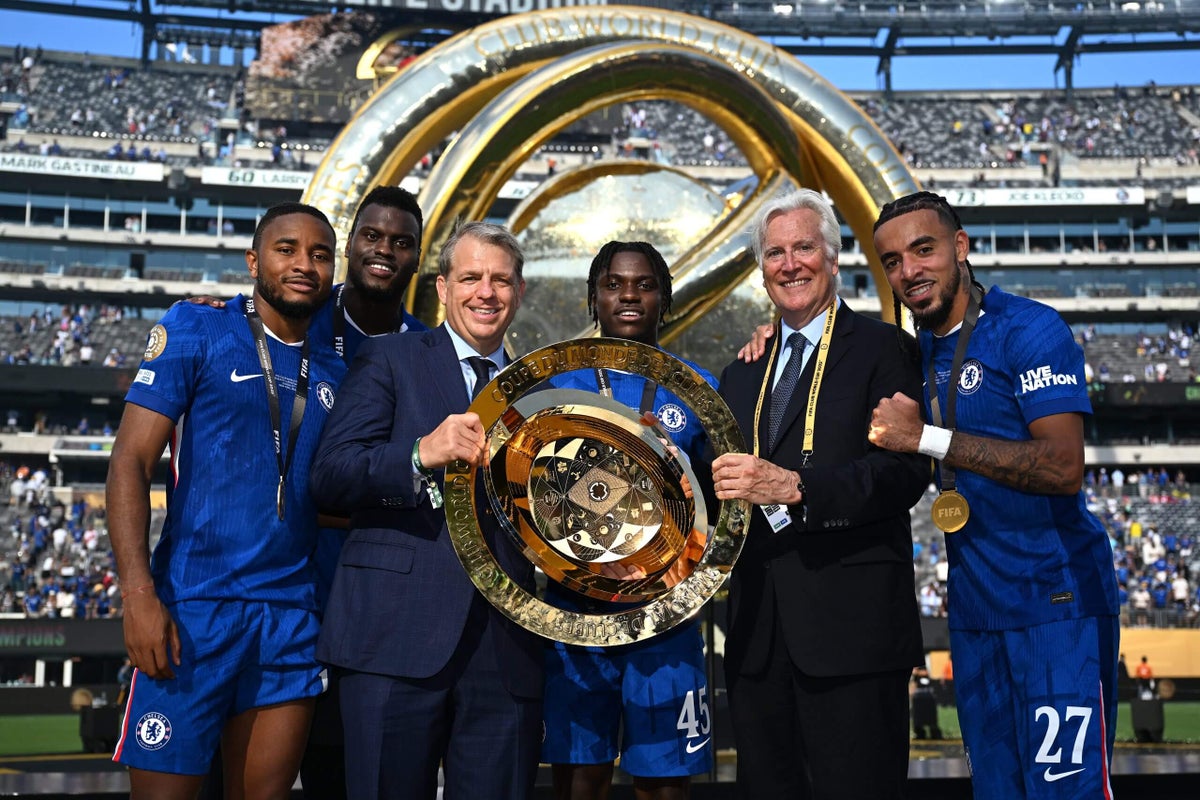
Тодд Боэли болон Марк Уолтер нар өөрсдийн эзэмшлийн хувьцааг тус клубийн олонхын хувьцаа эзэмшигч Клирлэйк Капитал руу шилжүүлэх яриа хэлэлцээг өрнүүлж байна.
Челсиг эзэмшигчдийн бүлгийн дотоод зөрчил болон АНУ-д Марк Уолтерийн бизнестэй холбоотой явагдаж буй шалгалтын улмаас ийм алхам хийхээр болжээ. Одоогоор талууд тодорхой тохиролцоонд хүрээгүй байгаа бөгөөд энэхүү үйл явц нь клубийн засаглалын тогтвортой байдалд нөлөөлөхүйц шийдвэр болох төлөвтэй байна.

Марк Уолтерийн хувьд АНУ-ын Хууль зүйн яамны мөрдөн шалгах ажиллагааны улмаас санхүүгийн эх үүсвэрээ нэмэгдүүлэх шаардлагатай байгаа тул Лос Анжелес Лэйкерс баг дахь хувьцаагаа худалдсаны дараа Челси дэх 12.7 хувийн эзэмшлээ ч мөн адил зарах сонирхолтой байна. Тодд Боэлигийн хувьд 2022 онд Роман Абрамовичийн үе дууссаны дараа клубийг худалдан авсан консорциумын тэргүүн байсан ч сүүлийн жилүүдэд клубийн үйл ажиллагаанд шууд хяналт тавиагүй юм.

Клубийн стратегийн бүхий л гол шийдвэрийг олонхын хувьцаа эзэмшигч Клирлэйк Капитал гаргадаг бөгөөд Тодд Боэлигийн тэргүүлэгчийн хугацаа ирэх онд дуусгавар болох юм. Энэхүү өөрчлөлт нь Челсигийн өдөр тутмын үйл ажиллагаанд томоохон нөлөө үзүүлэхгүй бөгөөд спортын албаны үйл ажиллагааг спортын захирлуудын баг хариуцсан хэвээр байна.
Дэлгэрэнгүйг эх сурвалжаас харах
↓Эх сурвалжийг нээх ↓
The tumultuous BlueCo era at Chelsea has delivered another momentous twist with the news that Todd Boehly and Mark Walter are in talks to sell their shares in the club to majority owner Clearlake Capital.
No agreement is believed to be imminent, but the sale would provide a form of resolution to long-standing tensions within Chelsea’s ownership group while also potentially easing the regulatory pressure that Walter is facing in the United States.
Here is a look at the key questions surrounding this situation and what it all means for Chelsea, as well as the implications for Walter and Boehly’s flagship sports investment, the Los Angeles Dodgers.
Why is this happening now?
None of the principal parties are commenting, but it is very difficult to view this development as unrelated to Walter’s unexpected sale of the Los Angeles Lakers to Josh Kushner and Bob Iger in a deal that valued the NBA franchise at $12.5billion (£9.2bn) last week.
That news — just 14 months after Walter had bought a controlling interest in the Lakers from the Buss family at a then-record $10billion valuation — broke against the backdrop of an investigation by the U.S. Department of Justice into the 66-year-old billionaire’s business dealings.
Bloomberg reported last week that Walter’s sudden sale of the Lakers was sparked by the need to raise cash to pay down loans on the books of his insurance firms at the centre of the federal probe. How much more could be raised by offloading his assumed 12.7 per cent stake in Chelsea?
Boehly was one of Walter’s partners in his brief Lakers venture, as well as in their hugely successful ownership of the Los Angeles Dodgers. From Boehly’s perspective, this could simply present a good opportunity to exit from Chelsea, an investment that has not panned out as he envisaged when he publicly fronted the BlueCo consortium which purchased the club from a sanctioned Roman Abramovich in June 2022.
Todd Boehly, left, with Chelsea’s sporting director Paul Winstanley and Clearlake co-founder Behdad Eghbali in 2025 (Robin Jones/Getty Images)
Despite maintaining a public profile with appearances at Stamford Bridge and on stage at various business conferences, Boehly has not enjoyed functional operational control over Chelsea since 2022, with majority shareholder Clearlake Capital directing the club’s strategy and the firm’s co-founder Behdad Eghbali actively involved in all major decisions.
Boehly’s four-year stint as chairman is also set to conclude next year with Clearlake empowered to pick his successor, potentially making it a natural endpoint for his presence at the club.
Liam Twomey
Who is Mark Walter and what is being investigated?
For a man who built a portfolio of some of the world’s most famous sports teams, Mark Walter has spent most of his 66 years on this planet flying well under the radar.
But then he sold one of those teams, the Los Angeles Lakers, in a stunning deal that took 48 hours to agree, without any of the usual armies of banks and brokers involved, and his name has not stopped popping up on screens since.
Walter at a Lakers game this year (Allen Berezovsky/Getty Images)
An Iowa native, Walter got degrees in business and law before starting a career in a relatively sleepy part of the financial services industry in Chicago in the 1990s.
His big break, although nobody noticed at the time, came in 1999, when he met a member of the uber-wealthy Guggenheim clan and co-founded Guggenheim Partners, a global investment and financial advisory firm based in New York.
There, he was among the first to spot the huge, steady but unsexy amounts of money being kicked out every month by America’s massive insurance market, particularly after the 2008 financial crash, when the valuations of state-based insurance firms plummeted.
Walter and his Guggenheim protege Todd Boehly also realised that you could borrow large sums of money, secured against the dependable flow of policyholder premiums, and then invest that cash in cooler, sexier assets, such as media companies, real estate and sports teams.
The first sports team came in 2012, when, in trademark fashion, he took advantage of then-owner Frank McCourt’s financial difficulties to buy baseball’s Los Angeles Dodgers for $2.15billion. And in another move that he later repeated, he did this as the lead investor in a large syndicate of big names, including Boehly, Earvin “Magic” Johnson and tennis star Billie Jean King.

Stan Kasten, Mark Walter, Magic Johnson, Peter Guber, and Todd Boehly at the Dodger Stadium in 2012 (Chris Williams/Icon SMI/Corbis/Icon Sportswire via Getty Images)
Two years later, Walter led another all-star syndicate in a failed bid for the NBA’s Los Angeles Clippers, losing out to Microsoft boss Steve Ballmer.
But he was not to be kept out of basketball for long, as he led a group that bought the WNBA’s Los Angeles Sparks later in 2014and then, in 2021, he bought just over a quarter of the Lakers.
A year later, he teamed up with his buddy Boehly to buy into Chelsea, another distressed asset, and in 2025, he bought majority control of the Lakers in a deal that valued the team at $10billion.
At this point, the quiet man from America’s Midwest owned stakes in three of the most famous teams in the world’s biggest leagues, plus the Sparks and North America’s professional women’s ice hockey league, the PWHL. And he had barely given a single media interview in his 40-year career.
He still hasn’t but everyone wants to talk to him now because the whispers about his complex web of insurance companies, secured loans and high-profile investments, which have always been there for those who were listening closely, have become blaring sirens.
Bloomberg and the Financial Times reported that last year the Federal Bureau of Investigation seized Walter’s phone and laptop as part of a probe into his empire. A spokesperson for the FBI declined to comment.
In February, two of his insurance firms received subpoenas from the U.S. Attorney’s Office for the Southern District of New York, which specialises in white-collar crime. The firms had to confirm this news in regulatory filings in March, when they also revealed they were under a parallel investigation by the Securities and Exchange Commission.
The issue Walter faces, and has already acknowledged by his actions, is that the money that regular folk pay to insurance companies is meant to be safe, which is why the sector is more highly regulated than others. There have been too many examples in the past of disreputable types just stealing people’s premiums.
So, insurance firms are not meant to put too much of their money in any single pot — they must diversify their own risks. Likewise, they must declare if any of their investments are with affiliated companies, as that would increase the risk of a problem elsewhere in the wider group impacting the insurance firm.

Walter with President Trump at the White House after the Dodgers won the 2024 World Series (Kevin Dietsch/Getty Images)
Delaware Life, one of Walter’s companies, has already been forced to reclassify nearly $17billion of its investments as they were clearly with “affiliated” businesses in his empire, most notably a $4.1billion loan to the Dodgers’ ticketing subsidiary.
All in all, it is estimated that Walter has needed to reclassify about $20billion worth of affiliated deals, mostly loans he has secured through his insurance businesses to invest in his sports properties.
The various investigations are looking into whether he did this illegally.
In the meantime, whether he acted illegally or not, he is in a race to refinance those loans and maintain the credit ratings of his companies. As there are not many buyers for loans under investigation, he has only one real option. He needs cash and fast.
So, he has already sold the Lakers and his 12.7 per cent stake in Chelsea will be next. The big question is whether that will be enough. Nobody that The Athletic has spoken to in American sports finance circles believes it will be, so, at the very least, a stake in the Dodgers is almost certainly available, too.
Walter did not respond to messages from The Athletic seeking comment for their reporting around the story, and federal officials at the agencies conducting the probe declined to comment.
Matt Slater
Who owns what at Chelsea?
Chelsea went from a one-man kitchen to a many-cheffed banquet in early 2022, when the Russian oligarch Abramovich was jettisoned and a merry band of private equity folk took up the reins.
The £2.5billion takeover which completed in May of that year granted a majority shareholding to Eghbali and Jose E Feliciano’s Clearlake Capital which, today, owns 61.85 per cent of the shares in 22 Holdco Limited, the UK-based holding company which oversees both Chelsea and Ligue 1 side Strasbourg.
The remaining 38.15 per cent is held by Blueco 22 Holdings LP, a UK-registered limited partnership. Six partners make up that partnership: CFCB, LLC, controlled by Boehly; SME FC Holdings, LLC, controlled by Walter; Hansjorg Wyss as an individual, and two further entities affiliated with him; and Greenelite CFC, LLC, a Delaware-registered business whose controlling owner is unknown.
That 38.15 per cent is not split evenly, with only Boehly and Walter, along with Eghbali and Feliciano on the Clearlake side, listed as having a ‘significant interest’ in Chelsea under Premier League rules. It means each of Boehly and Walter beneficially own at least 10 per cent of the club, while Wyss and whomever heads Greenelite split the rest.
On the assumption Boehly and Walter own a third each of Blueco 22 Holdings LP, each would own a 12.7 per cent beneficial stake in Chelsea. In other words, a little over a quarter of the club might be about to change hands.
Chris Weatherspoon
How much might Walter and Boehly’s shares be worth?
Beauty is in the eye of the beholder and never more so than at Chelsea, where that £2.5billion purchase of four years ago has been followed up with enormous spending, most of it on players.
In total, as previously reported by The Athletic, funding of the BlueCo project hit £4.2billion by the end of June 2025, and more has gone in since. That June 2025 figure was split £2.9bn in equity and £1.3bn in external borrowings, including a payment-in-kind loan which is accumulating interest at heady rates.
Reporting from The Telegraph on Monday evening stated Boehly and Walter were searching for a stake sale that would value Chelsea overall at north of £5billion, a sum which seems fanciful given how things have regressed on the field in recent years and the massive costs that have been incurred in the process. Several industry valuers have recently pegged Chelsea’s worth at a little over £3bn, or not much more than the to-date equity commitment of the current owners.
There’s naturally an incentive on behalf of the sellers to pump up the price, but so, perversely, might Clearlake be reluctant to snaffle up more shares at too low a cost. Doing so would signal to the market that Chelsea aren’t worth anywhere near what the current owners hoped they would be, even just over four years into their premiership. Clearlake have no immediate desire to sell but there is a need for Chelsea’s value to appreciate sooner rather than later.

Chelsea fans protesting against the owners before a Premier League match against Southampton last year (Justin Setterfield/Getty Images)
What is clear is that today Chelsea are worth nowhere close to what Clearlake and other prospective buyers were told they soon might be when the club was up for sale back in spring 2022. Then, Joe Ravitch, co-founder of Raine Group, the merchant bank tasked with selling the club, said: “My guess is that Chelsea and all of the top Premier League clubs will probably be worth in excess of $10billion (£7.7bn then, £7.4bn today) in five years.”
Short of oil spurting out of the Stamford Bridge centre circle inside the next 12 months, that guess will be falling some distance south of accurate.
Chris Weatherspoon
What’s the relationship been like between Clearlake and Boehly and Walter?
The Athletic went into great detail two years ago on how both sides (Boehly and Clearlake) were looking to buy each other out as disagreements over how to run Chelsea increased tensions behind the scenes.
This just feels like an inevitable conclusion as Clearlake have always maintained they were not going to cash in and they are the majority shareholder.
Walter has always been more of an investor than someone heavily involved, albeit his connection is with Boehly due to their time together with the LfA Dodgers and investment firm Guggenheim Partners.
Another member of the board representing the Clearlake side is Feliciano, but he is rarely seen at Chelsea now and he has headed the investor group which has just bought MLB side San Diego Padres.

Jose E Feliciano watching the San Diego Padres earlier this year (Meg McLaughlin / The San Diego Union-Tribune via Getty Images)
It has been made clear that the relationship between Clearlake and Boehly has remained a professional one despite any difference of opinion. However, when Boehly and Eghbali attend matches at Stamford Bridge, it is noticed by observers how they do not watch them together and stay in their own boxes in the West Stand.
Simon Johnson
Hasn’t Walter just sold the LA Lakers? What does this mean for the LA Dodgers?
The news that the Lakers were being sold shocked several within the Los Angeles Dodgers organization – after all, Walter was in the process of integrating the two iconic franchises and even having two notable figures in the baseball side’s rise to dominance (president of baseball operations Andrew Friedman and special assistant Farhan Zaidi) consult on the overhaul of the basketball operation.
Dodgers president and CEO Stan Kasten addressed the sale on Wednesday, saying, “This is a Lakers story. It’s not really a Dodgers story.” The executive said nothing is expected to change with the Dodgers and that there are no plans for the organization to sell. In that same conversation with reporters, however, Kasten said he didn’t have any information about the status of the ongoing federal investigations into Walter’s insurance companies. That can change things.
Major League Baseball’s labor strife, which likely will culminate in a lockout this winter, could be another factor as the league’s owners seek to implement a salary cap. The Dodgers are the target for much of the league’s marketing push heading into negotiations, with MLB arguing that the organization’s extreme spending and more than $1billion in deferred contracts disrupted the league’s competitive balance.

Walter welcomes Shohei Ohtani to the Dodgers in 2023 (Meg Oliphant/Getty Images)
The Dodgers have been successful in Walter’s tenurebut have hit new peaks on the field (with back-to-back World Series titles) and financially (earning an estimated $1billion in revenue in 2025) since the arrival of Japanese two-way superstar Shohei Ohtani. For what it’s worth, Ohtani – whose contract contains a rare “key man clause” tying him to Walter and Friedman – is not expected to go anywhere even if Walter does wind up selling the club.
Fabian Ardaya, LA Dodgers writer
What does this mean for how Chelsea operate?
Not a great deal will change to be honest. While Boehly has had a sign-off on all decisions, his input into how things are run has reduced dramatically over the years.
Boehly had a big influence on the first transfer window following the takeover in May 2022 when he was interim sporting director. But he has taken much more of a back seat since full-time sporting directors were put in place. There are five now in Paul Winstanley, Laurence Stewart, Joe Shields, Sam Jewell and Dave Fallows. They run the sporting side of the club while Jason Gannon heads the business aspect as the president and chief operating officer.
Out of all members of the consortium, it is Eghbali that you will see at most games and is often seen heading to the dressing room after matches at Stamford Bridge. He is a fairly regular visitor at the training ground, too.
On buying the club, clauses were put in place that shares could not be sold to those outside the consortium for 10 years. This means only Clearlake and Wyss can buy Boehly’s or Walter’s stake. Should Clearlake increase their share from its current 61.85 per cent, it will just further cement the fact that they are the ones running the show.
Simon Johnson

