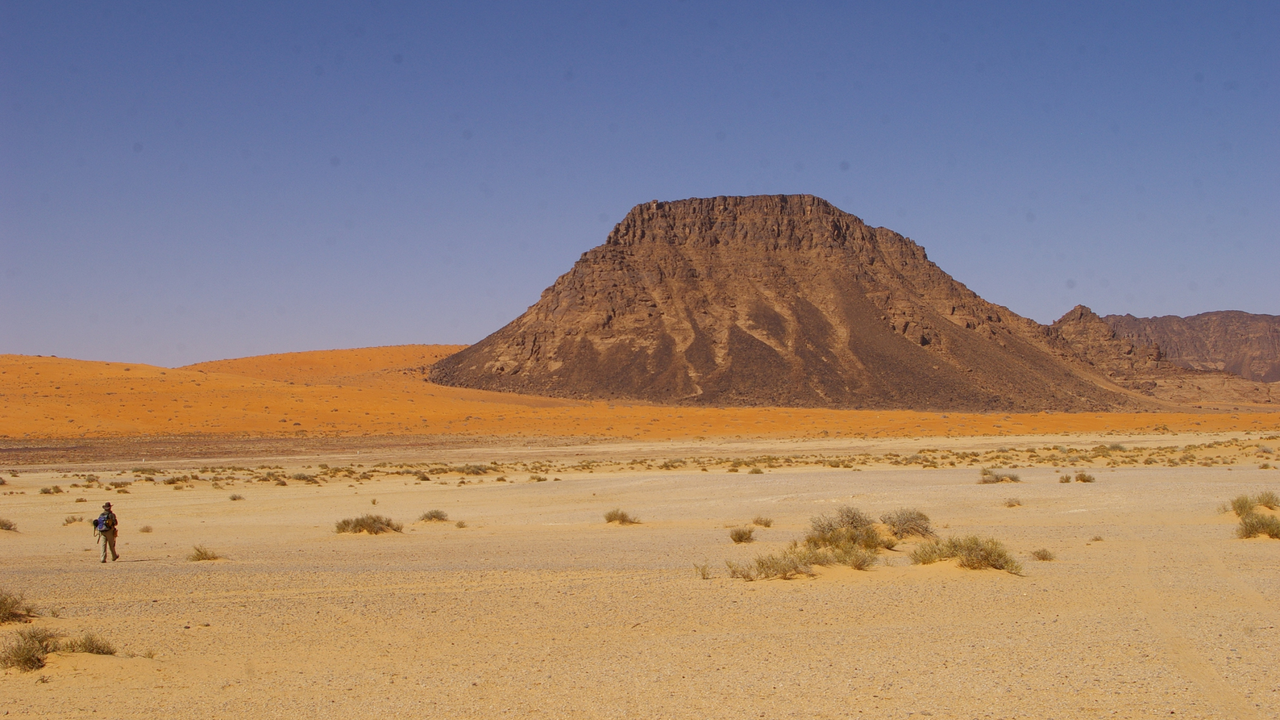
Саудын Арабын Нефуд цөлөөс олдсон чулуун зэвсгүүд нь неандерталь хүн өмнө нь төсөөлж байснаас илүү өргөн уудам нутагт тархан суурьшиж байсныг гэрчилж байна.
Мальтагийн их сургуулийн археологич Хью Грукатт болон түүний багийнхан Саудын Арабын Жуббах хотын ойролцоох Жебел Катефех-1 (JKF-1) малтлагын талбайгаас олдсон чулуун зэвсгүүдийг судалжээ. Тус бүс нутгаас неандерталь хүний яс одоогоор олдоогүй ч, олдсон зэвсгүүдийн хэлбэр дүрс нь Homo sapiens-ийн бус, харин неандертальчуудын урласан зэвсгийн онцлогтой илүү дөхөж байна. Судлаачид статистик загварчлал ашиглан эдгээр зэвсгийн ирмэгийн хэлбэрийг бусад бүс нутгийн олдворуудтай харьцуулж, ийнхүү дүгнэжээ.
Оптик гэрлийн тусламжтай он тогтоох аргаар шинжлэхэд эдгээр олдвор нь ойролцоогоор 55,000 жилийн тэртээх үед хамаарч байна. Энэ хугацаанд тус бүс нутагт зөвхөн неандертальчууд амьдарч байсан гэж үздэг. Тухайн үед цөлийн уур амьсгал өөрчлөгдөж, нуур ус бүрэлдэн, ногоон бүс үүссэн нь ан амьтдыг татах болсон бөгөөд неандертальчууд тэдгээр амьтдыг даган нүүдэллэж ирсэн байх магадлалтай аж.
Тюбингений их сургуулийн археологич Кнут Бретцке уг судалгааны үр дүнг анхаарал татахуйц хэмээн үнэлсэн ч, неандертальчууд Арабын хойгт амьдарч байсныг бүрэн нотлохын тулд чулуун зэвсгээс гадна ясны үлдэгдэл эсвэл ДНХ-ийн нотолгоо зайлшгүй шаардлагатай гэдгийг онцолжээ. Гэвч Арабын халуун уур амьсгалд яс болон эртний ДНХ муу хадгалагддаг тул чулуун зэвсэг нь тухайн бүс нутгийн эртний түүхийг судлах хамгийн гол эх сурвалж болоод байна.
Дэлгэрэнгүйг эх сурвалжаас харах
↓Эх сурвалжийг нээх ↓
Neanderthals may have trekked deep into the deserts of the Arabian Peninsula around 55,000 years ago, a new study of stone tools suggests.
The research, published online Aug. 12 in the journal Quaternary Science Reviews, hints that Neanderthals may have lived farther south than scientists thought, though more evidence is needed to confirm that conclusion.
“Our findings extend the Neanderthal range much further south than had been known, and into the much more open environments of Arabia,” study co-lead author Huw Groucutt, an archaeologist at the University of Malta, told Live Science in an email.
The study focused on stone tools discovered at Jebel Katefeh-1 (JKF-1), an archaeological site beside an ancient lake near the city of Jubbah, in Saudi Arabia’s Nefud Desert (also spelled Nafud or An Nafūd). No Neanderthal bones have ever been found in Arabia, so researchers wondered who was making tools there.
The new study found that tools discovered at JKF-1 more closely matched those made by Neanderthals than those crafted by Homo sapiens.
Neanderthals have traditionally been viewed as a cold-adapted, primarily European species. But that picture has been changing for years, as evidence has placed them thousands of miles east in Siberia as well as in the Middle East.
Lacking bones or DNA, Groucutt and his colleagues identified the Neanderthal tools based on the unique shape of their stone flakes. The team measured hundreds of sharp pieces of tools struck from a carefully prepared stone core from JKF-1 and other sites across Arabia, the Levant and northeast Africa.
Using statistical techniques, the researchers compared the flakes’ shapes across time and space. Based on the differences between stone tools from other sites where the toolmakers’ identities were well established, the researchers created a statistical model to help them identify whether a group of stone tools was made by Neanderthals or H. sapiens.
When they applied the model to the stone tools from JKF-1 and tools from a smaller nearby site called ALM-3, the results showed that it was far more likely that Neanderthals, not H. sapiens, had made the tools.
To pin down when those tools were made, the team dug a new trench at JFK-1 and dated grains of sand from the soil using a method called optically stimulated luminescence, which reveals how long ago those grains were last exposed to sunlight.
Previous work had dated the tools to somewhere between 90,000 and 50,000 years ago. But the new work narrowed down that range. The tools were discovered in a layer where older desert sand gave way to younger lake sediment, showing that people were at JKF-1 around 55,000 years ago, just as the desert was turning wetter.
Neanderthals were the only group living in southwest Asia 55,000 years ago. This date, together with the tools’ shape, is why the researchers think Neanderthals made them, even though no Neanderthal bones have yet been found in Arabia.
Knut Bretzke, an archaeologist at the University of Tübingen in Germany who wasn’t involved in the research, said the study’s evidence for a Neanderthal presence in northern Arabia was compelling.
- Neanderthals passed on a gene that helps modern humans pack on more muscle — but only a few people have it
- Some of the last surviving Neanderthals were remarkably diverse — suggesting inbreeding didn’t doom them
- ‘Major disruption in Neanderthal history’: 65,000 years ago, all Neanderthals in Europe died out except for one lineage
The new dates suggest the Neanderthal foray into Arabia may be linked to a shift in climate. JKF-1’s stone tools sit right at the transition from a dry spell to a humid phase, when a nearby lake was refilling and the surrounding desert would have begun turning green. Drawing on his own fieldwork in southern Arabia, Bretzke said that the wet spell may have drawn grazing animals into the desert interior, and Neanderthals would likely have followed them.
Still, Bretzke said the underlying assumptions deserve scrutiny. Several comparison sites used in the computer model are surface sites, where artifacts can accumulate over vast stretches of time, rather than a single occupation where artifacts are discarded over a short period, he told Live Science, but he finds the paper’s conclusion plausible.
For now, though, the evidence that Neanderthals lived farther south than previously known remains circumstantial.
“Do I believe there were any Neanderthals in northern Saudi Arabia? Yes,” Bretzke said. “Do I think we have solid evidence to prove that belief? No.”
Groucutt agreed that a fossil would help settle the question. But he noted that bones and ancient DNA preserve poorly in Arabia’s heat, so stone tools currently provide archaeologists’ best window into the region’s deep past.
How much do you know about our closest relatives? Find out with our Neanderthal quiz!


