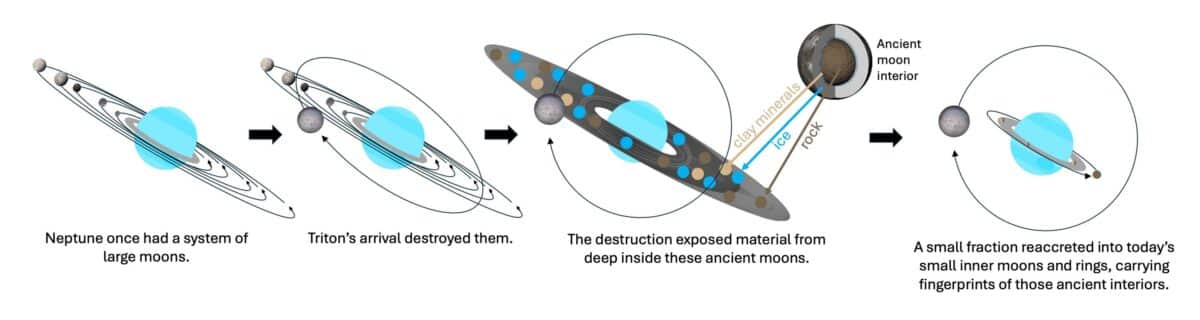
Далайн ван гарагийн дагуулын тогтолцоо нь Тритон дагуул ирснээр эрс өөрчлөгдсөн байж магадгүй гэсэн таамаглалыг шинэ судалгаа дэвшүүллээ.
Жэймс Вэбб сансрын дурангийн NIRSpec багажийг ашиглан Далайн ван гарагийн жижиг дагуулууд болон цагирагт хийсэн шинжилгээгээр магниар баялаг филлосиликат эрдэс бодис илэрчээ. Эдгээр эрдэс нь ихэвчлэн чулуулаг болон шингэн усны харилцан үйлчлэлээр үүсдэг ч, өнөөгийн Далайн ван гарагийн орчинд ус шингэн төлөвт байх боломжгүй юм. Судлаачид эдгээр эрдсийг жижиг дагуулуудын гадаргуу дээр биш, харин эрт цагт сүйрсэн том дагуулуудын дотоод бүтцэд бүрэлдсэн гэж үзэж байна.
Тритон дагуул Далайн ван гарагийн татах хүчинд олзлогдон ирэхдээ тус гарагийн анхны дагуулуудыг сүйтгэж, хэлтэрхий болгон хуваасан байх магадлалтай гэж эрдэмтэд тайлбарлав. Одоогийн жижиг дагуулууд нь тухайн сүйрсэн том биетүүдийн үлдэгдэл байж болох бөгөөд тэдгээрийн эрдсийн найрлага нь Церера болон үндсэн бүсийн астероидуудтай төстэй шинж чанартай байна.
Энэхүү таамаглалыг батлах нэмэлт нотолгоог Далайн ван гарагийн гурав дахь том дагуул Нереидээс олжээ. Нереидийн ойрын хэт улаан туяаны спектр нь талст усны мөс давамгайлсан шинжтэй байгаа нь түүнийг бусад астероид эсвэл Кайперийн бүсийн биетүүдээс ялгаатай, Далайн ван гарагийн анхны тогтолцооны нэг хэсэг байсныг харуулж байна. Цаашдын судалгаагаар эдгээр хэлтэрхийг судалснаар Далайн ван гарагийн эртний сарнуудын дотоод бүтэц болон гарагийн системийн түүхэн өөрчлөлтийн талаар илүү ихийг мэдэх боломжтой юм.
Дэлгэрэнгүйг эх сурвалжаас харах
↓Эх сурвалжийг нээх ↓
New observations from the James Webb Space Telescope (JWST) suggest that Neptune’s small moons and rings could contain pieces of ancient satellites destroyed when Triton was captured. Its moons have always stood out among the giant planets. While Jupiter and Saturn have large families of satellites with several major moons, Neptune’s system is dominated by a single object: Triton, which holds more than 99% of the total mass of Neptune’s moons.
Triton is also unusual because it travels around Neptune in a retrograde orbit, moving in the opposite direction to the planet’s rotation. This has led scientists to think that Triton did not form alongside Neptune but was captured from the distant Kuiper Belt.
A new study published in Science Advances used data from JWST’s Near-Infrared Spectrograph (NIRSpec) to examine Neptune’s smaller moons and rings. The results suggest that these objects may hold material from much larger moons that disappeared long ago.
JWST Finds Hidden Minerals on Neptune’s Moons
The researchers detected signs of magnesium-rich phyllosilicates on two of Neptune’s small moons, Larissa and Galatea, as well as in the planet’s rings. These minerals are often linked to reactions between rock and liquid water.
The discovery was unexpected because the surfaces of these moons are far too cold for liquid water to exist today. The team also did not find water ice connected to these minerals, suggesting that the material formed somewhere else before reaching its current location.
The researchers explain that these phyllosilicates likely developed inside larger bodies where internal heat allowed water and rock to interact. In other words, the minerals may come from the hidden interiors of ancient moons rather than from the small satellites seen today.
The study points out that the composition of these minerals is similar to material found on Ceres and some large main-belt asteroids. This suggests that Neptune’s former moons may have been large enough to experience internal changes similar to those seen in other differentiated worlds.
Triton Destroyed Neptune’s First Moons
The leading explanation is that Triton’s arrival caused a major disruption around Neptune. As a large object captured from the Kuiper Belt, Triton would have disturbed the planet’s original satellites and possibly broken several of them apart.
The study suggests that the planet’s current inner moons could have formed from the remains of those destroyed worlds. Their unusual mineral composition would then be a direct clue to the interiors of satellites that no longer exist.

The researchers write that these moons may be the only place in the solar system where scientists can study material from inside an icy satellite, or possibly a dwarf planet, depending on when the mineral changes occurred.
The idea also explains why Neptune’s system looks so different today. Before Triton’s capture, the planet may have had a more typical group of moons. After the event, only fragments remained, along with the unusually large captured moon that dominates the system.
Nereid Reveals Neptune’s Lost Past
Scientists also considered another possibility: a different large Kuiper Belt Object could have been destroyed near Neptune and delivered the mineral-rich material. The researchers say this explanation is less likely. Observations of Nereid, Neptune’s third-largest moon, provide another piece of evidence. The study team notes that Nereid’s near-infrared spectrum is dominated by crystalline water ice and does not match known Kuiper Belt objects or irregular satellites.
“Companion JWST observations of Nereid—Neptune’s third-largest moon, historically classified as an irregular satellite—provide independent evidence that a primordial regular satellite system existed around Neptune before Triton’s capture. Nereid’s near-infrared spectrum is dominated by crystalline water ice and is inconsistent with the spectrum of any observed KBO or irregular satellite,” the team explained.

Future studies of Neptune’s moons could reveal more about these ancient fragments. Hidden inside these small worlds may be the remains of a lost generation of satellites that existed before Triton’s arrival.
Enjoyed this article? Subscribe to our free newsletter for engaging stories, exclusive content, and the latest news.


