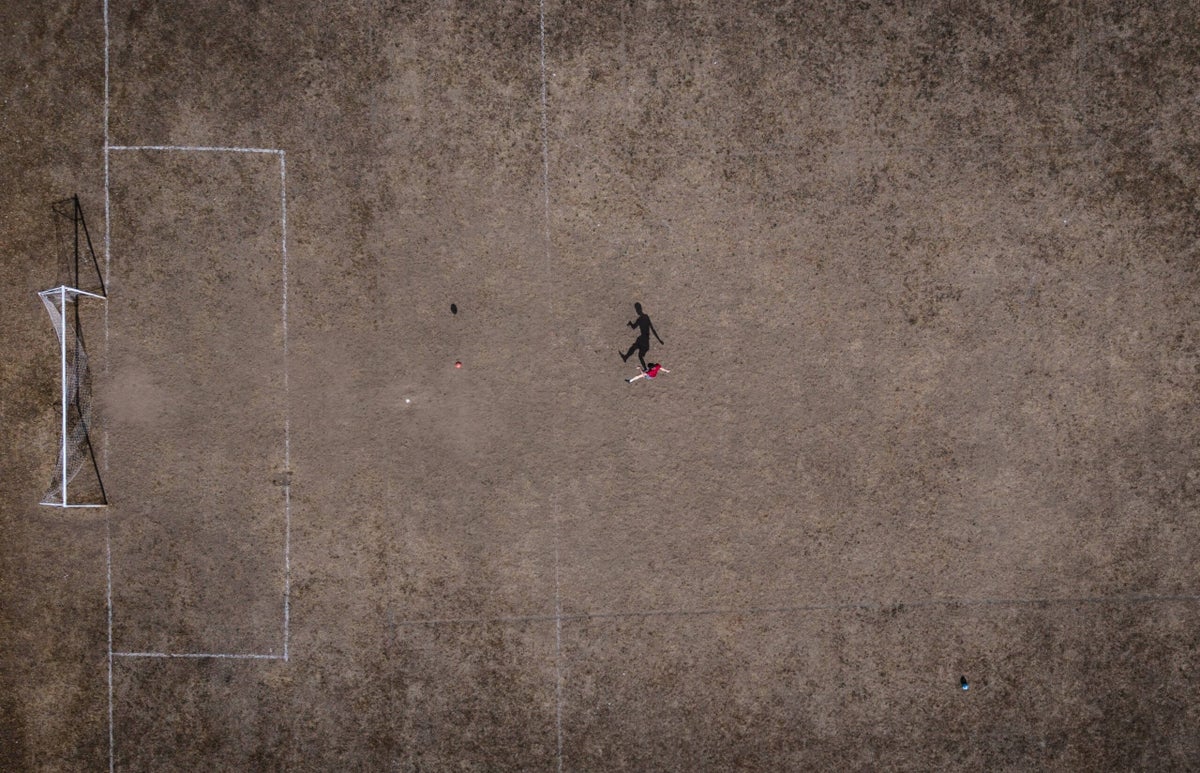
Талбайн нөхцөл байдал аюултай түвшинд хүрсэнтэй холбогдуулан олон улсын хэмжээнд тоглолтуудыг цуцалж, хуваарьт өөрчлөлт оруулж байна.
Англид сүүлийн жилүүдэд тохиолдоогүй их халалт, ган гачиг болсны улмаас зүлгэн талбайнууд хатаж, хатууран тоглогчдын эрүүл мэндэд ноцтой эрсдэл учруулж эхэллээ. Англиан Комбинейшн лигийн тэргүүн Дэйл Брауны мэдээлснээр, бэлтгэл болон нөхөрсөг тоглолтуудын үеэр тоглогчид гавлын яс цуурах, тохой хугарах зэрэг амьдралд нь сөргөөр нөлөөлөхүйц хүнд гэмтэл авсан тохиолдлууд бүртгэгдсэн байна. Үүнтэй холбогдуулан тус лиг улирлын эхлэлийг хоёр долоо хоногоор хойшлуулж, наймдугаар сарын сүүл хүртэл сунгажээ.
Английн хөлбөмбөгийн холбооноос улс даяарх лигүүдэд хандан талбайн нөхцөл байдлыг сайтар үнэлж, аюулгүй байдлыг хангахыг зөвлөв. Уэльсийн хөлбөмбөгийн холбоо мөн адил ган гачгаас үүдэлтэй талбайн эвдрэлийг өвлийн улирлын хөлдүү эсвэл ус тогтсон талбайтай адилтган авч үзэж, шүүгчид болон багийн дасгалжуулагчдад тоглолт явуулах эсэх эцсийн шийдвэрийг гаргах эрхийг олгожээ.
Зарим клуб санхүүгийн алдагдал хүлээх эрсдэлтэй ч тоглолтын хуваарийг өөрчлөх, хиймэл зүлгэн талбай ашиглах, эсвэл талбайгаа сэргээх зорилгоор тоглолтуудыг хойшлуулах арга хэмжээ авч байна. Нөрт Ийст Хэмпширийн залуучуудын лиг талбайг дараагийн тоглолтуудад бэлтгэх, гэмтлийн эрсдэлийг бууруулах үүднээс улирлын эхлэлийг аравдугаар сар хүртэл хойшлуулах магадлалтай байгааг анхаарууллаа. Одоогоор Их Британид орсон бага зэргийн хур тунадас талбайн хатуу хөрсийг зөөлрүүлэхэд хангалтгүй байгаа тул нөхцөл байдал хүнд хэвээр байна.
Дэлгэрэнгүйг эх сурвалжаас харах
↓Эх сурвалжийг нээх ↓
Footballers are suffering “life-changing” injuries on drought-affected pitches, according to a chairman of a senior amateur league.
Grassroots leagues across England have been forced to adjust the start of their seasons after one of the hottest and driest summers on record left parched pitches dangerous to play on.
Dale Brown, chairman of the Anglian Combination — which contains 100 teams and is at step 11 of the English football league system across Norfolk and Suffolk, and step seven of the National League — says the league has received reports of serious injuries during unofficial games, such as pre-season friendlies, over the summer months.
After an extraordinary meeting of the Anglian Combination Committee, it was unanimously decided that the start date for league matches should be delayed by two weeks to the end of August in the hope some much-needed rain would make the surfaces safer for play.
“What we’ve noticed, and what’s been reported to us as a league, is a spate of injuries that have been in some circumstances life-changing,” Brown told The Athletic.“There have been smashed elbows, fractured skulls, falls onto extremely hard ground where it’s not just been a pull strain or a muscle ache — it’s been quite severe.
“There didn’t appear to be any let up in the weather so we decided to delay the season by two weeks for player welfare. We have never had to delay the start of the season ever before. This is completely unprecedented.”
The move has been echoed across the country after England recorded its driest July since records began in 1836, according to the Met Office.
Just 6.5mm of rain — just 10 per cent of the long-term rainfall average, the typical amount of rain that falls in a specific place — was recorded last month. Southern England also experienced its driest individual calendar month ever observed, prompting widespread official drought status covering more than 70 per cent of the nation.
Grass pitches across the country have become so dry and fatigued that cracks have opened up on some, with grass reduced to straw.
Artificial turf protects the goal mouth on a dry pitch in Reading (Ryan Pierse/Getty Images)
The Football Association has issued advice to all leagues across the country on how to cope with the drought and, while there has been no blanket suspension of play on grass pitches, the FA is urging clubs to assess pitches before going ahead with fixtures.
As well as delaying the start of league seasons, clubs have been looking to reverse fixtures where possible or play on artificial surfaces if available.
Hartley Wintney FC of the Isthmian League South Central (level eight of the English football league system) issued a statement on August 5 stating that, despite the efforts of volunteers, concerns over their pitch at Memorial Playing Field in Hampshire had led them to reach out to opponents they were due to face in August and September to reverse or postpone fixtures.
Pre-season fixtures also had to be moved to neutral venues, costing the club vital income from ticket revenue and hospitality.
The Football Association of Wales (FAW) has also issued interim guidance that pitches affected by the drought should be assessed by match officials in the same way as frozen or waterlogged pitches during the winter.
“Local Authority and venue owners have primary responsibility for determining if public facilities are open and fit for play,” the FAW advised in a statement issued on August 14.“Match officials, alongside home and away team managers, retain final authority on matchday to assess if a pitch is safe for play under law one of the game.
“If a surface is deemed unsafe or poses an unreasonable risk of injury, the match or training session must not proceed.”
Jamie Clarke, interim CEO of the Leicestershire and Rutland County FA, told The Athletic that decisions on safety had to be taken on an individual basis.“Player and participant welfare is always our priority, particularly during periods of extreme weather,” he said. “We recognise the challenges that prolonged periods of hot weather can create for grassroots clubs, particularly as they prepare for the new season.
“We have clear warm-weather guidance available to support clubs, coaches, match officials and other volunteers in making informed decisions around football activity in hot conditions.
“We circulate this guidance through our club network and encourage those involved in grassroots football to regularly assess the conditions and make appropriate adjustments where necessary.
“Ultimately, there is no one-size-fits-all approach. Clubs know their facilities, players and local circumstances best, and we want to ensure they feel supported in making decisions that put the health and wellbeing of participants first.”
Safety concerns over hard pitches have affected other sports in the United Kingdom this summer, such as cricket, golf and bowls — and especially rugby union. England’s Rugby Football Union (RFU) has issued a blanket directive to delay the start of the grassroots season from September 5 to September 21 because of the high risk of injury on hard, dry pitches.
When it comes to football, as well as impact injuries, players are at a greater risk of sustaining injuries such as shin splints from running on rock-hard surfaces.
The preliminary round of the FA Cup is scheduled to take place this weekend with some non-League clubs having artificial pitches installed. This could be the future of grassroots football if drier and hotter summers continue.

Grassroots clubs may have to lean more on 3G playing surfaces (David Goddard/Getty Images)
Some rain has fallen in the United Kingdom over recent days, but not enough to ease the pressure on sports clubs keen to get seasons underway.“It’s really bad,” added Brown. “We have had a little rain but it’s still rock hard, so nothing has changed.
“I’m no weather forecaster, but I suspect we need a good couple of weeks of sustained rain to make any difference.Most of what has fallen in recent days is just greening the weeds and not absorbing into the ground because it’s so hard already. I’m sure it’s the same countrywide.”
As well as the safeguarding issues of using drought-affected pitches, junior football clubs are also facing the prospect of being prevented from playing so the pitches will have the chance to recover and not be ruined for later in the season, when more wintery weather will inevitably impact fixtures.
Duncan Swan, secretary for the North East Hampshire Youth League, has written to parents warning them that local councils who own and run the pitches may postpone the season, possibly even into October.
“The problem is playing on grass pitches where the grass needs to recover because what you don’t want to do is ruin the grass,” he told The Athletic.“We were playing in April and May on pitches which were pretty hard anyway, but they are rock hard at the moment.
“The grass needs to recover. We just need sufficient rain to actually allow that to happen, and then we can crack on.
“There just aren’t enough artificial pitches to allow teams to guarantee they’re going to play every week, certainly within the first few weeks of the season, which is due to start early September.
“We are asking the clubs to be sensible in making decisions as a lot of our referees are also very young, but in many cases the pitch providers will make the decision, and they will not want the pitches ruined for later in the season.”


