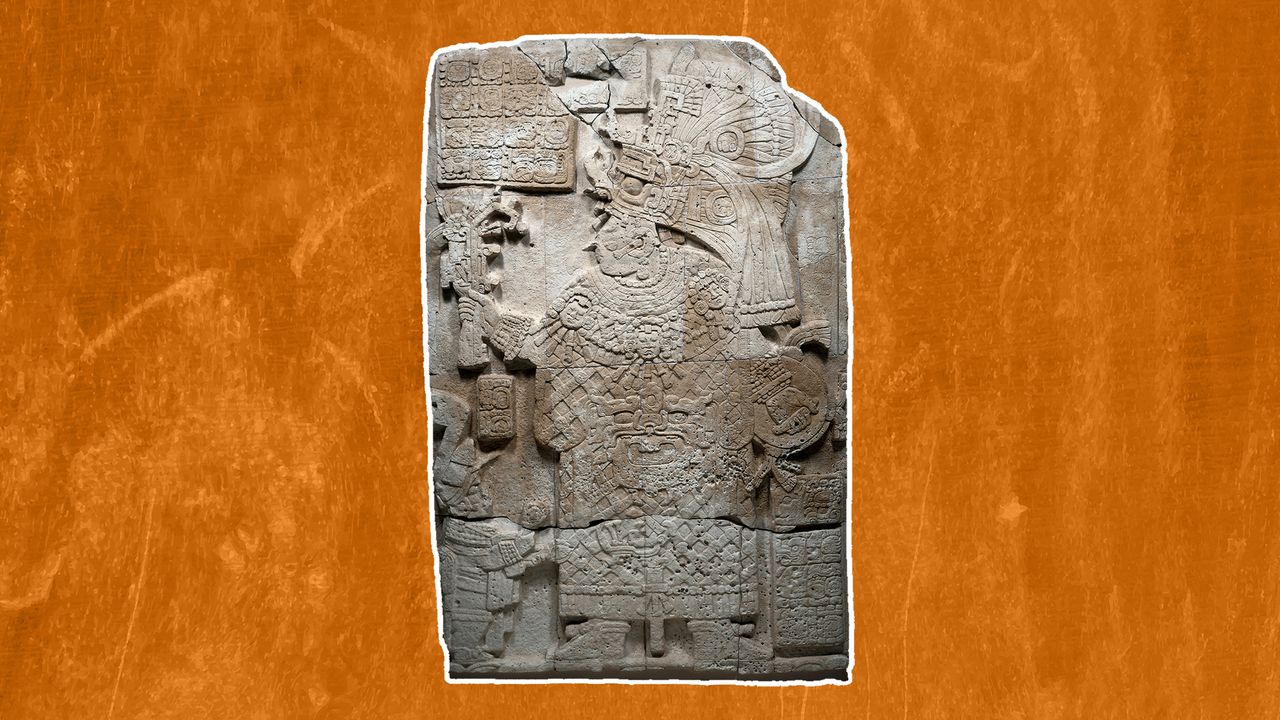
Археологичид Гватемалын хойд хэсгийн Эль-Перу-Вака суурингаас Маяагийн хатан хаан Лэди К’абелийн дүрс бүхий томоохон шохойн чулуун хөшөө болон түүний булшийг олж илрүүлжээ.
692 онд бүтээгдсэн гэж үздэг 2.7 метр өндөр, 1.1 тонн жинтэй энэхүү хөшөөг 40 гаруй хэлтэрхийгээс эвлүүлэн сэргээсэн байна. Кливлендийн Урлагийн музейн цуглуулгад хадгалагдаж буй уг хөшөөнд хатан хааныг эрдэнийн чулуун гоёл чимэглэлтэй, цэргийн дээд командлагчийн дүрээр дүрсэлжээ. Судлаачдын үзэж буйгаар, хатан хаан нь “Могойн угсаа”-ны хүчирхэг удирдагч байсан бөгөөд тухайн үедээ цэргийн захирагчийн үүрэг гүйцэтгэж, томоохон байлдааны ажиллагааг удирдаж байсан бололтой.
2012 онд археологич Оливия Наварро-Фарраар удирдуулсан баг Эль-Перу-Вакад малтлага хийх явцдаа хөшөөний ойролцоох шатны доороос хатан хааны булшийг олсон юм. Булшнаас олдсон хаш, обсидиан болон хясаан эдлэлүүд нь хөшөөн дээрх дүрслэлтэй яг таарч байсан нь уг булш Лэди К’абелийнх болохыг баталжээ. Түүнчлэн булшнаас олдсон дүрс бичиг бүхий албастрийн чулуун сийлбэр нь хатан хааны нэрийг тодорхой дурдсан нь түүхийн ховор бөгөөд төгс нийцэл бүхий олдвор болсон байна.
Дэлгэрэнгүйг эх сурвалжаас харах
↓Эх сурвалжийг нээх ↓
Name: Front face of a stela
What it is: A limestone carving
Where it is from: Petén, Guatemala
When it was made: A.D. 692
This massive limestone carving depicts a Maya queen known as Lady K’abel (meaning Water Lily Hand) and Na Kan Ajaw (meaning Divine Woman of the Snake Polity). The stela, or carved stone slab, was likely erected in A.D. 692 to mark the end of a k’atun, a 20-year period in the Maya calendar.
The stela is in the collection of the Cleveland Museum of Art (CMA). It has been reconstructed from more than 40 fragments of carved limestone but is only the front part of the original freestanding monument. The enormous carving is roughly 9 feet (2.74 meters) tall and weighs about 2,500 pounds (1,134 kilograms). It was found in a provincial Maya town called El Perú-Waka’ in the Petén region of northern Guatemala.
In Petén, this carved portrait of Lady K’abel stood next to a similar one of her husband, K’inich Bahlam II, a man of lower rank. As a member of the powerful Kaanul or Snake dynasty, Lady K’abel ruled El Perú-Waka’ as the military governor, according to the CMA. The stela also describes her as Ix Kaloomte’, meaning Lady Supreme Warlord, and experts think Lady K’abel may have led an army from the city of Calakmul against the city of Tikal.
On the stela, Lady K’abel is “smothered in finery,” Susan E. Bergh, then curator of Pre-Columbian and Native North American art at the CMA, wrote in 2014, which “allies her with a Maya supernatural being, either the maize god or the moon goddess.” Her headdress is a fan of green quetzal (Pharomachrus mocinno) feathers, and she wears a netted garment and necklace, both made of jade beads. The net dress is belted with the head of a fish-like creature, and Lady K’abel carries a scepter and a circular shield, alluding to her role as Lady Supreme Warlord. In the lower-left corner is a person with dwarfism, likely an attendant or courtier.
The stela was created to celebrate 20 years of Lady K’abel’s rule. Portraying her as the maize god conveys themes of creation and renewal, archaeologist Phil Wanyerka wrote in a 1996 study. “By wearing the attire of a god, a mortal being becomes divine, and here a woman is transfigured into the maize god to summon the associated powers of renewal and rebirth for the passage of the old k’atun and the inauguration of the new,” Wanyerka wrote.
Although Lady K’abel’s stela was acquired in 1967, her tomb was not discovered until 2012, when archaeologists excavating at El Perú-Waka’ stumbled across it when digging at the bottom of a previously unknown staircase near where the stela was found.
According to archaeologist Olivia Navarro-Farr, who led the excavation, the royal tomb was full of artifacts made from jade, obsidian and shells, including a bivalve shell placed on the skeleton’s pelvis. The shell exactly matches one depicted on Lady K’abel’s pelvis on the stela. In the tomb, the archaeologists also found a small alabaster carving with hieroglyphs that named Lady K’abel as its owner, almost certainly linking the occupant of the tomb with the imposing limestone stela that was discovered outside.
“It’s not rare to find royal tombs,” Navarro-Farr said. “But it is rare to have the perfect confluence of evidence that leads one to be able to make that kind of historical identification.”
For more stunning archaeological discoveries, check out our Astonishing Artifacts archives.
Can you put together last week’s Astonishing Artifact?

