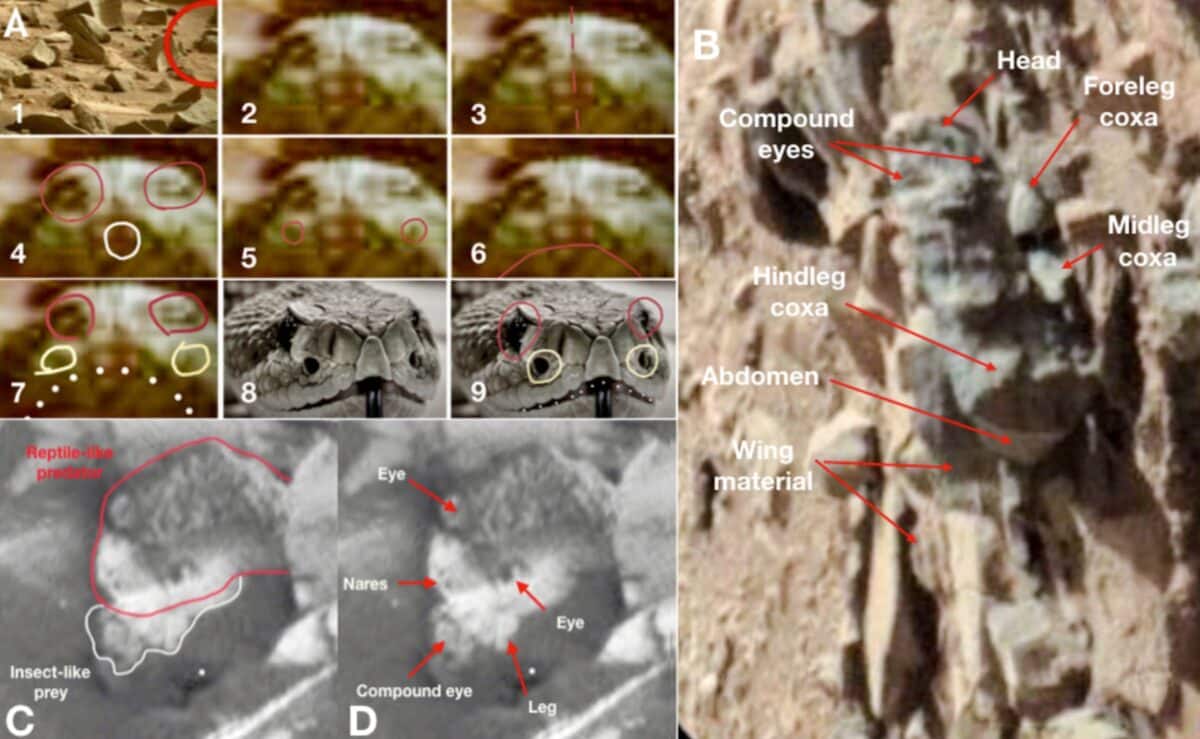
Охайогийн их сургуулийн профессор, энтомологич Уильям Ромосер NASA-гийн Ангараг гаригийн судалгааны Curiosity хөлгийн авсан гэрэл зургуудад дүн шинжилгээ хийж, тэнд шавьж болон мөлхөгч амьтантай төстэй биетүүд байж болзошгүй гэсэн таамаглалыг дэвшүүлэв.
Уильям Ромосер 2019 оны арваннэгдүгээр сарын 19-нд болсон Америкийн энтомологийн нийгэмлэгийн хурлын үеэр судалгааныхаа үр дүнг танилцуулжээ. Тэрээр гэрэл зургуудын тод байдал, өнгө, ялгарал зэргийг өөрчлөх болон дүрс хувиргах аргуудыг ашиглан биеийн бүтэц, хөдөлгөөн, тэгш хэм зэргийг ажигласан байна. Судлаачийн үзэж буйгаар, зарим зурагт шавьжийн далавч, хөл, нүд болон толгой, цээж, хэвлийн хэсгүүд тод харагдаж байгаа бөгөөд зарим нь чулуужсан, зарим нь амьд мэт дүр төрхтэй байжээ.
Судалгааны хүрээнд мөн мөлхөгч амьтны дүрсүүдийг нэгэн төрлийн могойтой харьцуулан судалсан байна. Ромосер эдгээр дүрсүүд нь хоорондоо харилцан үйлчлэлцэж буй, тухайлбал мөлхөгч амьтан нь шавьж төст биетийг барьж авсан байж болох дүр зураг ажиглагдсаныг тэмдэглэжээ. Гэсэн хэдий ч тэрээр эдгээр дүрсүүдийн талаарх тайлбарууд нь зөвхөн таамаглал бөгөөд цаашдын нэмэлт судалгаагаар өөрчлөгдөх боломжтойг онцолсон байна.
NASA-гийн хувьд Curiosity хөлөг нь Ангараг гаригийн геологийн түүх, уур амьсгал болон бичил биетэн оршин байсан эсэхийг тогтоох химийн болон эрдсийн шинжилгээ хийх зорилготой юм. Хөлөг нь одоогоор тус гаригаас нүүрстөрөгчийн агууламжтай органик нэгдлүүдийг илрүүлээд байгаа боловч эдгээр нь биологийн бус, физик-химийн үйл явцаар ч үүсэх боломжтой гэж үздэг.
Дэлгэрэнгүйг эх сурвалжаас харах
↓Эх сурвалжийг нээх ↓
Dr. William Romoser of Ohio University (Emeritus) was an entomologist who believed that there may be winged, flying insects and possibly even large reptilian predator forms visible in NASA’s photographs of Mars taken using the Mars rover.
Dr. Romoser is an Emeritus Professor at Ohio University. At the November 19, 2019 Entomological Society of America Conference in St. Louis, Missouri, Dr. Romoser gave his findings on the possible winged, flying insects and reptile like forms of Mars based on the images of the rovers taken over many years, primarily by NASA’s Curiosity rover.
Dr. Romoser used various methods to identify potential insect/reptile forms in the photographs. He looked for specific body parts, or segments of the body; legs; wings; and interaction between different forms of life. Dr. Romoser stated that some of the photographs showed “fossil” like forms and some were forms he believed to be living.
There were numerous photographs examined by Dr. Romoser and he referred to them as “insect-like forms.” One set of photographs in particular show “apparent insects in flight,” according to Dr. Romoser. There were many examples of each type of insect, including bee-like forms.
In addition, Dr. Romoser labeled certain photographs with features such as compound eyes, forelegs, hindlegs, wing bases and wing veins. He also identified a group of what he termed “forms” with three body sections, similar to those of a head, thorax and abdomen.
Dr. Romoser determined his identification of the photographed shapes by their visible anatomy. He sought out symmetry, body segmentation, repeated forms, skeletal remains, apparent movement of shapes and multiple objects together in one photograph. When examining the photographs, Dr. Romoser adjusted the brightness, contrast and saturation levels, and utilized image inversion.
Dr. Romoser stated he added no new features and removed none of the features present in the original photograph. Based on the scale of the original photograph, Dr. Romoser estimated one shape to be approximately twenty (20) inches long. Another photograph was interpreted as showing a wing caught on the rover with longitudinal veins, cross-veins and cells.

“The aggregate of my description above would appear to me to be quite compelling,” Dr. Romoser stated in his written report.
Dr. Romoser emphasized his descriptions and interpretations regarding the photographed shapes are speculative and subject to revision based on further investigation.
Predator-Like Reptile Forms & Prey Behavior
Dr. Romoser’s analyses also include what he referred to as “reptile-like” forms.
On one plate, Dr. Romoser compared an object found in a Martian debris field with the front view of an Eastern King Snake. On that plate, he indicated what he perceived as eyes, bilaterally symmetrical structures and an oral opening.
Additional plates were shown as evidence of possible predation activity between insect-like and reptile-like forms. For example, Dr. Romoser described one image as depicting a reptile-like creature with an insect-like creature captured in its jaws. He noted that insect-like creatures seen in images appeared to be being preyed upon by reptile-like creatures.

His paper describing possible fossilized life on Mars also included comparisons between fossilized serpent-like reptiles and insect-like fossils.
Images analyzed were obtained from public releases provided by NASA and the Jet Propulsion Laboratory. Although Dr. Romoser mentioned that his collection contains raw images and panoramic images derived from several Mars missions, most of his analyses relate to information provided from NASA’s Curiosity Mission.
Mars Exploration Using NASA’s Curiosity Rover
NASA describes Curiosity’s main purpose differently than Dr. Romoser’s interpretation. Curiosity was launched on November 26th, 2011 and arrived on Mars August 6th, 2012. Per NASA’s webpage:
“What does Curiosity do?…Curiosity investigates how our solar system formed and evolved.”
Early in its mission, Curiosity discovered chemical and mineral evidence that ancient Martian environments likely supported microbial life. Since landing on Mars in 2012, Curiosity has continued analyzing rocks in Gale Crater where the rover operates.
As a vehicle roughly the same size as a small SUV, Curiosity carries ten (10) scientific instruments. Some of these tools include seventeen (17) cameras; A laser that vaporizes very small portions of rocks for sampling purposes; And a drill that creates powder from rock for analysis purposes. NASA states that Curiosity has sampled forty-two (42) rocks using its drilling mechanism.
Curiosity is searching for organic molecules on Mars. Organic molecules are carbon-based chemicals necessary to create biological processes; However, organic molecules can also develop via abiotic processes.
NASA reported that Curiosity detected long chain organic molecules, specifically decane, undecane and dodecane in a drilled sample called Cumberland. As per NASA’s webpage related to the Curiosity mission, these organic molecules represent the longest chain organic molecules previously detected on Mars.
Enjoyed this article? Subscribe to our free newsletter for engaging stories, exclusive content, and the latest news.


Мэдээний зураг дээр шавьж болон мөлхөгч амьтны дүрс байж болзошгүй гэдэг сонирхолтой таамаглал байна. Тэгвэл та энэ тухай юу гэж бодож байна, дэлхий дээрх амьтад шиг амьтдын дүрсийг Ангараг дээр ч харж болох юм уу?