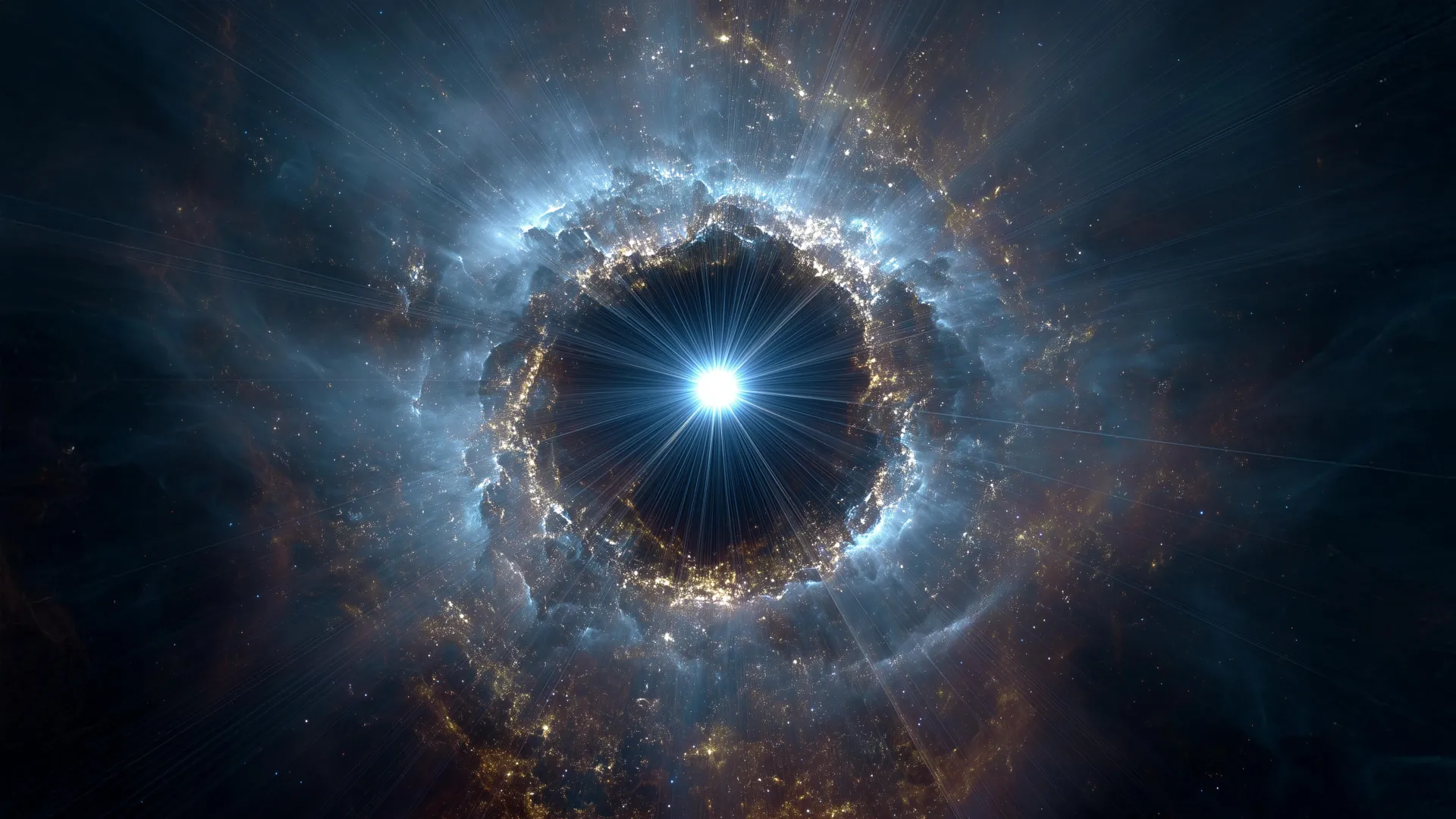
Судлаачид орчлон ертөнцийн үүсэл хөгжлийн эхэн үед бий болсон “харанхуй оддын” үлдэгдэл нь өнөөдөр бүртгэгдэж буй таталцлын долгионы суурь шуугианд томоохон хувь нэмэр оруулсан байж болзошгүйг тогтоожээ.
Колгейтийн их сургуулийн судлаачид Сохан Годла болон Космин Или нар “Physical Review D” сэтгүүлд нийтлүүлсэн судалгаандаа эртний орчлонд үүссэн супермассив хар нүхнүүд өнөө үед Pulsar Timing Arrays (PTA)-аар илэрч буй таталцлын долгионы эх үүсвэр мөн эсэхийг шинжилжээ. Тэдний загварчлалаар, харанхуй материйн нөлөөгөөр үүссэн супермассив “харанхуй оддын” мөхлөөс үлдсэн хар нүхнүүд нь хоорондоо нэгдэн нийлэх замаар өнөөгийн таталцлын долгионы гол дохиог бүрдүүлж байж болох талтай.
Уг судалгаа нь эртний орчлонгийн асар том хар нүхнүүдийн үүсэл болон тэрбум жилийн дараа тэдгээр хар нүхнүүдийн хос системүүдээс ялгарч буй таталцлын долгионы хооронд холбоос тогтоосон байна. Хэрэв эртний харанхуй оддын нягтрал тодорхой хэмжээнд байсан бол тэдний үр сад өнөөгийн таталцлын долгионы дохионы дийлэнх хэсгийг бүрдүүлэх боломжтой гэж үзжээ. Эсрэгээрээ, шууд нурангиар үүссэн хар нүхнүүдийн популяци нь ажиглагдаж буй дохионд бага нөлөөтэй болохыг тогтоосон байна.
Судлаачдын тэмдэглэснээр, PTA-ийн хэмжилтүүд нь эртний хар нүхнүүдийн үүслийн талаарх хязгаарлалтыг тогтоох шинэ боломжийг олгож байна. Хэрэв эртний хар нүхнүүдийн анхдагч үр хөврөл хэт олон байсан бол өнөөдрийн таталцлын долгионы дохиог хэтрүүлэх эрсдэлтэй бөгөөд хэт цөөн байвал өөр эх үүсвэр шаардлагатай болно. Энэхүү судалгаа нь харанхуй матер, анхны гэрэлт биетүүд болон супермассив хар нүхнүүдийн үүслийн нууцыг тайлах шинжлэх ухааны цоо шинэ өнцгийг нээж байна.
Дэлгэрэнгүйг эх сурвалжаас харах
↓Эх сурвалжийг нээх ↓
A faint background of extremely low frequency gravitational waves detected through networks of pulsars could contain clues to events that unfolded more than 13 billion years ago, including the emergence of some of the Universe’s earliest supermassive black holes.
In a study published as a Letter in Physical Review D, Colgate University researchers Sohan Ghodla and Cosmin Ilie examined whether supermassive black holes that originated in the early Universe could eventually produce a significant share of the gravitational wave background now being measured by Pulsar Timing Arrays, or PTAs.
The findings connect two areas of astronomy that may at first seem far apart. One involves observations of surprisingly massive black holes that already existed when the Universe was young. The other involves gravitational waves generated billions of years later by pairs of supermassive black holes spiraling toward one another.
The researchers found that one possible class of early black hole seeds, remnants left behind by supermassive Dark Stars, could potentially provide a dominant contribution to the PTA signal.
“Pulsar timing arrays are usually thought of as probes of supermassive black-hole binaries in the relatively recent Universe,” said Ilie. “What our work shows is that the signal may also contain information about how the ancestors of those black holes formed at cosmic dawn. In that sense, gravitational waves observed today could provide a new window onto the birth of the first supermassive black holes.”
Pulsars as Precise Cosmic Clocks
Pulsar Timing Arrays rely on rapidly spinning neutron stars known as pulsars, which act as extraordinarily precise clocks in space. When gravitational waves pass through the cosmos, they cause tiny changes in the timing of the radio pulses that eventually arrive at Earth. By tracking many pulsars over long periods, international research teams have found evidence for a stochastic gravitational wave background at nanohertz frequencies.
The most widely accepted astrophysical explanation for this background is a population of supermassive black hole binaries gradually spiraling inward. Systems whose black holes have a combined mass greater than roughly a billion Suns make especially important contributions at the frequencies detected by PTAs.
But explaining those enormous black holes raises a deeper question. Astronomers still want to know how their original seeds formed. Observatories including the James Webb Space Telescope and Chandra have discovered massive black holes at unexpectedly early stages of cosmic history, increasing interest in formation mechanisms capable of producing large black hole seeds very quickly.
Ghodla and Ilie investigated whether the descendants of such ancient seeds could persist through cosmic time, grow alongside their host galaxies, eventually pair up, and generate the gravitational wave background detected billions of years later.
Could Dark Stars Seed Giant Black Holes?
The researchers explored two possible routes for producing massive black hole seeds in the early Universe: direct collapse black holes and black holes formed through the collapse of supermassive Dark Stars.
Dark Stars are hypothetical primordial stars that would receive much of their energy from heating associated with dark matter instead of relying primarily on ordinary nuclear fusion. In the WIMP dark matter scenario considered in the study, these stars could remain relatively cool and extended while continuing to gather material. Under the right conditions, they might grow to a million times the mass of the Sun or more before collapsing into massive black holes.
Ghodla and Ilie modeled how black holes produced through these pathways would evolve over cosmic history. They followed the halos hosting the black holes, estimated how frequently the objects would merge, and calculated the gravitational wave background those mergers would produce.
Their results indicate that if remnants of supermassive Dark Stars existed at a number density of roughly 10-3 Mpc-3, their descendants could provide a large, and possibly dominant, share of the gravitational wave signal measured by PTAs.
The direct collapse black hole population considered in the study appears likely to have been much less common. With characteristic densities near 10-6 Mpc-3, those objects would contribute substantially less to the observed signal.
Using Gravitational Waves to Probe Cosmic Dawn
One of the study’s key conclusions is that current PTA measurements can place limits on how common the earliest seeds of supermassive black holes could have been.
“Produce too many of these massive seeds and you end up over-producing the PTA-detected signal. Produce too few, and you need other sources to efficiently assemble these supermassive black holes later in the life of the universe to match PTA observations,” said Ghodla.
Within the models examined by the researchers, seed densities around the 10-2 to 10-1 Mpc-3 range would begin generating more gravitational wave background than observations allow. The exact limit depends strongly on the masses of the dark matter halos where those seeds originally formed.
That gives PTA observations an unexpected ability to probe extremely ancient populations. They may be able to constrain objects that existed at redshifts greater than 10, even though the mergers of their descendants that create the gravitational waves happen much later in cosmic history.
The calculations also support an earlier finding that binaries with total black hole masses roughly above 109 solar masses dominate the predicted PTA signal. Binary systems containing less massive black holes contribute far less.
Connecting Dark Matter, Dark Stars, and Black Holes
The findings create a new observational link between several major questions in modern cosmology, including the nature of dark matter, the formation of the first luminous objects, the origins of supermassive black holes, and the gravitational waves that travel through the Universe.
“Dark Stars were originally proposed as objects that might be seen directly at cosmic dawn,” Ilie said. “This work points to a completely different way of testing their possible role in cosmic history. Their descendants could leave a gravitational-wave imprint that persists all the way to the present-day Universe.”
As Pulsar Timing Array measurements become more precise, and astronomers improve their understanding of distant black holes and the galaxies that hosted them, researchers may be able to distinguish more clearly among competing explanations for how the Universe’s first supermassive black holes formed.


Эртний хар нүхнүүдийн судалгаа үнэхээр сонирхол татаж байна шүү, тэд өнөөдрийн таталцлын долгионд ямар нөлөө үзүүлж болох вэ? Харанхуй материйн нөлөөгөөр үүссэн хар нүхнүүд одоо ямар хэмжээгээр нөлөөлж байгааг та бодож байв уу? Энэ судалгаа орчлон ертөнцийн нууцыг илчлэхэд ямар ач холбогдолтой бол гэж бодож байна?