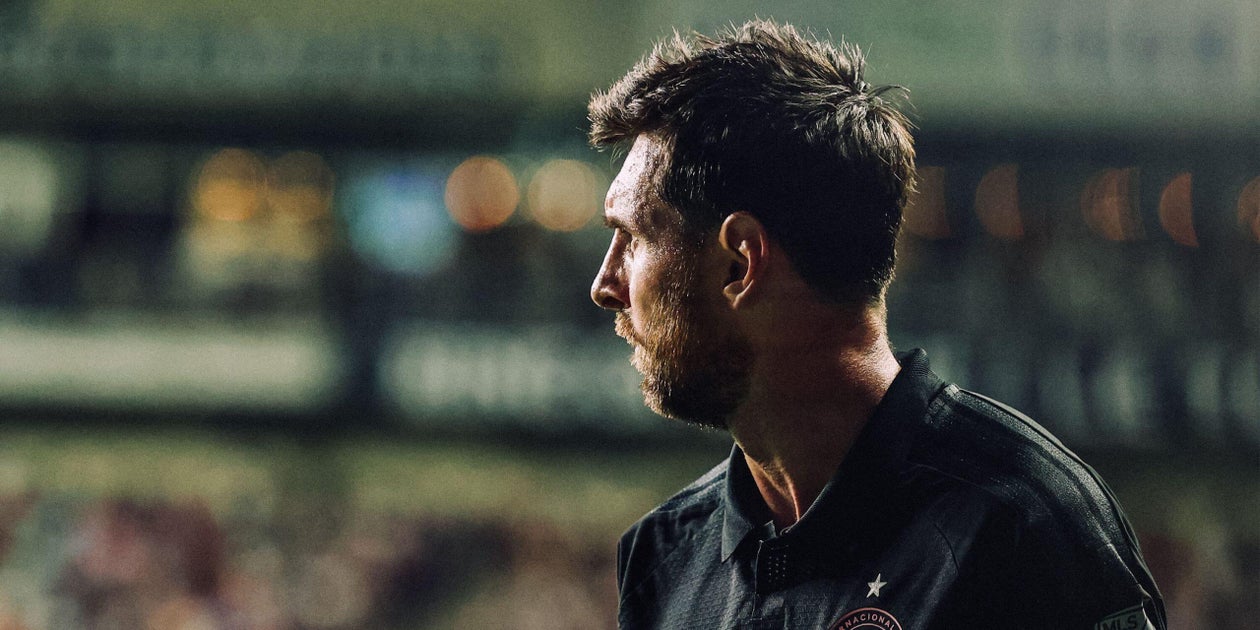
Дэлхийн аваргын финалд хожигдсоны дараа Лионель Месси хувийн амьдралдаа тохиолдсон хүнд гарзтай тулгарч, хөлбөмбөгчин хүний хувьд хэцүү үеийг даван туулж байна.
2026 оны Дэлхийн аваргын шигшээ тоглолтод Аргентины шигшээ баг Испанийн багт нэмэлт цагт 1-0-ийн харьцаатай хожигдсон нь Мессигийн хувьд том цохилт болсон юм. Тоглолтын дараах FIFA-гийн мөрдөн шалгалтаар Леандро Паредес 10 тоглолтын эрхээ хасуулж, торгууль төлөх шийтгэл хүлээсэн нь тус тэмцээний үеэрх Аргентины багийн сахилга бат, FIFA-гийн хандлагатай холбоотой маргааныг улам дэвэргэв.

Тэмцээний дараа Месси төрөлх Росарио хотдоо эргэн ирсэн ч удалгүй аавынхаа таалал төгссөн гунигт мэдээг хүлээн авлаа. Тэрээр аавынхаа дурсгалыг хүндэтгэн оршуулгын ажиллагаанд оролцсон бөгөөд энэ хүнд үеэ хөлбөмбөгийн талбайд гаргах хичээл зүтгэлээрээ даван туулахыг оролдож байна.


Интер Майами багтаа эргэн ирсэн Месси талбайд гарч тоглолтоо үргэлжлүүлж байгаа ч багийнх нь амжилт тааруухан байна. Түүнийг үргэлжлүүлэн тоглох эсэх нь тодорхойгүй байгаа бөгөөд Аргентины шигшээ багийн дасгалжуулагч Лионель Скалони ирээдүйн талаарх шийдвэрээ гаргахад Мессигийн шийдвэрийг хүлээж байж болзошгүй байна.


Дэлгэрэнгүйг эх сурвалжаас харах
↓Эх сурвалжийг нээх ↓
The sycamore trees sway and the chain-link fences rattle. It’s a cold July day in Arroyo Seco, in the depths of the Argentine winter, and the wind blowing off the Parana River brings a chill to the spectators gathered in the bleachers for a fourth-division game at the Antonio Di Giacomo Stadium.
Union Arroyo Seco are the local team here. But on this particular Saturday, they’re not playing at home. They share the ground with Leones, a club founded by Lionel Messi a little over a decade ago. One of his brothers, Matias, is their president. In the away dressing room, Central Cordoba are getting changed. One of their players pulls on a navy blue shirt. ‘Messi’ and ’10’ are printed on the back. This Messi, Joaquin, is no relation. And when the crowd begin to chant “Me-ssi! Me-ssi! Me-ssi!”, it isn’t for him. Instead of watching the game, fans are turning to look at a hooded figure in the stands.
It’s less than a week after the 2026 World Cup final; defending champions Argentina suffered a 1-0 defeat to Spain after extra time. From the sold-out MetLife and arguably the most expensive ticket in football’s history, Messi is now sat among his people. Forty minutes’ drive from his home on the sleepy, bucolic outskirts of Rosario, the Di Giacomo has a capacity of barely 1,000 black and white bucket seats. The match, broadcast live on YouTube, gets 775 viewers, around 37 million fewer than U.S. network Fox recorded for what could well prove Messi’s last appearance at a World Cup.
To try to stay warm, Messi sips maté. His team lose again. Joaquin Messi does not make the scoresheet but his team-mates Marcos Cordoba and Franco Fernandez are not quite as distracted or overawed by a namesake’s presence. Central leave Arroyo Seco as 2-0 winners. Messi, meanwhile, doesn’t depart until the final whistle, descending the stadium steps as shirts and notepads are thrust in front of him to sign. He gladly scribbles his “LEO” signature, climbs into a black car and heads back to the country club in nearby Funes where the Messi family reside.

As he passed Rosario, another game was concluding. Newell’s Old Boys, the club Messi had joined as a boy, were getting the Clausura championship underway against Talleres. A year ago, as Messi turned 38, the Lepers, as they’re known, renamed the Tribuna Sur (South Stand) as the Lionel Messi Stand. At the time, it was considered a gesture designed not only to honour Messi but to tempt him to come home. He had not yet committed his future to Inter Miami.
“Thank you Seleccion for uniting and making the Argentine people happy,” a banner read. The result against Spain didn’t alter their opinion of him. They were proud of the national team and some Old Boys of their own; Argentina’s head coach Lionel Scaloni, his assistant Walter Samuel and Messi. Argentina flags fluttered in the old Tribuna Sur. Streamers in Newell’s black and red colours bent under the weight of another choreography showing the kid Messi, ball under his arm, and the man holding the World Cup he lifted in Qatar four years ago.
Unlike many of his team-mates, Messi did not fly back to Buenos Aires immediately after the World Cup final. He did not board the Aerolineas Argentinas plane, with its distinct No 10 tailfin painted in the sky blue and white of their home shirt. A red carpet was rolled out for the 16 players who did. An army band played the ‘Muchachos’ song and while there weren’t five million jubilant Argentines on the streets like in December 2022 after that Qatar triumph, thousands still lined the route from Ezeiza airport to the Argentine Football Federation’s training facility.

Argentina are warmly welcomed home, despite falling at the final hurdle (Juan Manuel Foglia/Xinhua via Getty Images)
On X, Argentina’s president Javier Milei announced plans for a national holiday in consultation with the AFA. In the event of a win against Spain in New Jersey, he had promised to vacate his palace, the Pink House, and hand it over to the team for a party. Sadly for him, and Argentina in general, that was not necessary.
With the World Cup concluded, Messi eventually made his way back to Rosario. After the final, he did not stop for interviews. His team-mates avoided the mixed zone at MetLife Stadium. They did not walk through hoods up, headphones on. Instead, they left by another exit. Only Scaloni braved the media throng.
“I already cried my heart out in the dressing room,” he said. The man known as the llorona (crybaby) needed to compose himself three times in his press conference. Waves of emotion kept sweeping through him. He choked under them. “I’m very sorry,” Scaloni sobbed. He claimed not to have spoken to Messi since the game ended. He did not know if the final was his last ever appearance for Argentina. “I hope that everyone feels very proud of him, of what he’s achieved, because he’s the best player ever to step foot on a football pitch.”

Lionel Scaloni and his players begin to process defeat in the World Cup final (Rodrigo Valle/Getty Images)
The first anyone heard from Messi, at least in public, was on Instagram.
On the eve of the final, he posted: “Whatever happens tomorrow, this group has already written a story we will never forget and no one can erase.”
The day after it, his tone was understandably more anguished. “The pain is so great and it’s going to be hard for me to close this wound,” he admitted. It was the second time he had been on the losing side in a World Cup final, the previous one 12 years ago against Germany in Brazil.
Experience did not make it any easier. He resolved to “hold onto the good stuff too”. The asados in Kansas City. A hat-trick against Algeria. Breaking Miroslav Klose’s World Cup finals goals record. The knockout-stage comebacks against Egypt and, above all, England.
AFA president Claudio ‘Chiqui’ Tapia claimed to TyC Sports that Argentina had, in some respects, already achieved a sense of fulfilment before reaching the final. The rivalry with England is such that the semi in Atlanta was framed as much more than a football game. Tapia argued this was “because of the emotional weight” from the 1982 Falklands Conflict, a forever war in the Argentine imagination, and winning it was, in Tapia’s words, “like winning the World Cup” again. He argued that “the responsibility of not letting the Argentinean people down (in that match) was overwhelming compared with playing against Spain”.

Messi celebrates making the World Cup final with team-mate Lautaro Martinez (Li Ming/Xinhua via Getty Images)
On one level, there was very little in the way of mystery about Argentina’s defeat.
Spain outclassed them, and Messi congratulated the country that had, effectively, adopted him as a boy at Barcelona and made him who he is today.
Spain were, in truth, by far the superior side. “If it wasn’t for their ’keeper (Emi Martinez), maybe we would have had a larger margin, a larger win,” Spain head coach Luis de la Fuente said.
Messi could not get into the game that sunny afternoon. The desperation was clear when he tried to get Marc Cucurella sent off for covering his mouth while speaking to him. Some of his team-mates disgraced themselves further. Enzo Fernandez’s red card in second-half stoppage time all but ended Argentina’s chances, as they went to a third extra-time period in their four knockout ties a man short. Giuliano Simeone lost track of Ferran Torres for the only goal of the game because he was pulling up his socks. The Atletico Madrid winger then missed the one glaring opportunity presented to Argentina to take the match to penalties.
A brawl ensued after the final whistle and much of the football world appeared to turn on Argentina. “It makes me angry,” the embattled Tapia said. “Because it seems there are people who are bothered by the fact that the Argentine national team keeps winning or keeps winning titles. I think they’re bothered that the Argentine people are happy.”
In contrast with Qatar, there was no fairytale ending to make such antics a footnote.
Leandro Paredes had started a fight in the quarter-final of that tournament by kicking a loose ball into the Netherlands’ dugout. It brought out a new side of Messi. The “What you looking at, fool?” moment. Characterised, up until then, as an inscrutable silent-film star, the hitherto unseen machismo turned him into a badass.
Four years later, a much dimmer view was taken; particularly, come as it did, after Argentina pushed things to the very limit, maybe understandably so, given the cultural baggage, against England.
At the end of a long investigation, FIFA issued a series of bans, the heaviest of which was awarded to Paredes, who received a 10-match suspension and a $90,000 (just over £66,000) fine for grabbing one Spain player, Eric Garcia, by the throat and wrestling another, Gavi, to the ground.

Leandro Paredes takes things too far in the aftermath of the World Cup final (Ibo Guengoer – GES Sportfoto/Getty Images)
What was it about FIFA being biased in favour of Argentina?
The ‘VARgentina’ moniker had irritated the players over the course of the tournament. It led to the idea that Argentina made it to their third World Cup final out of four only because of the favours they were perceived to obtain against Algeria and Egypt. To say it riled them up is an understatement.
Rodrigo De Paul, once depicted as Messi’s on-field bodyguard, as if El Nano(The Short One), as they know him, needed a heavy to rough up anyone who came near him, posted: “Today I see just how many people were hoping for this defeat, spreading baseless conspiracy theories throughout the World Cup to ease their own pain at not being able to experience what all of us Argentines were experiencing – because our smiles annoy them, because our ways get on their nerves… But it only served to reaffirm that the passion and love for our shirt can overcome anything… It will hurt for a long time but today more than ever I am proud to be Argentinian.”
Inevitably, a little mystery remained.
As Messi led them out of the dressing room for the final, he was caught on camera telling his team-mates to forget everything. But forget what? Had something happened? Or did he mean the fatigue and controversy accumulated over a long tournament? In the warm-up, he was filmed missing five consecutive free-kick shots. It did not look like being his day.
National president Milei also chose to stay away. Out of superstition? Because of tensions with Tapia? The chosen line-up, too, caused some consternation. Nico Gonzalez had not started all tournament, and yet there he was in place of Simeone. Misfortune struck in the form of mid-game injuries to both centre-backs, Lisandro Martinez and, later, Cristian Romero, forcing Scaloni into changes he didn’t want to make.
But when Argentina needed a goal, what did Scaloni do? He left Lautaro Martinez, a supersub in the ties against Switzerland and England, on the bench. Tiredness on the pitch and in the dugout was, for some, not a convincing enough explanation for the defeat. Online speculation continued to suggest, without foundation, that there must be something deeper behind it.
And yet it had been a physically and mentally exhausting six weeks.
Messi gave little away. But after scoring his first goals of the tournament in their group opener against Algeria, he cried. “I went through some difficult days,” he said. “But I’m grateful to the entire delegation and my team-mates because they were always by my side, giving me a lot of strength to help me through it.”

Lionel Messi has likely kissed goodbye to his last World Cup appearance (Robbie Jay Barratt – AMA/Getty Images)
Messi’s father Jorge had been ill. And, while the family tried to keep the matter private, they were left with no option but to go public when a TV personality in Argentina, Florencia Pena, claimed incorrectly on the country’s Luzu TV media outlet that he had passed away.
The story provoked a furious reaction. It even became a matter of state. On X, Milei posted, “Just when you think you’ve seen it all from the media, certain individuals take it upon themselves to remind us that they can always sink lower, they can always utter an even worse aberration, and they can always inflict more damage.” The Messi family called for “responsibility, prudence and humanity”.
Such is the relentlessness of events: the show had to go on. Messi did it for his old man. If you’re wondering where a 39-year-old finds the motivation to play like that, look no further than Rosario-based youth team Grandoli — the man who coached him there, then left behind everything he knew to move to Barcelona so the boy could get the treatment he needed to make his dreams possible.
“Every time a match ended, I’d wait for your message and miss it,” Messi later revealed. “That’s when I realised the situation was really bad. Even so, I couldn’t stop thinking about getting as far as possible, to give you time to watch a match. We reached the final and you couldn’t be there. I wanted to win it so I could take it to you and show you another trophy. I couldn’t do it, my legs wouldn’t carry me any further. This time I tried to go against my physical limits, but I couldn’t. I never managed to feel right.”
The Leones game Messi attended in Arroyo Seco came while he was visiting his father.
“When I got back, you thought we’d lost the final on penalties,” Messi explained. “We couldn’t talk about any of what had happened. You couldn’t enjoy any of it. We didn’t win the title, but you have no idea how much we enjoyed every match. Once again, you were right: I had to be there and play.”

A young Messi poses for the camera with his family, back where it all began (Marcelo Boeri/El Grafico/Getty Images)
Time and again, football served as an escape.
FIFA and the sport’s global union FIFPro are committed to players having a mandatory three-week rest period at the end of a season. Messi left Rosario, flew back to the United States and, on Saturday, August 1, made his return for Miami as a second-half substitute against Columbus Crew. Technically, MLS was in rather than out of season due to its February to December calendar, and Messi had made a similar quick return to action after Miami’s involvement in the Club World Cup last June and July. Still, less than two weeks had gone by since the World Cup final.
At the club’s training ground in Fort Lauderdale, a new signing was waiting for him. Casemiro turned down offers to move to Italy and back to Brazil after leaving Manchester United in order to play with Messi. “Let’s face it,” Casemiro said, “every player dreams of playing alongside the very best of all time. So for me, without a doubt, I’m living a dream by playing alongside the very best. I want to enjoy it. I want to help him keep winning because he’s a winner.”
Tragically, it wasn’t long before Messi was called back in Rosario. The defeated hero returned home for a funeral. A statement from a local hospital confirmed his father had passed away, aged 68, at 2am on Saturday, August 8.
A minute’s silence was observed by Miami before they kicked off their Leagues Cup match against Mexico’s Monterrey that night. When De Paul scored to give them the lead, he pulled off his pink shirt to reveal another underneath, pointing to the name and number on the back: Messi, 10.
Rodrigo De Paul strikes from distance for the opener and honors his friend Leo Messi and his family ❤️ pic.twitter.com/96GEG7XpMh
— Major League Soccer (@MLS) August 9, 2026
Argentine football predictably rallied around him. Newell’s led the tributes, but they were universal. Banners offering strength and solidarity to the Messi family appeared in Boca Juniors’ Bombonera and other stadiums up and down the country.
It was no ordinary outpouring of gratitude. Much of Argentina’s identity is bound up in football. It’s where a country finds purpose and greatness. The epic. The stories Argentina tells about itself are, in some respects, a modern version of the Greeks’ relationship with gods in ancient mythology. Only their gods — Alfredo Di Stefano, Maradona and Messi — play football. Jorge helped bring one of them into the world, and for that a nation paid tribute.
After an intimate funeral at a private cemetery near Rosario, Messi did not take further compassionate leave. Within days, he was back on a football pitch.
On August 12, he came on at half-time of Miami’s 3-2 defeat to Leon in the Leagues Cup. Three days later in MLS, he started in an Eastern Conference top-of-the-table clash against Nashville. Having been poor from the penalty spot at the World Cup, Messi missed again in a 4-1 loss. It was aggravating.
He was then fined by MLS for slapping Philadelphia Union’s Quinn Sullivan in a heated 2-2 draw in Miami’s next match. Though swiftly back among the goals last weekend, Messi could only score a consolation as his defending league champions suffered another setback, falling 2-1 at home to Toronto.
“I think Leo’s situation needs to keep developing little by little because there’s a lot of pain there,” Miami coach Guillermo Hoyos said. “This isn’t something that happens from one day to the next. So I think silence, calm and peace are what’s best, and for him to find his own moments.” Still winless in MLS since his return, Miami have slipped 10 points behind Nashville in the standings.

Messi during Miami’s defeat by Toronto at the weekend (Leonardo Fernandez/Getty Images)
Messi is processing a lot. He suffered a loss far heavier than the footballing one at MetLife just over a month ago.
“I don’t know what I’m going to do without you, I don’t know how to carry on,” he said in a statement, referring to his father. “All I ever did was play football, and now I have a fair few doubts as to whether I’ll carry on doing it for much longer. You were by my side from the start, we were so close to the end (of my career). Why didn’t you hang on just that little bit longer so we could finish it together?”
Last October, the eight-time Ballon d’Or winner signed a new deal with Miami until 2028. He smiled as he put pen to paper on a walnut desk in the then unfinished Nu Stadium he later inaugurated. Rediscovering that smile will take time.
So much, right now, is up in the air. Argentina have yet to announce any friendlies for the September/October international break. Scaloni is unsure whether to renew his contract as it nears expiry in December.
“My plan A, my plan B and my plan C is Scaloni,” Tapia has said. But what if Scaloni is waiting to see what decision Messi takes before committing to a new cycle?
“We have to leave him alone,” Tapia explained. “It was a great Leo at the World Cup, and you have to enjoy it a lot. He was the talisman of this World Cup, of the group, as in all competitions with this squad. For me, he was the best player at the World Cup. He has to feel the same desire he felt until now.”
It makes a question raised already this summer even more acute: for how much longer will we have the joy of seeing Messi play football? Answering it frankly seems unimportant given what he is going through. It has been a cruel summer for Messi.
All the world can do is grant him the one thing no defender ever should — time and space.

