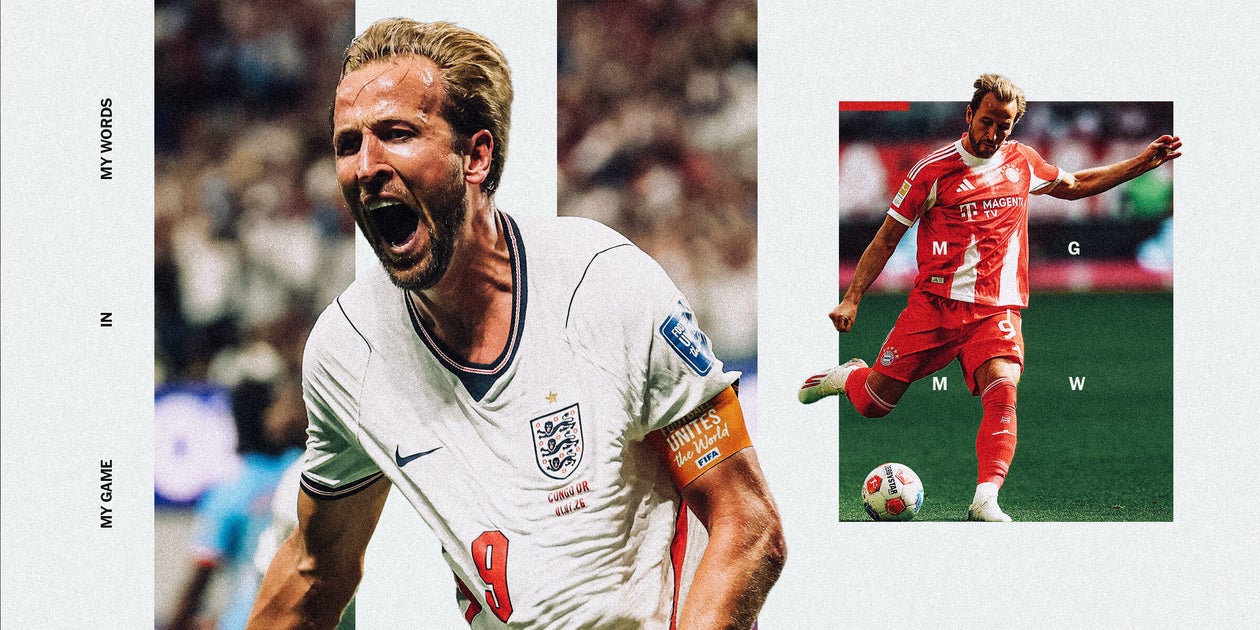
Байерны довтлогч Харри Кэйн өнгөрсөн улирлын амжилт болон талбай дээрх тоглолтын арга барилаа хуваалцав.
Харри Кэйн өнгөрсөн улиралд клуб болон шигшээ багийн төлөө нийт 73 гоол оруулж, Байерны хамтаар дотоодын хос цомыг хүртсэн юм. Тэрээр Дэлхийн аваргын 32-ын даваанд БНАСАУ-ын эсрэг тоглолтын 86 дахь минутад хожлын гоолыг оруулсан нь карьерынх нь шилдэг мөчүүдийн нэг болсныг онцоллоо. Кэйн талбай дээр оновчтой байрлал эзлэх, хамгаалагчдын хөдөлгөөнийг ашиглан цохилт гүйцэтгэхдээ манекен ашиглан бэлтгэл хийдэг нь түүний өндөр түвшний гүйцэтгэлийн үндэс болдог гэв.
Аваргуудын лигийн хүрээнд Реал Мадридын хаалганд оруулсан гоол болон ПСЖ-ийн эсрэг Луис Диазад өгсөн дамжуулалт нь түүний талбайг харах чадвар, тоглолтын хэмнэлийг мэдрэх мэдрэмжийг илтгэж байна. Өдгөө 33 настай тэрээр Бундеслигт 94 тоглолтод 97 гоол оруулж, түүхэн дээд амжилтыг тогтоогоод байгаа бөгөөд бие бялдрын бэлтгэлээ өндөр түвшинд хадгалж, бэртэл гэмтлээс урьдчилан сэргийлэх тал дээр онцгой анхаардаг байна.
Байерн болон Харри Кэйн нар шинээр гурван жилийн гэрээ байгуулахад ойрхон байгаа бөгөөд талууд хэлэлцээрт хүрэхэд итгэлтэй байна. Тэрээр өнгөрсөн долоо хоногт Германы супер цомыг өргөж, Бундеслигийн эхний тоглолтод Штутгартыг 5-1-ийн харьцаатай хожсон амжилтаар улирлаа эхлүүлээд байна. Кэйн өдгөө Ballon d’Or шагналын гол нэр дэвшигчдийн нэгээр нэрлэгдэж байгаа нь түүний карьерын оргил үе үргэлжилж байгааг харуулж байна.
Дэлгэрэнгүйг эх сурвалжаас харах
↓Эх сурвалжийг нээх ↓
It’s late summer in the hazy Bavarian countryside.
In a sports club half an hour outside Munich, beside pale stone houses buttered by the sunshine and deer chewing quietly at the grass, Harry Kane is talking The Athletic through an individual season for the ages.
Kane scored 73 goals for club and country. But he is a prohibitive favourite to win the Ballon d’Or later this year because of his many other dimensions. Kane is football’s heavyweight goalscorer, but also the creative, physical and emotional heart of a Bayern Munich side that won a domestic double last season and will again contend to become European champions.
So, with a laptop between us and highlights loaded up, each describing a different part of his game capturing him at his best, the England captain is ready to show us what football looks like through his eyes.
This is Harry Kane, My game in my words…
It’s the 86th minute of England’s World Cup round-of-32 tie against DR Congo. The score is 1-1 and having equalised, Kane is about to score a winning goal of the very highest quality.
“It’s one of my best finishes in an England shirt,” he says, “maybe of my career.”
With his back to goal, three defenders close by, and two team-mates — Bukayo Saka and Anthony Gordon — well placed to receive a pass, it does not look like a scoring opportunity at all.
“Whenever I’m around the box, especially on the edge of the box, my first thought is always to get a shot off. Because I know that anywhere around there, if I can get a good touch and then a clean shot, then I’m either going to be working the goalkeeper or I’m scoring.”
“In this moment, Ant does really well to see the pass, because he could have easily just taken another touch and gone wide, but he saw the forward pass.

“I try to play on the half-turn as much as possible, so I can feel there’s a bit of space between me and the defender, so once I’ve had that touch, I’m then trying to process where the best place is to get a shot off — or where’s the quickest place to get a shot off.


“I don’t know if you can see here,” he says, pointing to the moment when he escapes the defenders, “but I try to slow down, take a half-touch, wait, and then take a bigger touch and speed it up.”


“Someone said to me recently — another player — that my biggest strength is being able to finish from uncomfortable positions. So, when I’m off-balance, I’m still able to get my shots off. A lot of players wouldn’t be able to generate the same power from that position.”

Kane’s produced maximum power for minimal backlift (Darrian Traynor/Getty Images)
It’s a tendency that has shown throughout Kane’s career. There are plenty of examples just from last season of Kane making strong contact while falling or despite being challenged. His first goal of the season, against RB Leipzig. An edge-of-the-box curler against Union Berlin. Or against Real Madrid, in the second leg of the Champions League quarter-final.
The winner against DR Congo was another, with Kane shooting on the run, at a perpendicular angle from the goal and still producing a pure, violent contact.

But in the split seconds after Kane freed himself from his markers, was the focus just on the contact or was there more method to it than that?
“When I got there, I knew that the defender was blocking my cross-goal finish, so I was thinking: can I go with power and can I go at the front post?
“Then, whenever I’m going front post, I’m always thinking that I probably need to start the shot outside the front post. So, in this situation, I’m actually using the defender.
“When you’re playing and everything’s so quick, you see the defender’s shape rather than who it is. That’s why I practice against mannequins so much: because it means you have the vision in your periphery.
“So, now I know he’s blocking a certain amount of the goal, I’m thinking I need to go strong, start it outside of him and then see how much power I can generate.”

Kane fires England past DR Congo (Joosep Martinson – FIFA/FIFA via Getty Images)
One of the biggest nights in Bayern’s season came in April, when they faced Real Madrid in the Bernabeu in the first leg of the Champions League quarter-final.
Kane was involved in the first goal, eventually scored by Luis Diaz, before bagging the second, at the end of a typical move, full of attacking chemistry, quick decisions and ruthless execution.
It began in the seconds after half-time. Aleksandar Pavlovic stole possession in the middle of the pitch, Real are caught upfield and outnumbered, and Diaz, Michael Olise and Serge Gnabry begin to push forward on the counter.
The Athletic pauses the clip.
“First of all, I’m there for the second ball,” Kane says, pointing at his position, slightly behind his team-mates.

“After (Pavlovic) wins the ball, I see Serge (Gnabry) making that run. If I was there, I’d be the one making that run, making sure that Michael then has the freedom to go one-on-one when he gets the ball.
“I like to wait; I want to see how the play develops. It’s natural for all the Real Madrid players to start sprinting back to try to stop Serge, Lucho (Diaz) or Michael, so I’ll hover in a position. Michael might just go one-on-one and score — if so, perfect — but if not, then I’m going to end up in a position of space at the edge of the box, because two of their players are out, their wingers are out, and so right now in my head I’m waiting, even though I’m still running.”
As the move develops, Kane continues to trail behind, remaining in the pocket of space as the attacking and defending players race away from him. He can also be seen glancing over his shoulder two or three times. What was he checking for?
“It’s everything. I’m taking a picture in my head of what’s around me. I’ll be checking for whether there’s another midfielder or defender on my blindside. Do I have a team-mate who I can play in first-time when I get the ball? You’re always taking those pictures of what’s around you.

“So here, for example, when I look over and see the winger is far away from me and see this defender is moving forward, I know that I’m going to have the whole edge of the box to myself.

“If you move it (the clip) forward…
“… then you can see me almost stop, because I know what’s coming.”

At this point, Olise has reached the edge of the box. His threat draws in two defenders. Kane points out that Gnabry’s diagonal run has distracted a third, Antonio Rudiger.

“But a really important part of this clip is Michael’s ball to me; it makes a big difference. Some players in this situation would just play a strong pass across, meaning that I’ve got to take a touch.
“But Michael knows where I want to shoot and he lays it into the perfect position to finish first time.”

“Right, so now I’ve got the pace of the ball (that I want). Had he played it harder, I would have had to take a touch and finish with my left. But as soon as the ball is released, I know that I’m going to be shooting from inside the D.
“Then it’s dictated by where the defenders are. I’m looking at where Rudiger is and, actually, this might be one where I could have gone either side. But I think the front post can be hard for the ’keeper, because his momentum is taking him into the middle of the goal and now he’s got to go back to where he came from.”


The same is actually true for Rudiger, who cannot block a shot shaped back across his body, against the momentum of his direction of travel.
Accuracy is key 🎯 pic.twitter.com/pEV1Kjostd
— FC Bayern München (@FCBayern) April 7, 2026
During the course of the interview, Kane mentions how often he uses mannequins in training and how important they are in tuning his instinct for where shooting opportunities lie.
This chance against Real Madrid carried an expected goals rating of just 0.07xG. But the different variables — the speed of Bayern’s break, the quality of Olise’s final pass, and how Kane used the defenders’ and goalkeeper’s position to guide his finish — made it look much, much simpler.
In the next round of the Champions League, Bayern faced Paris Saint-Germain. The first leg of that semi-final, which PSG won 5-4, will be remembered as one of the great European games of the last decade. And Bayern’s fourth goal was its masterpiece.
It was scored by Diaz, after a masterful first touch and a wicked dummy that rocked Marquinhos back on his heels, but the chance was created by a fabulous pass from Kane.
“So, I always want to turn and play forward quickly,” he says, with the clip paused on the moment he receives possession.
“As I’m on the turn, I know Lucho is either going to be wide or going to be in that attacking 10 position from where he’ll run in behind. In that split second when I turn and look up, I see him making the run and that he’s not wide.”

Bayern were in trouble in this game and found themselves 5-2 down in the second half. Dayot Upamecano made it 5-3 with a header from a set piece, but their position was still precarious.
“I always want to play the most effective pass and to play forward. If you’re 3-0 up, you might just want to keep the ball in this situation. But it was 5-3; we needed a goal, so it was time to take a risk.
“I think this is one of the best passes in my career. Just because of everything about it. It had to be pinpoint. It was like a floating sidefoot, but it had to come down (at the right moment).

“The way Lucho finished it made it even better.
“These are like the quarterback passes. I’m a big NFL fan and you see them drop (their passes) just over the heads of defenders.”
Like Tom Brady to Randy Moss, all those years ago? Yes, he agrees, with a smile.
“It still left Lucho with a lot to do, and it was his touch and finish that made the goal so special.”
This side of Kane’s game has attracted more attention since he left England. The way Bayern play, often with him in deeper positions, has emphasised these creative abilities and shown the range of different passes in his repertoire that allow him to create chances, or just progress the play from an early stage in a move.
As we can see from the visualisation below, he is capable of threading neat passes into the penalty area, but also enjoys spraying the ball out left and right to move the ball up the pitch.

It’s an armoury that seems to be expanding. He has long been able to play a long, driven diagonal, but there’s often delicacy to his play that allows him to break through the opposition lines at short range.
Is this something that he has consciously worked on as he has got older?
“Not so much, to be honest. When I think of my passing, especially the longer range passing, I used to work on that almost as much as my finishing when I was an academy player. I remember back in those days, I’d get (to training) an hour early with one of my team-mates and he would stand on one side of the box, I would stand on the other, and we would just drill passes. Left foot, right foot, left foot, right foot.
“So I think I’ve always had that. Even the last few years at Spurs we saw more and more of it, because I had a bit more freedom to get on the ball deeper. Maybe earlier with Mauricio Pochettino, I was more of a No 9 who waited for the play and then in behind the defence. I think from when Jose Mourinho came to the club, when you started to see me get more assists and develop that relationship with Son Heung-min. Then with Antonio Conte, it was the same and I would be playing in the wing-backs or full-backs (from deep positions).
“I think the passing has always been there. I played a lot as a midfielder at youth team level, too, so I understood different areas of the pitch and I enjoy being in that area. I feel like I can help the team by taking the ball under pressure and then playing forward with effective passes.”
Kane’s productivity in those positions is clear enough. He made 84 line-breaking passes in the Bundesliga alone last season. The next highest centre-forward managed 29.
That can be ascribed to Vincent Kompany increasingly using him at the beginning of possession phases. It was not unusual in 2025-26 to see Kane receive possession between his centre-backs, directly from goalkeeper Manuel Neuer.
Partly, as he says, that’s because he is comfortable receiving the ball under pressure and using it productively. But it also has a tactical purpose, too.
“We like to test the commitment of the opposition we play against,” Kane explains.
“It’s easy for a team to say that they’re going to press us man-for-man, but it takes a lot to actually do that. If you’re a centre-back and you’re marking me and I then drop around the halfway line, you might feel comfortable going that far.
“But if I then drop a little deeper, then all of a sudden you’re a centre-back and you’re playing as the highest presser, it takes a lot of practice from the opposition and their coach to really commit to that.”
The final clip comes from Bayern’s 5-0 win over Hamburg in September 2025 and Kane’s role in a move that flowed from one end of the pitch to the other. It was an early example of what Bayern’s counter-attacking play would look like last season, but also showed the burgeoning chemistry between their forwards.
The Athletic pauses the footage with the ball at Kane’s feet, after a Hamburg cross has been cleared.

“For me, here, it’s about beating my man. Can I get ahead of him? Because doing that and having the momentum puts me in a much better spot. So, if I was defending me in that position, I’d be trying to get in front to stop me running. I’d be blocking me or holding me.
“Once it goes to Lucho here, Nicolas Jackson does a really good job of stretching the play. The boss always wants one or two runners to make the pitch big and make the defenders drop.

“Sometimes, when Michael has the ball in this position, I’ll run across him for the slip ball. That’s because it gives him two options. He can either play me in there, or he can cut in and shoot. This time I was a little too far away from him, so I decided to hover back and create a five-yard gap between me and my centre-back.

“Michael sees it and plays a strong pass. This — again — is where the strength of the pass really matters. If it’s not a strong pass, it doesn’t get to me. And now, it’s touch and finish.
“But the touch is good, because it took me away from the centre-back’s momentum. A lot of defenders expect you to open up in that position and shoot with your left, but I change back to my right – and think that’s a goal that really highlights a lot of aspects of my game.”

One aspect worth lingering on is stamina: Kane covered 100 yards to score that goal and it was hardly an outlier. He’s able to play deep and still score as many goals as he has because of how much distance he has covered. STATSports performance data shows that last season he ran more than 10km per game in 30 games, when elite forwards typically cover around 9.2-9.4km. In 18 of those matches, he covered 11km or more. Those are startling numbers for a player who has just turned 33.
It’s also unexpected given the spate of injuries in the first half of his career. Between 2014 and 2020, he suffered three significant ankle issues and a hamstring tear serious enough to bring his longevity into question. To this day, Kane is perceived by some as a brittle athlete, even though the years since have shown him to be anything but.
“The biggest strength among top players is being available and I take a lot of pride in that,” he says. “Some people will call it luck, but I work extremely hard behind the scenes to make sure I’m available as much as possible.”
Since arriving in Germany in 2023, he has missed only six Bayern games through injury. He has also featured in 50 or more club and international games in each of those seasons.
Given his set of abilities — his passing range and his physical profile — Kane could probably have been expected to become a less mobile forward as he grew older, depending on his brain and technique to remain at the highest level.
In reality, his athleticism is becoming only more pronounced. He recorded his top speed in the Bundesliga last season (32.2km/h) and across the year as a whole, performed more accelerations and spent longer running at top speed. It’s not a coincidence.

The stats tell a story of impressive athleticism and durability for Kane at Bayern Munich (Kevin Voigt/GettyImages)
“After I had my hamstring back in January 2020,” he explains, “I basically tore the muscle off the bone and had to have surgery. There were a lot of questions about whether I’d ever return to being the same level. But I found a doctor who does a lot of acupuncture and electrical nervous system work, and working with him 100 per cent helped me, also with some of my old injuries.”
“From there, it’s just been about pushing myself with everything you can do off the pitch. Ice baths, saunas, recovery. You start to realise towards your late twenties that your career is not going to last forever and that you’re different to when you were 21. But I’m also someone who likes to take life as it comes.
“Whenever athletes get into their thirties, people always start asking about when they’re going to slow down. One of my heroes is Tom Brady, and he played until he was 44. And I think sometimes this is a perception thing. Everyone around you starts to talk about you slowing down, so you start to believe it. But I’m the opposite.
“Until I start seeing it in data or in my performance, I’m just going to keep pushing and see where that takes me.”
By the end of last season, Kane had scored 97 Bundesliga goals in 94 games, reaching that total faster than any player in history. He was quicker than Gerd Muller and Robert Lewandowski.
Across all competitions, he became the fastest player to score 100 goals for a club from the top five European leagues. And his relationship with Olise and Diaz, who feature so regularly in his personal highlights, has been ludicrously productive. Collectively, across last season’s Bundesliga and Champions League, those three players alone produced 141 goals and assists.
Kane himself posted numbers that no one else could touch.

A new three-year contract at Bayern is close; both sides are confident of reaching an agreement. No wonder. This is a relationship in perfect harmony. Kane and Bayern lifted the German Super Cup last weekend and won their first Bundesliga game on Friday night, beating Stuttgart 5-1.
The Ballon d’Or voting will also begin soon and, for him, that has never felt so achievable. Kane is arguably the most complete attacking player in world football today and his candidacy for its biggest individual prize is the strongest it has ever been.
(Additional contributors: Conor O’Neill, Thom Harris)

