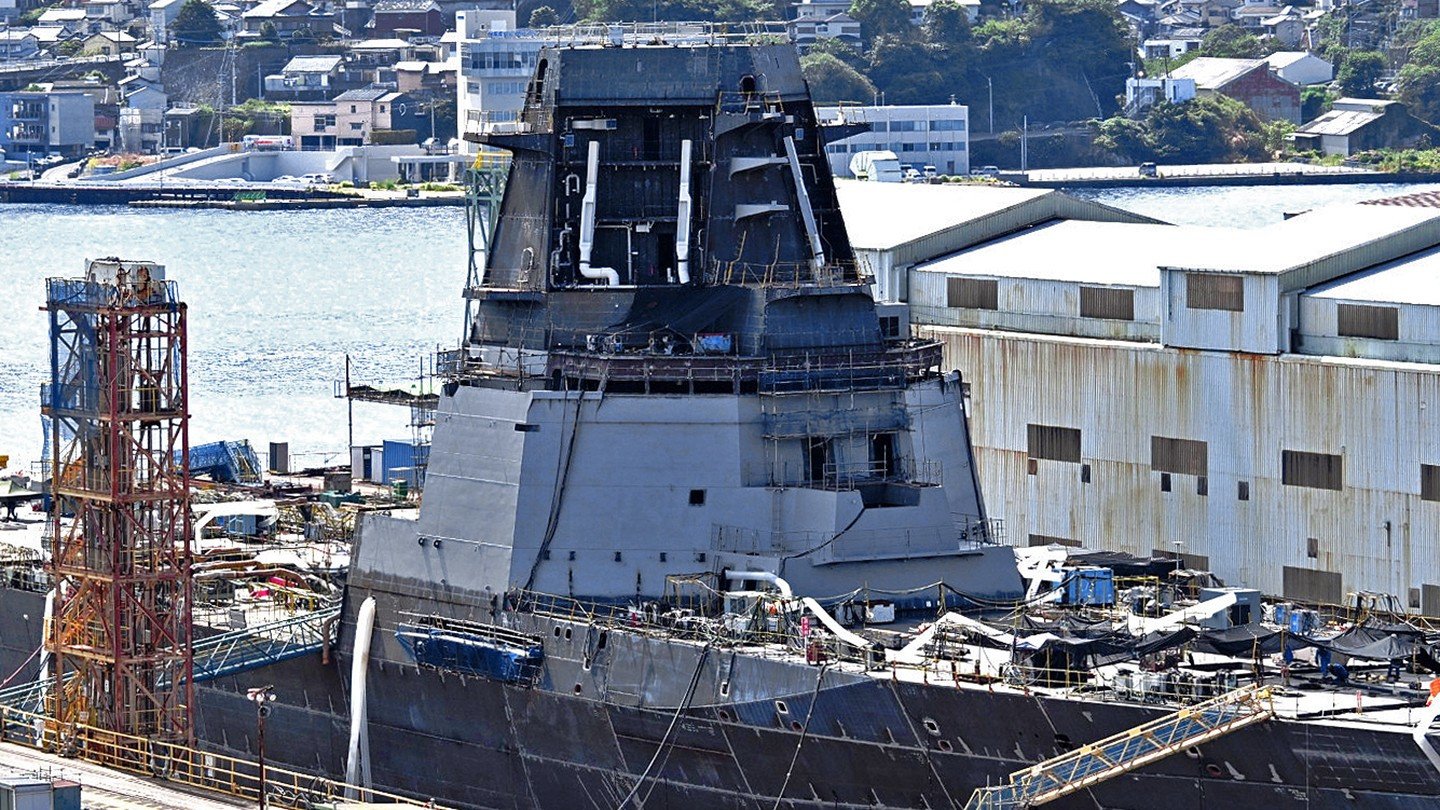
Нагасаки хотын усан онгоцны үйлдвэрт баригдаж буй ASEV ангиллын хөлөг онгоц нь AN/SPY-7(V)1 радар бүхий хүчирхэг тоног төхөөрөмжөөр тоноглогдож, бүс нутгийн аюулгүй байдлыг хангах гол хэрэгсэл болох төлөвтэй байна.
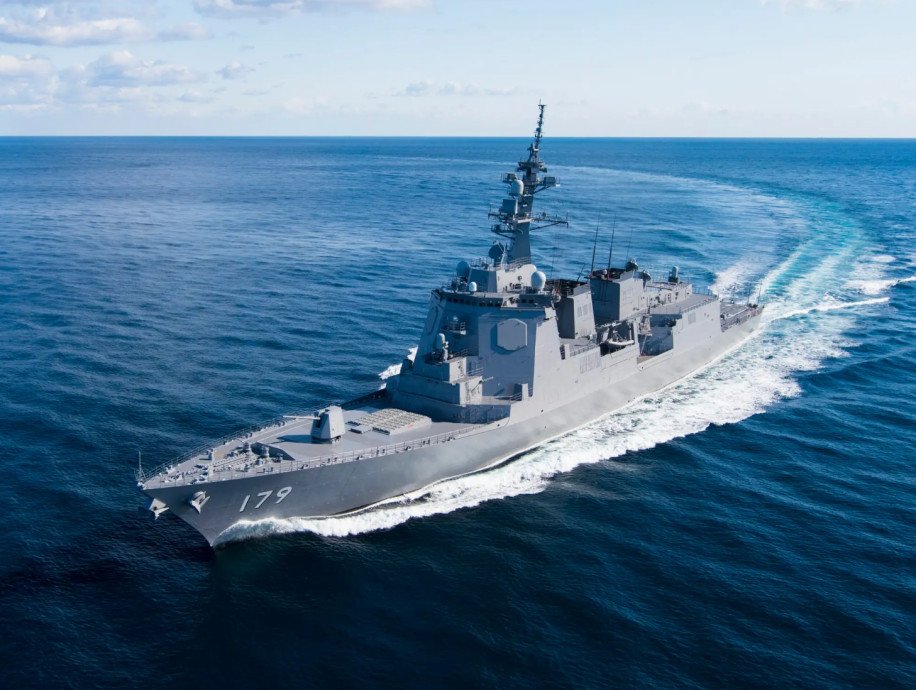
Япон улс пуужингийн довтолгооноос хамгаалах зориулалттай, “Aegis System Equipped Vessels” (ASEV) хэмээх хоёр хөлөг онгоцыг бүтээж байна. Одоогоор эхний хөлөг онгоцны их биеийн бүтээн байгуулалт Нагасаки хотод, хоёр дахь хөлөг онгоцны ажил Иокогама хотод тус тус явагдаж байгаа юм. Эдгээр хөлөг онгоц нь 12,000 тонн усны түрцтэй, 620 фут урттай бөгөөд одоогийн Японы тэнгисийн цэргийн хүчний хамгийн том “Maya” ангиллын сөнөөгч онгоцноос хавьгүй том хэмжээтэй юм.
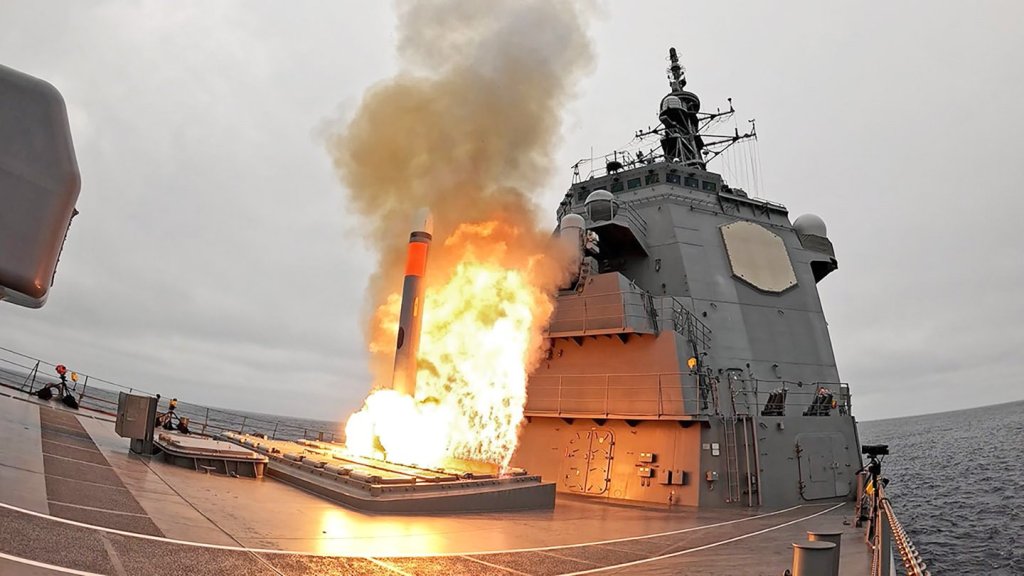
Хөлөг онгоцны үндсэн зэвсэглэлд SM-3 болон SM-6 стандартын пуужингууд багтах бөгөөд 128 ширхэг босоо пуужин харвах төхөөрөмжөөр (VLS) тоноглогдоно. Японы Батлан хамгаалах яамны мэдээлснээр, эдгээр хөлөг онгоц нь баллистик пуужингаас хамгаалах үндсэн үүргээс гадна ирээдүйд нисгэгчгүй онгоц, усан доторх болон хуурай газрын байг устгах чадавхтай болох аж. Мөн 2032 он гэхэд Tomahawk далавчит пуужин болон Type-12 ангиллын пуужингуудыг зэвсэглэлд нэмж оруулахаар төлөвлөж байна.
Эдгээр хөлөг онгоцыг Японы 2027 оны санхүүгийн жил дуусахаас өмнө ашиглалтад оруулахаар зорьж байна. Энэхүү технологийн шинэчлэл нь Хятад, Орос болон Хойд Солонгосын зүгээс ирж буй пуужингийн болон бусад аюулаас хамгаалах зорилготой бөгөөд Японы батлан хамгаалах стратегийг “алсын зайн хамгаалалт” (stand-off defense) үзэл баримтлал руу шилжүүлэхэд чухал үүрэг гүйцэтгэнэ.
Дэлгэрэнгүйг эх сурвалжаас харах
Эх сурвалжийг нээх ↓
The first of Japan’s two new cruiser-sized Aegis System Equipped Vessels (ASEV) is continuing to take shape, recently receiving its huge main integrated mast, giving the vessel a new and remarkably imposing silhouette. The four very large fixed arrays for the ship’s powerful AN/SPY-7(V)1 radar will eventually be integrated onto this structure. The ASEV’s stated primary mission is missile defense, but Japanese authorities plan to give the vessels additional counter-drone, anti-ship, and land attack capabilities in the future. Tomahawk cruise missiles are notably set to be added to the ship’s arsenal down the line.
The ASEVs are large surface combatants, set to be some 620 feet long, have a beam (the widest point of the hull) of some 82 feet, and a standard displacement of 12,000 tons. For comparison, Japan’s largest surface combatants today, its Maya class destroyers, are just over 557 feet long, have a beam of some 73 feet, and a standard displacement of around 8,200 tons. It is worth noting here that the size of new and advanced destroyers, often optimized for anti-air warfare missions, has been trending upward globally in recent years. This, in turn, has caused the line between destroyers and what have more historically been categorized as cruisers to blur in certain cases.
The first ASEV was laid down at Mitsubishi Heavy Industries’ (MHI) shipyard in Nagasaki in July 2025. The second was laid down in February of this year at Japan Marine United Isogo shipyard, which is situated in Yokohama City near Tokyo, according to a past report from Naval News. The Japanese Ministry of Defense is currently aiming to have the first of these vessels in service before the end of the country’s 2027 Fiscal Year, which runs from April 2027 to March 2028. The second is expected to follow in the 2028 fiscal cycle, which extends into 2029.
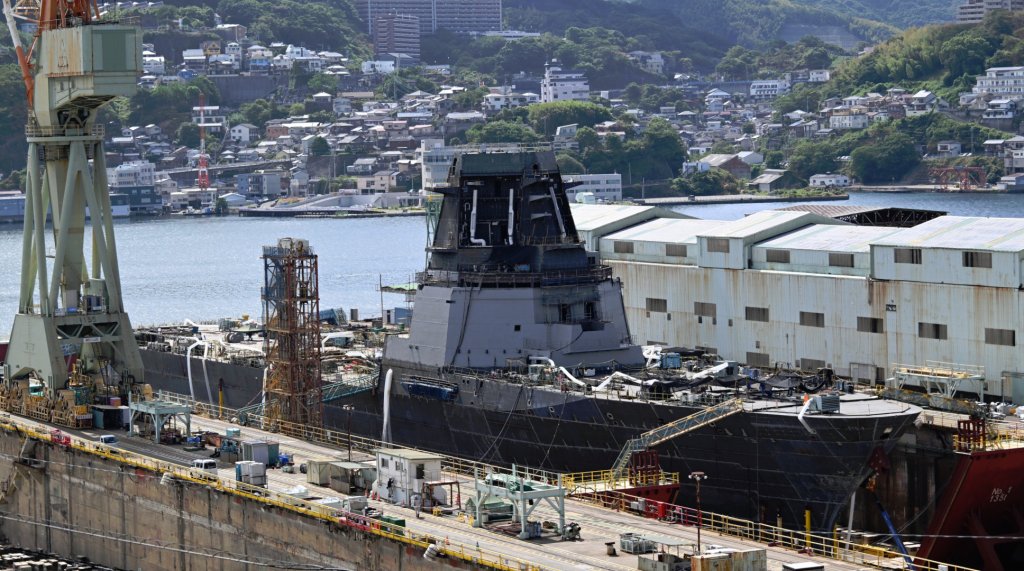
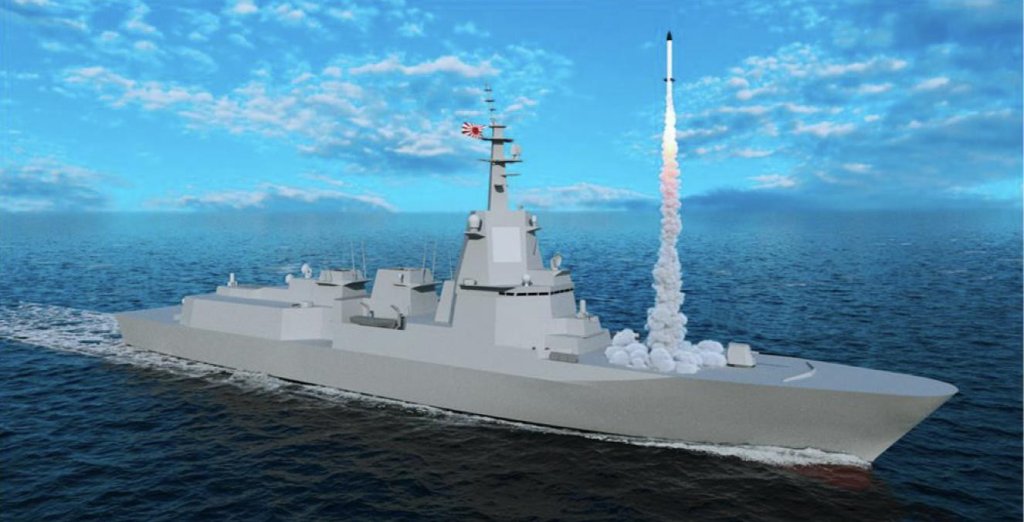
Significant progress in the overall construction of the first ship has been made just this year. The addition of the main mast structure, installed on top of the main superstructure, as seen in pictures at the top of this story and below, has drawn particular attention in recent weeks.
The especially large size of the ASEV’s integrated mast is driven by that of the AN/SPY-7(V)1 active electronically-scanned array (AESA) radar from Lockheed Martin. Each one of the radar’s four rectangular arrays is reportedly around 14 feet (nearly 4.3 meters) tall. This would put them in the same general size category as the arrays for Raytheon’s AN/SPY-6(V)1 Air and Missile Defense Radar (AMDR) found on U.S. Navy Flight III Arleigh Burke class destroyers. That being said, the pictures we have now raise the question of whether the AN/SPY-7(V)1 arrays are bigger than previously assessed. The AMDR is another notably large design heavily optimized for missile defense.
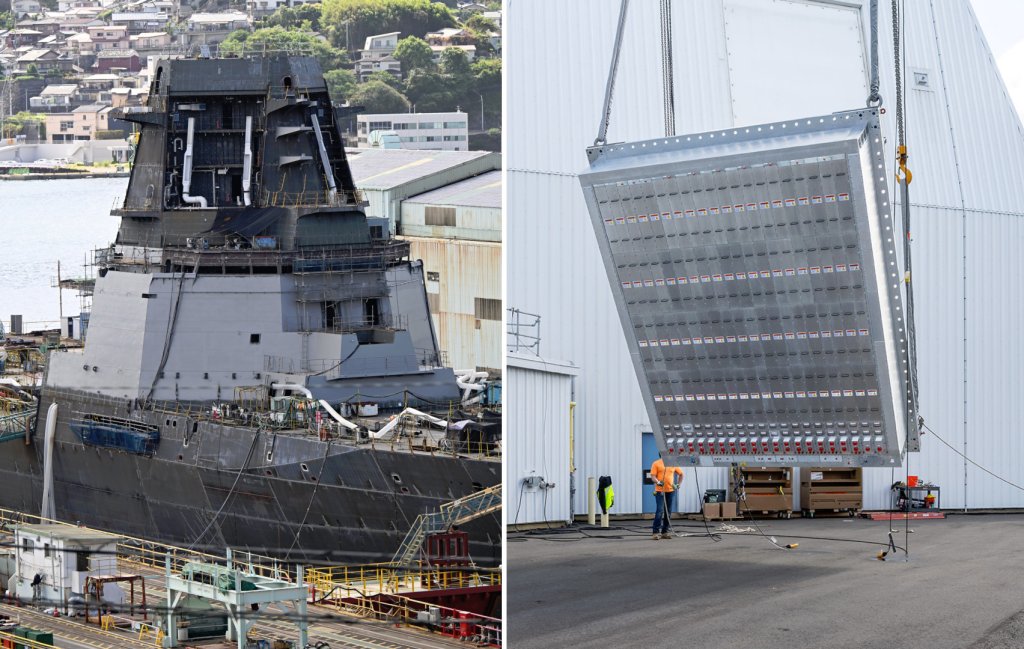
The size and location of the mast provide a centralized, elevated position for the AN/SPY-7(V)1’s large arrays, which will also require significant power generation capacity and thermal management to keep everything cool. This is a notable departure from the placement of the arrays on the main superstructure on existing Japanese destroyers, as well as the U.S. Arleigh Burke class, and offers an unobstructed, elevated line-of-sight to the horizon. Beyond the ballistic missile defense mission, this view farther out over the horizon would be important for tracking and engaging low-flying drones and cruise missiles, which might be targeting the ship itself. This is something we will come back to later on.
“With five times the tracking capability of the SPY-1, it [the AN/SPY-7(V)1] counters lofted trajectories and simultaneous multiple ballistic missile threats,” according to a machine translation of a section of the Japanese Ministry of Defense’s 2026 defense policy white paper, which was released earlier this month.
The passive electronically-scanned array (PESA) AN/SPY-1 was the first radar to be paired with the Aegis Combat System, and both were first introduced in the 1970s. Variants of the SPY-1 are still found on a variety of U.S. and foreign Aegis-equipped warships, including Japan’s Kongo, Atago, and Maya class destroyers.
The AN/SPY-7(V)1 is also a derivative of the U.S. military’s static, land-based Long Range Discrimination Radar(LRDR) in Alaska. Japan also originally planned to employ the AN/SPY-7(V)1 on land at a pair of Aegis Ashore missile defense sites. However, that effort was subsequently cancelled, with the ASEV emerging to fill the resulting gap.
Additional versions of the AN/SPY-7 with much smaller arrays are also being integrated onto new F110 Bonifaz class frigates for the Spanish Navy and the Royal Canadian Navy’s forthcoming River class destroyers (also known as the Canadian Surface Combatant). The use of the AN/SPY-7(V)1 on the ASEV could impact decisions regarding new radars for other future and existing Japanese warships. Raytheon is also pitching versions of its increasingly popular AN/SPY-6 family for use on a successor to the Kongo class and for refit on the Maya class, according to a recent report from Naval News.
When it comes to the ASEV, as already noted, the AN/SPY-7(V)1 is central to the ship’s main stated missile defense mission. As the name makes clear, the ship will also feature the Aegis Combat System. The vessel will be capable of “remote engagement and guidance against anti-air targets tracked by other vessels” via a “Cooperative Engagement Capability (CEC),” per the Japanese Ministry of Defense’s most recent annual defense white paper.
The video below provides details about the U.S. Navy’s Cooperative Engagement Capability (CEC) developments, which are likely very similar to what Japan has planned for the ASEV.
In terms of armament, when the ASEVs first enter service, their main weaponry is expected to be a mix of variants of the Standard Missile-3 and -6 (SM-3 and SM-6). The SM-3 family is designed to engage ballistic missile threats during the mid-course portion of their flights while they are traveling outside of the Earth’s atmosphere. The SM-3 also has a demonstrated anti-satellite capability. The SM-6 is a multi-purpose missile that was originally designed with an anti-air focus. It can be used to target incoming ballistic missiles in the terminal phase of flight and also has at least a degree of capability for engaging hypersonic weapons. SM-6 can be used in a surface-to-surface mode, including against ships, as well. Japan is also a partner in the U.S.-led development of a new Glide Phase Interceptor (GPI), which is being designed specifically to intercept unpowered, but highly maneuverable hypersonic boost-glide vehicles.
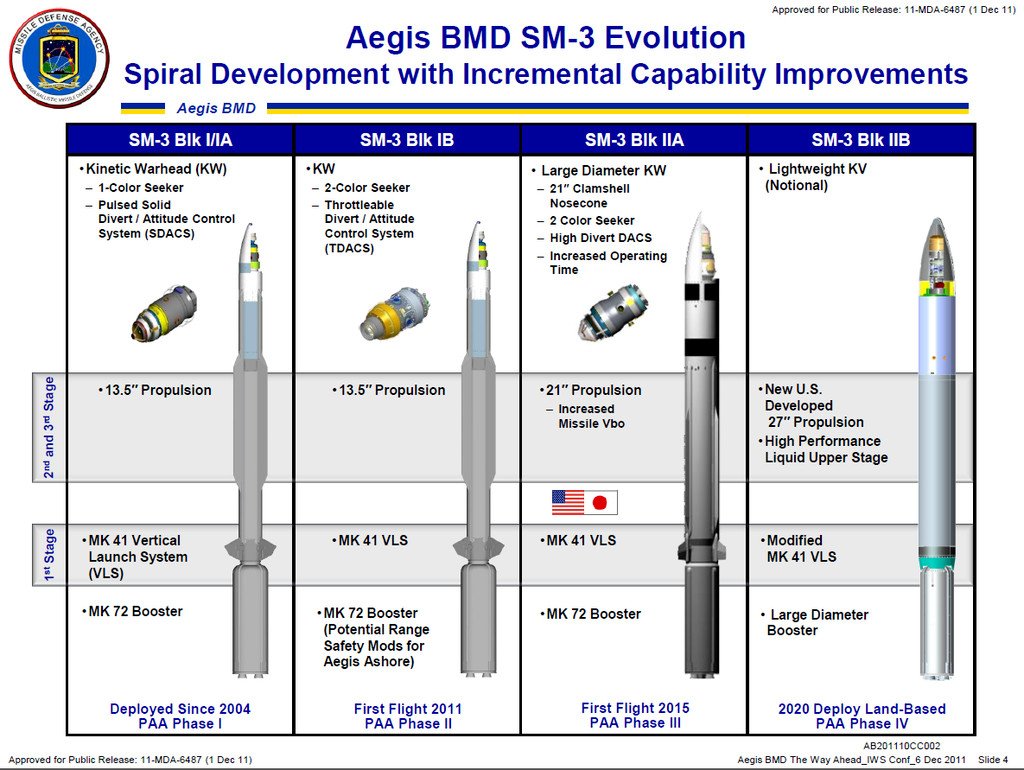
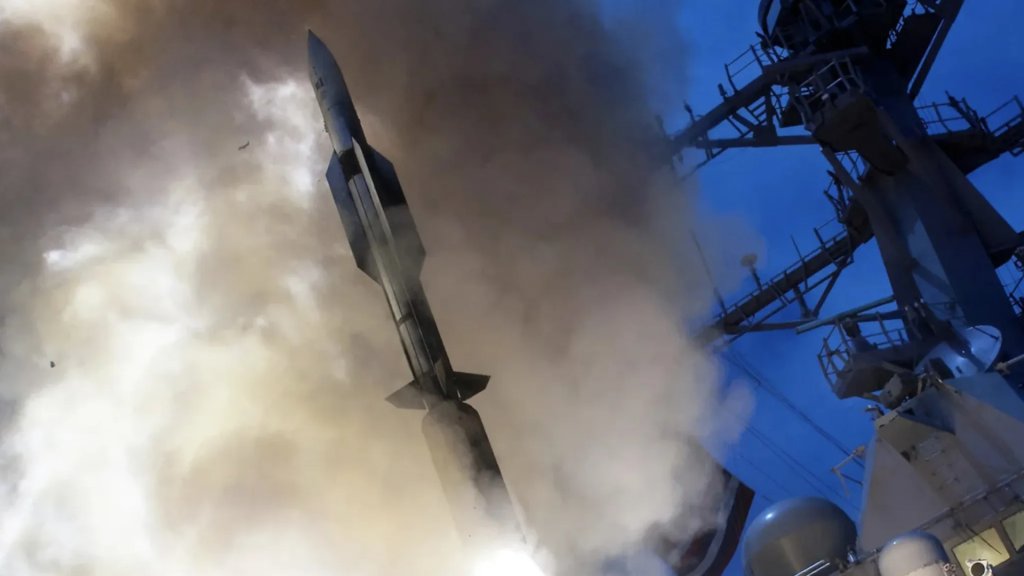
SM-3, SM-6, and future GPIs will be loaded into either of the ASEV’s two Vertical Launch System (VLS) arrays, one at the bow end and another toward the stern. Each one of the ships will have a total of 128 VLS cells. For comparison, Japan’s Maya class destroyers, as well as the U.S. Navy’s Flight IIA and III Arleigh Burke class destroyers, have 96 VLS cells apiece. The U.S. Navy’s Ticonderoga class cruisers each have 122 VLS cells. 128 is also the number of VLS currently expected to be found on the future Trump class battleships.
At the time of writing, Japanese authorities do not appear to have explicitly mentioned plans to arm the ASEVs with other missiles when they first enter service. That being said, any VLS array capable of accommodating SM-3s and SM-6s should be able to fire a variety of other weapons, including shorter-ranged SM-2s and Evolved Sea Sparrow Missiles (ESSM), which the ship could use for more localized air and missile defense, as well as protecting the ship itself.
Renderings and models of the ASEV do show the design also armed with a five-inch naval gun in a turret on the bow, along with two Phalanx Close-in Weapon Systems (CIWS) and other automatic cannons for point defense.
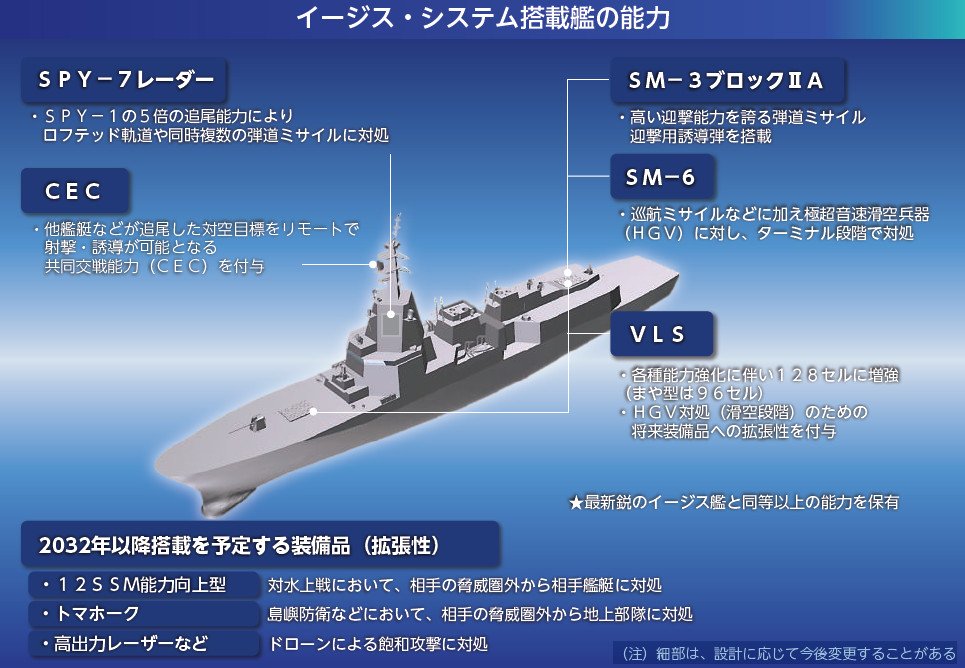
As mentioned, while missile defense is the immediate focus for the ASEVs, there are already plans to significantly expand their capability to engage other ships and targets on land. Tomahawk cruise missiles and a new, extended-range version of the Type 12 anti-ship cruise missile are set to be added to the arsenal of these vessels in the 2032 timeframe, according to the latest official Japanese defense white paper.
Japanese authorities want the ASEVs to eventually be able to help fend off waves of enemy drones, too. High-energy laser-directed energy weapons are set to be integrated onto the ships down the line to help address those threats. The overall size and other general characteristics of the ships would leave the door open to the possible addition of high-power microwaves and other capabilities in the future.
TWZ has long noted that the ASEVs will bring huge new boosts in naval air and missile defense and long-strike capability to the Japan Maritime Self-Defense Forces. The vessels also reflect a significant evolution in post-World War II Japanese doctrine, toward what officials currently frame as a “stand-off defense” construct that remains within the bounds of the country’s current pacifist constitution.
Just with SM-3, SM-6, and GPI, the ASEVs will offer an important addition to the air and missile defense bubbles around Japan’s home islands and outlying territories in the face of growing geopolitical friction with China and Russia, two countries that are increasingly cooperating militarily. The vessels will also add to Japan’s deterrent against long-standing and still evolving threats posed by the regime in North Korea, which has its own close ties to the Chinese and Russian governments. All three of these nations continue to expand their arsenals of ever-more capable ballistic, cruise, and hypersonic missiles. Long-range one-way-attack drones are another growing part of the equation, with the ongoing conflict in Ukraine and fighting in the Middle East in recent years underscoring just how real a threat they pose.
With the addition of Tomahawks, the ASEVs, along with other Japanese warships, will gain the additional ability to threaten counterstrikes against targets on land (and potentially at sea) at least around 1,000 miles in any direction. As part of the broader stand-off defense strategy, the Japan Self Defense Forces is developing new land-based long-range strike capabilities, including hypersonic missiles, as well.
It is worth noting that with current plans to acquire only two ASEVs, these will be high-value, but also low-density assets, which will have to be very deliberately deployed for maximum effect. They will also stand out as top-priority targets in any future conflict, and will need to be protected as such.
It is possible that the roles and missions of the ASEVs, just like their designs, could evolve further as time goes on. The threat ecosystem facing Japan will continue to evolve, likely more rapidly, in the coming years. The country is also expanding its naval capabilities in other ways, and with an eye toward more blue water operations. This includes expanded light carrier capabilities through refits of existing Izumoclass ships. Anti-ship ballistic missiles and hypersonic cruise missiles, among large volumes of more traditional threats, could see the ASEVs used as escorts, even if experimentally. While just two hulls are barely enough to keep one on patrol to protect Japan, more could be built for expeditionary applications.
Regardless, the ASEVs are set to be a major addition to the Japan Maritime Self Defense Force’s fleets that will have big ramifications. From the progress that is visible at the shipyard in Nagasaki, MHI looks to be well on track to deliver the first of these ships next year or two.
Special thanks to @kensakai9310 on X, who also goes by “Sakai,” for sharing recently taken pictures of the first ASEV under construction at MHI’s yard in Nagasaki with us.
Contact the author: joe@twz.com
The post Japan’s First Dedicated Missile Defense Warship Is A Monster appeared first on TWZ.

