Шинэ судалгаагаар Ангараг гарагийн гадаргын ялгаатай байдал нь түүний гүн дэх дулааны ялгаатай шууд холбоотой болохыг илрүүлжээ
Аризонагийн их сургуулийн судлаач Александр Бернэ болон түүний баг Ангараг гарагийн гүний бүтцийг тодорхойлохын тулд таталцлын хүчний өөрчлөлтийг ашиглан шинэ загвар бүтээжээ. Тэд NASA-гийн Mars Global Surveyor, Mars Odyssey болон Mars Reconnaissance Orbiter сансрын хөлгүүдийн олон арван жилийн турш цуглуулсан хэмжилтийн өгөгдлийг ашиглан Ангараг гарагийн дотоод бүтцийн гурван хэмжээст загварыг гаргасан байна. Судалгаанд Нарны таталцлын хүчний нөлөөгөөр гарагийн хариу үйлдлийг судалдаг “tidal tomography” хэмээх аргыг ашиглажээ.
Судалгааны үр дүнгээр Ангараг гарагийн өмнөд хагас бөмбөрцгийн гүн дэх температур хойд хэсгээс 200-400 хэмээр илүү дулаан болох нь тогтоогджээ. Эрдэмтэд өмнөд бүсийн мантийн зарим хэсэг хэсэгчлэн хайлсан байж болзошгүй гэсэн таамаглал дэвшүүлж байна. Энэхүү температурын зөрүү нь NASA-гийн InSight хөлгийн илрүүлсэн чичирхийллийн долгион өмнөд хэсгээр дамжихдаа эрчим хүчээ хурдан алддаг үзэгдлийг тайлбарлах боломжтой юм.
Энэхүү нээлт нь гарагийн соронзон орны нууцлаг хэв шинж болон эртний усны үлдэц бүхий сав газруудын үүслийг ойлгоход чухал ач холбогдолтой юм. Температурын энэхүү ялгаа нь Ангараг гарагийн гадаргын болон гүний бүтцийн хувьсал хоорондоо нягт холбоотой болохыг харуулж байна. Температурын тэнцвэргүй байдал үүссэн шалтгаан нь тодорхойгүй хэвээр байгаа бөгөөд судлаачид үүнийг аварга том мөргөлдөөн, мантийн конвекцийн урсгал эсвэл дулааныг хуримтлуулсан геологийн бүтэцтэй холбоотой байж болзошгүй гэж үзэж байна.
Дэлгэрэнгүйг эх сурвалжаас харах
↓Эх сурвалжийг нээх ↓
A recent study has found that there is an important thermal difference on Mars. The area in the southern part of the interior of Mars is about 200 to 400 °C warmer than the northern part of the interior. Some researchers have suggested that some areas in the southern part of the mantle may be at least partially melted.
This research changes how scientists understand the dichotomy on Mars. For years, most scientists thought that the major differences between the very flat northern plain and the much higher elevations and many craters of the southern highlands were strictly limited to just the top layer or “surface” of Mars. Now it seems that these same major differences exist deep inside the Red planet.
The researchers made their discoveries using data from NASA space vehicles. Their research offers new information for a number of other questions about Mars such as; what caused strange patterns in the magnetic field of Mars? why did NASA’s InSight lander detect certain types of seismic activity while studying the planet? what can geologists learn from evidence related to water on Mars during the distant past?
Mars Hides A Warmer Region Below
The research was led by Alexander Berne, a Caltech alumnus now working as a postdoctoral associate at the University of Arizona. His team created a model that uses small variations in gravity to estimate the internal structure of Mars.
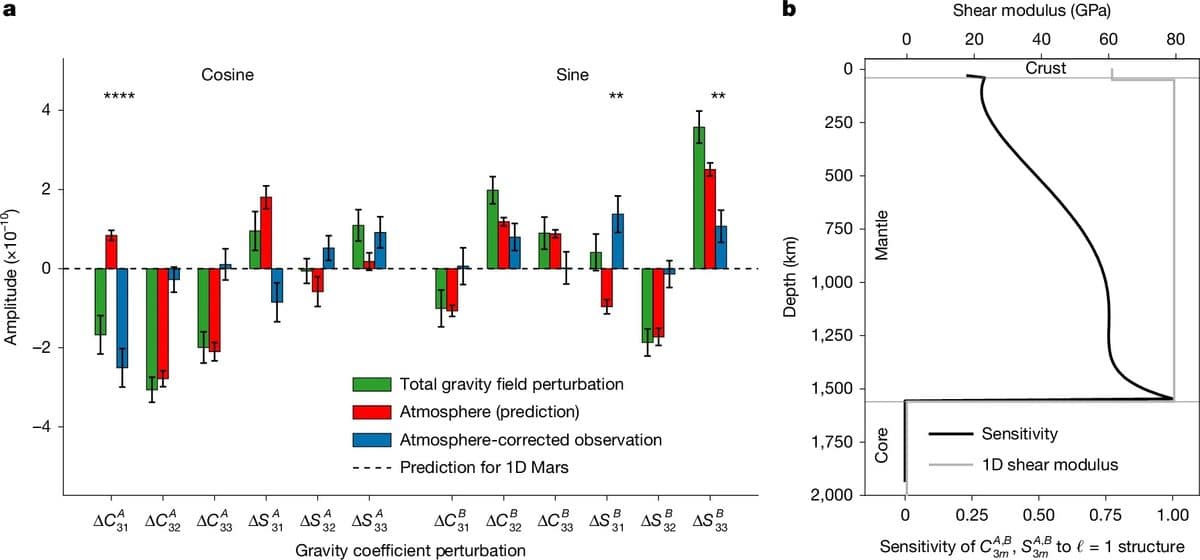
The researchers studied decades of measurements from Mars Global Surveyor, Mars Odyssey, and Mars Reconnaissance Orbiter. By tracking tiny changes in spacecraft velocity caused by variations in Mars’s gravitational field, the team reconstructed information about the planet’s interior.
The analysis relied on a technique called tidal tomography, which examines how a planet responds to changes in gravitational forces from the Sun. Mars’s slightly elliptical orbit and tilted rotation axis create variations that can be measured and used to study internal structures. Berne explained that:
“Scientists usually assume that the interiors of planetary bodies are generally spherically symmetric, but this is not necessarily true.” he added, “As we get more gravity data, we can determine the three-dimensional intricacies of a planet’s interior structure. These inferences in turn give us a blueprint for designing future missions and scientific exploration of these worlds.”
The new model shows that the Red Planet contains significant internal variations, with a much warmer region beneath the southern hemisphere.
A Hotter Mantle Beneath Mars
The newly identified heat anomaly provides a possible explanation for several unusual observations recorded on Mars. Iron-rich minerals in the southern hemisphere preserve distinctive magnetic signatures linked to the planet’s ancient magnetic environment. The warmer southern interior could help explain why magnetic patterns differ between regions of Mars.
The temperature difference also connects with data collected by NASA’s InSight lander, which studied seismic activity on the planet. The mission found that seismic waves lose energy more quickly when moving through the southern hemisphere.

Researchers found that higher temperatures inside Mars could influence the way seismic waves travel through planetary material. The thermal divide therefore offers a possible connection between deep internal conditions and measurements collected at the surface.
The origin of this temperature imbalance remains uncertain. The research team identified several possible explanations, including a giant impact that released heat from the northern region, ancient convection within the southern mantle, or geological structures that trapped heat and slowed its escape.
A Heat Divide Inside Mars
This discovery may also help clarify how Mars evolved during the periods when it still had liquid water on its surface. The authors noted that the north-south divide is important for understanding processes that influenced its hydrology, including the formation of basins that may have held water.
The connection between the planet’s interior and surface evolution could help explain how its landscape changed over time. Amirhossein Bagheri, a postdoctoral scholar at Caltech and co-author of the research, said:
“The dichotomy that we see between north and south is important to understand because it gives information about processes that may have influenced the hydrology of Mars, including the formation of basins that may have held water.”

Through the study of gravity variations, researchers are now able to probe regions of Mars that remain otherwise inaccessible. The finding of a hotter southern interior shows that the planet’s most obvious surface divide is mirrored deep beneath its crust, preserving traces of the events that shaped the planet across billions of years.
Enjoyed this article? Subscribe to our free newsletter for engaging stories, exclusive content, and the latest news.

