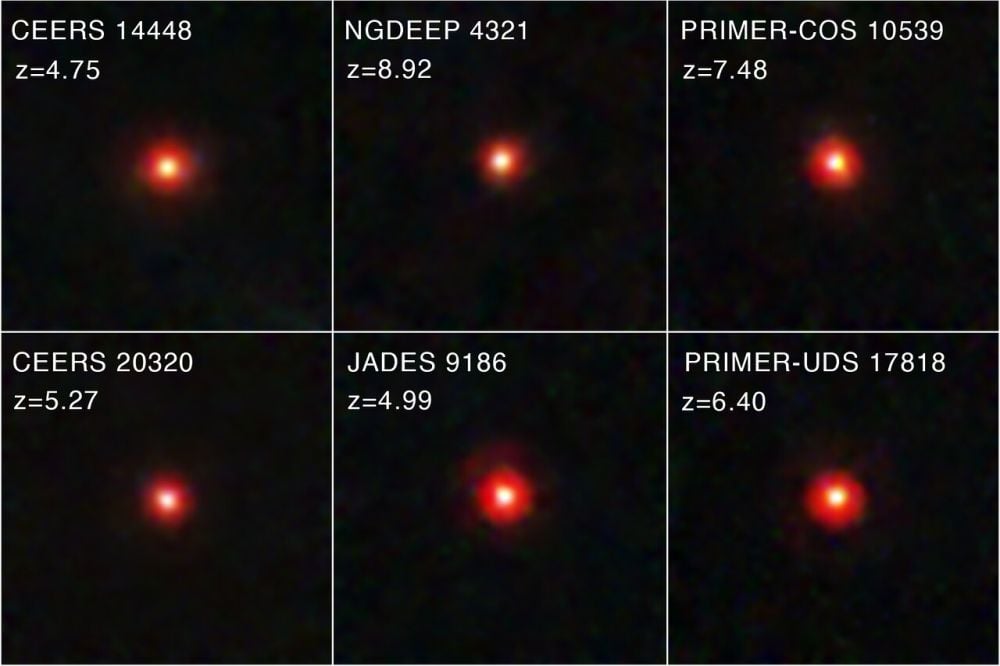
Эрдэмтэд Жэймс Вэбб сансрын телескопын тусламжтайгаар хэт их масстай хар нүхнүүдийн эрт үеийн өсөлтийн үе шат гэж үздэг “бяцхан улаан цэгүүд”-ийн хос хосоороо нэгдэх гэж буй дүр зургийг олж тогтоолоо.
Токиогийн их сургуулийн Кавлийн сансар судлал, математикийн хүрээлэнгийн судлаач Такуми Танака тэргүүтэй баг “Publications of the Astronomical Society of Japan” сэтгүүлд нийтлүүлсэн судалгаандаа энэхүү нээлтийг танилцуулав. Тэд COSMOS-Web судалгааны өгөгдлийг ашиглан, пиксел тус бүрийн өнгөний ялгааг нарийвчлан шинжлэх шинэ аргачлалын тусламжтайгаар нэгдэхэд бэлэн байгаа дөрвөн хос “бяцхан улаан цэг”-ийг илрүүлжээ. Эдгээр объект нь 5300-аас 24000 гэрлийн жилийн зайд байрлаж байгаа нь тэдгээрийг нэгдэх үйл явцдаа орсон гэдгийг баталж байна.
Хэт их масстай хар нүхнүүд хэрхэн ийм асар том хэмжээтэй болдог нь одон орон судлалын хувьд олон жил тайлагдаагүй оньсого байсаар ирсэн. Судлаачдын үзэж буйгаар, эдгээр “бяцхан улаан цэгүүд” нь хар нүхнүүдийн эрт үеийн өсөлтийн үе шат бөгөөд тэдгээрийн нэгдэл нь хэт их масстай хар нүхнүүд огцом хурдаар томроход нөлөөлдөг гол хүчин зүйлсийн нэг байж болох юм. Энэхүү үйл явц нь галактикийн хувьсал, оддын үүсэл болон идэвхтэй галактикийн цөмүүдийн хоорондын уялдаа холбоог ойлгоход чухал ач холбогдолтой юм.
Гэсэн хэдий ч судалгааны хүрээ одоогоор хязгаарлагдмал байгааг эрдэмтэд хүлээн зөвшөөрч байна. Цаашид илүү өргөн хүрээтэй судалгаа явуулж, илүү олон спектроскопийн өгөгдлийг цуглуулах нь эдгээр объектын мөн чанар болон галактикийн хувьсалд гүйцэтгэх үүргийг бүрэн дүүрэн тайлбарлахад чухал алхам болох юм.
Дэлгэрэнгүйг эх сурвалжаас харах
Эх сурвалжийг нээх ↓
There’s widespread agreement that large galaxies in today’s Universe host supermassive black holes (SMBH). But how exactly these black holes becane so massive isn’t clear, even though astrophysicists know mergers have something to do with it. There are many unanswered questions around the process and how it’s played out over more than 13 billion years of cosmic history.
Somehow, these SMBH behemoths came to have millions or billions of solar masses. Sgr. A*, the Milky Way’s SMBH, has more than four million solar masses. One of the JWST’s science goals is to observe the very early Universe for clues to how SMBH like Sgr. A* became so massive.
When the JWST discovered its infamous Little Red Dots (LRD), it generated excitement and curiosity. Most think that they’re related to black holes, and could be the early stages of SMBH growth.
New research in Publications of the Astronomical Society of Japan presents evidence that LRDs are in fact early black holes, and that their mergers leads to SMBH. It’s titled “Hidden in Pixels. I. Discovery of dual “little red dots” indicates excess clustering on kilo-parsec scales.” The lead author is Takumi Tanaka, a graduate student at The University of Tokyo Kavli Institute for the Physics and Mathematics of the Universe.
The authors point out that SMBH and their feedback are critical parts of galactic growth and evolution. “The tight relation between black hole mass and galaxy properties, such as stellar velocity dispersion, bulge mass, and stellar mass observed in the local universe implies that SMBHs influence star formation in galaxies through feedback from active galactic nucleus (AGN) activity,” they write. This means that, by extension, understanding LRDs, SMBH, and galaxies, are all related.
Though there’s widespread agreement that LRDs are related to SMBH, the exact nature of that relationship is far from clear. But in this work, the researchers found pairs of LRDs that are so close to each other, a merger seems almost certain.
“‘‘Little Red Dots” (LRDs) are an abundant high-redshift population newly discovered by the James Webb Space Telescope (JWST) and considered to be an early growth phase of supermassive black holes (SMBHs),” the authors write. “Using a method of pixel-by-pixel color selection and relaxing the compactness criteria, we identify four dual LRD candidates in the COSMOS-Web survey with projected separations of 0″2 – 1″2.”
“Assuming that the detected lines are Hα based on its high equivalent width and broad profile, the spectroscopic redshifts of z = 5.822 and 5.464 for the two pairs are consistent with their photometric redshifts, yielding projected separations of 1.64 and 7.36 kpc,” the authors write. That’s about 5,300 and 24,000 light years.
According to the authors, this isn’t an error. “A comparison between existing LRD samples and mock data reveals that the projected separations of these dual LRD candidates are unlikely to result from chance projections of objects at different redshifts,” the authors write.
These panels are false-colour infrared JWST images of the four pairs of LRDs. The white lines in the lower right corners show the length of about 5000 light years. (Image Credit: COSMOS-Web / Tanaka)
It would be easy to mistake these pairs for a single object. But Tanaka and his co-researchers developed a new method that goes pixel-by-pixel, examining the colour of each one. In this work, they actually looked for LRDs that could appear as a single object. These are the ones most likely to be pairs of LRDs in reality.
Since the LRDs are only separated by perhaps a few tens of thousands of light years, they’re very close to one another. For comparison, the visible component of the Milky Way is only about 100,000 light years across.
One explanation for LRDs is that they’re super-accreting black holes. Some scientists think they’re just the visible part of a population of super-Eddington black holes, and that there are many more waiting to be found. Others think they could be smaller SMBH surrounded by a dense cocoon of gas, giving them their red colour.
But finding these close together pairs points in a different direction. It suggests that LRDs are pre-merger SMBHs.
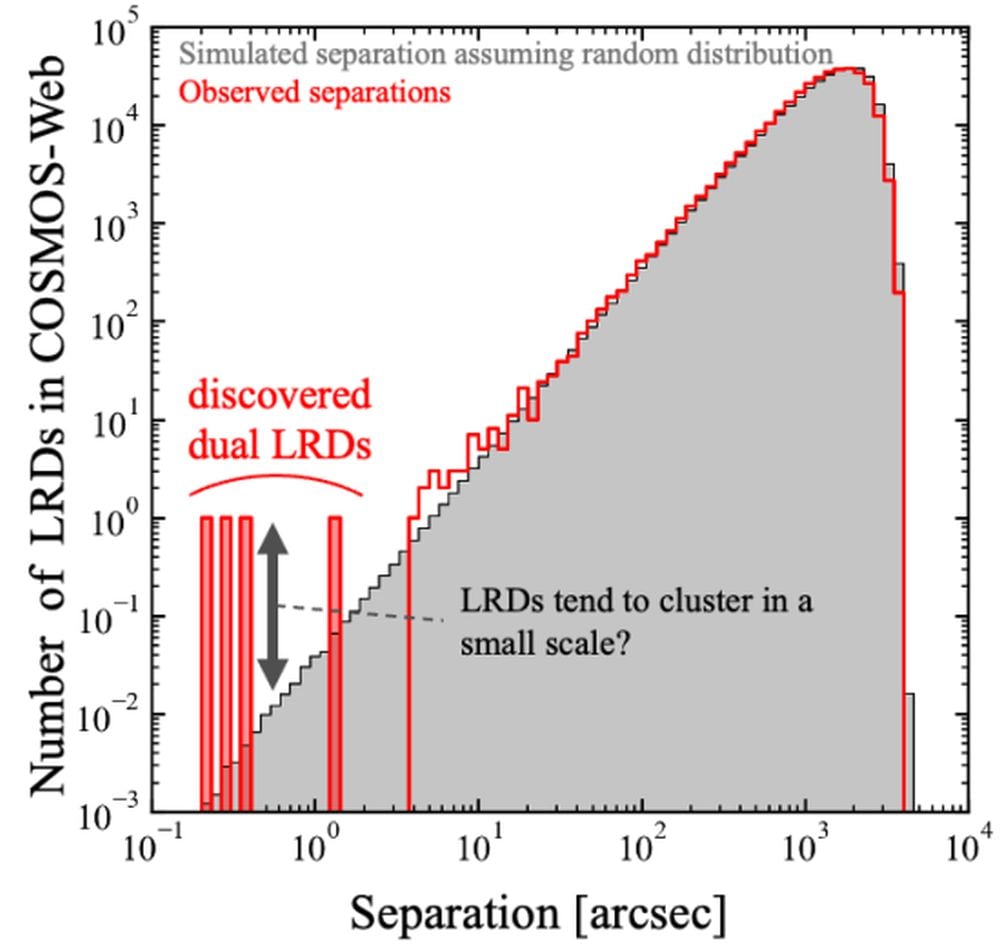 This histogram shows the angular separation between LRDs on the celestial sphere. The discovery is significant and can’t be random. Assuming a random distribution, the probability of finding two LRDs with the angular separation observed in this study would be extremely low. (Credit: Tanaka et al. 2026, PASJ)
“Our sample is likely to represent precursors of mergers between LRDs, and such mergers may be one of the mechanisms that can drive the rapid growth of SMBHs in their early evolutionary stages,” the authors write.
Of course, this sample size is small, and the researchers acknowledge that. “Since the current sample size is small, we need to expand the sample further with large field surveys,” they explain.
“Investigating the environments of LRDs with larger spectroscopic samples and comparing them to other AGNs and galaxies will also be critical for understanding their nature,” they conclude.

