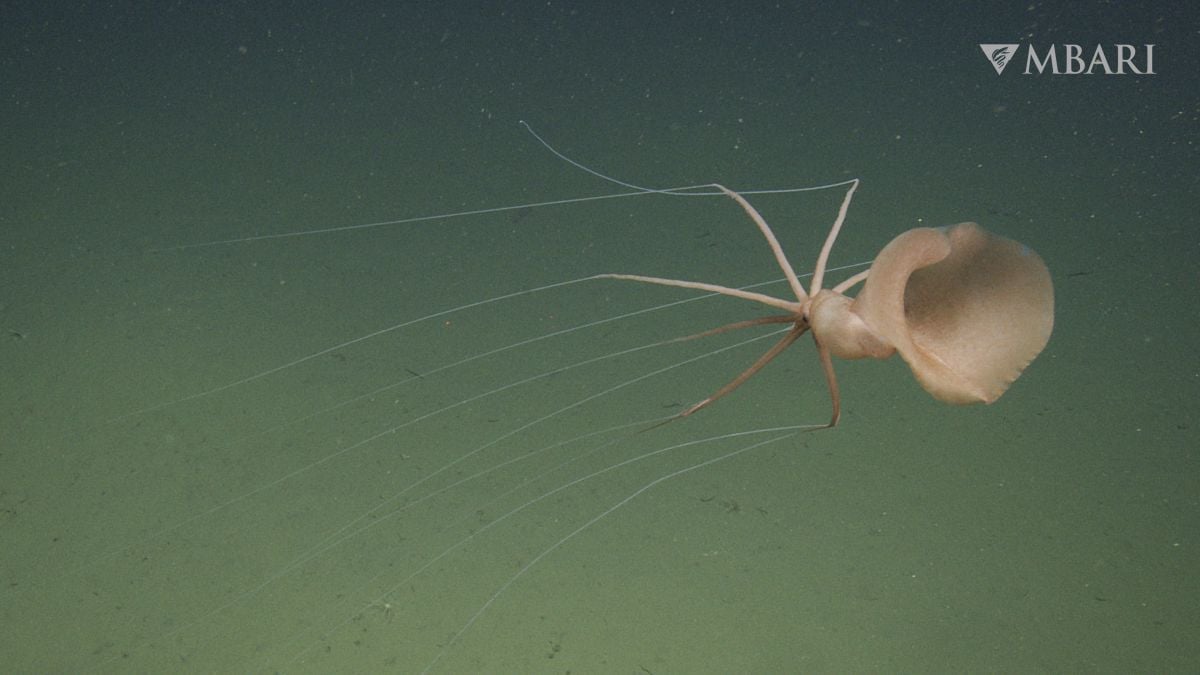
Монтерей Бэй Аквариумын судалгааны хүрээлэнгийн (MBARI) эрдэмтэд Номхон далайн зүүн хойд хэсгийн далайн гүнээс нэн ховор Magnapinna наймаалжийг анх удаа баримтжуулжээ.
Калифорнийн эрэг орчмын Дэвидсон далайн уул орчимд 3277 метрийн гүнд судалгаа хийж байх үед уг амьтанг илрүүлсэн байна. MBARI-ийн далайн гүний экологич Оливиа Соарес Перейрагийн тайлбарласнаар, Magnapinna наймаалж нь маш урт, нарийн тэмтрүүлүүдтэй бөгөөд тэдгээрээ тохой мэт нугалан байрлуулах нь түүний өвөрмөц онцлог юм. Одоогоор энэ төрлийн наймаалжийг дэлхий даяар 70 орчим удаа л бүртгэж авсан нь тэдний биологи, хооллолт болон нөхөн үржихүйн талаарх мэдлэг дутмаг байгааг харуулж байна.
Судлаачид уг амьтныг далайн ёроолд хөвж, тэмтрүүлүүдээ ашиглан идэш тэжээлээ идэвхгүй байдлаар барьдаг хэмээн таамаглаж байна. Хэдийгээр эдгээр наймаалж дэлхийн далай тэнгис даяар тархсан байж болзошгүй гэсэн судалгаа байдаг ч хүн ам нь маш сийрэг тул тэднийг олж харах нь нэн ховор тохиолдол юм.
Энэхүү олдвор нь далайн гүний экосистем, ялангуяа далайн уулын орчимд амьдардаг амьтдын төрөл зүйлийг ойлгоход чухал ач холбогдолтой юм. Эрдэмтэд уг судалгаагаар дамжуулан далайн гүний нууцлаг ертөнцийг танин мэдэх, ирээдүйн судлаачдыг урамшуулах зорилготой байгаагаа илэрхийлжээ.
Дэлгэрэнгүйг эх сурвалжаас харах
↓Эх сурвалжийг нээх ↓
In the liminal darkness of the water column deep under the sea, an entire ecosystem thrives.
Under pressure, temperature, and light conditions deeply inhospitable to humans, life has found many different ways to adapt.
In a new video, Monterey Bay Aquarium Research Institute (MBARI) scientists have documented a rare encounter with one of the eeriest: A Magnapinna squid, its bizarre fins and trailing appendages emerging from the inky black of the bathypelagic – the midnight zone.
It’s the first confirmed sighting of this elusive creature in the Northeastern Pacific Ocean.
“At first, I could only see the tips of what looked like fine tentacles, so I thought it was a jelly, but when the ‘elbows’ showed up on the screen, I knew this was something really special,” MBARI deep-sea ecologist Olívia Soares Pereira told ScienceAlert.
“Magnapinna is one of the few, if not the only, deep-sea squid with such fine, long arms and tentacles that can bend like that.”
There are few things in this world that look as uncanny as Magnapinna, also known as the bigfin squid. It lives only in the deep ocean, amid perpetual cold, crushing pressure, and permanent darkness beyond the reach of sunlight.
The encounter took place on 7 August in just such inhospitable-to-humans conditions, as the research team used the remotely operated vehicle Doc Ricketts to survey the seafloor near Davidson Seamount, off the coast of Central California.
At a depth of 3,277 meters (10,751 feet), the squid hovered above the muddy seafloor, gently undulating its two enormous fins as its eight arms and two tentacles trailed below. Using the ROV’s laser measuring system, the researchers estimated the animal measured around 1.25 meters from the top of its body to the ends of its arms.
Bigfin squid are among the most elusive cephalopods known. Only around 70 have ever been observed or collected, leaving huge gaps in our understanding of even their most basic biology.
“There is actually so little that we know about bigfin squid,” Soares Pereira said.
“From submersible sightings, we know they are the deepest-dwelling squids, with one seen an astonishing 6,212 meters – almost four miles – underwater. They are commonly seen hovering over the seafloor with their arms and tentacles extended. We have ideas and hypotheses about why they do that and what the ‘elbow’ pose is.
“We still have a lot of questions about their basic biology, like what they eat, how they capture prey, how they reproduce, and how rare they truly are.”
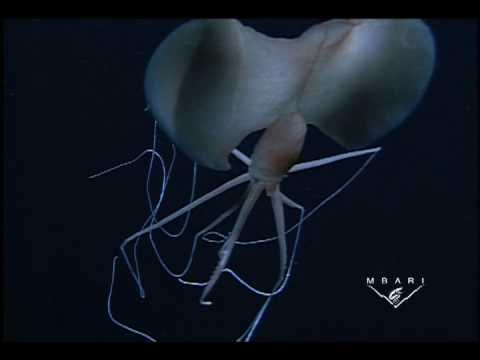
Magnapinna is a magnificent weirdo of astonishing physical proportions. Its mantle is relatively small and squat, adorned with absolutely enormous fins on either side – that’s what gives it the name Magnapinna, or big fin. It looks like a tiny torpedo with giant flapping wings.
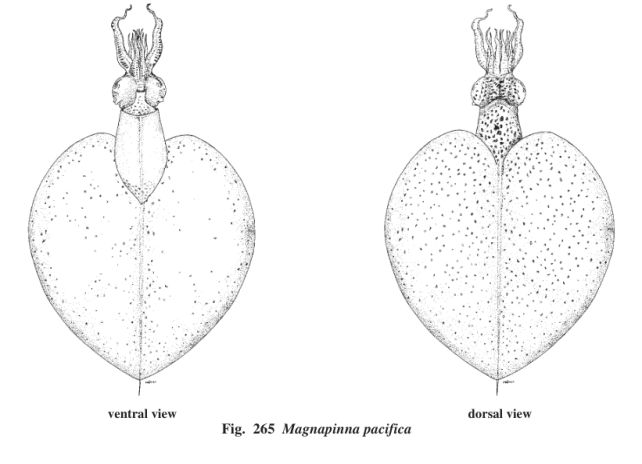
Then, there are its appendages. Like other squid, it has eight arms and two tentacles. But in Magnapinna, the distinction is visually much less obvious because both arms and tentacles terminate in extraordinarily long, thin filaments. These have been recorded up to several meters in length.
It’s not just the length, though. The way it comports itself is even weirder. Magnapinna angles its appendages practically perpendicular to its mantle, then abruptly bends them at close to right angles – the so-called ‘elbow’ pose.
Because the squid is so elusive, the reason for this odd posture is not known.
“We still do not know what bigfin squid eat,” Soares Pereira explained.
“Based on the behavior of other deep-sea squids, scientists believe they hover over the seafloor to passively capture prey that sticks to their tentacles. The ‘elbow’ pose could be a part of this feeding behavior, keeping the arms and tentacles extended without getting them tangled up.”
Even how rare these strange squid really are is difficult to pin down.
Despite the rarity of encounters, bigfin squid appear to be widespread. Sightings have been recorded across the Atlantic, Pacific, and Indian oceans, from the Gulf of Mexico and Mid-Atlantic Ridge to Australia, Hawai’i, the Philippines, Micronesia, and the Cook Islands. So the new sighting does not significantly extend its known range.
Indeed, a recent global analysis of Magnapinna records suggests that suitable habitat could encompass a vast proportion of the world’s oceans – as much as 62 percent of the world’s ocean area and 70 percent of its volume. Yet within that enormous potential range, the squid appears to occur at very low population densities.
“These scattered sightings make me believe they might be genuinely rare,” Soares Pereira said.
“But in a space so big as the global ocean, I think it’s hard for us to say for sure if they are genuinely rare or instead rarely encountered, or perhaps even a combination of both. That is why these encounters are always so special!”
This particular encounter was also entirely unexpected.
The researchers weren’t looking for bigfin squid. The expedition was studying what makes Davidson Seamount such a hotspot for deep-sea life, and on this dive the team was looking for signs of another animal entirely.
“Considering that we were specifically investigating furrows on the seafloor that we believe are made by feeding beaked whales, it’s exciting to see another animal, and a rare one at that, potentially using the site for feeding too,” Soares Pereira said.

Seamounts can be oases for marine life. Rising from the deep seafloor, they deflect ocean currents in ways that concentrate nutrients and food.
Related: 31 Haunting New Deep-Sea Species Discovered Off The Coast of Brazil
Davidson Seamount, around 130 kilometers (80 miles) southwest of Monterey, is already known for its gardens of ancient deep-sea corals and a remarkable deep-sea octopus nursery.
It now seems that one of the deep sea’s most iconic denizens may also partake of the bounty it provides.
“The deep sea never ceases to amaze me. These sightings have given me an even greater appreciation for where I am now and for opportunities that allow me to experience things that once felt so far out of reach,” Soares Pereira said.
“These rare encounters are always a reminder of why we do science and how important it is to share my passion and sense of wonder for the deep sea to help inspire the next generation of ocean explorers.”
This article was fact-checked by Rebecca Dyer and edited by Rebecca Dyer. While we pride ourselves on our process, we are only human. If you spot a mistake, please let us know.

