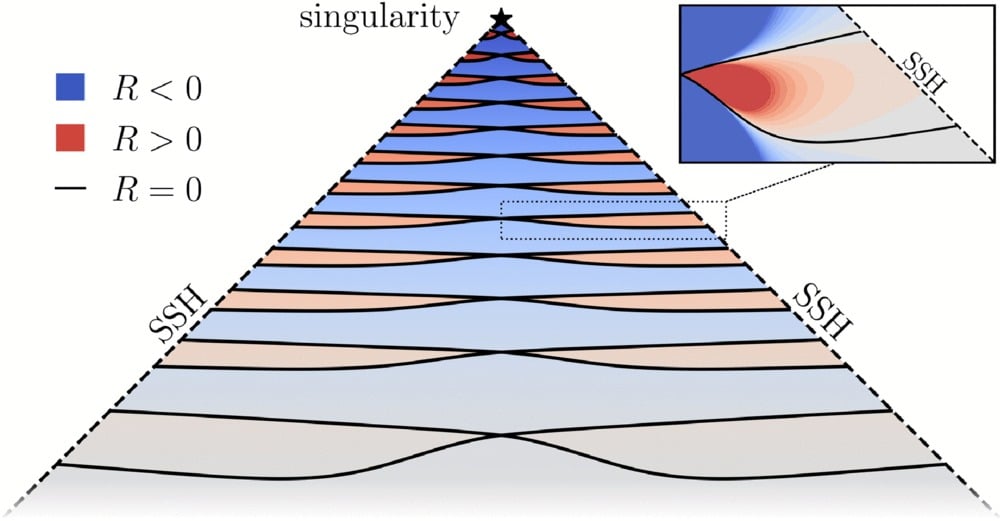
Эрдэмтэд орон зайн талст бүтэц тодорхой нөхцөлд микро хар нүх болон хувирч болохыг онолын шинэ судалгаагаар тогтоожээ.
Франкфуртын Гёте их сургууль болон Венийн Техникийн их сургуулийн физикчид орон зайн талст гэгдэх бүтцийн шинж чанарыг судалж, түүнийг хар нүх болон хувирах үйл явцыг математикийн аргаар тодорхойлсон байна. Судалгааны баг “критик нуралт” гэгдэх үзэгдлийг судалсан бөгөөд энэ үед систем нь хоёр өөр төлөвийн зааг дээр тэнцвэртэй байрладаг аж. Энэхүү тогтворгүй бүтэц нь багахан хэмжээний энерги нэмэгдэхэд хар нүх болон хувирч, харин энерги өөрчлөгдөхгүй бол орон зайн хэвийн төлөв рүү буцаж болно.
Эйнштейний харьцангуйн онолын дагуу масс болон энерги нь орон зайг мурийлгадаг бөгөөд тодорхой нөхцөлд энэ мурийлт нь давтагдсан бүтэцтэй талст шиг төлөвийг үүсгэдэг байна. Профессор Даниел Грумиллер энэ үйл явцыг ус хөлдөж мөс болохтой адилтган, багахан өөрчлөлт нь системийн төлөвийг эрс өөрчлөх хүчин зүйл болдгийг тайлбарлав. Өмнө нь 1993 оноос хойш компьютерын симуляцаар судалж байсан энэ үзэгдлийг судлаачид анх удаа онолын хувьд аналитик аргаар тайлбарлаж чадсан нь энэ юм.
Судлаачид уг асуудлыг шийдвэрлэхийн тулд олон хэмжээст орон зайг ашигласан бөгөөд энэ нь тооцооллыг хялбарчлах боломжийг олгожээ. Ингэснээр олдсон үр дүнгүүдийг бидний оршин буй дөрвөн хэмжээст орон зайн нөхцөлтэй холбон тайлбарлах зам нээгдсэн байна. Энэхүү аргачлал нь компьютерын загварчлалаас гадна таталцлын эрс тэс үзэгдлүүдийг онолын түвшинд илүү гүнзгий судлах боломжийг олгож байгаа юм.
Энэхүү судалгаа нь өнөө үед микро хар нүх бодитоор үүсэж байгааг нотлох бус, харин орон зайн бүтцийн тогтворгүй төлөвүүдийг ойлгох шинэ аргыг санал болгож байна. Эрдэмтэд уг үзэгдлийг их тэсрэлтийн дараах бодис болон энерги маш нягт байсан эртний орчлон ертөнцийн нөхцөлтэй холбон судалж байна. Тус аргыг цаашид илүү нарийвчлалтайгаар сайжруулах боломжтой гэж судлаачид үзэж байна.
Дэлгэрэнгүйг эх сурвалжаас харах
↓Эх сурвалжийг нээх ↓
A newly described spacetime crystal could collapse into a microscopic black hole when exposed to a very small energy change, according to a mathematical breakthrough by physicists from Goethe University Frankfurt and TU Wien. The research explores a rare phenomenon known as critical collapse, where a system sits at the boundary between two possible outcomes. A slight variation can determine whether the structure disappears or evolves into a black hole.
Unlike the massive black holes found at the centers of galaxies or created by collapsing stars, these theoretical objects would be extremely small. Scientists have studied the possibility of such black holes for decades, particularly because similar conditions may have existed in the early universe.
The study focuses on a strange arrangement of spacetime that behaves like a crystal. Computer simulations had previously shown that this type of structure could exist, but finding a precise mathematical description remained a major challenge.
A Hidden Crystal in the Fabric of Spacetime
The idea behind the spacetime crystal comes from the way matter influences the shape of the universe. Under Einstein’s theory of relativity, mass and energy curve spacetime, changing the paths followed by objects and light. As Christian Ecker from the Institute for Theoretical Physics at Goethe University Frankfurt explained:
“We say that spacetime is curved by mass,” adding that, “large objects such as stars curve spacetime strongly — for example, we can observe this when light rays are deflected by massive stars. But smaller masses also produce spacetime curvature, just to a lesser extent.”
Under certain conditions, this curvature can organize itself into a repeating pattern across space and time. Researchers describe this unusual configuration as a crystal-like state because of its ordered structure.
The state is highly unstable. A small amount of additional energy can push it toward collapse, creating a microscopic black hole. Without that extra energy, the structure can instead dissolve and return to ordinary spacetime.
Professor Daniel Grumiller from TU Wien compared the process with water freezing at zero degrees Celsius. A minor change can cause molecules to rearrange into a regular pattern and create ice, showing how small variations can trigger major transformations.
Physicists Solve a Long-Standing Mystery
The possibility of black holes forming through critical collapse was first identified through computer simulations in 1993. Since then, researchers have attempted to reproduce the phenomenon through mathematical equations. The difficulty came from describing the process analytically rather than relying on numerical simulations. The team found a solution by changing the number of dimensions used in their calculations.
The researchers examined the problem in a hypothetical universe containing infinitely many dimensions. While this approach appears more complicated at first, it allowed certain calculations to become easier. Ecker explained that physicists can formulate equations in spaces with additional dimensions, including five dimensions, forty-two dimensions or even infinitely many. The team then studied whether the results from this theoretical setting could be connected back to the four-dimensional spacetime of our universe.

The method that was mentioned in Physical Review Letters allowed the researchers to obtain information about critical collapse that had previously been difficult to calculate directly.
A New Window Into Black Hole Formation
The new approach could help scientists investigate extreme gravitational phenomena with analytical tools rather than relying only on computer models. As explained by Florian Ecker from TU Wien, the technique is remarkably stable and can be improved through additional approximation methods.
“This gives us a new method for studying black-hole-related phenomena that could previously not be analyzed analytically.”
The research also relates to questions about the conditions of the early universe. Shortly after the Big Bang, matter and energy existed in an extremely concentrated environment where unusual gravitational states may have occurred.

The study does not suggest that microscopic black holes are appearing in space today. Rather, it offers a new way to understand how spacetime can reach an unstable state, where a tiny energy shift can determine whether the structure disappears or turns into a black hole.
Enjoyed this article? Subscribe to our free newsletter for engaging stories, exclusive content, and the latest news.

