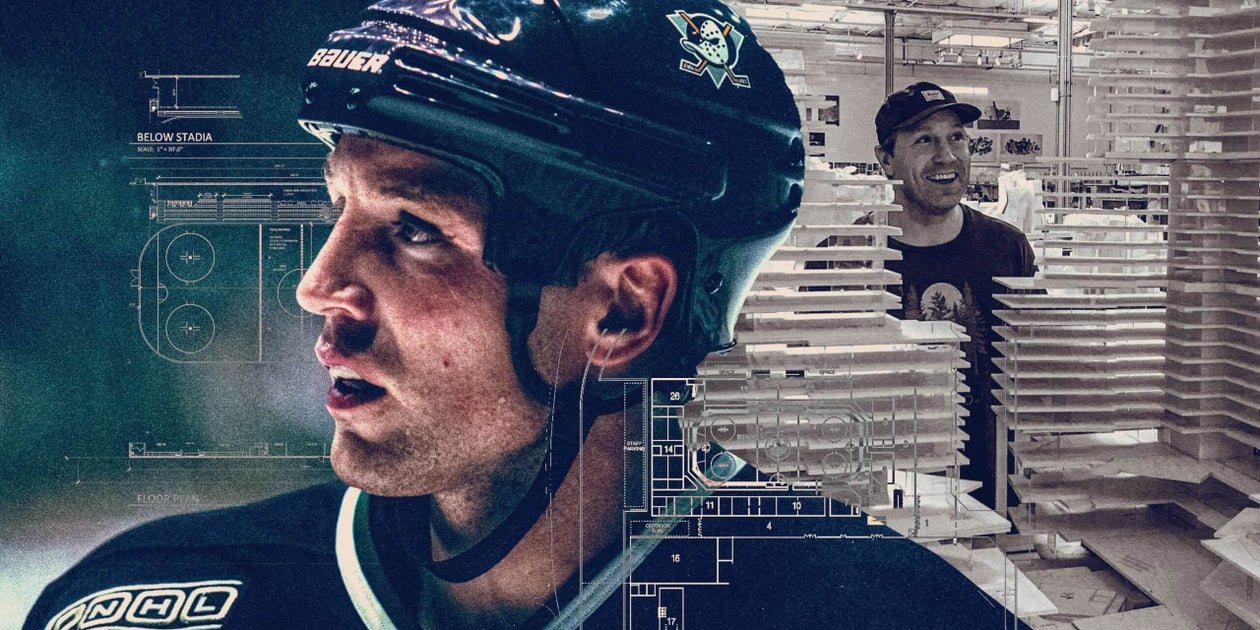
NHL-ийн 500 гаруй тоглолтод оролцсон Жейсон Маршалл мэргэжлийн тамирчны карьераа өндөрлүүлсний дараа архитектурын чиглэлээр шинэ амжилт гаргаж байна.
NHL-д Майти Дакс, Уайлд, Шаркс багуудад хүчин зүтгэж, нэг тоглолтод дунджаар 16 минут талбайд гардаг байсан хамгаалагч Жейсон Маршалл 2008 онд зодог тайлжээ. Тэрээр 2003 онд Уайлд, 2004 онд Шаркс багийн бүрэлдэхүүнд багтан Баруун бүсийн финалд шалгарч байсан туршлагатай. Хоккейн замнал нь өндөрлөсний дараа тэрээр 40 настайдаа Калифорнийн политехникийн улсын их сургуульд архитектурын мэргэжлээр суралцаж эхэлсэн бөгөөд 45 насандаа бакалаврын зэрэг хамгаалжээ.
Маршалл алдарт архитектор Франк Геригийн компанид найман жил ажиллаж, олон улсын томоохон төслүүдэд хувь нэмрээ оруулсан байна. Тэрээр өдгөө JLG Architects фирмд спортын асуудал хариуцсан захирлаар ажиллаж, Хойд Америк даяар хоккей болон спортын цогцолбор байгууламжуудын зураг төслийг гаргаж байна. Түүний хамгийн сүүлийн үеийн төслүүдийн нэг нь Сан-Диего Галлс багийн бэлтгэлийн баазын бүтээн байгуулалт юм.
Маршалл тамирчин байхдаа хуримтлуулсан тэсвэр тэвчээр, багийн төлөө гэсэн сэтгэлгээгээ архитектурын ажилдаа чадварлаг ашиглаж байгааг хамтран ажиллагсад нь онцолсон байна. Тэрээр орчин үеийн NHL-ийн тоглогчдын хэрэгцээ шаардлагад нийцсэн, тамирчдын тав тухыг хангасан орчин бүрдүүлэхэд өөрийн туршлагаа шингээн ажиллаж байна. Тамирчны амьдралаас архитектурын салбарт шилжсэн энэхүү ховор тохиолдол нь олон хүний хувьд урам зориг болж байгаа юм.
Дэлгэрэнгүйг эх сурвалжаас харах
↓Эх сурвалжийг нээх ↓
When Jason Marshall landed in Germany in fall 2006, the stay-at-home defenseman had two goals in mind.
One was to extend his professional hockey career, which was decidedly winding down after six-plus seasons in the minor leagues and more than 500 NHL games. The other was to enjoy the new cultural and bonding experience with his wife, Sonia, and their three children — far removed from the vagabond existence they shared in the United States as Marshall bounced between teams in Peoria, Ill., San Diego, Baltimore, Anaheim, Minneapolis-St. Paul, San Jose and Houston.
But Marshall, who ultimately spent the final two seasons of his playing career with the Cologne Sharks and Frankfurt Lions of Germany’s top league, never expected that the country would lead him to find another calling altogether.
“We got to travel a lot and we had three kids at the time, but we kind of dragged them everywhere,” said Marshall, then in his mid-30s. “We went to parks for half the day and then we would go see churches and all that.
“That’s where I really kind of fell in love with architecture. I just thought it was amazing. All the buildings. So I kind of had this idea that I wanted to try it. But I had no idea. I didn’t know any architects.”
Which next gen superstars jumped the highest in the NHL player tiers?
Today, Marshall not only knows many architects — he is one himself. In his role as a sports principal for the Midwest-based JLG Architects, he has spent the past two years helping the firm design hockey arenas all over North America. At 55 years old, the two worlds of his life have collided to form a one-of-a-kind second career.
On the ice, despite not logging a full NHL season until seven years after he was drafted as a first-rounder, Marshall went on to average nearly 16 minutes per game as a dependable third-pair defender for the Mighty Ducks, Wild and Sharks. He has similarly reached the pinnacle of his new craft, working alongside luminaries such as Frank Gehry for major international design competitions and landmark construction projects involving museums, art galleries and other high-profile subjects across the world.
Despite his late start and unusual backstory, Marshall has impressed his architectural peers. They can see in his work how he earned a reputation as a team-first, lunch-pail hockey player, someone more known for blocking shots and taking out opponents in front of the net than for scoring pretty goals.
“I shake my head,” said Tom Betti, the principal director of JLG’s sports studio and Marshall’s boss. “I’m like, ‘How did you do all of that?’
“He has a dedication and this grind to him that you need as an architect. It’s such a difficult profession with long hours and a long education process. Then when you get into practice, it’s a lot of grind to it, too.”
A hard pivot
Marshall finally hung up his skates in 2008 as the family settled back in Southern California, where he had played the bulk of his NHL career — 370 games — over two stints with the Mighty Ducks. As a teenager growing up in Cranbrook, B.C., Marshall had always wanted to attend college. But after the St. Louis Blues took him at No. 9 in the 1989 draft, he instead jumped to the WHL as a way to attempt to fast-track his path to the big leagues.
Decades later, this decision meant that his unique second career began in 2009 at a local community college, Orange Coast, as a part of its Architectural Technology program. Then, in 2011, at age 40 with four kids, he was accepted as a transfer student to California Polytechnic State University, home to one of the country’s top undergraduate architecture programs, where he became the oldest student in his enrolling class.
Right away, Marshall struggled with getting up in front of Cal Poly classmates who were more than 20 years younger and making presentations on what was, at times, incredibly dense material.
But he also fell in love with the challenge — and with the field itself. The passion soon replaced a brief uneasiness about no longer playing hockey, as Marshall avoided the existential struggles some peers face in retirement by fully reinventing himself as an architect.
“I think in a lot of ways, (NHL players) are probably all wired a little the same,” Marshall said. “We want to work towards something. As a player, you’re always every day like, ‘OK, how do I get better at this?’ That gets ingrained in you. After that stops, it’s a weird feeling.
“I was super lucky to find something that I really liked. It was a lot of work. Every day for nearly eight years, I was driving up (nearly an hour) to Cal Poly and the community college, wondering what I was doing. …But I could transfer that focus from hockey to this. I think it helped a lot in a lot of ways.”
Marshall’s friends in the NHL alumni community were impressed by the ex-player’s drive toward his aspiring new career. One of them, Jason Doig, had become a regular on a local beer league team in Los Angeles that had long been captained by Gehry, then in his early 80s and no longer playing. After mentioning to some teammates that there was a former NHLer trying to become an architect, Doig connected Marshall with Tensho Takemori, one of the firm’s partners.
Then in his freshman year at Cal Poly and daunted by the road ahead, Marshall’s first question to Takemori was whether he was making a mistake.
“He wanted to know, ‘Do you think it’s too late for me? I’m the oldest kid in my class,’” Takemori recalled. “Luckily, with Frank being a prime example, architecture is fortunately more of an old person’s game. It takes a long time to learn all the things you need to, to build a reputation, et cetera. I told him I thought that he actually had quite a great chance of doing that just because of the nature of the field that he happened to be interested in.”
Takemori paused and chuckled.
“After that, I waited the appropriate two weeks before asking him to join our office hockey team.”
New work, same work ethic
In 2013, leading up to his third year at Cal Poly, Marshall became a summer intern for Gehry Partners, where he learned on the job by building large-scale physical models for the firm’s projects. Altogether, he spent eight years at their Los Angeles office, including six as a full-time architect after completing his Bachelor of Architecture degree at age 45.
“I don’t think there’s any other place in the world like it,” Marshall said. “Their process and what they do is really unique because they’re working on amazing projects and they build everything by hand, in terms of all the design sketches, and it’s all physical models. You go into the office, and there’s thousands of models everywhere of all different sizes. As an architecture nerd, it was like ‘This is like the coolest place ever.’”
One significant design, which Marshall didn’t directly contribute to but grew fascinated by, was led by colleague Sevak Karabachian, who previously redesigned the World Cup of Hockey trophy for the 2016 tournament. For several other projects and architectural competitions, Marshall gained fond memories of working directly with Gehry himself. (Gehry died from a respiratory condition last December at age 96.)
“Frank was there every single day,” Marshall said. “He was in his mid-80s then, but he was there even Saturdays and he’d go around and talk to everyone …. He was awesome. I remember one time he came up to me and was like, ‘What do you think of this s—?’ I was thinking, ‘What can I even say to him?’”
Before long, Marshall made his own impression at Gehry Partners. He proved to be an excellent collaborator who was willing to take on any task, even if it wasn’t directly assigned to him. Takemori noticed the impact of Marshall’s NHL career as he blended in among industry stars and the firm’s Ivy League hires, filling a valuable role for large design teams working grueling hours on complex assignments.
Once, while toiling deep into the night as part of a design competition, Marshall remarked to Takemori that the physical and mental exertion reminded him of playing in “triple overtime” in the playoffs. Marshall never won the Stanley Cup in his career but participated in two deep runs to the Western Conference final with the Wild in 2003 and the Sharks a year later. He was also a member of the 1996-97 Ducks squad that took the eventual Cup-champion Detroit Red Wings to overtime in three of four first-round games, including a triple-overtime loss in Game 2.
“I think his past life as a player really helped him with that because you go through a lot of adversity in your playing life that he could bring to the table,” Takemori said. “More so than actually some of the younger kids who haven’t faced that level of professional adversity. So he was able to handle it in some ways better than some of his colleagues, of similar experience level.”
“He always had the team at the forefront of everything that he was interested in,” Takemori added.
Marshall’s former NHL teammates have watched his transformation closely over the past decade. They remember him as always being a bit different — studious, kind and very smart — and used to razz him for reading National Geographic on road trips rather than playing cards or watching movies with them.
“He was definitely the only guy on the bus reading that magazine,” said Ted Drury, who played three seasons alongside Marshall in Anaheim.
But Marshall also earned teammates’ respect — both for how humble he was and for how willing he was to step up whenever things heated up. An understated person off the ice, he was a ferocious competitor on it, someone who succeeded in the NHL as much due to willpower as skill.
They’ve seen that theme manifest again after Marshall left the game.
“I didn’t appreciate how hard it was to become an architect before watching Jason go through it,” said Drury, who admires how Marshall balanced being an “amazing dad” with pursuing his second career. “I mean, he was competing against kids in the classroom that, because of how hard it was, would literally just sleep in the classroom.
“If he could do that then, (it’s) such an extreme example of what’s possible. If anyone post-(NHL) career wants to make a transition into something that’s really interesting, that should inspire them.”
Marshall eventually left Gehry Partners for family reasons, as he became more involved in his teenage sons’ hockey careers as a coach and needed to be closer to home in Newport Beach. But in his new role with JLG, he has begun to apply the lessons he learned under Gehry and Takemori at the prestigious firm.
Except now, instead of museums and galleries, the focus is on building hockey arenas.

Architectural plans for a proposed practice facility for the AHL’s San Diego Gulls. (Courtesy of JLG Architects)
Two careers collide
The sports division at JLG specializes in designing midsize arenas for college and junior hockey teams, as well as practice rinks for NHL and AHL clubs. One of Marshall’s most recent projects involved a proposed three-sheet practice facility for the San Diego Gulls, the Ducks’ AHL affiliate with whom he spent the 1994-95 season.
As a former player, Marshall has brought a different perspective to the project, his boss Betti said. During the design phase, Marshall advocated for an open courtyard area to bring in natural light and allow for outdoor access and views of a surrounding park. Marshall recalled how going to a hockey arena often felt like entering a bunker, even in Southern California, so he wanted to bring a warmer aesthetic to team meeting and workout areas by incorporating that exterior space and natural environment.
Marshall has also spoken with Ducks executives such as Scott Niedermayer, a Hockey Hall of Famer and hockey operations special adviser in Anaheim’s front office, and with members of the team’s training staff, about how best to help a generation of pro players who spend far more time at their teams’ training facilities than he ever did.
The relatively recent introduction of full-time chefs, masseuses, skills coaches and other support personnel has turned those buildings into homes away from home for players. Marshall believes that their interiors should be designed to reflect that shift.
“I ask them, ‘How do these guys use the space? What are the problems you’re seeing?’” Marshall said of his discussions with Ducks and Gulls staffers. “It’s so fascinating to me to see how these spaces have changed. And I just love going in and talking to the trainers. These guys are there every day. The equipment guys spend their whole day there. So, yeah, I wanna hear from them how these spaces function. How it’s changed, what they need and what they don’t need.”
In the end, Betti said, Marshall’s design pitch impressed the Ducks and Gulls so much that it became their top choice. According to Betti,
“He really brought the idea of, ‘We can open this thing up and do this the right way, and players are going to want to stay there,’” Betti said. “So I thought that was a very insightful way of thinking about the space, instead of just looking at it like, ‘OK, we need, whatever, 40 lockers in this room.’ He stood back and thought of his playing days and what would help him as an athlete. And ownership loved it. They think it’s an absolute game-changer for their organization.”
As a former NHL player, the ultimate culmination of Marshall’s hard work would be to one day design an arena for a team in the league. When he brings his kids to Ducks games at Honda Center, instead of reliving his hockey days by relating to the players on the ice, he inspects the sightlines and concourses in contemplation of how the building was put together. That’s how much architecture has transformed and enriched his post-hockey life.
“When I go to games a couple times a year as a fan, I’m always thinking about ‘What’s that experience like and what could be better?’” Marshall explained. “So you’re always learning. And that’s what makes it fun.”


Жейсон Маршалл хөлбөмбөгийн талбайгаас архитектурын загварт шилжсэн нь үнэхээр сонирхолтой! Тэрээр тамирчны амьдралыг орхиж, шинэ хобби, мэргэжлээ олж чадсан нь урам зориг өгдөг. Та энэ амжилттай өөрчлөлтийн ард ямар туршлага байсан гэж бодож байна?