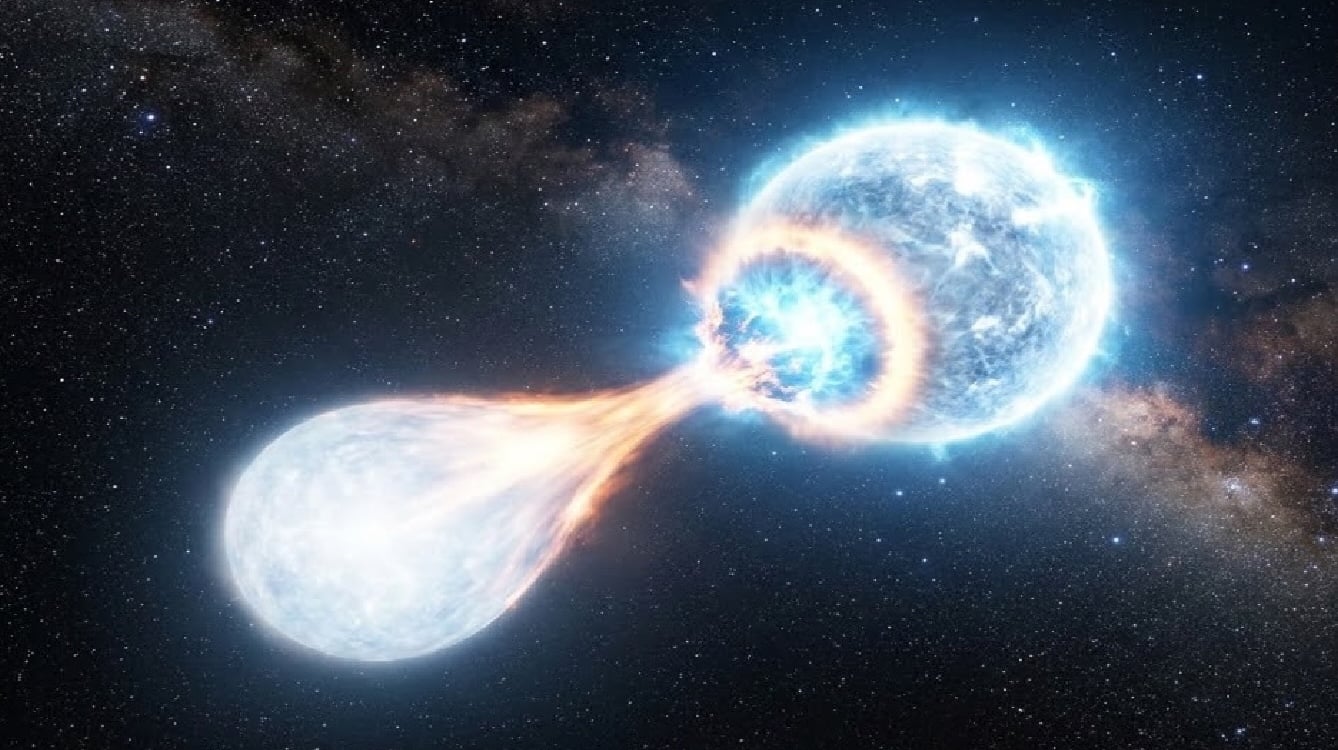
Одон орон судлаачид маш хурдан тойрог замд эргэлддэг цагаан одой хос одны системийг илрүүлсэн нь ирээдүйн таталцлын долгионы ажиглалтад чухал ач холбогдолтой юм.
Одон орон судлаачдын баг eRASSU J0608 нэртэй рентген цацрагийн эх үүсвэрийг судалснаар энэ нь зургаан минут гаруй буюу 374 секунд тутамд гэрэлтдэг, маш ойрхон эргэлддэг цагаан одой хос од болохыг тогтоожээ. NICER болон Einstein Probe рентген дурангийн тусламжтайгаар хийсэн ажиглалтаар эдгээр од нь хоорондоо маш ойр байрлах тул нэгнээсээ ялгарсан бодис нь тойрог диск үүсгэхгүйгээр шууд нөгөө од руу татагддаг болохыг илрүүлсэн байна. Энэхүү үйл явц нь рентген цацрагийг тасралтгүй биш, харин тогтмол давтамжтайгаар тэсрэлт хэлбэрээр ялгаруулахад хүргэдэг.
Судлаачид XMM-Newton дурангийн өмнөх мэдээллүүдийг шинэ үр дүнтэй харьцуулан гурван жилийн хугацаанд гарсан өөрчлөлтийг шинжилжээ. Үүний үр дүнд хос одны тойрог зам хурдацтай муудаж байгаа нь тогтоогдсон бөгөөд энэ нь таталцлын долгионы улмаас энерги алдаж байгаатай холбоотой гэж үзэж байна. Энэхүү систем нь 0.43 нарны масстай тэнцэхүйц “чирп масс”-тай бөгөөд хос одны системийн хувьд таталцлын долгионы хамгийн хүчтэй эх үүсвэрүүдийн нэгд тооцогдож байна.
Одоогийн байдлаар уг системийн зайг нарийн тогтоох боломжгүй байгаа нь судалгааны гол хязгаарлалт болж байна. Таталцлын долгионы дохио нь зайнаас хамааран сулрах тул эрдэмтэд гурав дахь одны хамтрагчийг олж илрүүлснээр зайг тодорхойлохыг зорьж байна. Хэрэв зай нь хангалттай ойр бол уг системийг ирээдүйн сансарт суурилсан LISA зэрэг таталцлын долгионы ажиглалтын төхөөрөмжүүдийг тохируулахад ашиглах боломжтой юм.
Дэлгэрэнгүйг эх сурвалжаас харах
Эх сурвалжийг нээх ↓
Current gravitational wave observatories aren’t sensitive enough to capture the gravitational waves of binary stars. They can only see the gravitational chirps of black holes just as they are merging. But that will change as we develop more sensitive instruments. Recently a team of astronomers has discovered a binary white dwarf system that could be a good target for advanced gravitational observatories.
The system is known as eRASSU J0608. It’s an x-ray source that has a bright pulse every 374 seconds, or just over six minutes. Usually when we observe a repeating source such as this, it is due to some kind of periodic motion. Pulsars are due to the rotation of a neutron star. Many variable stars are eclipsing binaries. So the team wanted to see what was behind eRASSU J0608.
Using data from the Neutron star Interior Composition Explorer (NICER) and the Einstein Probe x-ray observatory, they were able to see that the system is a close-orbiting pair of white dwarf stars. They orbit so closely that material ejected from one of the stars is directly captured by the other instead of forming an accretion disk around the two stars. This is why the x-rays are emitted in regular bursts rather than having a constant glow. We see the x-rays of the super-heated material when things line up just so.
The authors then compared their new data with older observations from XMM-Newton. From this they could look at how the system changed over a span of more than three years. What they found is that the orbits of the stars are rapidly decaying. The rate of their decay is consistent with the loss of energy from gravitational waves. We have observed this kind of orbit decay many times before, but the rate of this system is one of the fastest. This means it is one of the strongest gravitational wave sources for a binary star system. The estimated “chirp mass” of the system is 0.43 solar masses.
Unfortunately the x-ray observations can’t give us the distance to eRASSU J0608. The more distant the binary system, the weaker the gravitational signal will be. Gravitational wave sources obey the inverse-square law just as light does for regular stars. The team hopes to discover a third stellar companion in the system that could allow them to pin down the distance.
If the system isn’t too far away, then its gravitational waves could be strong enough to be detected by future space-based gravitational wave observatories such as LISA. The system could then be used to calibrate the gravitational signals of other objects.
Reference: Sharma, Rahul, et al. “Rapid Orbital Decay in the Ultracompact Double-degenerate Binary eRASSU J060839. 5–704014.” The Astrophysical Journal Letters 1007.1 (2026): L7.

