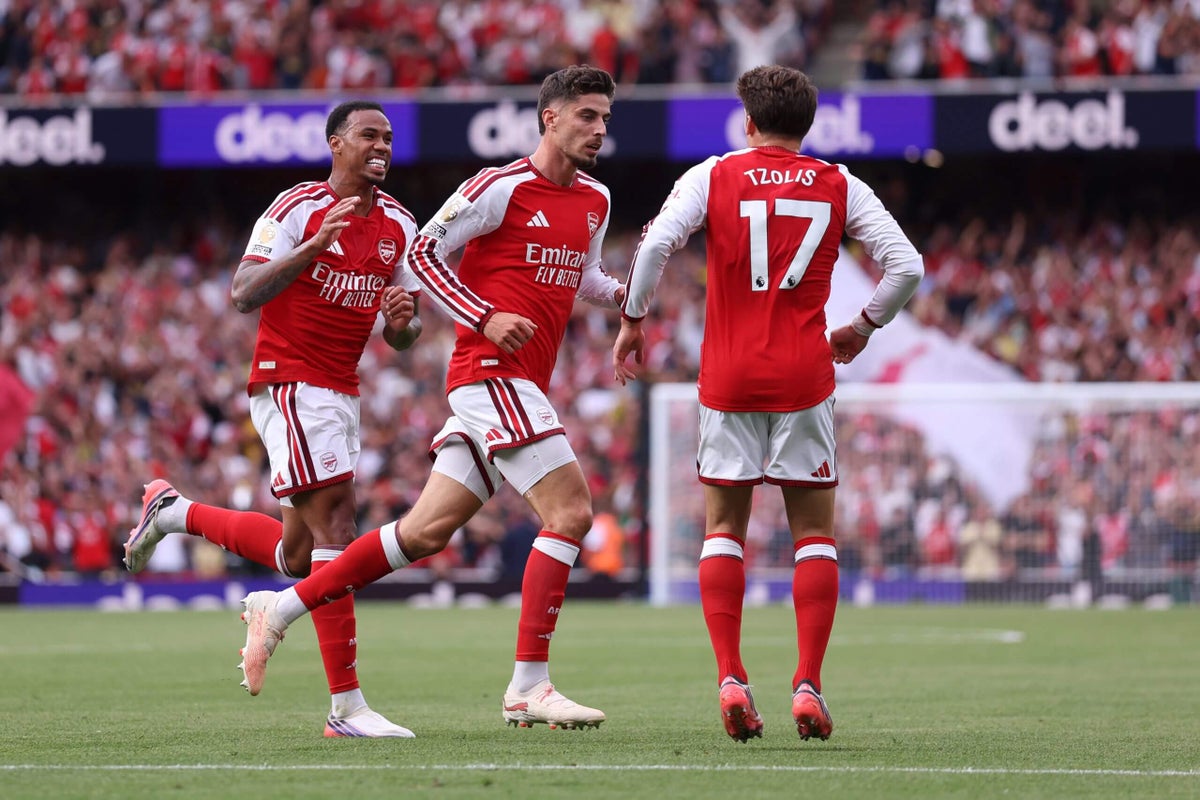
Эмиратс цэнгэлдэхэд болсон дерби тоглолтод Арсенал эхний минутад гоол алдсан ч эргэн ирэлт хийж, Челсиг 2-1-ийн харьцаатай хожлоо.
Тоглолтын хоёр дахь минутад Челсигийн довтлогч Морган Рожерс тооны харьцааг нээсэн бол Арсеналаас Кай Хавертз тэнцээний гоолыг оруулж, улмаар Мартин Эдегор ялалтын гоолыг бүртгүүлэв. Хавертз тоглолтын турш өндөр ур чадвар гаргаж, Эдегорын гоолын өмнө бөмбөгийг алгасан өнгөрөөх ухаалаг үйлдэл хийсэн нь тоглолтын эргэлтийн цэг болсон юм.
Арсеналын дасгалжуулагч Микель Артетагийн баг бүрэлдэхүүний байнгын ротаци болон богино дамжуулалтад суурилсан довтолгоог хэрэгжүүлсэн бол Челсигийн дасгалжуулагч Хаби Алонсогийн баг сөрөг довтолгооны арга барилаар аюул учруулж байлаа. Тоглолтын явцад Арсеналын хамгаалагч Риккардо Калафьоригийн гоол оффсайд байрлалтай хэмээн тооцогдоогүй бөгөөд Челсигийн хаалгач Эми Мартинес хэд хэдэн удаа баг аварсан хаалт хийв.
Челсигийн хувьд Рожерс, Коул Палмер, Жоао Педро нарын гурвал довтолгоонд шинэ өнгө төрх нэмж байсан ч багийн дунд шугамын асуудал хоёрдугаар хагаст илүүтэй мэдрэгдсэн юм. Ромео Лавиа болон Рис Жэймс нар тоглолтын эхэнд найдвартай тоглосон ч Арсеналын дарамтыг эцсийн мөч хүртэл тогтоон барьж чадсангүй.
Арсенал есдүгээр сарын 9-нд Аваргуудын лигийн хүрээнд Наполитой, Челси мөн өдөр Карабао цомын гуравдугаар тойрогт Лийдстэй тус тус тоглоно.
Дэлгэрэнгүйг эх сурвалжаас харах
↓Эх сурвалжийг нээх ↓
The story of Arsenal’s summer was ending up with fewer attackers than they started, but in this comeback win against Chelsea, they showed that they still have enough to perform in the biggest games.
Morgan Rogers was one player they went for and missed out on, and it was the former Aston Villa forward who opened the scoring for Chelsea within two minutes.
But then former Chelsea forward Kai Havertz, who was excellent throughout and received a standing ovation when substituted, equalised as Emi Martinez struggled to get down in time. Pedro Neto hit the post before the break.
The second half was much the same in terms of entertainment as Xabi Alonso’s side continued to threaten, especially on the break, but it was Martin Odegaard who put Arsenal in front with a goal similar to the one that scored against Manchester City in the Community Shield. David Raya then made a late, great save from Estevao.
Considering the control Arteta and Arsenal desired in games last season as they won the Premier League, this was very open and, with it, entertaining. There were also moments of controversy, as Gabriel seemed to kick out at Martinez and Declan Rice tripped Rogers. But for Chelsea, there were positives in the way they threatened on the break and had chances throughout.
Art de Roche, Liam Twomey, Jack Lang and Conor O’Neill break down the action.
How good was this game?
It has been, all told, a relatively low-key start to the Premier League season. For all the uncontrolled explosions in the transfer market, a huge number of teams have begun the season looking slightly adrift, a little rudderless. The contrast with Arsenal, a picture of stability, has dampened hopes of anything even remotely resembling a title race.
Only time will tell whether we get one. This, though, was a match to fire the imagination — a rolling, shape-shifting battle that will take some living up to in the months ahead.
Arsenal were good value for their win, playing with craft and bite. But there were, in Chelsea’s display, signs that the champions may not have things all their own way. In the first half especially, the away team tugged Arsenal around, might easily have built upon that early Rogers goal.
Their efforts challenged Arsenal and, eventually, made their comeback feel all the more significant. This was no sterile victory; it was emotional, stirring, a victory of the spirit. Both sides emerge from the game with reason for hope. So, importantly, do the neutrals.
(Stuart MacFarlane/Arsenal FC via Getty Images)
Jack Lang
Havertz brilliance: goal, a dummy, leading the line
We live in a data-driven era where every on-ball action is codified, weighted and measured. But Havertz’s clever dummy for Odegaard’s goal was a reminder that assists and chances cannot capture every flash of creative brilliance.
After Christos Tzolis cut inside off the left, Havertz drifted into the central area in front of the box, demanding the ball with a raised arm. Tzolis obliged, playing it into him, but the gesture proved a classic case of misdirection. Havertz extended a foot as if to collect the ball, only to withdraw it just as quickly, allowing it to roll through to Martin Odegaard in the centre of the penalty area.
Odegaard duly applied the calm finish, a goal that will go down as a Tzolis assist. The Greek winger will take the boost to his creative numbers, but he will know it was Havertz’s uncredited contribution that proved decisive.
It capped a brilliant overall performance by Havertz. He scored his fourth goal in seven appearances against his former club, who struggled to contain that marauding creativity that makes the German so hard to stop when in full flow.
Conor O’Neill
How did Rogers and Chelsea’s front three look?
Arsenal opted not to match Chelsea’s £117million offer for Rogers in July, so it felt like the football gods were having fun by seeing to it that the most expensive British footballer ever’s volley nestled in the back of David Raya’s net with 1:17 on the clock at the Emirates Stadium.
To have any hope of competing against the Premier League champions, Chelsea’s vaunted front three had to demonstrate that a Gunners defence which has carried its aura of invincibility into the opening weeks of this new season could be made to bleed.
It was no shock that Rogers, rather than Cole Palmer or Joao Pedro, was the man to do it. Of the three, he is the natural risk-taker, the man who tries things that others won’t – like volleying a dropping ball from outside the box, for example – in his quest to make something happen.

(Adrian Dennis / AFP via Getty Images)
At times that risk-taking instinct can make Rogers lose possession in bad areas, creating more defensive work for his teammates. But he has already given Chelsea’s attack under Alonso a new, more direct dimension to anything this team had last season, and he is already dovetailing with Palmer and Joao Pedro beautifully.
On the half-hour mark he latched onto a perfectly measured long kick from Emi Martinez, exchanged passes with Joao Pedro and then shifted the ball inside Ezri Konsa and whipped a shot just wide of David Raya’s far post.
Konsa got the better of his former Villa teammate with a thunderous sliding tackle in the second half, but Rogers always forces opposition defences to react. That makes him valuable even when his best-laid plans in the final third aren’t quite coming off, as Arsenal found on Sunday.
Liam Twomey
Arsenal fluid and rotating in attack?
Arsenal had no choice but to go all out after conceding on 77 seconds and seemed better for it.
Instantly, there was a crispness and intent to their play, which manifested in Bukayo Saka, Odegaard and Ben White making their right flank look just as threatening as it did on the opening day against Coventry.

Unlike the previous season, however, Arsenal were not dependent on that right wing. Christos Tzolis took the more direct route as his runs in behind gave Arsenal a dual threat to keep the entire Chelsea backline honest.
It was Arsenal’s constant positional rotations and short passing on the right that made the difference, however. Kai Havertz pulling to the right, combined with the snappier passing of Rice, is what brought their equaliser.
Tzolis and Odegaard’s developing on-pitch relationship is impressive too. Their combination to put Arsenal ahead was almost a carbon copy of the Arsenal captain’s goal against Manchester City in the Community Shield last month.
For the Greek international to be so consistent with repeat actions like that tempting pass should be a massive help to Arsenal throughout the season.
The endless movement of red and white shirts, also helped with Kai Havertz’s role in Arsenal’s second goal.
Art de Roche
How can Chelsea sort midfield issues?
It is to Romeo Lavia and Reece James’ great credit that Chelsea supporters did not spend most of this game pining for Moises Caicedo, or even Lamine Camara.
Chelsea were in survival mode for long spells of the first half after Rogers put them ahead, but it might have been Lavia’s best half of football defensively since he joined the club. He was jumping into the press high up the pitch to force Arsenal mistakes, sniffing out danger in his defensive third and screening off passing angles effectively.
James, meanwhile, largely lived up to Alonso’s bold assessment of his potential as a midfielder, bringing class and composure to Chelsea’s spells of possession.
But the absence of Caicedo and additional quality options was felt more keenly in the second half, when Odegaard managed to run off James to put Arsenal in front.
Lavia’s tank generally runs empty around the hour mark and it was telling that Alonso turned to Malo Gusto, another natural full-back, to replace him rather than Valentin Barco.
Gusto brought good energy to Chelsea’s final push but he does not have the on-ball quality to pick apart Arsenal’s low block defence, though he did help their transition defence.
Even if Caicedo is back sooner than later and James can be as good a midfielder as Alonso believes, Chelsea’s manager needs a bit more against opponents of this calibre.
Liam Twomey
Battle of the set-piece coaches
With two of the game’s most eminent set-piece coaches in the dugouts, dead balls were always going to have an outsized influence. Nicolas Jover’s ingenious routines have become a well-established part of Arsenal’s success since he joined the club in 2021, while Austin MacPhee joined Chelsea this summer after a successful five-season spell at Aston Villa.
It was MacPhee who struck first, with Rogers volleying in after Reece James punted a free-kick forward from halfway. It is hard to attribute the opener to any clever set-piece choreography, though, with Rogers latching onto the ball just outside the box after a succession of four headers, the last a failed clearance from Rice.
Whether Rogers’ positioning had been pre-planned to leave him primed to attack second balls is guesswork, but there were definitely rehearsed elements in the Arsenal set-pieces that followed as they searched for an equaliser.

Arsenal set-piece coach Jover (Marc Atkins/Getty Images)
In particular, Odegaard’s low, clipped deliveries wreaked havoc. Shortly after Rogers’ opener, Odegaard stood over a free-kick just outside the box on the right, with Chelsea’s defenders clearly expecting a cross to the back post, only for him to play a reverse low ball towards the near post that Ricardo Calafiori just failed to connect with. It was another low cross that Joao Pedro failed to clear, which led to Calafiori’s disallowed goal, only for Pedro to earn a reprieve when Konsa was ruled offside in the build-up.
MacPhee had some counter-measures of his own to try to limit Jover’s set-piece threat. When defending corners, Chelsea stationed four attackers upfield in a bid to force Arsenal to keep more players back. The approach was reminiscent of Chelsea’s strategy in the second leg of last season’s Carabao Cup semi-final under their former set-piece coach Bernardo Cueva.
Conor O’Neill
Disallowed equaliser from Arsenal…
Eleven minutes in, Arsenal thought they had produced the perfect response to Chelsea’s flying start. A free-kick in the right channel, clipped into the box by Rice, created carnage, resulting in what the Emirates assumed was an equalising goal for Calafiori.
It was a messy, confusing little chunk of play. Joao Pedro should have hacked the cross clear but only succeeded in slicing it into the path of Gabriel. The Arsenal defender did well to get a quick shot away; the ball ricocheted inside the six-yard area, Martinez scrambling on the floor like a man looking for a contact lens.
The ball struck the post before being bundled home by Calafiori, who wheeled away in celebration. The goal, though, was soon ruled out. Initially it seemed that Konsa had been punished for a foul on Martinez, which would have been soft. But in reality, Konsa was in an offside position when Gabriel shot, then got a touch on the ball before Calafiori.
It was a good intervention from the video assistant referee. Arsenal would have to wait slightly longer before levelling the match.


Jack Lang
What did Arteta say?
We will bring you this after he has spoken at the post-match press conference.
What did Alonso say?
We will bring you this after he has spoken at the post-match press conference.
What next for Arsenal?
Wednesday, September 9: Napoli (Away), Champions League, 8pm BST, 3pm ET
What next for Chelsea?
Wednesday, September 9: Leeds (Home), Carabao Cup third round, 8pm BST, 3pm ET; Saturday, September 12: Hull (Home), Premier League, 3pm BST, 10am ET.

