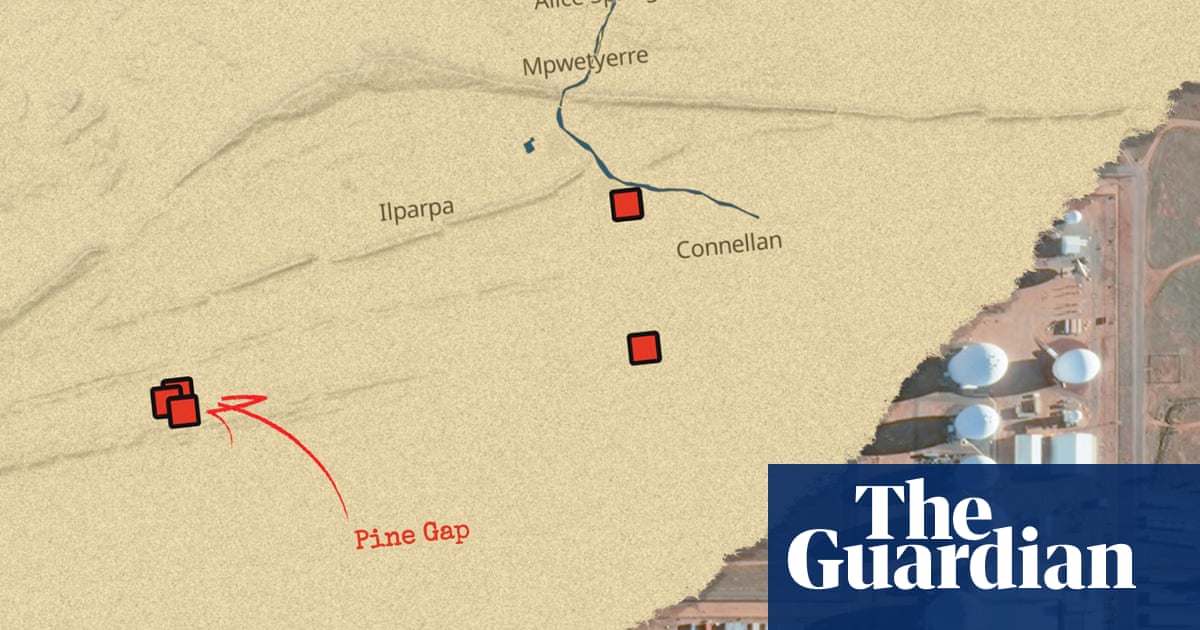
Наутилус хүрээлэнгийн судалгаагаар АНУ-ын зэвсэгт хүчин болон батлан хамгаалахын корпорацууд Австралийн 110 гаруй цэргийн байгууламжид хяналт тавьж эсвэл нэвтрэх эрхтэй болсон нь тус улсын нийт цэргийн объектуудын талаас илүү хувийг эзэлж байна.
Австралийн нутаг дэвсгэр дэх АНУ-ын цэргийн энэхүү өргөн хүрээтэй байршил нь тагнуулын мэдээлэл цуглуулах, хиймэл дагуулын өгөгдөлд нэвтрэх, цэргийн сургуулилт хийх болон Номхон далайн бүс нутагт болзошгүй мөргөлдөөн гарсан тохиолдолд зэвсэг, шатахуун, техник хэрэгслийг түргэн байршуулах зорилготой юм. Тухайлбал, Pine Gap зэрэг байгууламжууд нь АНУ-ын хилийн чанад дахь цэргийн ажиллагаанд чухал үүрэг гүйцэтгэдэг боловч тэдгээрийн үйл ажиллагаа ихэнхдээ нууцлагдмал хэвээр байна. Шинжээчдийн үзэж байгаагаар энэ нь зүгээр нэг цэргийн хамтын ажиллагаа бус, харин Австралийг АНУ-ын цэргийн стратегид бүрэн нэгтгэж, улмаар БНХАУ-тай үүсэж болзошгүй мөргөлдөөнд татан оролцуулах эрсдэлийг дагуулж байна.
Австралийн Батлан хамгаалах яамны зүгээс тус улсын нутаг дэвсгэр дээр гадны цэргийн бааз байхгүй гэж мэдэгддэг ч албаны хүмүүс АНУ-тай хийсэн батлан хамгаалахын гэрээ нь үндэсний аюулгүй байдлыг хангах, цэргийн чадавхыг бэхжүүлэхэд зайлшгүй шаардлагатай болохыг онцолж байна. Гэсэн хэдий ч олон нийтийн дунд АНУ-ын бодлогод итгэх итгэл буурч, судалгаагаар Австралийн иргэдийн дийлэнх нь гадаад бодлогоо илүү бие даасан байдлаар явуулахыг дэмжиж байгаа юм.
Шинжээчид АНУ-ын цэргийн нөлөө Австралийн батлан хамгаалах бодлогод хэт гүнзгийрсэн нь тус улсын бие даасан шийдвэр гаргах эрх мэдлийг сулруулж, АНУ-ын оролцсон аливаа дайнд татагдан орох “өгөгдмөл байр суурь”-д хүргэж байна гэж дүгнэж байна. Ялангуяа өнгөрсөн гуравдугаар сард АНУ-ын цөмийн шумбагч онгоц Ираны хөлөг онгоцыг устгасан үйл явдалд Австралийн цэргийн албан хаагчид байлцсан нь энэхүү эрсдэлийг бодитой болгож байгааг судлаачид анхаарууллаа.
Дэлгэрэнгүйг эх сурвалжаас харах
↓Эх сурвалжийг нээх ↓
US military interests control or have access to more than 100 defence facilities on Australian soil, in what some analysts describe as a “saturation” – even a “colonisation” – of the Australian continent.
New data compiled by the Nautilus Institute and published by Guardian Australia maps the extent of US militarisation. The US military controls 17 facilities on mainland Australia and has access to 75 more Australian-run military installations. US defence corporations have access to an additional 18.
In total, the US military and US defence corporations have control of or access to 110 facilities on Australian territory, well over half of all the military installations in Australia.
“We have been thinking about American influence on Australian defence policy as a matter of penetration,” the database’s author, Prof Richard Tanter, tells the Guardian, “and we’re aware of the closeness of the alliance, the integration of the armed forces …
“But what this database shows is it’s not a matter of penetration, it’s a matter of saturation. Over half of the defence facilities that we have looked at have some level of American access: that means American personnel, it means American corporations, some of the biggest armaments companies in the world.”
The US military-industrial complex in Australia
Each square represents one facility
United States-controlled facilities with Australian access (17)
Australian facilities with US military and US corporate access (24)
Australian facilities with US military access (51)
Australian facilities with US corporate access (18)
Australian facilities with no significant US access (41)
Australian facilities with US access unresolved (17)
| Access level | Facilities |
|---|---|
| United States-controlled facilities with Australian access | 17 |
| Australian facilities with US military and US corporate access | 24 |
| Australian facilities with US military access | 51 |
| Australian facilities with US corporate access | 18 |
| Australian facilities with no significant US access | 41 |
| Australian facilities with US access unresolved | 17 |
Guardian graphic
‘Aligning ourselves completely’
The US military controls or has access to 92 defence facilities on Australian soil for:
-
Gathering intelligence, accessing satellite data for targeting information and communications intercepts.
-
Training, including for 2,500 marines on dry-season rotation in the Northern Territory.
-
Pre-positioning warfighting assets such as Osprey aircraft.
-
Logistics hubs holding weapons, munitions and fuel, stored in case of a war in the Pacific.
Some bases, including Pine Gap, play critical roles in identifying targets for US strikes overseas and are well known by Australians, even if their operations are highly classified.
Others are massive – the Bradshaw field training area in the Northern Territory is the size of Cyprus – but barely known.
Announced in June, Bandiana base in Wodonga will be the site of tens of millions of dollars worth of pre-positioned US weapons, munitions, fuel and vehicles, stationed for rapid deployment in the event of conflict in the Pacific.
Beyond the military’s presence, at least 42 Australian military facilities are accessed by US defence contractors – some of the biggest weapons manufacturers in the world – which use Australian sites for manufacturing, testing and training of weapons systems deployed by militaries across the globe.
Lockheed Martin assembles guided missiles in Port Wakefield, South Australia. Northrop Grumman signed a multimillion-dollar contract this year to build rocket motors for guided weapons at Mulwala in New South Wales. Collaboration with US manufacturers will “promote allied interoperability and provide a second source of supply for critical munitions”, the Australian defence force says.
Of the military bases that operate under US control, with Australian access, Pine Gap is the best known. But its precise role in US warfighting is hidden from public view.
Like several large military bases across Australia, Pine Gap hosts multiple defence facilities, each with distinct functions: a ground-control station for signals intelligence satellites; a relay ground station for early-warning missile launch systems; and a site for intercepting foreign satellite communications.
The Nautilus Institute database counts defence facilities, rather than bases, so Pine Gap consists of three distinct, co-located facilities.
Critical to US operations around the world, including conflicts in the Middle East, it is formally a “joint defence facility” but it is always commanded by an American.
The Force Posture agreement – “with full respect for Australian sovereignty” – gives US forces and contractors “unimpeded access to and use of” agreed Australian facilities, including for deploying forces and materiel, bunkering vessels and refuelling aircraft.
The US military presence will continue to expand. From next year up to 1,200 uniformed military personnel will operate from the HMAS Stirling submarine base just off Fremantle. The government insists that technically this will not be a US base – rather a “rotation” – but there is little contestation of its actual implication.
Arguing in favour of the Aukus nuclear submarine agreement, the former defence minister Christopher Pyne told a public inquiry the multibillion-dollar deal was “a lot more than the submarine procurement”.
“From a strategic point of view, it’s not something that’s ever really discussed in the public, but it’s one of the most important aspects of it: Aukus is also a new United States submarine base in the Indian Ocean.
“For the Americans, being able to have a submarine base in the Indian Ocean is a massive strategic advantage.”
Tanter, a senior research associate at the independent public policy thinktank the Nautilus Institute for Security and Sustainability and an honorary professorial fellow at the University of Melbourne, says the US military’s expanding presence is not in service of its junior alliance partner but rather US interests alone.
“Over more than a decade, the United States has been preparing the capacity for high-tempo warfighting operations with China, springboarding from Australia,” he says. “And that means we are aligning ourselves completely with American strategic planning.
“From a Chinese perspective, Australia is not so much hosting US bases on its territory, it’s a US base in its own right … Australia is a serious piece of real estate in the US warfighting machine.”
There exists no comprehensive public record of foreign military access to bases on Australian territory. This database has been compiled from open-source information, responses provided to parliament, and government and commercial reporting.
Tanter argues that the acceptance of the US military presence has become so ingrained within the government and defence that unwinding Australia’s enmeshment within the world’s most powerful military is increasingly difficult.
“This is a massive institutional failure in Australia, a kind of learned incapacity at a political, parliamentary and bureaucratic level,” he says. “We’ve learned how not to ask those questions.”
‘Waltzing its way into a war’
At a press conference in June, the defence minister, Richard Marles, demonstrated the breadth of the US military presence in Australia.
Speaking in Rockingham, Western Australia – across a narrow bay from HMAS Stirling – Marles was announcing the establishment of a $30m US logistics base in Wodonga, Victoria.
“We are seeing a growing US footprint in Australia that is important in terms of building our own military capability but also it’s very important for Australia’s national security,” Marles said.
Marles said the “hugely significant American presence” in the region was a balance to China’s “very significant military buildup”.
Earlier, the minister told the Defending Australia Summit that US military presence in Australia was indispensable to deter conflict in the region.
“We will see an increasing American military footprint on our continent over the course of the next few years.”
Just last week Marles met the US defense secretary, Pete Hegseth, at the Pentagon, where both leaders “agreed to accelerate force posture initiatives at Australian bases, bolster cooperation in combined logistics, and build greater interoperability through joint exercises”.
The Guardian put a series of questions to Marles’s office about the implications of an “increasing American military footprint” across Australia. A spokesperson for the defence department said Australia held a fundamental principle of “having no foreign bases on Australian sovereign territory”, and that the Australian government retains sole control over deployment of the ADF and over the use of Australian territory.
But, the spokesperson said, Australia’s 2026 national defence strategy reiterated “Australia’s alliance with the United States remains fundamental to our national security and the Australian Defence Force’s (ADF) capacity to generate, sustain and project credible military capability”.
The alliance with the US allowed Australia to “pursue our national security interests far beyond what we could achieve alone”, they said.
Australians’ fragile faith
Government ministers are fond of the reassuring line that the Australia-US relationship is broader, deeper and more enduring than the tenures of prime ministers and presidents.
But Australians’ faith in the US is fragile and fracturing.
A Lowy Institute poll showed Australians’ “trust in the United States to act responsibly in the world” has fallen to 31%, the lowest level in its polling history.
Just 21% of Australians have confidence in “Donald Trump to do the right thing in world affairs”, the lowest level of confidence in a US president yet.
Just more than half of Australians (55%) said they were either “strongly” or “somewhat” in favour of allowing the US to base military forces in Australia, down eight points from 2022 (63%).
Australians feel the alliance with the US remains important: 73% rate it as either “very important” or “fairly important” to the nation’s security.
Other findings are more damning: a poll for the Australia Institute found more than half (52%) of Australian voters believed Trump was a greater threat to global security than Vladimir Putin (17%) or Xi Jinping (16%).
More than twice as many Australians (59%) now believe Australia’s interests are best served by a more independent foreign policy rather than a closer alliance with the US (23%). Just 13% of Australians believe the US is a “very reliable” security ally.
Explore the US military’s footprint in Australia
Australian facility
Australian facility with US military access
Australian facility with US access unresolved
US facility with Australian access
US corporate access
<!–>
[–>
Guardian graphic
This represents, Dr Emma Shortis says, a “seismic shift” in Australia’s perception of its once-great and powerful friend.
“After following the US into nearly every war since World War II, Australians have had enough. They see tangible risks in being so close to President Trump’s bleak and violent version of America.”
Shortis, the director of international and security affairs at the Australia Institute, argues that the Trump administration has repeatedly demonstrated that the US is willing to jettison security commitments made to allies. US bases across the Middle East have been repeatedly attacked by Iran.
“Trump has demonstrated that it’s all contingent, it’s all insecure,” she says. “And what he has also highlighted – particularly with his illegal war in Iran – is the way those US bases themselves become targets.
“It doesn’t matter what you do, it doesn’t matter how much you give him, you can literally give him a plane, and it’s not enough, he will not defend those bases.”
Shortis says Australia’s increasing integration with the US military has resulted in “an accelerating erosion of Australia’s independent, sovereign, decision-making power”.
“Instead of having the option of saying ‘no’ to involvement in United States wars, involvement becomes the default position.”
She cites the March attack by a US nuclear-powered submarine on an Iranian frigate, sinking it and killing more than 100 people. Three Australian naval personnel were onboard, part of the submarine’s crew: the US did not forewarn Australia of the attack.
“Australia might maintain the pretence of sovereign decision-making power, but that’s not the reality.”
Dr Albert Palazzo, an adjunct professor at the University of New South Wales Canberra and formerly the director of war studies for the Australian army, tells the Guardian the US military’s accelerating buildup carries danger for Australian security.
“The Australian government seems to be waltzing its way into a war between the United States and China, by allowing this country to become an outpost or bastion of the US military, and as a platform from which they will launch military force against China,” he says.
Dr Vince Scappatura, the author of The US Lobby and Australian Defence Policy, described US base access across Australia as a kind of “second wave of colonisation”.
“Today we are shaping up to be the ‘tip of the spear’ for US power projection into the region – that’s what the sprawling US base access represents,” he says.
“Each one of those dots on the map represents a point of leverage Washington has over Canberra when it comes to matters of defence and foreign policy. Not that they really need to use it.”
Scappatura says the phrase “empire by invitation” was originally coined to describe US hegemony over western Europe “but it is applicable equally here. I sometimes describe it as ‘voluntary subordination’.”

