Судлаачид 55 сая жилийн настай чулуужсан мөрийн ул мөрийг илрүүлснээр Антарктидын экосистемд шувуудаас гадна махчин хөхтөн амьтад байсныг анх удаа нотлов.
Чили болон Аргентины эрдэмтэд Антарктидын Кинг Жорж арлын “Fossil Hill” бүсээс T-373 гэж нэрлэсэн чулуужсан мөрийн ул мөрийг олжээ. Энэхүү олдвор нь гурван дугуй хэлбэрийн хурууны хээ, гурвалжин өсгий, мөн хумсны ул мөр байхгүй зэрэг шинж чанартай бөгөөд ойролцоогоор 1.3 кг жинтэй, муурны дайтай амьтан байсныг илтгэж байна. Судлаачид уг мөрийг одоогийн опоссумтай төстэй, Өмнөд Америкт түгээмэл байсан “sparassodont” хэмээх мөхсөн махчин амьтны бүлэгт хамаарах магадлалтай гэж үзжээ.
Антарктидаас хөхтөн амьтны яс, шүдний олдвор ховор олддог бөгөөд махчин хөхтөн амьтны ул мөр огт олдоогүй байсан нь тус тивийг эртний Эоцений үед зөвхөн шувууд ноёрхож байсан гэсэн таамаглалыг төрүүлж байв. Энэхүү олдвор нь тухайн үед Антарктид болон Өмнөд Америкийн хооронд хуурай газрын гүүр байсныг баталж, эртний Антарктидын хүнсний гинжин хэлхээний тухай ойлголтыг өөрчлөх чухал нотолгоо болж байна.
“Polar Biology” сэтгүүлд нийтлэгдсэн уг судалгаа нь Антарктидын экосистемд хөхтөн амьтад амьдарч байсныг баталсан анхны шууд олдвор юм. Хэдийгээр тус бүс нутгаас sparassodont-ын яс, шүд олдоогүй ч энэхүү мөрийн ул мөр нь тэдгээр махчин амьтад эртний Палеогений үед өмнөд өргөрөгт хүрч байсныг илэрхийлж байна.
Дэлгэрэнгүйг эх сурвалжаас харах
↓Эх сурвалжийг нээх ↓
A research team has just discovered a single fossilized footprint that becomes the first evidence that mammals ever walked across Antarctica as predators. Discovered on a remote island off the continent’s coast, the track dates back roughly 55 million years and researchers believe to belong to a small, cat-sized carnivore related to modern opossums.
For decades, scientists have pieced together Antarctica’s ancient past through scattered bones, teeth, plant remains, and the occasional trace of long-vanished animals. But direct evidence of land mammals on the frozen continent has always been rare, and evidence of mammalian predators has been essentially nonexistent. That absence has shaped the standard picture of Eocene Antarctica as a place where birds, not mammals, ruled the forest floor as apex hunters.
Uncovered at a fossil-rich site so significant it now carries formal protected status, the footprint indicate that a completely different kind of predator was stalking Antarctic ecosystems long before the ice took over.
A Rare Trace From a Protected Fossil Site
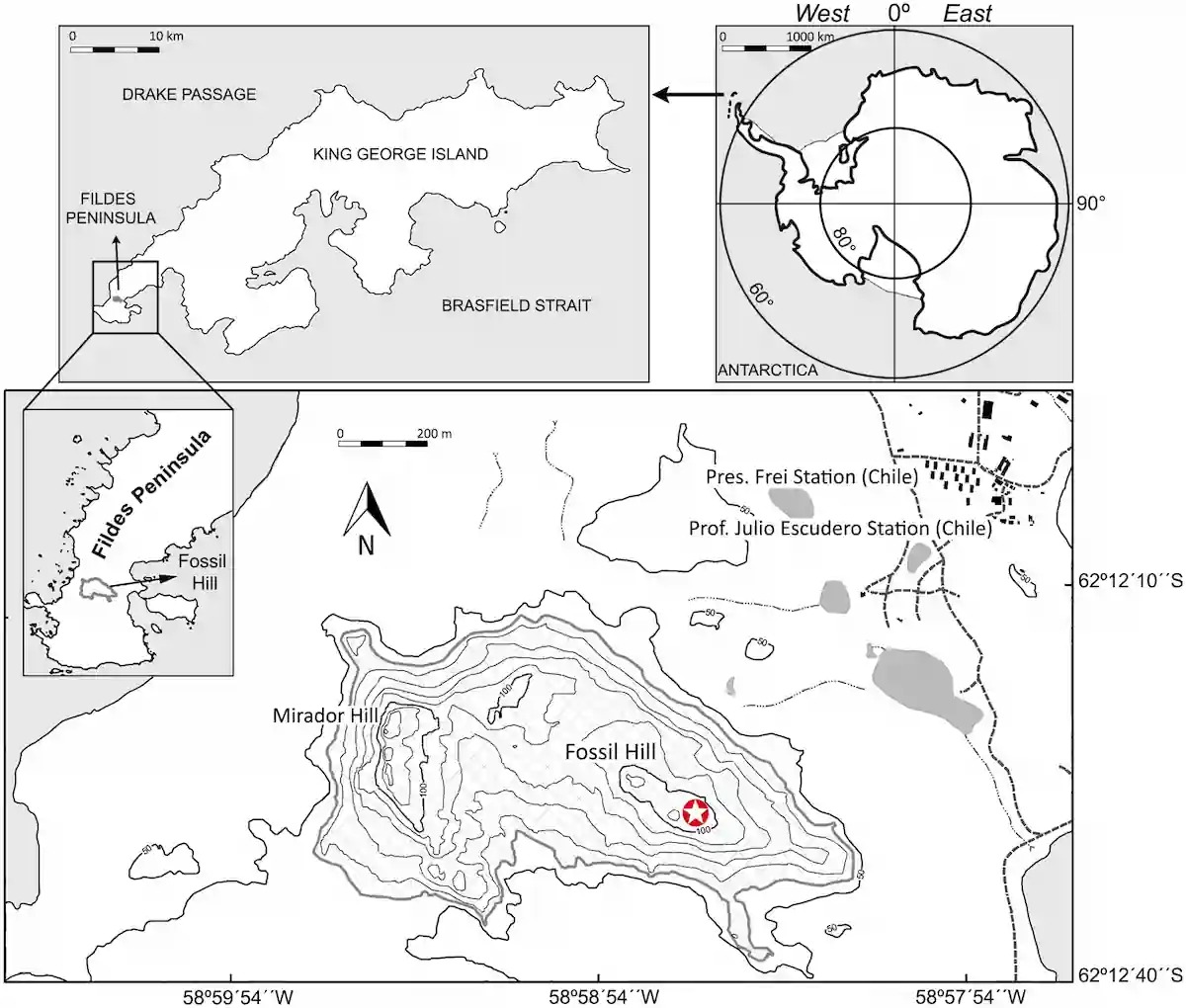
The specimen, labeled T-373, is a partial hand-and-foot, or manus-pes, print set collected from the Fossil Hill Formation on King George Island’s Fildes Peninsula. The site is protected as an Antarctic Specially Protected Area precisely because of how much it has already yielded: preserved plants, feathers, and animal traces that together sketch out a picture of a once-temperate coastal environment. According to Dr. Héctor Mansilla-Vera of the Instituto Antártico Chileno and colleagues from Chile and Argentina, the broader mammalian fossil record tells an uneven story.
While mammal and mammal-like footprints stretch back to the Late Triassic, their diversity exploded near the end of the Mesozoic and again after the Cretaceous-Paleogene mass extinction, when bones, teeth, and footprints of land mammals became far more abundant worldwide. Antarctica, though, has lagged far behind. As the researchers put it:
“The complete land-mammal fossil record from Antarctica is represented mainly by isolated teeth and, to a lesser extent, by skeletal remains.Notably, all these materials are restricted to Eocene-Oligocene layers on Seymour (Marambio) Island, West Antarctica, highlighting the strong geographic bias of the Antarctic Paleogene mammalian record in a continent where terrestrial mammals are now entirely absent.”
Ancient Track Reveals Lost Predator
Published in august in the journal Polar Biology, the study reveals that the footprint’s modest size belies its precision, it shows three rounded toe pads arranged in an arc, a triangular heel pad, and no visible claw marks, a set of features the researchers interpret as consistent with a cat-sized animal that walked on the balls of its feet.
Research team calculated the animal’s likely weight using a formula that estimates body mass from footprint area, arriving at a figure of about 1.3 kg.Those proportions point toward sparassodonts, a group of extinct South American predators sometimes described as pouched, weasel-like mammals related to opossums, which thrived in Patagonia during the same period. The scientists were specific about the match, they estimated the body mass for the T-373 trackmaker, they wrote:
“The estimated body mass for the T-373 trackmaker aligns precisely with the size range of small Hathliacynidae sparassodonts, e.g.,Pseudonotictis.”

No sparassodont bones or teeth have ever been found in Antarctica, which makes this footprint the closest thing to physical proof that the group made it there at all.
Redrawing Antarctica’s Food Web
The researchers argue that the footprint is best explained by sparassodonts crossing a land bridge that once linked Antarctica to South America, before the two continents separated and Antarctica’s climate turned hostile. Until this discovery, the going assumption was that Antarctica’s Eocene land predators were limited to early relatives of falcons and flightless terror birds.

As the paleontologists concluded, the footprint constitutes the first direct ichnological evidence of a land mammal in the Eocene ecosystems of Antarctica.
“The discovery supports the idea that these endemic South American predators had reached high southern latitudes by the early Paleogene,” concluded the authors
Enjoyed this article? Subscribe to our free newsletter for engaging stories, exclusive content, and the latest news.

