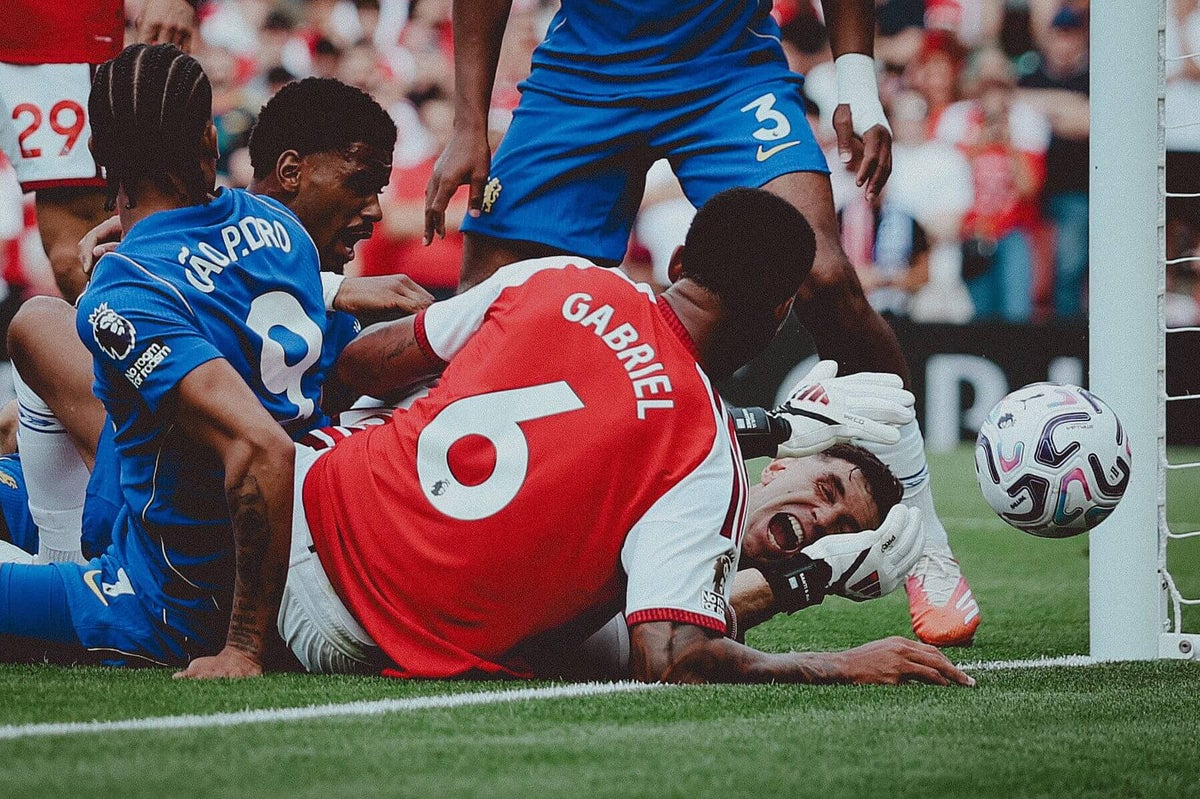
Премьер лигийн гуравдугаар тойрогт гарсан маргаантай шийдвэрүүд, тэр дундаа Габриэл болон Эмилиано Мартинез нарын мөргөлдөөн болон Неко Уильямсын хүчингүй болгосон гоолын талаарх асуултуудад мэргэжилтэн хариулт өглөө.
Лондоны дерби тоглолтын үеэр Габриэл бөмбөгний төлөөх тэмцлийн үеэр Эмилиано Мартинезийн толгой руу өшиглөсөн үйлдэлд шүүгч Крис Каванаг чөлөөт цохилт олгосон нь зөв шийдвэр байсан гэж үзэж байна. Шүүгчийн шинжээч Грэм Скоттын тайлбарласнаар, тухайн агшинд бөмбөг талбай дээр тоглолтод байсан тул VAR-ын оролцоо шаардлагагүй байсан аж. Мөн Майлс Льюис-Скелли тоглолтын турш таван удаа алдаа гаргасан ч шар хуудас аваагүй нь шүүгчдийн “дахин давтагдах алдааг” тодорхойлох арга барилтай холбоотой гэв.
Ноттингем Форест багийн Неко Уильямсын гоолыг гар хүрсэн шалтгаанаар хүчингүй болгосон нь телевизийн бичлэгээр тодорхойгүй байсан ч оффсайд технологийн камерын бичлэгээр батлагдсан бололтой. Хэдийгээр VAR протоколын дагуу зөвхөн телевизийн бичлэгийг ашиглах ёстой ч энэ удаад зөв шийдвэр гарсан нь технологийн ач холбогдлыг харууллаа. Мөн Ливерпүүл багийн довтлогч Коди Гакпог торгуулийн талбайд унагасан асуудлыг шүүгч нар алдаа гэж үзээгүй эсвэл торгуулийн талбайн гадна болсон гэж дүгнэсэн байх магадлалтай юм.
Лидс Юнайтед багийн Ао Танакагийн гоолыг оффсайд байрлалтай гэж үзэн хүчингүй болгосон шийдвэр нь хиймэл оюун ухаан дээр суурилсан хагас автомат оффсайд системийн нарийвчлалаар баталгаажсан. Түүнчлэн VAR-ын шүүгчид удаашруулсан бичлэгийг ашиглахдаа тоглолтын хэмнэл болон нөхцөл байдлыг харгалзан үзэж, хэт удаашруулалт нь шийдвэрт буруу нөлөөлөхөөс сэргийлэх ёстойг онцоллоо.
Дэлгэрэнгүйг эх сурвалжаас харах
↓Эх сурвалжийг нээх ↓
The third round of Premier League matches brought yet more controversy, including an unpunished kick to the head in a London derby and confusion around a goal disallowed for handball.
Graham Scott refereed in the Premier League for a decade before retiring in 2025 to return to his previous career as a journalist. He was a video assistant referee (VAR) more than 100 times and brings a unique insight into how officials operate, both on the pitch and in the video booth.
As The Athletic’s resident refereeing expert, he answers your questions about the weekend’s big in-game decisions and VAR interventions…
Why was Neco Williams’ goal not allowed to stand when there was no clear, visual evidence of a handball and initially the goal was given?
– Tarun A
Based on the replays shown on TV, I was surprised this goal was ruled out by VAR, as the available evidence was inconclusive.
A new angle has since been released by the referees’ body, Pro Ref, which must be taken from one of the cameras used by the semi-automated offside system.
The only other possibility is that it was footage obtained by a Nottingham Forest analyst for internal use, but it seems implausible that the club would release video proving Williams had handled, especially given Williams’s post-match interview denying any such thing.
Forest’s goal was disallowed for this Neco Williams handball (Michael Regan/Getty Images)
The VAR protocol is clear that video officials can only review the TV broadcast footage, so the separate cameras used for semi-automated offside should not have been available.
It does throw up the question of whether this should continue to be the case, given that they proved in this instance that the correct decision was reached.
Earlier this season, West Bromwich Albion striker Aune Heggebo was suspended for two matches by the FA after scoring with his hand at Norwich City in a Championship game. Williams will not be charged because Heggebo’s offence was successfully deceiving a match official. Ultimately, Williams did not.
Do you think the decision not to punish Gabriel for kicking Emiliano Martinez in the head was correct?
– BluesFan
I was not surprised in the slightest that this scramble for the ball did not lead to anything more than a free kick, and I think it was a fair outcome.
Such was the crowd scene that referee Chris Kavanagh would have had precious little chance of seeing all that went on. It’s rather easier when watching replays from a camera behind the goal, when one knows what to look for.
Even so, the VAR was right to keep out because at the time Gabriel went to play the ball, it was up for grabs. Martinez claimed it and was caught on the top of his head for his troubles.
Referees are asked to be more tolerant when players are desperately trying to score or defend their goal. That was one of the reasons I was surprised that Alisson was penalised the week before in Liverpool’s game with Nottingham Forest.
But I don’t think that was a factor in this case. Had the incident occurred in the centre circle, I would only award a free kick and leave it at that.

Emi Martinez was left holding his head after the goalmouth scramble (Ryan Pierse/Getty Images)
Miles Lewis-Skelly committed five fouls without receiving a yellow card. Why is this possible?
– Paul M
That’s a good question, and I suspect most fans will not believe or like the answer, but I hope they will understand it.
There is no definition in the laws of football of what constitutes persistent infringement. One player may receive a yellow card for two offences, while another escapes after committing many more.
Referees differ in their methods, with some good at keeping a mental log of who’s done what, a few asking the fourth official to keep a tally, and most relying on a less robust approach based on whether a player’s actions have stood out for some reason.
Two poor challenges in quick succession, both of which were borderline cautions anyway, usually lead to a card. Five innocuous fouls spread out over the whole match may go unnoticed.
You’re right that Lewis-Skelly was penalised five times, all for challenges from behind that involved just enough contact, mostly with his upper body, to justify free kicks.The offences were in minutes: 9, 43, 44, 54 and 57. None were remotely reckless, and none prevented a promising attack, which are the usual triggers for cautions.
A yellow card, even after his fourth foul in relatively quick succession, would therefore have come as a surprise unless Lewis-Skelly had received a public warning, which he had not. I’m not saying that referee Chris Kavanagh was right, but I can say that it’s highly likely I would have taken the same approach.
In my 17 seasons in the professional game, dealing with persistent infringement was never discussed at a training meeting, and no single method was promoted as best practice.
There is a seductive argument for a more systematic approach in the interests of greater consistency, but the issue rarely arises and gets lost among more pressing matters.

Lewis-Skelly (right) made five fouls against Chelsea, but was not booked (Justin Setterfield/Getty Images)
How much do VAR officials take into account that incidents look very different in slow motion?
– Noel L
When we were initially being trained as VARs, in the abstract world of training camps, we considered this issue in depth.
My view was that the game was played at full speed, so we should not slow down the replays. Others argued that we are judged by everyone in the game by the replays they see, so we would be daft not to use the same footage when making decisions in the VAR chair. I lost the argument and on balance accept I was wrong.
Nowadays VARs are most cautious about using slow motion in relation to handball and serious foul play, the term that covers challenges for the ball that deserve red cards.
We have all seen social media posts that depict a still image or slowed down loop of a ball striking an outstretched arm, or six studs being implanted halfway up the leg of an opposing player. It’s easy to think the referee must have been wrong, but watched in context, often neither was an offence or the referee’s decision was understandable.
In relation to a routine handball decision, VARs are expected first to check the position of the alleged offender’s arm when the ball was last played. If at this point it is in a justifiable position given what the player is trying to do, then they should only be penalised if they move their arm into the path of the ball or brace themselves to block it.
For potential red card tackles, the protocol involves the VAR watching the incident at full speed from a wide angle first to establish the intensity, before getting more forensic with the point of contact. This sequence should also be followed at the pitch-side monitor, but sometimes the VAR cuts straight to slow motion replays in the interests of speed.
Why weren’t Liverpool awarded a penalty at Ipswich Town when Cody Gakpo was brought down in the box by Abdul Fatawu?
Adrian B
I have only seen one angle of this incident, which was taken from behind the referee. From this footage, it looks like a clear foul, but it is less clear where any offence occurred.
No replays were shown at the time by the broadcaster because the ball only went out of play very briefly before the referee blew for half-time.
We can safely assume that the VAR checked the tackle and can conclude that either he saw a foul that was outside the area, in which case he could not intervene, or no foul at all.
The laws of the game state explicitly that holding offences that start outside and continue into the area are penalised by a penalty kick.
There is no such statement in relation to foul tackles, but officials are expected to award a free kick if the first contact is outside the box, and a penalty if that contact is inside. The line itself is inside the area.
I cannot be sure but am reasonably confident that this should have been a free kick, hence the lack of intervention.
Do you think the right offside line was used to disallow Ao Tanaka’s goal for Leeds United at Brighton & Hove Albion on Saturday?
Keith I
Yes. I have operated the semi-automated offside system, and it is incredibly accurate in relation to the moment the ball is played and the position of all the players.

(David Horton/Getty Images)
Dozens of fixed cameras around the grounds take 200 images a second, and an AI-based program runs continually to assess every body part of every player. TV images are never as accurate, even on the highest-resolution sets.
A decision might be dubious if there is an incredibly crowded area, so the ball disappears from view briefly, or if the judgement depends on whether a player from either side gets the faintest touch on the ball. This one was clear-cut.

