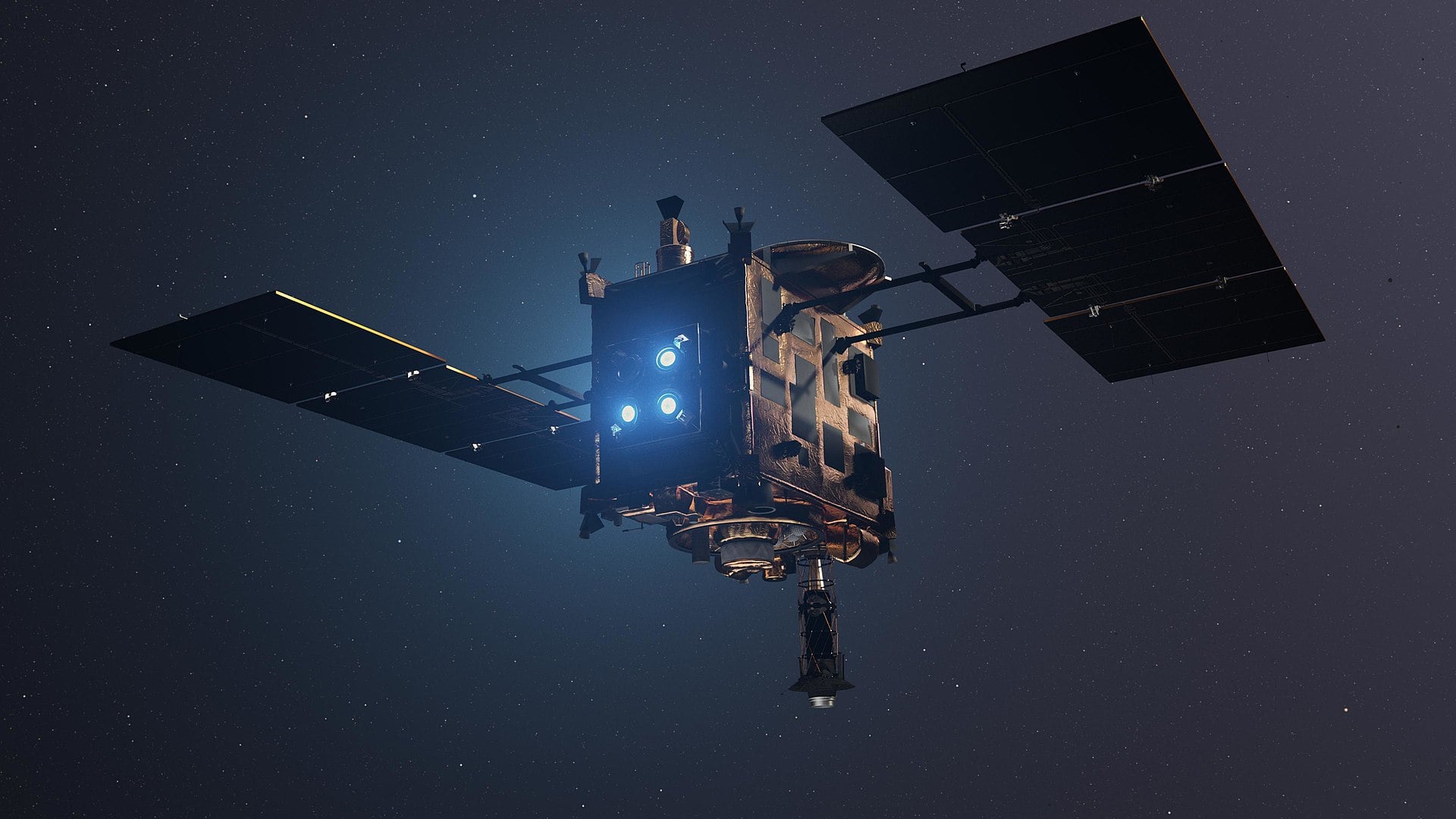
Энэхүү амжилттай туршилт нь ойрын зайн астероидуудыг судлах, гариг эрхсийн хамгаалалтын чадавхыг нэмэгдүүлэхэд чухал ач холбогдолтой юм.
Японы Агаарын сансрын судалгааны агентлаг (JAXA)-ийн Hayabusa2 сансрын хөлөг долдугаар сарын 5-ны ням гарагт Torifune астероидын хажуугаар өнгөрөх үедээ анх удаа лазерын зайн хэмжилт хийх туршилтыг амжилттай гүйцэтгэлээ. Энэхүү ажиллагаа нь Hayabusa2 хөлгийн өргөтгөсөн номлолын хүрээнд хийгдсэн бөгөөд сансрын судалгааны түүхэнд анх удаа астероид дээр лазер тусган зай хэмжсэн тохиолдол болж байна.
Тус туршилтад Kaguya сарны тойрог замын хөлгөөс уламжлан бүтээсэн LIDAR лазер алтиметр (LALT) төхөөрөмжийг ашиглажээ. Энэхүү багаж нь зай хэмжихээс гадна астероидын нягт, сүвэрхэг чанар, гадаргуугийн ойлт болон тоосны бөөмсийн оршихуйг тодорхойлох зориулалттай юм. Хөлөг 5.3 км/с буюу 18,000 км/ц хурдтайгаар хөдөлж байх үедээ 20 км болон 15 км-ийн зайнаас лазерыг хоёр удаа амжилттай харвасан байна.
Лазерын нарийн туяа нь Torifune астероидын гадаргуу дээр 30 метр болон 23 метр диаметртэй хэсгийг тусгажээ. Энэхүү хэмжилт нь сансрын уудамд байрлалын лавлагаагүй үед объектын хэмжээг нарийвчлан тогтоох, тойрог замын урьдчилсан таамаглалыг сайжруулахад чухал үүрэгтэй.
Энэхүү технологийн ололт нь зөвхөн сансрын судалгаагаар хязгаарлагдахгүй бөгөөд дэлхийд аюул учруулж болзошгүй астероидуудын мөргөлдөх эрсдэлийг урьдчилан тооцоолох гариг эрхсийн хамгаалалтын ажилд томоохон хувь нэмэр оруулна. Одоогоор эрдэмтдийн баг лазерын туяа астероидын гадаргуу дээр яг хаана туссаныг нарийвчлан тогтоох судалгааг үргэлжлүүлж байна.
Дэлгэрэнгүйг эх сурвалжаас харах
Эх сурвалжийг нээх ↓
The Japan Aerospace Exploration Agency’s (JAXA) Hayabusa2 spacecraft hit another milestone this summer, which was also a first-ever for space agencies. On Sunday, July 5th, the probe conducted the first successful laser ranging experiment during a flyby of asteroid Torifune, the first exploration target of Hayabusa2’s Extended Mission. This latest milestone will advance the capabilities of JAXA and other space agencies as they pursue future missions with Near-Earth Asteroids (NEAs) and other deep-space objects.
The experiment relied on Hayabusa2’s LIDAR laser altimeter (LALT) instrument, developed from the Light Detection and Ranging (LIDAR) altimeter used by JAXA’s Kaguya lunar orbiter. In addition to measuring distances, the instrument was designed to measure asteroid density and porosity, surface reflectance, and the presence of levitating dust particles. The LALT instrument already played an important role in the probe’s navigation and acquired significant data on the surface topology of asteroid Ryugu.
The laser was successfully fired twice, at 06:29 p.m. (02:29 a.m. PDT; 05:29 a.m. EDT) and 56.5 seconds and 57.5 seconds, from distances of about 20 km and 15 km (12.5 mi and 9.3 mi), respectively – about 4 and 3 seconds before the flyby with Torifune. This presented many challenges that required advanced preparations by the mission team. For starters, the laser had to be directed at a small target while the spacecraft traveled at 5.3 km/s, or 18,000 km/h (3.3 mi/s or 11,185 mph).
The area illuminated by the laser when ranging was success (red) and for unsuccessful pulses (blue). Credit: JAXA
Due to the narrow focus of the beam, it struck only a tiny portion of Torifune’s surface, covering areas of 30 and 23 meters (100 and 75.5 ft), respectively. Second, accurately targeting the asteroid required precise attitude and trajectory control, while ensuring the instruments were configured to avoid detecting background noise. This required extensive preparation by the mission team. Fortunately, these preparations paid off not once, but twice.
In space, there are no reference objects, which makes it difficult to distinguish foreground from background. Laser ranging assists this by adding scale to spacecraft images and accurately determining the size of astronomical objects. When laser ranging is obtained at multiple points in time and combined with spacecraft tracking data, it can accurately determine a celestial body’s position and trajectory, improving orbital predictions.
This information has implications beyond space exploration and plays an important role in planetary defense, allowing scientists to accurately predict which asteroids could pose a potential future collision risk. The successful test also shows that scientists can gather crucial information on celestial objects while spacecraft are traveling at high velocities. The team is now conducting a detailed analysis to determine the exact location where the laser touched the asteroid’s surface.
Further Reading: JAXA

