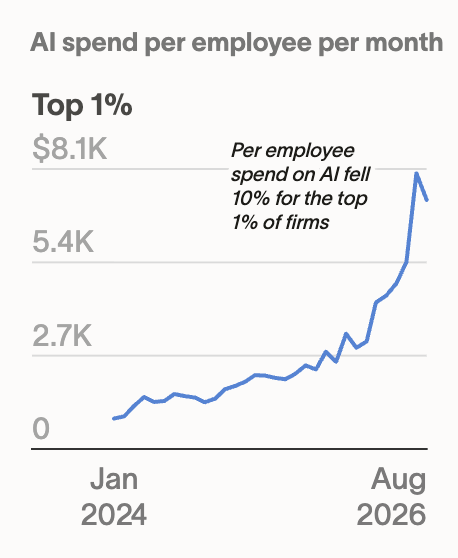
Төлбөрийн үйлчилгээний Ramp компанийн судалгаагаар бизнесүүдийн хиймэл оюун ухааны хэрэгсэлд зарцуулах зардал өсөлт нь удааширч, зах зээлийн ирээдүйн төлөв байдалд эргэлзээ төрүүлж эхэллээ.
Ramp компанийн 70 мянган байгууллагыг хамруулсан мэдээллээр наймдугаар сард үйлчлүүлэгчдийн 56 хувь нь хиймэл оюун ухааны бүтээгдэхүүнд төлбөр төлсөн нь өмнөх сараас ердөө 0.4 хувиар өссөн үзүүлэлт юм. АНУ-ын Хүн амын тооллогын товчооны судалгаагаар хиймэл оюун ухаан ашигладаг бизнесүүдийн эзлэх хувь 22 хувьтай байгаа нь Ramp-ийн мэдээлэл зах зээлийг бүрэн төлөөлөхгүй байж болохыг харуулж байна. Гэсэн хэдий ч салбарын шинжээчид энэхүү удаашралыг хиймэл оюун ухааны дэд бүтцэд асар их хөрөнгө оруулалт хийж буй компаниудын хувьд анхаарал татах дохио гэж үзэж байна.
Ramp-ийн эдийн засагч Ара Харазианы тайлбарласнаар, салбарын шилдэг нэг хувьд багтах компаниудын ажилтанд ногдох хиймэл оюун ухааны зардал бараг 10 хувиар буурч 7,205 ам.доллар болжээ. Үүнд OpenAI болон Anthropic зэрэг компаниудын токен үнийг бууруулсан нь нөлөөлсөн бөгөөд нэг сая токенын үнэ 2026 оны гуравдугаар сард 1.15 ам.доллар байсан бол 0.68 ам.доллар болж хямдарсан байна. Энэ нь үйлчилгээ үзүүлэгч компаниуд үнийн бууралтыг хэрэглээний өсөлтөөр нөхөж чадахгүй байгааг илтгэж болзошгүй юм.
Одоогоор зах зээлд OpenAI-ийн ChatGPT 5.6-Terra болон Anthropic-ийн Sonnet зэрэг илүү хямд, хуучин загваруудыг сонгох хандлага давамгайлж байна. Хиймэл оюун ухааны салбарын өрсөлдөөн хэрэглэгчдэд хүртээмжтэй байдлыг нэмэгдүүлж, зардлыг бууруулж байгаа ч энэ нь технологи хөгжүүлэгч компаниудын орлогын өсөлтөд сөргөөр нөлөөлөх эрсдэлтэй. Харазианы үзэж буйгаар, хэрэв тухайн компани хиймэл оюун ухааныг үр дүнтэй ашиглаж чадаж байвал энэ нь хэвийн үзэгдэл боловч томоохон хөрөнгө оруулалт хийсэн технологийн аваргуудын хувьд сорилт болох юм.
Дэлгэрэнгүйг эх сурвалжаас харах
↓Эх сурвалжийг нээх ↓
The adoption of AI tools by businesses slowed in August, according to spending data at 70,000 companies collected by the payments company Ramp. The latest survey shows 56% of Ramp customers paid for AI products in August, rising just 0.4% from the month before.
This isn’t the first time Ramp’s metrics have shown adoption slowing down. Last year, the company’s AI index showed little to no growth in adoption between August and October, only to have growth pick up again as the year finished.
Still, the extreme pace of the AI buildout means even small slowdowns can be cause for concern. The gobsmacking investment in AI infrastructure by frontier labs and hyperscalers rests on the hope that there is plenty of revenue out there to pay it back. Thus far, usage has grown steeply, particularly as software engineers adopted agentic coding tools — but if that adoption slows down, revenue is likely to slow as well.
Ramp’s figures may overstate overall adoption, thanks to the company’s techy clientele: An ongoing US Census Bureau survey of AI adoption updated on August 23 shows just 22% of businesses report using AI. Ramp’s survey isn’t necessarily representative of the market, but it’s one of the few direct spending data sets available and potentially a leading indicator.
To be sure, this data is from August, when much of the industry is on vacation. That may explain the doldrums. But there are other warning signs for companies that depend on token spend, per Ramp economist Ara Kharazian.
First, a major decline in AI spend per employee in the top 1% of firms in his sample, falling nearly 10% to $7,205. That may be the vacation-token factor, but it also speaks to falling token costs. As OpenAI and Anthropic have cut prices, average token costs have declined to $0.68 per million tokens, as opposed to the 2026 peak of $1.15 per million tokens in March.
The data suggests that the labs have yet to make up for the price cuts with growing volume. And the same incentives have many customers choosing to use older, cheaper models like OpenAI’s ChatGPT 5.6-Terra and Anthropic’s Sonnet instead of the more powerful frontier releases. Employees at frontier labs have said much of the cost of training is recouped in the first weeks of a new model’s release, and slower adoption could threaten that dynamic.
Still, for all the talk of open-weight models threatening the frontier labs, only 6.4% of AI-spending businesses used model-serving or inference platforms in August; a share that’s growing steadily but not fast enough to drive the dynamics of broader business adoption.
“We are showing that competition between OpenAI and Anthropic is making AI more accessible, and also driving the price down for companies—and not just driving the price down, but driving spend down at the top 1% of companies that previously the market was expecting to drive much of the growth going forward,” Kharazian said.
That also helps explain the focus at AI labs on winning over non-technical users for AI co-working tools.
This data point — dare we call it a blip? — could be a bad sign if you’re a model-builder or a hyperscaler with a couple hundred billion of chips on order. But, Kharazian notes, “it depends on who you are in the market. If your company is using AI, it’s great.”
When you purchase through links in our articles, we may earn a small commission. This doesn’t affect our editorial independence.

