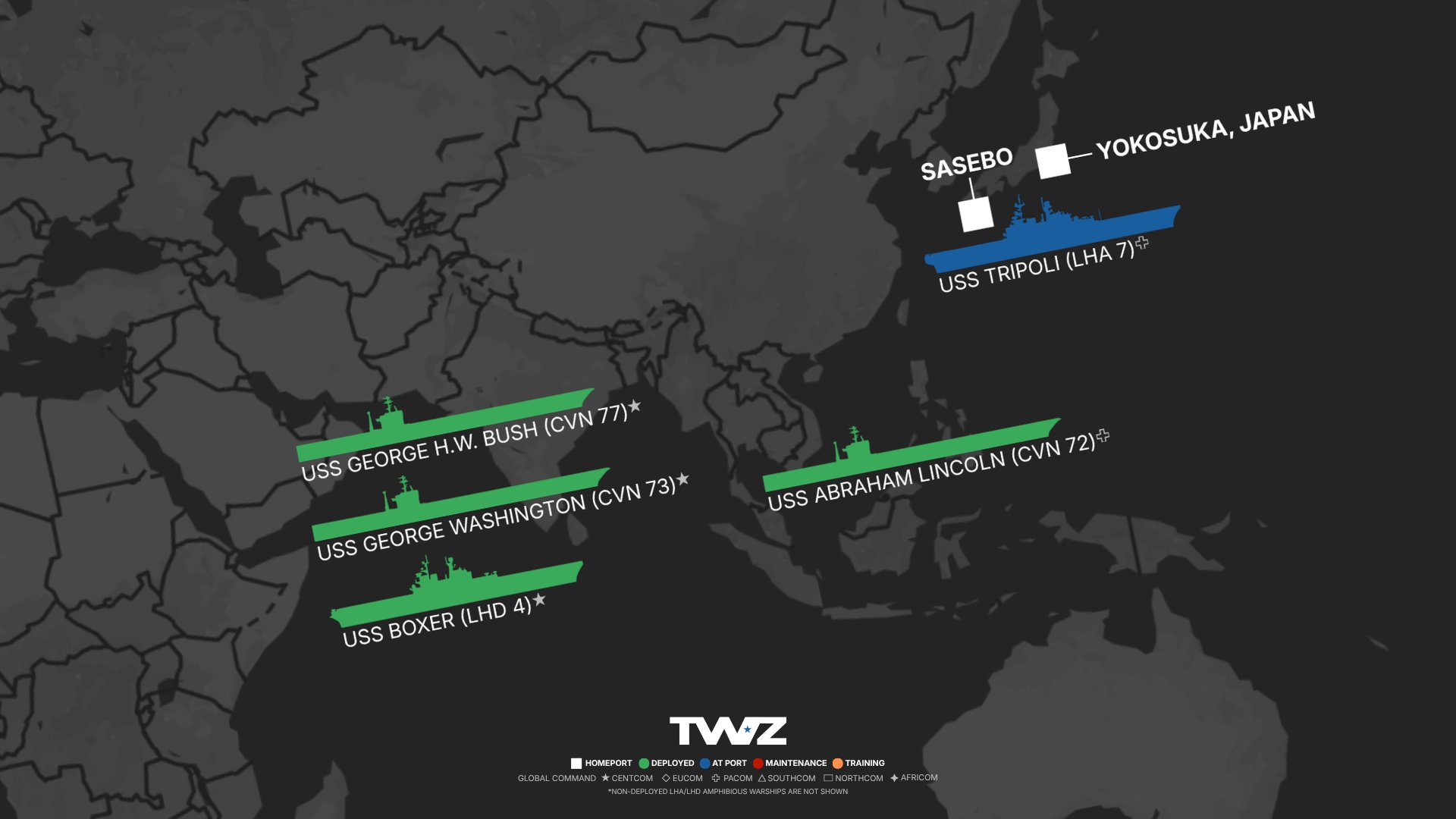
Ойрх Дорнод дахь мөргөлдөөн эрчимжиж, АНУ-ын тэнгисийн цэргийн хүчин Ираны талтай сөргөлдөөнөө нэмэгдүүлж буй энэ үед нисэх онгоц тээгч хөлөг онгоцнуудын үйл ажиллагаа болон бэлэн байдлыг шинэчлэн зохион байгуулж байна.
Ойрх Дорнод дахь “George Washington” цохилтын бүлэг есдүгээр сарын 5-нд баллистик пуужингийн халдлагад өртсөн боловч амжилттай зайлсхийж чаджээ. Үүний хариуд АНУ-ын Төвийн командлал (CENTCOM) Ираны Хувьсгалт гвардийн үйл ажиллагааг санхүүжүүлдэг “сүүдрийн флот”-ын 10 газрын тос тээвэрлэгч хөлгийг устгасан байна. Мөн есдүгээр сарын 9-нд Ираны талаас Иордан дахь АНУ-ын цэргийн бааз руу томоохон хэмжээний пуужингийн цохилт өгснийг Patriot зенит пуужингийн системүүд эсэргүүцэн хамгаалжээ.
АНУ-ын Тэнгисийн цэргийн хүчин “Gerald R. Ford” болон “Abraham Lincoln” хөлөг онгоцнуудын урт хугацааны үүрэг гүйцэтгэлээс авсан сургамжид үндэслэн багийнхны амьдрах орчин, хангамжийн асуудлыг сайжруулахаар төлөвлөж байна. Энэхүү өөрчлөлтийг удахгүй байршуулахаар бэлтгэж буй “Theodore Roosevelt” хөлөг онгоцноос эхлэн хэрэгжүүлэх юм. Тус хөлөг онгоц нь Сан-Диего хотод богино хугацааны засвар үйлчилгээ хийсний дараа есдүгээр сарын 5-нд хөдөлгөөнд орж, бэлтгэл сургуулилтаа үргэлжлүүлж байна.
“Abraham Lincoln” нисэх онгоц тээгч хөлөг есдүгээр сарын 2-нд Тайландад боомтын айлчлал хийсний дараа есдүгээр сарын 6-нд буцсан байна. Бараг есөн сар гаруй хугацаанд үүрэг гүйцэтгэсэн тус хөлөг онгоц Сан-Диего руу буцаж байгаа бөгөөд АНУ-ын тэнгисийн цэргийн хүчин Номхон далайн бүс нутаг дахь цэргийн бэлэн байдлаа хэвээр хадгалж байна гэж албаны эх сурвалж мэдэгдлээ. Одоогийн байдлаар АНУ-ын гурван нисэх онгоц тээгч хөлөг үүрэг гүйцэтгэж байгаа бөгөөд бусад хөлгүүд засвар үйлчилгээ болон бэлтгэл сургуулилтын үе шатанд байна.
Дэлгэрэнгүйг эх сурвалжаас харах
Эх сурвалжийг нээх ↓
The Navy says it is making a concerted effort to apply the hard lessons learned from the marathon deployments of the USS Gerald R. Ford and USS Abraham Lincoln, both in combat and in quality of life for the crew, according to a new video posted by the Chief of Naval Operations, Adm. Daryl Caudle. The changes will be rolled out when USS Theodore Roosevelt deploys following a brief, last-minute, and previously unreported maintenance availability, TWZ has learned. Meanwhile, the United States and Iran are quickly climbing the escalation ladder again, as the latest series of tit-for-tat strikes has resulted in a massive overnight ballistic missile attack on a Jordanian base hosting U.S. forces and the destruction of ten Iranian commercial oil tankers over the past week.
Here’s TWZ’s weekly carrier tracker monitoring America’s flattop fleet, including deployed Carrier Strike Groups (CSG) and Amphibious Ready Groups (ARG), using publicly available open-source information. Check out last week’s report here.
George Washington Strike Group Evades Iranian Ballistic Missiles
Less than a month after taking up station in the Middle East, elements of the George Washington CSG reportedly came under ballistic missile fire from the Islamic Revolutionary Guard Corps (IRGC) on September 5, according to Iranian media. “A U.S. aircraft carrier and guided-missile destroyer successfully evaded multiple unprovoked Iranian attacks,” U.S. Central Command (CENTCOM) confirmed in a statement, without identifying which warships were targeted. TWZ cannot independently verify the Iranian reports, and the Islamic Republic has frequently leveraged disinformation throughout the war.
U.S. forces responded swiftly the same day, striking three Iranian commercial oil tankers, part of the “shadow fleet” that funds IRGC operations, in a notable step beyond U.S. President Donald Trump’s recently announced tanker-for-tanker policy. “Let the message to the IRGC be clear: If you shoot at two of our ships, we will impose an even higher economic cost – taking out three of yours,” Adm. Brad Cooper, the CENTCOM commander, warned. “We will not hesitate to defend American forces, and if necessary, destroy Iran’s limited and exposed oil fleet,” he added. No U.S. casualties or damage to the American ships was reported.
Details surrounding the attack on September 5 are limited, but Iranian-affiliated channels claimed the IRGC fired the Qassem Basir medium-range anti-ship ballistic missile (ASBM) for the first time. If true, it would represent the first known combat employment of the ASBM since it was unveiled in May 2025 and pose a new threat to Navy warships operating within the 1,200-kilometer, or roughly 750-mile, stated range (although that figure is more than likely overstated). Generally speaking, American cruisers and destroyers can engage ASBMs in two layers, in some cases using Standard Missile-3 (SM-3) in the midcourse phase and SM-6 during the terminal phase. Both are finite resources, and only so many can be loaded in their Vertical Launch System (VLS) cells.
Since the initial exchange on September 5, the tit-for-tat strikes have continued to escalate. CENTCOM destroyed another five crude oil tankers on September 8, bringing the total to ten in a week, after the IRGC targeted an unidentified Navy warship again with ballistic missiles. Iran answered overnight, launching a huge salvo of ballistic missiles toward Muwaffaq Salti Air Base in Jordan, where a significant contingent of U.S. forces is forward-deployed. Dramatic videos on social media show Patriot batteries firing against the incoming projectiles, with open-source analysts counting at least 60 interceptors employed.
The USS George Washington arrived in the CENTCOM area of responsibility (AOR) on or around August 19, escorted by a single guided-missile destroyer, USS Shoup. The pairing matches the composition described in CENTCOM’s statement about the IRGC attack on September 5. Washington’s public affairs team reposted the statement on their social media accounts.
The possibility that the second Nimitz class flattop operating alongside Washington in the Middle East, the USS George H.W. Bush, was the target of the attack cannot be ruled out. Both carriers are the same class and look alike from a distance (or through a seeker). The George H.W. Bush CSG is currently composed of a guided-missile cruiser, USS Princeton, and two guided-missile destroyers, USS Ross and USS Donald Cook.
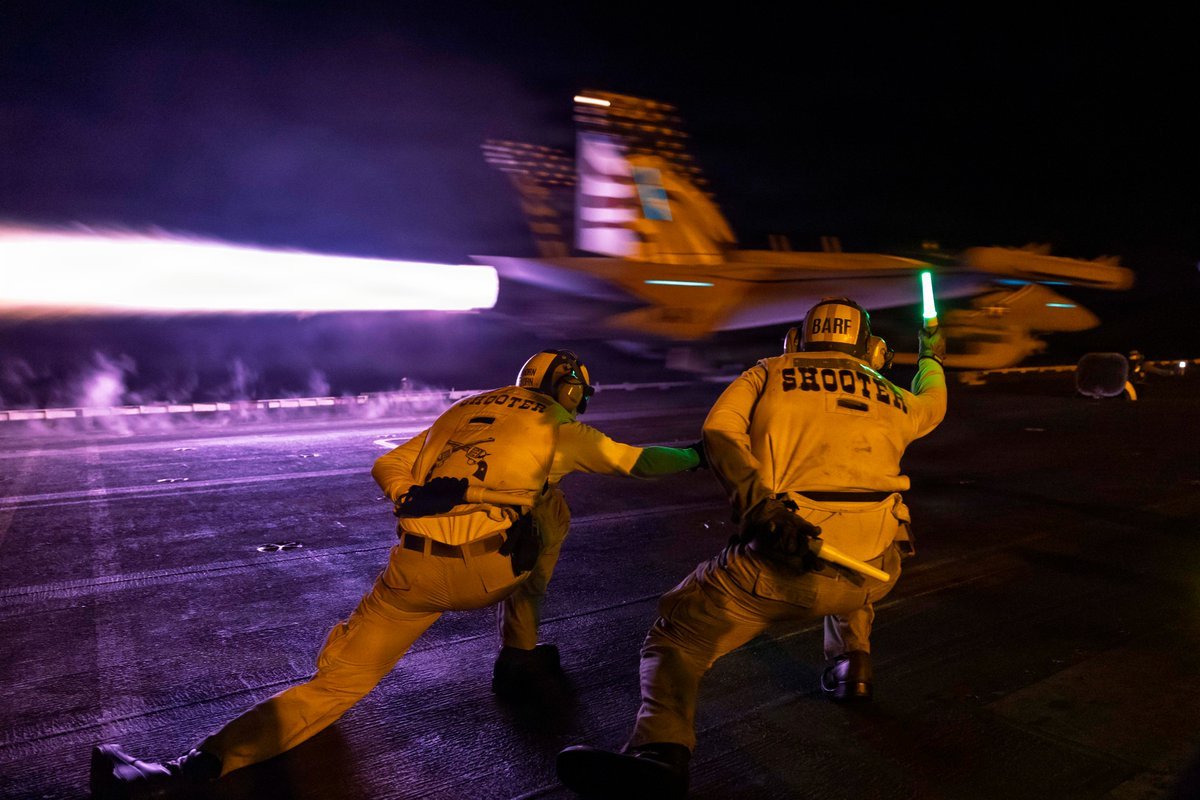
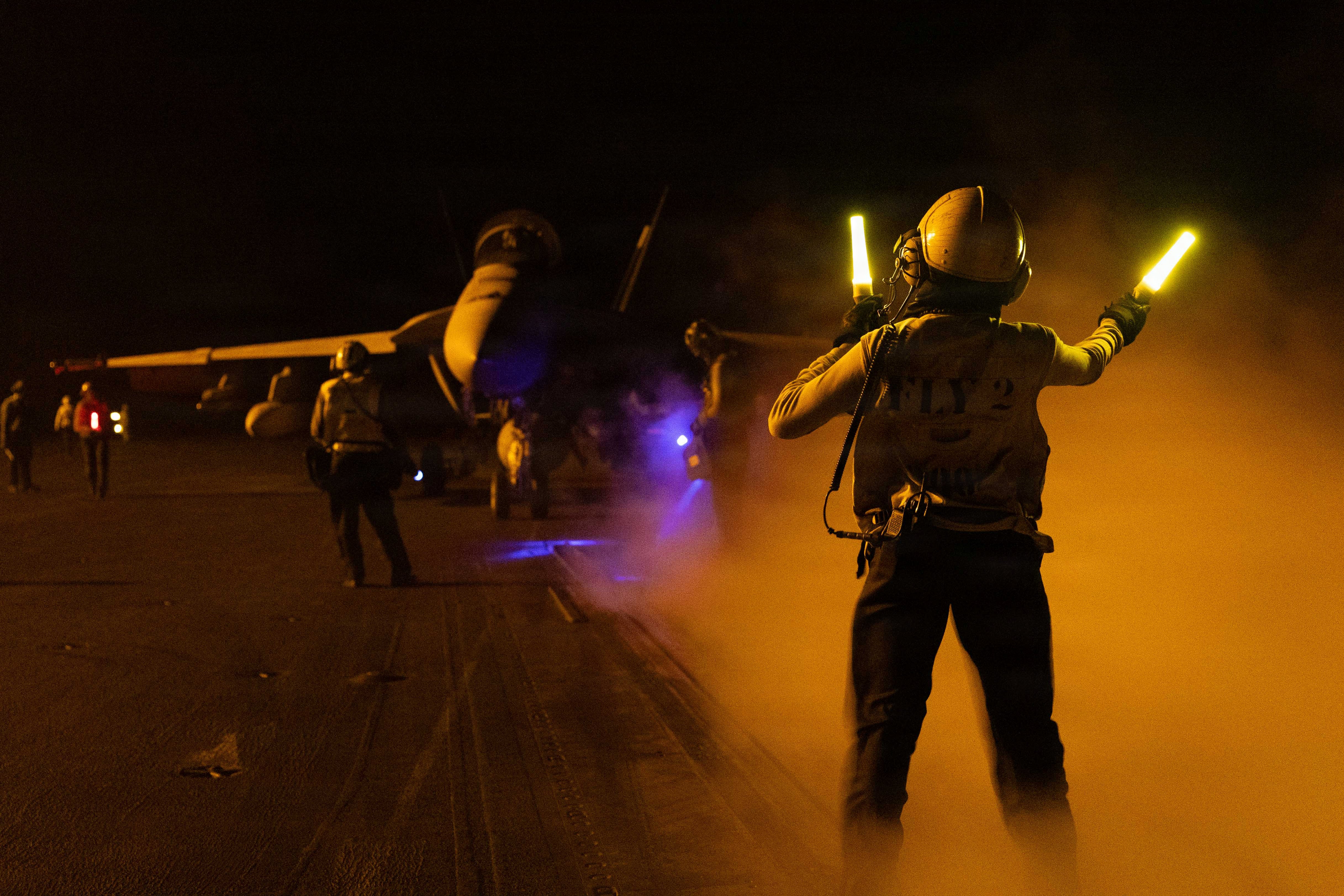
Bush was pictured conducting nighttime flight ops in CENTCOM’s most recent update detailing the status of the ongoing blockade: U.S. forces redirected 94 commercial vessels, kinetically disabled three, and boarded two to ensure compliance, as of September 7.
USS Theodore Roosevelt Undergoes Last-Minute Maintenance Ahead of Deployment
The next carrier scheduled to deploy from the U.S., the USS Theodore Roosevelt, recently got underway after a brief maintenance period. While there was no mention of an upcoming availability in budget documents, we noticed what appeared to be pierside work in commercial satellite imagery, similar to the brief stints Washington and Vinson completed recently while in homeport. In response to our inquiry, a Navy official told TWZ, “Nimitz-class aircraft carrier USS Theodore Roosevelt (CVN 71) is currently in port at Naval Air Station North Island in San Diego conducting routine, planned maintenance. While we do not comment on future operations or movements due to operations security, aircraft carriers follow an optimized fleet response plan that provides full realignment of maintenance, training, and deployment cycles to fit in a standard 36-month rotation.”
Roosevelt’s upcoming deployment has been the subject of heavy speculation, as there will soon be no carriers available in Asia should a contingency arise. While Lincoln is currently in the South China Sea, she’s at the tail end of her deployment and in the process of heading home. The same official addressed the coverage gap, telling us, “U.S. Pacific Fleet’s posture across the region remains strong, adaptive, and ready. The U.S. Navy is purpose-built to flex, surge, and sustain across multiple theaters simultaneously – and that flexibility is a strategic advantage, not a vulnerability. U.S. Pacific Fleet’s commitment to the region is enduring – backed by the Joint Force and a strong network of allies and partners – and we will continue to fly, sail, and operate wherever international law allows to support a free and open Indo-Pacific.”
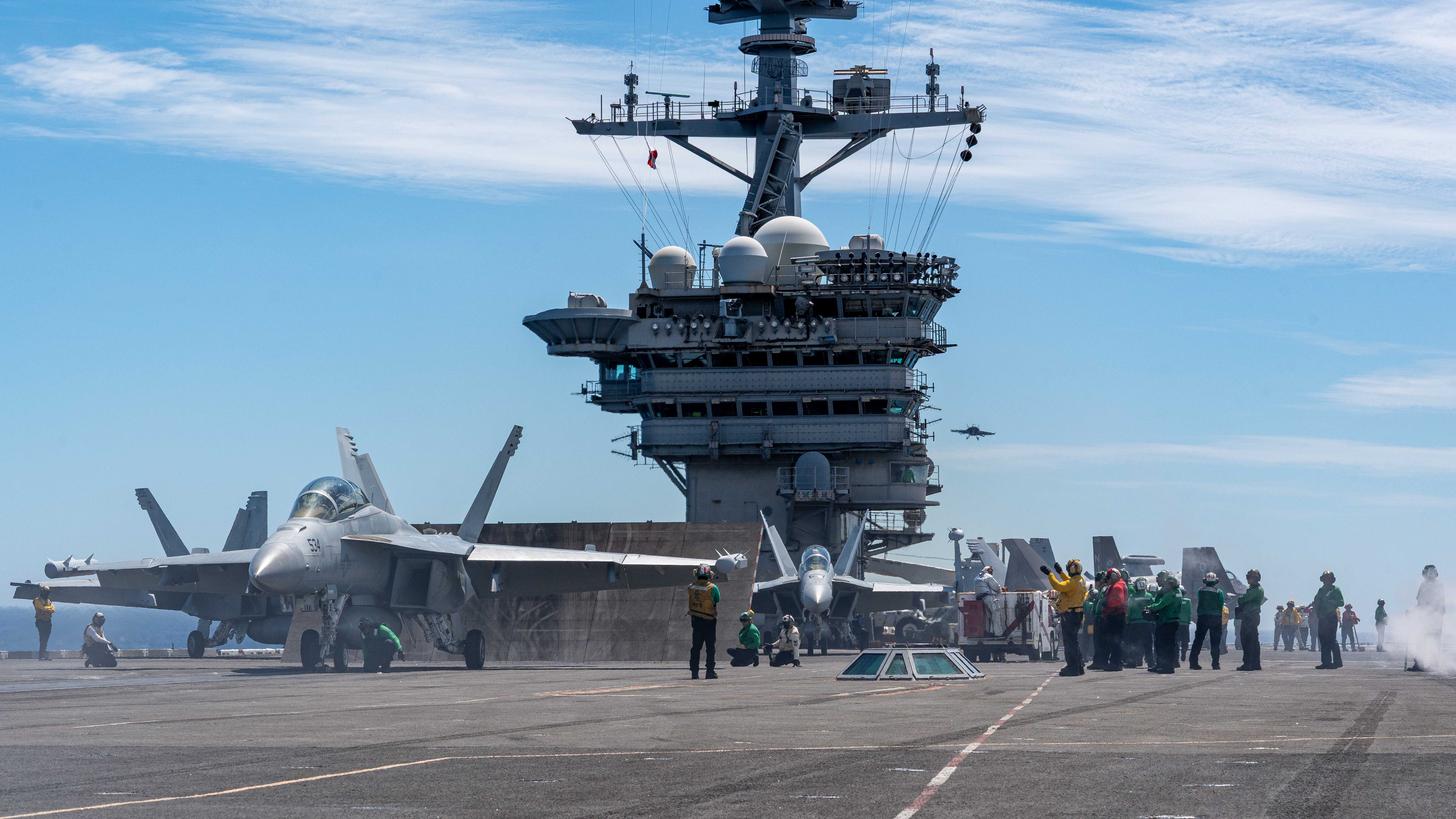
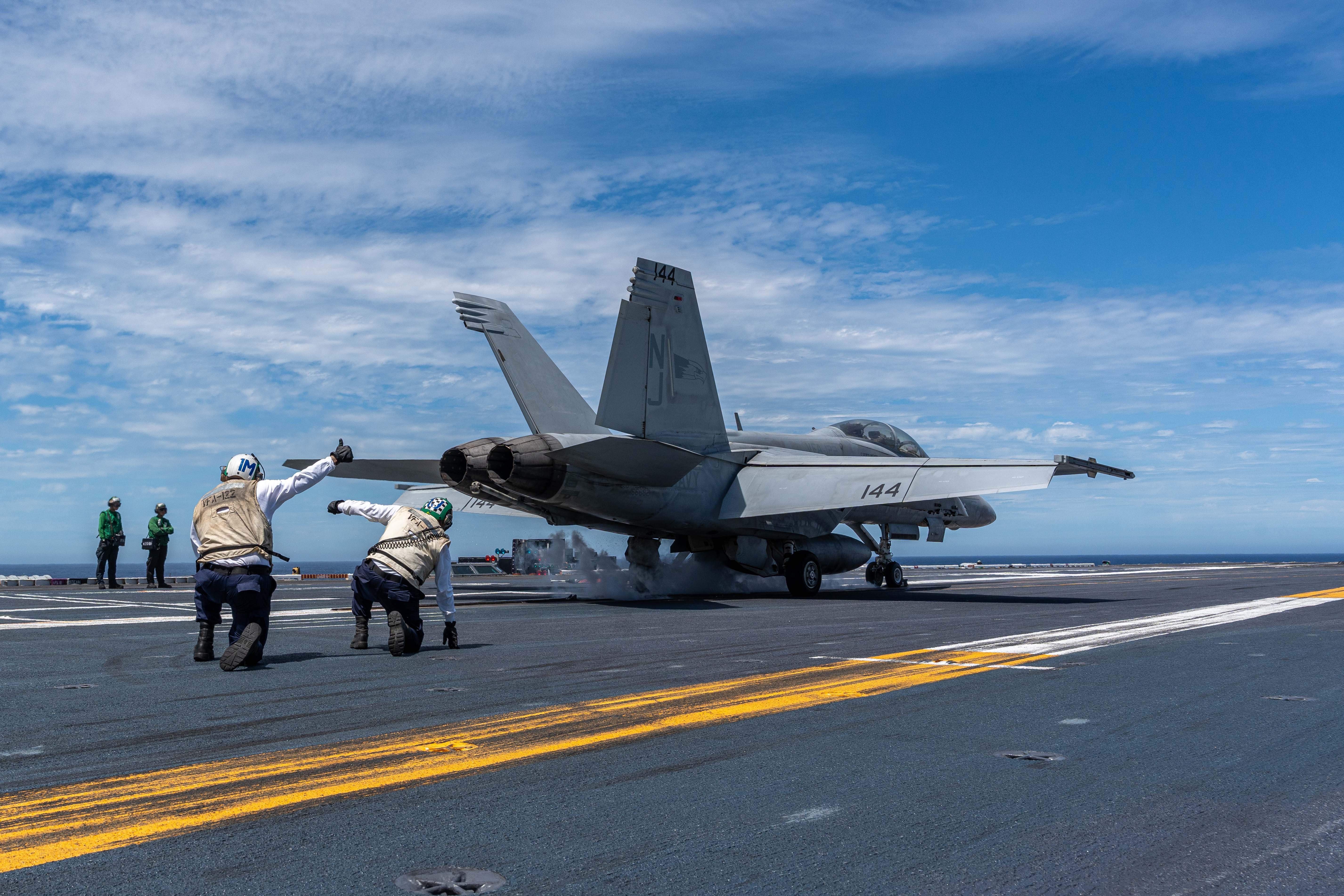
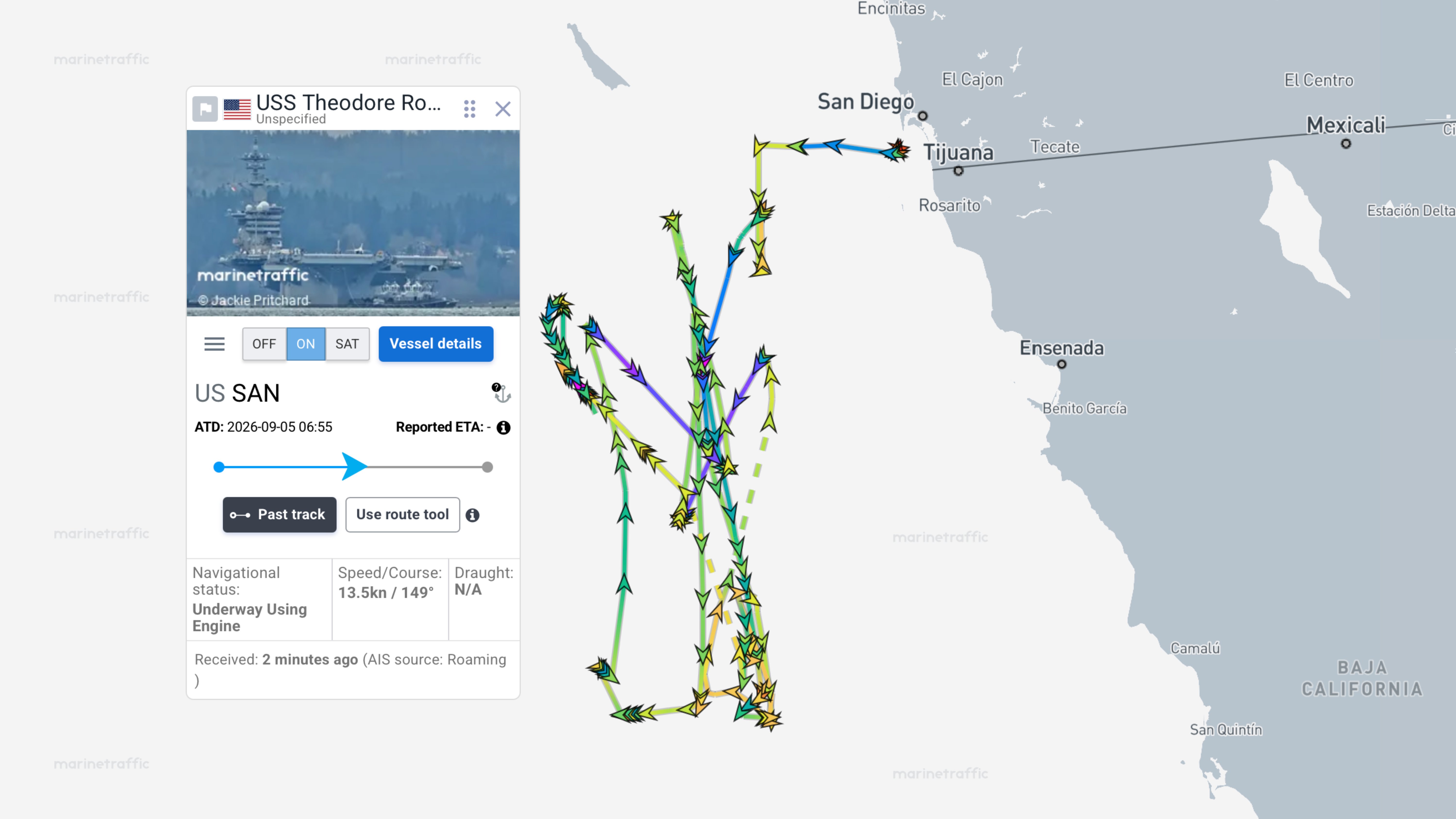
Roosevelt departed San Diego on September 5 and is still at sea as of publication. Imagery posted two days later on DVIDS, the military’s content-sharing platform, shows the flattop carrying out flight operations in the U.S. 3rd Fleet AOR and conducting “advanced training to bolster strike group readiness and capability.” The carrier was last tracked broadcasting a position publicly with her Automatic Identification System (AIS) transponder on, operating to the west of Baja California, Mexico, according to MarineTraffic. It’s unclear if the maintenance has been completed or if additional modifications and training will be required before the CSG deploys.
As noted above, the Chief of Naval Operations, Adm. Daryl Caudle, alongside Master Chief Petty Officer of the Navy (MCPON) John Perryman, posted a video yesterday with new information on Roosevelt’s upcoming deployment. “The lessons you’re bringing home are helping us better prepare the next team to deploy,” Perryman explained, addressing Lincoln’s crew. “Right now USS Theodore Roosevelt is putting those lessons into action using what we learned from Abraham Lincoln and Gerald R. Ford,” Caudle continued. On logistics, that means maximizing the loadout of food, retail products, and hygiene items by converting available spaces into additional storage facilities. Regarding quality of life, improvements include new entertainment, more fitness equipment, and holiday materials purchased in advance.
“Small things matter during a long deployment because taking care of our Sailors is part of maintaining combat readiness,” Perryman noted. Watch the full video below.
Three other U.S.-based carriers, USS Carl Vinson, USS Dwight D. Eisenhower, and USS Ronald Reagan, were recently underway for training but have returned to their respective homeports since our last report on September 1.
Eisenhower returned to Pier 14S at Naval Station Norfolk on September 2 after a 12-day underway for Fleet Replacement Squadron (FRS) and Training Command (TRACOM) Carrier Qualifications (CQ) in the Virginia Capes and Jacksonville operating areas. Vinson completed 25 days of Tailored Ship’s Training Availability (TSTA) and Final Evaluation Period (FEP) before mooring at Juliet Pier on Naval Air Station North Island, San Diego, on September 4. And Reagan, which just finished a nearly 18-month Drydocking Planned Incremental Availability (DPIA), returned to Naval Base Kitsap-Bremerton in Washington state on September 7 after a four-day post-availability shakedown and sea trials. It’s unknown how many rounds of sea trials will be required before Reagan returns to the fleet.
For the time being, America has one carrier coming back online, but the net gain will be short-lived, as Lincoln is expected to begin a DPIA after returning home.
USS Abraham Lincoln Leaves Thailand Looking Like A Different Ship
Elements of the Abraham Lincoln CSG, as well as escort cruiser USS Robert Smalls, arrived in Thailand on September 2 for what the Navy characterized as the “first full port call” of their nine-plus-month deployment. The crew of roughly 5,000 Sailors and Marines was finally able to leave the ship for liberty, with the majority standing on solid ground for the first time since November 2025.
“This port visit to Pattaya was a tremendous opportunity for this crew to recharge and a highlight for the strike group,” Abraham Lincoln’s commanding officer, Capt. Dan Keeler, said in a press release. “Thailand has such a rich culture and history, coupled with incredible hospitality, and that all shone through in this port visit. We are grateful to our Thai allies for hosting us, and we look forward to continuing our mission here in 7th Fleet, alongside Thailand and our other regional allies and partners.”
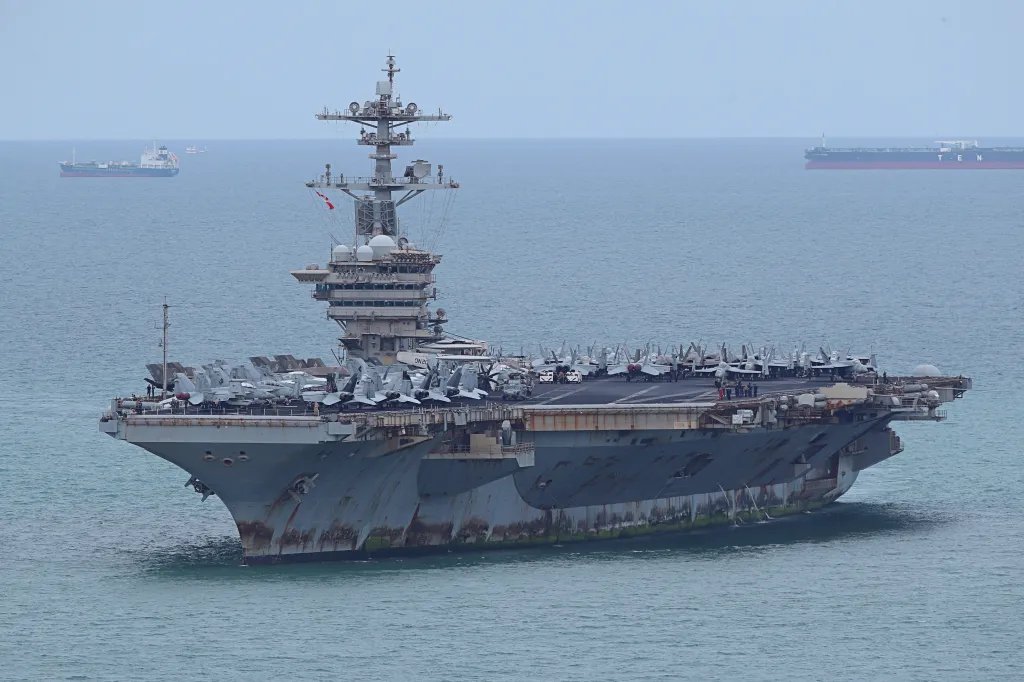
According to the press release, the crew “experienced all the sights and sounds Thailand has to offer, deepening their understanding of the Thai people and strengthening interpersonal bonds.” Lincoln pulled into port looking worse for wear after 286 days at sea, with noticeable algae and rust spots, conditions that are expected given the high operational tempo endured during nearly seven months of combat. Videos surfaced of the hull being scrubbed by Thai contract crews at a fraction of what the same job would cost stateside. The carrier departed five days later on September 6 in much better shape.
Lincoln is now continuing the journey home to San Diego, though whether any additional stops will be made along the way is unknown. A single-sourced report from Newsweek, which TWZ has not verified, claimed that another port call might be added, according to the wife of an officer aboard. As of publication, Lincoln is 293 days into the deployment, just 33 days short of the 326-day record set by USS Gerald R. Ford earlier this year.
U.S. Navy Big-Deck Fleet At A Glance
Overall, three U.S. carriers are deployed (with one heading home), one is preparing to deploy in the near term, three are working up in various states of readiness, three are in current or upcoming maintenance, and one is being used primarily for training before deactivation next year. One amphibious ready group is deployed, one is forward-deployed and at homeport, four are working up or in port, and three are in maintenance.
Note: Positions are general approximations.Non-deployed LHA/LHD amphibious warships are not shown.
Contact the author:ian.ellis-jones@recurrent.io
The post Where Are The American Aircraft Carriers?: September 9, 2026 appeared first on TWZ.

