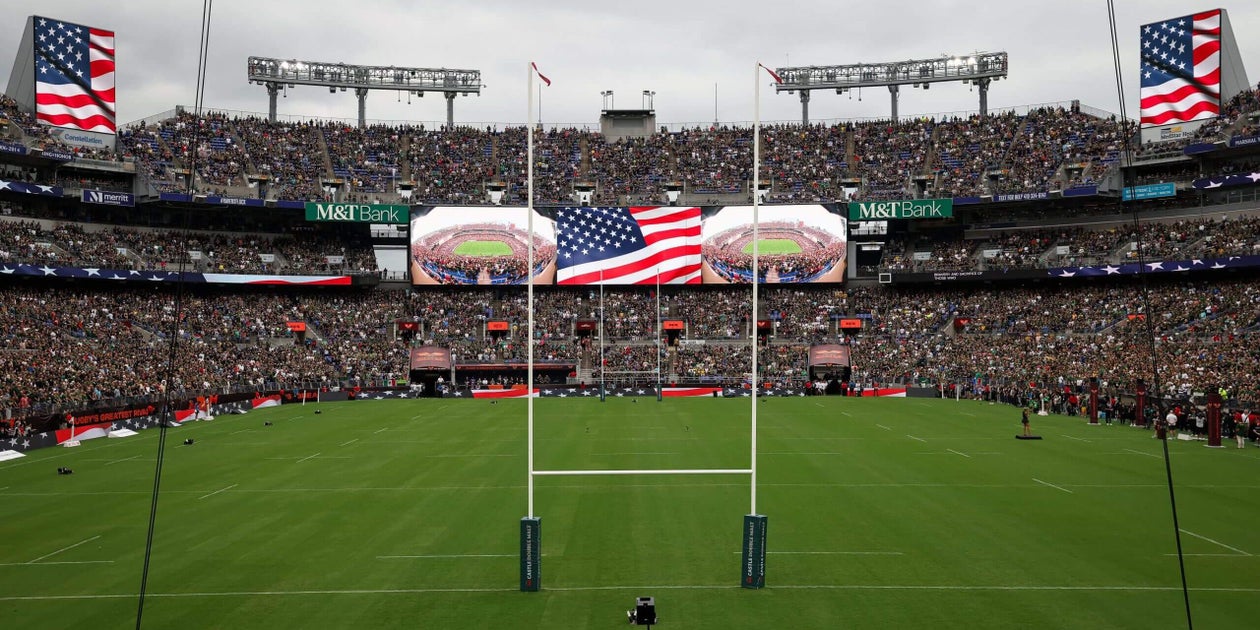
Балтимор хотод болсон регбигийн тоглолтын үеэр зохион байгуулагчид ирэх 2031 оны дэлхийн аваргын тэмцээнд бэлтгэх хүрээнд хөлбөмбөгийн томоохон тэмцээний алдаа, оноог судалж байна.
Өнгөрсөн зун болсон хөлбөмбөгийн дэлхийн аварга шалгаруулах тэмцээний үеэр АНУ-ын хотууд ФИФА-гийн хатуу шаардлага, санхүүгийн ачаалалтай холбоотой хүндрэлтэй тулгарсан нь орон нутгийн удирдлагуудын дургүйцлийг хүргэжээ. Энэхүү туршлагаас үүдэн 21 хотын захиргаа орлого хуваах илүү шударга загвар болон дэд бүтцийн зардлыг хамтран хариуцахыг шаардаж байна. Үүний эсрэгээр, “World Rugby” байгууллага нь хотуудтай түншлэлийн харилцаа тогтоож, хамтран ажиллах замаар 2031 оны эрэгтэйчүүд, 2033 оны эмэгтэйчүүдийн дэлхийн аваргын тэмцээнийг зохион байгуулахаар төлөвлөж байна.
Балтимор хотын M&T Bank цэнгэлдэх хүрээлэнд Өмнөд Африк болон Шинэ Зеландын шигшээ багуудын хооронд болсон тоглолтыг 68,173 үзэгч сонирхсон нь АНУ-д регбигийн түүхэн дэх хамгийн өндөр үзүүлэлт боллоо. Хэдийгээр шүүгчийн харилцаа холбооны системд техникийн саатал гарч тоглолт 10 гаруй минут зогссон ч энэхүү арга хэмжээ нь регбиг АНУ-д сурталчлах томоохон алхам болсон гэж зохион байгуулагчид үзэж байна.
“World Rugby” нь ирэх тэмцээнүүдийн үеэр хотуудад үзүүлэх санхүүгийн ачааллыг багасгах, үзэгчдийн тав тухыг хангах үүднээс талбайн хэмжээ болон ивээн тэтгэгчдийн брэндинг дээр уян хатан бодлого баримтлахаа мэдэгдлээ. Түүнчлэн, тухайн улсын иргэд болон цагаачдын суурьшлыг харгалзан тоглолтуудыг бүсчлэн хуваарилах замаар тасалбарын борлуулалтыг нэмэгдүүлэх стратегийг хэрэгжүүлэхээр ажиллаж байна.
Дэлгэрэнгүйг эх сурвалжаас харах
↓Эх сурвалжийг нээх ↓
“The key thing you’ve got to keep in mind is they are two different organisations,” begins Ashley Harper Cottrell, the project manager of the Maryland Sports Commission. “World Rugby is not FIFA. They (World Rugby) have always been friendly, gregarious, willing to work and listen. Partnership is the key thing they talk about.”
Is that what sets them apart from FIFA? “Yes,” she replies, in an instant.
By the end of the World Cup this summer, many U.S. cities were exasperated by their dealings with FIFA, the world governing body of soccer, which celebrated $15 billion in revenues from the tournament cycle, taking home almost all the earnings from ticketing, hospitality, sponsorship, car parking, concessions and media rights.
The host cities picked up the tab, often at great taxpayer expense, to arrange the costs of transportation, safety and security, FIFA Fan Fests and even vehicles used in the competition. The figures were dizzying, stretching into billions, with millions spent on special access traffic lanes and police escorts for FIFA VIPs, as well as the sometimes farcical “cleaning-up” of stadiums to rid them of sponsor names, and even a $13 million injection from New Jersey to enhance the playing field.
Some of FIFA’s asks led to visible friction. Former Chicago mayor Rahm Emmanuel said “no” to hosting the tournament in America’s third most populous city, baffled by FIFA’s insistence that the hosting contracts included an option for FIFA to require Soldier Field to build a dome for the tournament. New Jersey governor Mikie Sherrill launched a public attack on FIFA, arguing its refusal to provide more funding for her region left her with no choice but to hike the NJ Transit round-trip rail ticket to MetLife Stadium over seven times its usual price to $98.
While host cities clearly enjoyed a significant economic impact, independently commissioned studies are still to land, which means the true cost and benefit to the U.S. taxpayer remains unclear. What is clear, however, is that cities often felt like they got the raw end of the deals signed for 2026. They have told U.S. Soccer and FIFA that they expect a more beneficial arrangement for the women’s edition of the soccer tournament in 2031.
A letter, distributed between and signed by 21 U.S. host cities in November 2025, said the cities want a revenue-sharing model on FIFA’s vast income to alleviate the exposure on public finances. They also want FIFA to share the costs of fan festivals and for venue naming-rights sponsors to be retained rather than scrubbed away. Speaking during the World Cup, Democratic Congressman Rick Larsen told The Athletic some cities may not want to host again “because of their experience with FIFA.”
“You’re not working with the Qatari government here,” he said, explaining that U.S. society has stakeholders at federal, state and mayoral levels, taking it beyond the whims of one all-powerful ruler. “In 2031, FIFA needs to incorporate some lessons. That’s more important than host cities bending to FIFA.”
Over the summer, World Rugby kept a keen eye on all things FIFA before it brings the men’s World Cup to the U.S. in 2031 and the women’s edition in 2033. Brett Robinson, the chair of World Rugby, told a small group of reporters, including The Athletic, that he had a team on site throughout the soccer tournament, “observing, learning, understanding.” He said there are strong “knowledge exchange” programs between the two entities. They admired the upside FIFA uncovered in its revenues and how cities connected with the events they hosted.
South Africa fans flocked to Baltimore (Scott Taetsch/World Rugby via Getty Images)
At the same time, there were learnings from some of what many considered to be FIFA’s missteps. World Rugby, for example, intends to encourage tailgating, which was largely not possible around FIFA World Cup games due to vast stadium perimeter requirements, a decision made on commercial and security grounds.
Ross Young, World Rugby’s GM for U.S. operations, noted that FIFA managed to largely sell out its ticketing despite taking a reputational hit for the unprecedentedly high prices charged. Young says World Rugby wants to ensure its pricing strategy allows rugby to “continue to be accessible to the sporting consumer.” FIFA’s World Cup was mired in off-field scandals. Robinson says: “The most inspiring thing about the FIFA World Cup was that when the sport got to be the front and centre, it became the thing.”
Encouraging, too, has been subsequent feedback from host cities. Despite fraying relations with FIFA, the vibe once the sport began was largely good. The Scots drank Boston dry. The Dutch marched through Kansas and Dallas. The Argentines took Messi-mania on a national roadshow. It left regions keen to host more mega sporting events.
At the same time, they are more judicious in their partnerships. In rugby union, the appeal is a strong global sport. According to World Rugby, the sport recorded 1.33 billion viewing hours across all programming during the previous men’s World Cup in France in 2023.
Executives from World Rugby point out that its fans spend more than supporters of many other global sports. It is popular with nations who have significant diasporas in the U.S. This was showcased on Saturday afternoon in Baltimore, where South Africans turbocharged a 68,173 attendance (a record for rugby in the U.S.) as the Springboks defeated New Zealand in the final match of a four-game test series.
Major rugby nations including England, Ireland, Scotland, Wales, Italy, Argentina, Australia and Japan all have healthy diasporas or a culture of travelling fans to major sporting events. Tickets for next year’s World Cup in Australia are splitting evenly between domestic and international, welcome news for U.S. host cities who crave the spending power of a tourist over a local. Only 10 per cent of tickets for South Africa against New Zealand on Saturday were sold to locals. Prices at hotels soared well above usual rates.
That is the good news, as is the improving performance of the U.S. national teams, which rank eighth in the women’s game and 14th in the men’s. The soccer World Cup reiterated what we knew: America gets into a mega-event when an American team starts winning.

New Zealand perform their Haka before taking on South Africa (Caean Couto/Getty Images)
The more challenging news is that rugby is a deeply embryonic spectator sport in the U.S., far behind even soccer, which itself is often described as a sport being in a growth phase. Major League Rugby is down to only five teams. Rugby’s biggest stars do not have the face or brand recognition in the U.S. of other leading sports.
Rugby’s World Cup window, played in 2023 across September and October, and next year in Australia across October and November, will clash with the NFL schedule and the MLS season. World Rugby has confirmed the window for the 2031 men’s tournament will not change, as it would be too disruptive to rugby leagues and competitions across the globe.
To make the tournament earlier in the summer would clash with the FIFA Women’s World Cup, which is to be co-hosted by the U.S. in 2031. Despite all those caveats, the hope is that America’s immigrant communities, combined with the love of watching elite sport, whatever it may be, will coalesce to provide the most lucrative tournament in rugby’s history.
Rugby is certainly attempting to build an appetite. Saturday’s game brought the two best national teams in the world to Baltimore, the decisive Test match of a series entitled Rugby’s Greatest Rivalry. The New Zealand All Blacks have sought to build their brand in the U.S. in recent years, including two games against Ireland in Chicago, as well as a match against Fiji in San Diego and a game against the U.S. in Washington, D.C..
Saturday’s match sold 40,000 tickets immediately on pre-sale, according to event promoters TEG, and tickets were purchased from all 50 U.S. states and more than 30 countries. “It shows people travel for the best versus the best,” TEG managing director of rugby Stephen Cottrell told The Athletic.
World Rugby does not disguise their desire to bring more games here. The organization wants to bring a Six Nations match to the U.S., which may alienate local fans in Europe but entice diasporas and new supporters. South Africa Rugby president Mark Alexander says it wants to become America’s second favorite team by the World Cup in 2031. “We cannot do it by just playing in Johannesburg and in Cape Town.” Attempts have been made to take a game between New Zealand and France to Las Vegas.
Saturday was not perfect. World Rugby invested around $1.5 million to get the game on at M&T Bank Stadium, the home of the NFL’s Baltimore Ravens, in the hope that the presentation and infrastructure would improve upon last year in Chicago, when the referee mics malfunctioned. There was a half-time show and fireworks greeted the arrival of the teams onto the field. Sadly, the ref’s communications system went down again, leading to a stoppage of more than 10 minutes in the first half, and the delay was not adequately explained to those in the stands.
According to Cottrell, this game was a “tentpole” moment, attracting the biggest crowd for a rugby game. Over the coming months, World Rugby will narrow down its options for U.S. host cities. Twenty seven entered the applicant phase, signing broad and non-binding letters of intent.
According to Young, World Rugby will fight its corner with cities to ensure that its flagship tournament generates cash to be returned to the game.
But it is clear that World Rugby will not demonstrate the same intransigence as FIFA, through choice, or a relative lack of leverage. For example, World Rugby intends to incentivise cities, where possible, by intentionally placing nations in the group phase of the 24-team tournament into regions which house a significant proportion of its diaspora. It would not be a surprise, therefore, to see Argentina games land in Florida, or Ireland games in Massachusetts, or Italy games in New York or New Jersey. West Coast locations for New Zealand or Australia would make it a little more accessible to travelling fans, while the Polynesian diaspora of California may be a clever place for the Pacific Island teams.
Such strategic placements will depend on the right terms being struck between cities, venues and World Rugby. Nothing has been decided yet. Venues need to be available in the early phase of the NFL season, while smaller-sized MLS venues will need to be worked around. Talks are underway with the NFL’s scheduling department. Major college venues are not entirely out of the question.

Jasper Wiese takes selfies with fans after South Africa’s win over New Zealand (Scott Taetsch/World via Getty Images)
A non-negotiable for venues will be rugby’s insistence on grass turf, which was also requested by FIFA. Sixteen NFL teams play on grass, while the other 16 play on artificial turf. Stadiums must ensure that the width of the field is fit for rugby. Usually, World Rugby insists upon a field width of between 74 and 77 yards but the organization will allow U.S. venues a width as low as 71 yards for the World Cup.
A standard NFL field is 53 and one-third yards from sideline to sideline, meaning that stadiums may be required to make infrastructure adjustments. Venues which hosted World Cup games will have a head start. “A lot of venues are putting demountable and easily removable structures to allow fields to be widened again,” says Young. There needs to be leeway at the sideline to allow for players to be tackled over the line in a safe way, while providing room for set pieces.
Reducing the width of the field may not be the only compromise. While World Rugby would like clean stadiums to maximise opportunities for their partners, they may seek solutions, where the conflict is not excessive, to bring a stadium sponsor into the rugby tournament.
World Rugby knows the costs of fully cleaning up a stadium — FIFA insisted on taping over every brand in a venue — can be expensive in unionized buildings and will likely be impractical if stadiums are being used in between commitments for NFL or MLS teams.
There will be sharing of ticketing data between World Rugby and NFL teams. The NFL’s international ventures take them to many of the countries that will compete in a rugby World Cup, so if they have the data about fans who attend rugby games in the United States, the hope is that those same fans could be converted into high-spending NFL fans when NFL games land overseas.
Robinson says: “We do need to be flexible because the venues are different around the country and we need to work with the host city and venue owners.
“That’s something we have looked closely at and we’re conscious of the partnership and the win-win of how we need to interact.”

