Манчестер Сити талбай дээр 10-уулаа үлдсэн ч Манчестер Юнайтедыг 1-0-ийн харьцаатай буулган авч чадлаа
Ням гарагт болсон Манчестерын дерби тоглолтын 23 дахь минутад Фил Фоден улаан хуудас авснаар Манчестер Сити тоглолтын ихэнх хэсгийг 10 хүнтэйгээр өнгөрүүлсэн. Энэхүү нөхцөл байдалд Энцо Марескагийн удирдсан баг хамгаалалтаа маш нягт зохион байгуулж, ялангуяа Эллиот Андерсоны гүйцэтгэсэн хамгаалалтын үүрэг болон Илиман Ндиаегийн сэлгээгээр орж ирсэн хамгаалалтын хувилбар нь Манчестер Юнайтедын довтолгоог бүрэн хааж чадсан юм.
Майкл Каррикийн удирдсан Манчестер Юнайтед тоон давуу талаа ашиглахын тулд довтолгооны байрлалаа өөрчилж, Патрик Доргуг зүүн жигүүрт илүү идэвхтэй тоглуулсан ч эцсийн дамжуулалт болон шийдвэрлэх цохилтууд дээр алдаа гаргаж байлаа. Тоглолтын 51 дэх минутад Кобби Майнугийн хаалганы шон оносон цохилт нь Юнайтедын хамгийн бодитой боломж байсан ч багийн тоглогчид хамгаалалтын шугамыг сэтлэх оновчтой шийдвэр гаргаж чадаагүй нь хожигдолд хүргэв.
Тоглолтын дараа Юри Тилеманс багийн дамжуулалтын алдаа болон эцсийн шийдвэрүүд хангалтгүй байсныг хүлээн зөвшөөрсөн бол Энцо Мареска өөрийн багийн хамгаалалтын нягт байдал нь Манчестер Юнайтедын сөрөг довтолгоог зогсооход гол үүрэг гүйцэтгэсэн гэдгийг онцоллоо. Ийнхүү Манчестер Сити Лигийн аваргын төлөөх өрсөлдөөнд чухал ялалт байгуулсан бол Манчестер Юнайтед гүн хамгаалалтын эсрэг тоглох тактикийн шийдлүүдээ сайжруулах шаардлагатай байгаа нь тодорхой болов.
Дэлгэрэнгүйг эх сурвалжаас харах
↓Эх сурвалжийг нээх ↓
There are usually two sides to a victory with 10 players: resilience and wastefulness.
Manchester City’s back-to-the-walls defensive display in their 1-0 victory in the Manchester derby on Sunday presented the former, while Manchester United’s inability to create chances against 10 men embodied the latter.
After Phil Foden’s red card in the 23rd minute, there was one main question: how will Michael Carrick’s side break down City’s defence?
The immediate change in United’s shape on the ball (below) was the more aggressive positioning of Patrick Dorgu down the left side, instead of supporting Lisandro Martinez and Harry Maguire in the build-up.
Meanwhile, Matheus Cunha continued dropping from his centre-forward position in an attempt to create space for Marcus Rashford and Bryan Mbeumo to attack against City’s 4-4-1 shape.
United’s attempts to attack the space in behind the defence and the area vacated by Cunha were clear from the beginning of the match when Diogo Dalot dashed inside the pitch behind City’s centre-backs in the ninth minute but failed to control Bruno Fernandes’ chipped pass.
Executing this idea was United’s main problem in the first half.
Here, Fernandes tries to find Rashford behind City’s defence while Cunha is pinning Ruben Dias and Marc Guehi, but the midfielder’s pass is heavy and United’s left-winger fails to control the ball.
Note how Mbeumo is syncing his movement behind City’s defensive line to provide Rashford with a passing option.

In another example, Fernandes is occupying Dias as Mbeumo is dropping and Maguire is carrying the ball forward.
Initially, Mbeumo is marked by Enzo Fernandez, but the Cameroon forward changes his direction when the Argentina midfielder has to defend Maguire. That is complemented by Fernandes dragging Dias out of position, which allows Mbeumo to attack the vacated space.
However, Maguire decides to shoot instead of slipping the ball through to Mbeumo.

Again, United try to attack the space in behind before City drop their defensive block, but the pass isn’t played.
Here, Rashford attacks the space behind Guehi, with Cunha positioning himself between the lines to complement the run which should stretch the defensive line, but Martinez doesn’t play the ball to either of them.
Seconds later, Mbeumo tries to attack the space behind Josko Gvardiol and Dias, with Fernandes occupying the latter.
However, Martinez doesn’t try the pass; asequence which is best summarised by Mbeumo’s reaction.

It’s unfair, though, to ignore City’s defensive organisation, which minimised United’s attacking threat in the second part of the first half.
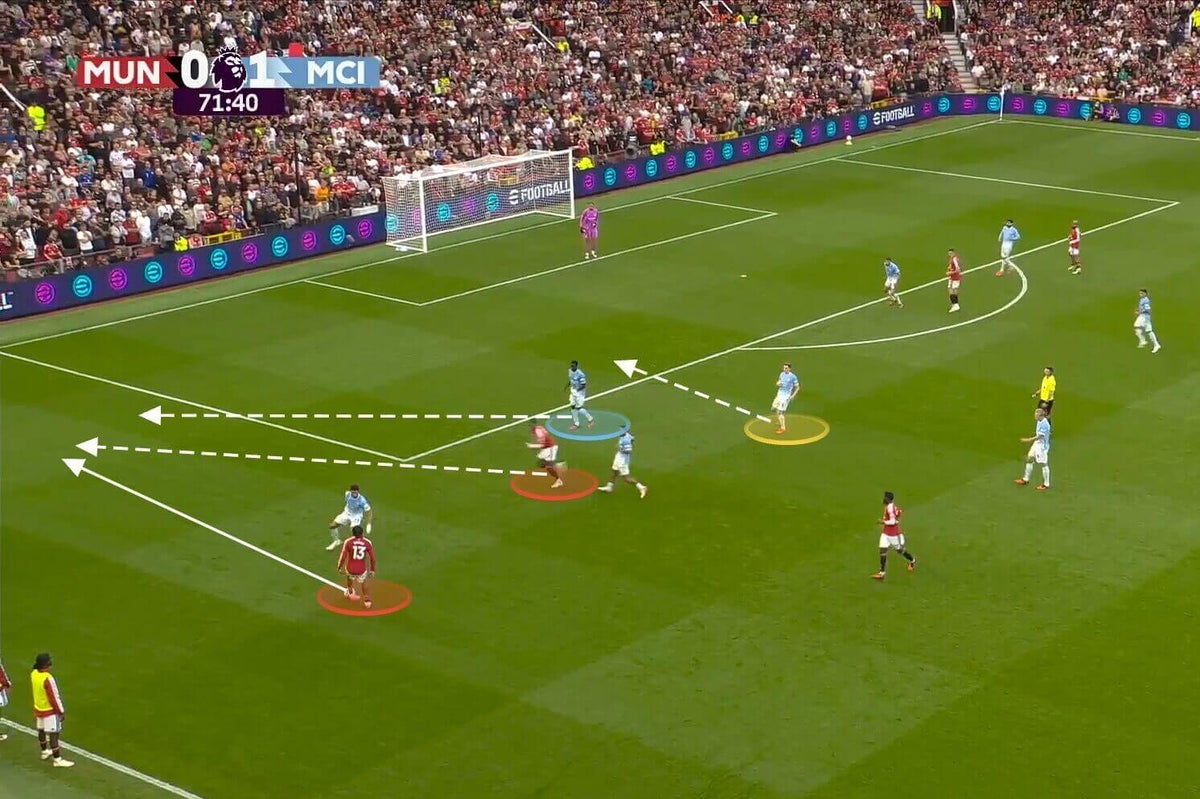
Elliot Anderson in particular had an important role in dropping to cover for his centre-backs when Guehi or Dias moved wide to defend United’s overloads.
Here, Anderson drops as Guehi moves up to defend Cunha, who plays the ball to Rashford.
When the England forward tries to find Cunha behind Guehi, who is momentarily thinking about defending Dorgu down the wing, Anderson is in position to win the ball.

Anderson’s task of allowing his centre-backs to defend the half-spaces continued in the second half and was crucial in stopping United’s attacks from the wide areas as Enzo Maresca’s side dropped deeper.

The other tweak was introducing Iliman Ndiaye in place of Rayan Cherki, which provided a better defensive profile down City’s right and a threat on counter-attacks.
In the second half, City continued with the same defensive shape, but they were more aware of blocking the central space and funneling United’s attacks wide, where Antoine Semenyo and Ndiaye supported Gvardiol and Matheus Nunes.

In this example, Ndiaye is in the right position as Martinez is searching for a passing option.
Nunes’ initial movement towards Dorgu allows Martinez to find Rashford between the lines, but City’s right-back spots that Ndiaye is dropping to cover United’s left-back and maintains his position.
This allows Nunes to intercept the ball when Rashford tries to combine with Mbeumo and attack the space behind City’s defence.

Ndiaye and Semenyo also had another role to protect the central space in front of City’s penalty area when Anderson dropped deeper, but United’s failure to exploit these multiple roles for City’s wingers made things easier for Maresca’s side.

“I think the game, with 10 players, becomes more difficult for us, but also for them,” Maresca said in his post-match press conference.
“They are a team that loves transitions (and) space in behind. With 10 players, we just drop waiting for them so we didn’t concede any transition (or) space in behind.”
After the half-time break, Carrick’s side changed their attacking approach, looking to combine centrally to play through City or create space out wide, or attack the flanks to then find players between the lines or put crosses into the penalty area.
Execution failed United again, but so did their inability to master different solutions against a deep defence, which has been a worrying trend under Carrick.
If United had stretched their opponents in the right manner, the roles of City’s midfield line created space in front of their penalty area, as seen when Kobbie Mainoo’s shot hit the post in the 51st minute.
Here, Anderson is deep to support his centre-backs, Ndiaye is covering Dorgu, and Semenyo and Fernandez are defending the ball.
When Dalot cuts inside and finds Fernandes in the D, Anderson dashes forward, but Ndiaye is unable to move up towards Mainoo.
Fernandes then flicks the ball to his team-mate and Mainoo rattles the woodwork, with Anderson unable to block the shot.

United should have attacked this area in front of the box more, either to create shooting situations or to trick the opponent into thinking that they would shoot to manipulate their opponents’ defensive line.
In this example, Martinez and Dorgu combine to find Mainoo in space.
The England midfielder then dribbles past Anderson, which prompts Fernandez to drop and perform his team-mate’s role.
However, this leaves the edge of the area free, with Semenyo unable to cover it due to the positioning of Dalot and Fernandes.
Mainoo chooses the wrong option, though, and tries to find Fernandes instead of Youri Tielemans. The Belgium midfielder attempts to control the ball, but he only takes it away from Fernandes.

In another example, Rashford has the ball on the left wing and Dorgu’s run forces Ndiaye deeper, while Anderson is dropping in anticipation of the cross.

Even if Anderson is near Cunha, there’s space for the Brazil forward on the edge of the box to manipulate the England man’s position, but Rashford doesn’t play the ball to Cunha and City’s midfield line isn’t stretched. United’s left-winger crosses the ball and it is blocked by Nunes.

“We didn’t use the right spaces,” Tielemans told United’s official channels after the match. “We made mistakes in our passes, maybe rushed it a little bit too much. (We) didn’t make the right last passes in the final third to create enough chances.”
In a game influenced by the referee’s decisions, there are more important sides of the story for City and United.
Maresca’s side have to build on this resilient performance if they want to battle Arsenal for the Premier League title. Carrick, his staff and the players meanwhile still need to work on solutions against deep defences.

