Сарны туйлуудад хадгалагдаж буй мөсөн усны хэмжээ нь олон сая хүнтэй хотыг тогтвортой хангах боломжгүй болохыг эрдэмтэд тогтоожээ.
Сарны туйлын бүсүүд дэх мөнхөд сүүдэртэй тогоонуудад хадгалагдсан мөсөн ус нь сансрын суурин байгуулах гол түлхүүр гэж үздэг. Гэвч Smithsonian Astrophysical Observatory-ийн доктор Мартин Элвис болон Durham их сургуулийн доктор Жонатан Макдауэлл нарын Frontiers in Space Technologies сэтгүүлд нийтлүүлсэн судалгаагаар энэхүү нөөц нь хүн амын томоохон суурьшлыг дэмжихэд хангалтгүй болохыг харуулжээ. Тэд нэг тэрбум тонн усны нөөцийг баримжаа болгон авч, хүн амын ундны ус болон хүнс үйлдвэрлэлийн хэрэгцээг тооцоолсон байна.
Судалгаагаар нэг сая хүн амтай хот нь одоогийн Олон улсын сансрын станцын ус дахин боловсруулах хамгийн өндөр буюу 98 хувийн үр ашигтай технологиор ажилласан ч 100 жилийн дотор л нэг тэрбум тонн усыг бүрэн шавхах тооцоо гарчээ. Хүнсний үйлдвэрлэл нь зөвхөн хувь хүний хэрэглээнээс 6-15 дахин их ус шаарддаг нь тогтвортой суурьшлын гол бэрхшээл болж байна. Хэрэв суурингийн хүн ам 100,000 орчим байвал усны нөөц 1,000 жилийн турш хүрэлцэх боломжтой бөгөөд энэ нь илүү бодитой хувилбар гэж судлаачид үзэж байна.
Эрчим хүчний хувьд Сарны тогоонуудын ирмэг дээр нарны эрчим хүчний байгууламж суурилуулах нь хангалттай боломжтой боловч усны асуудал шийдэгдээгүй хэвээр байна. Сарны гадаргуу дээрх усны нөөцийн хэмжилтийн үр дүн эрдэмтдийн дунд харилцан адилгүй байгаа нь нөхцөл байдлыг улам бүр тодорхойгүй болгож байна. Иймд Сар дээрх анхны суурингууд нь Антарктид дахь судалгааны баазуудтай адил 1,000 орчим хүнтэй байх нь хамгийн оновчтой бөгөөд тогтвортой байх магадлалтай юм.
Эрдэмтдийн үзэж буйгаар Сарны усны нөөцийг “түрүүлж ирсэн нь эзэмшинэ” гэсэн зарчмаар бус, харин төлөвлөгөөтэй, хатуу зохицуулалттайгаар ашиглах нь нэн чухал байна. Илүү их усны нөөц Сарны гүнд хадгалагдаж байж болзошгүй боловч түүнийг олборлох боломж, хүртээмж нь одоогоор тодорхойгүй байна. Судлаачид хэрэв сансрын салбарын томоохон төлөвлөгөөнүүдийг хэрэгжүүлэх гэж байгаа бол хамгийн эхний алхам нь нэмэлт усны нөөц хайх явдал гэдгийг онцолжээ.
Дэлгэрэнгүйг эх сурвалжаас харах
Эх сурвалжийг нээх ↓
The dawn of the space age in the 1950s and 60s came with a particular kind of hubris. The futuristic zeitgeist of the time led to scientific ideas of humans living in cities on the Moon. Arthur C. Clarke envisioned outposts of inflatable, pressurized domes that would grow into a city. The US Army’s Project Horizon was a serious feasibility study for establishing a military and scientific lunar base. And there were others.
An eventual human presence on the Moon was considered an inevitability by many.
Our current understanding that the Moon harbours a vast amount of frozen water ice has triggered a renewed interest in lunar colonies and cities. The usual billionaire suspects have shared their dreams of building a city on the frigid satellite. But are these ideas practical? Or are they throwaway ideas?
Billionaires waxing rhapsodic about Moon cities is one thing. But the foundation of any human settlement is water. Is the Moon’s water accessible and plentiful? Is there some way of providing enough water for an actual city full of people?
A new article in Frontiers in Space Technologies digs into the meat of the idea. The article is “No cities on the Moon: a billion tons of water is not enough for sustainability,” and the authors are Dr. Martin Elvis and Dr. Jonathan McDowell. Dr. Elvis is from the Smithsonian Astrophysical Observatory at the Center for Astrophysics, Harvard and Smithsonian, and Dr. McDowell is from the Space Research Centre at Durham University in the UK.
Discusssions of lunar water ice focus on the Moon’s Permanenently Shadowed Regions. These are craters near the Moon’s poles where ancient ice billions of years old is sheltered from the Sun’s warmth. There are some other deposits, like in the regolith itself, but those are not rich sources and not easily exploited.
“The Moon, with an area of 37.93 million km2, about 50% bigger than North America (24.71 million km2), is talked about as our “8th continent”, the authors write. “As a result, many authors consider the Moon’s resources to be so vast as to pose no significant constraints on industry and settlement.”
Listen to the hubris the authors are pointing out. As if the Moon is like a continent. As if there are “no significant restraints.”
Bezos said we should move heavy industry to the Moon as if that’s something we could actually do. Musk says we should build self-growing cities on the Moon. In this work, the authors point out how ludicrous this is. And their reasoning comes down to water.
“Presumably, in order to make an economic difference to the human economy, they are both imagining significant settlement of, say, at least 1% of Earth’s population, i.e., ∼80 million people living on the Moon,” the authors write. “These are grand plans,” they add.
Grand plans are great when they’re grounded in reality. The Moon landings, for instance, were grand. The Hubble Space Telescope was a grand idea. Those grand plans only came to fruition after decades of rigorous science.
When applying science to the ideas of Moon cities and lunar industrial parks, they collapse into hubristic rambling.
These futuristic settlements would also need energy to exploit all of this ice. So the problem is two-fold: accessible ice and the energy to melt it, deliver it, and critically, to recycle it sustainably. “Is it correct to make the assumption that sufficient power and water are available?” the authors ask, framing their work.
There’s one thing working in favour of Moon cities. The useful ice deposits are in the bottoms of shadowed craters near the poles. But the rims of the very same craters are excellent locations for solar power generation. These rims are seldom shaded, and because of the angles involved, photovoltaics can be mounted vertically. “These arrays can be tall, from several meters to as high as 1 km and could rotate to follow the Sun around the horizon,” the authors write.
Elvis and McDowell crunch the numbers for personal energy use and industrial energy use and conclude that energy isn’t a limiting factor, although that includes fusion power.
“If industry requires no more than double the personal use rate, then a million people can be supported on the Moon with either solar or fission power,” they write. They add that fusion power, if attainable, is a necessity if considering a human population of several millions. “For both solar and fission sources power generation is a weak constraint on the lunar population,” they explain.
So it’s all about water.
There are some necessary constraints on the Moon’s water. While there are multiple methods of measuring the water in PSRs, and different researchers have calculated the total amount of water ice on the Moon, measurements are uncertain and don’t agree with one another.
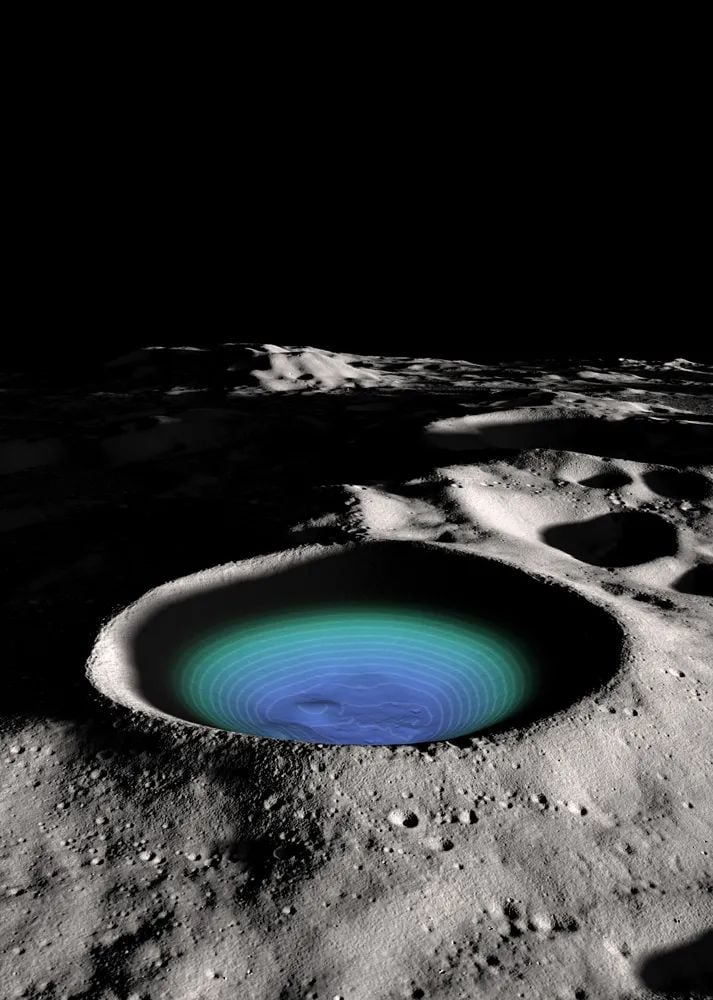
Shackleton Crater is a large, 21 km crater near the Moon’s south pole that’s prominent in discussions about lunar water. A 2007 study showed that it could hold between 1.6 to 4.5 million tons of water ice. That range shows how badly more accurate measurements are needed.
Regardless of the amount of ice present, the reality is not all of it will be retrievable. “Achievable retrieval fractions for lunar water will only be known once we have ground truth on how the water ice is mixed with the surface regolith,” the authors write.
There are assumptions involved in this issue. The authors settle on a number often used in these discussions: one billion tons of water ice in the Moon’s permanently shadowed regions. “One billion tons of water will be taken here as a generous baseline,” they write.
The blue areas show potential water ice deposits at the Moon’s south pole. Image Credit: NASA.
Though one billion tons sounds like a lot, it’s not. Earth has about 1.4 billion billion tons (1.4 × 10¹⁸ metric tons.) The water will be used as drinking water, to make rocket fuel, for growing food, and for breathing.
The researchers use the figure of 125 tons of personal water use per person per year, based on estimates for an adult in the USA. That’s for personal use only.
Growing food requires much more. The World Bank estimated that 2 to 5 tons, or 2,000 to 5,000 liters, are needed to feed one person per day. “That comes to 730–1825 tons/year/person, or ∼6–15 times as much as direct personal water consumption,” the authors write.
Working with these ranges, the authors calculate that a city of one million people would exhaust the Moon’s water in only 2.4 years.
But the water consumption numbers can be reduced in a lunar setting where water will be more tightly controlled and accounted for. The researchers considered water recycling efficiency and applied it to cities of different populations to establish time frames for water exhaustion.
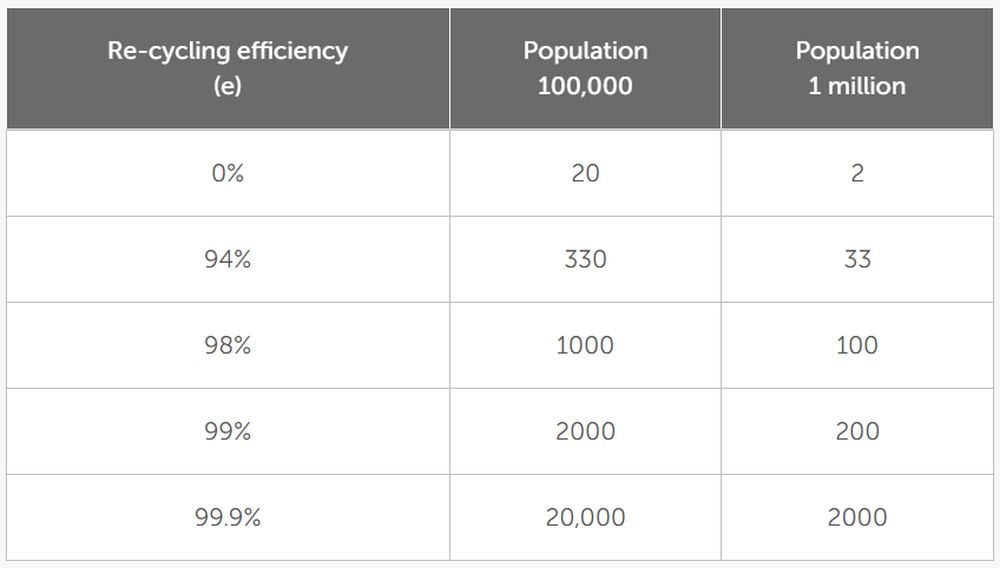 This table shows the number of years to full exhaustion of a billion tons of lunar water. Image Credit: Elvis and McDowell 2026. Frontiers in Space Technologies.
Humans have some expertise in water recycling. The authors point out that the International Space Station has, by necessity, the most efficient water recycling system ever devised. Up until 2023, it reached a 94% efficiency. “At that efficiency a billion tons of water is gone in 40 years for a population of 1 million,” they explain.
Building a lunar city that can only last 40 years would be pointless. But the ISS improved its water recycling efficiency to 98% in 2023. “That may sound like a small change, but it is a major achievement, cutting the losses threefold,” the researchers write.
If a lunar base can reach 98% water recycling efficiency, the numbers shift. An ISS-like 2% loss rate means that it would take 100 years for a city of one million people to use up a billion tons of water. “For such a large investment, a lifetime of about a century seems to fall short of the sustainable, long-term settlement beyond Earth that some advocate,” the authors explain.
But a smaller city of about 100,000 people could sustain itself for about 1,000 years, which are much more palatable numbers. “This timescale seems long enough to justify being called sustainable,” Elvis and McDowell write.
In terms of water, these figures start to illustrate what may be feasible in the future. But shifts and changes in how people live will be required to succeed. At some point, recycling efficiency will be maxed out and other approaches will be needed.
A low-meat or no-meat diet lowers water use, though it’s not clear if there’s any real way of raising livestock, poulty, or fish on the Moon anyway. Water could be potentially imported from other sources, perhaps from water-rich asteriods. The magnitude of that task is beyond this paper.
Finding more water on the Moon may be the most reasonable solution. But where? Underground seems the most likely location.
“In the case that an unexpected reservoir of water is found, then doubling the total available water would double the longevity of lunar settlements,” the authors write.
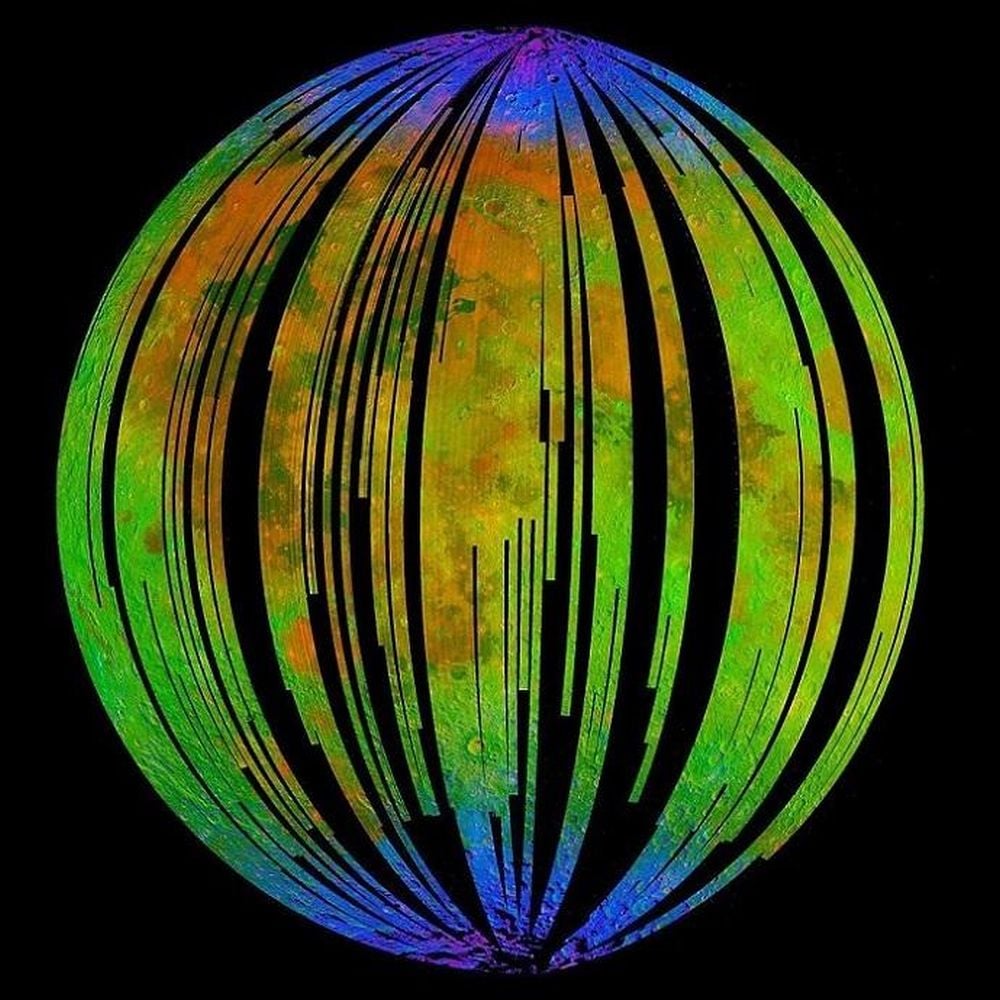 This mineral mapping of the Moon also shows the distribution of water ice in blue at the lunar poles. Image Credit: NASA
How easily accessed that potential reservoir may be is a difficult question to answer. There could be water ice under the surface, but will it be concentrated like it is in PSRs?
There are many unanswered questions. Billionaires may get away with glossing over them and blithely pointing to some kind of unrealistic future. But that path isn’t open to scientists. These scientists say the most likely future sees a population of about 1,000 on the Moon, similar to the population of researchers and staff in Antarctica.
“If the settlement remains a “Moon Village” at a population of about 1,000, comparable to the winter-over population of Antarctica, then we can be relatively carefree in our use of lunar water,” the researchers write. “If the population reaches 100,000, then we need to start being careful.”
There’s a huge list of other factors to consider when contemplating any kind of city or industry on the Moon. But the basic need is water.
The authors say that no matter what happens, stewardship of the Moon’s water resources will be vital. “Humanity will need to plan, govern and regulate the use of lunar water, rather than adopt a ‘first come first served’, free-for-all approach to water extraction and use,” they write.
It comes down to finding more water, according to the authors.
“If the ambitious plans of the space billionaires are to be realized, then finding more water will be the first step,” Dr. Martin Elvis wrote in an accompanying letter.

