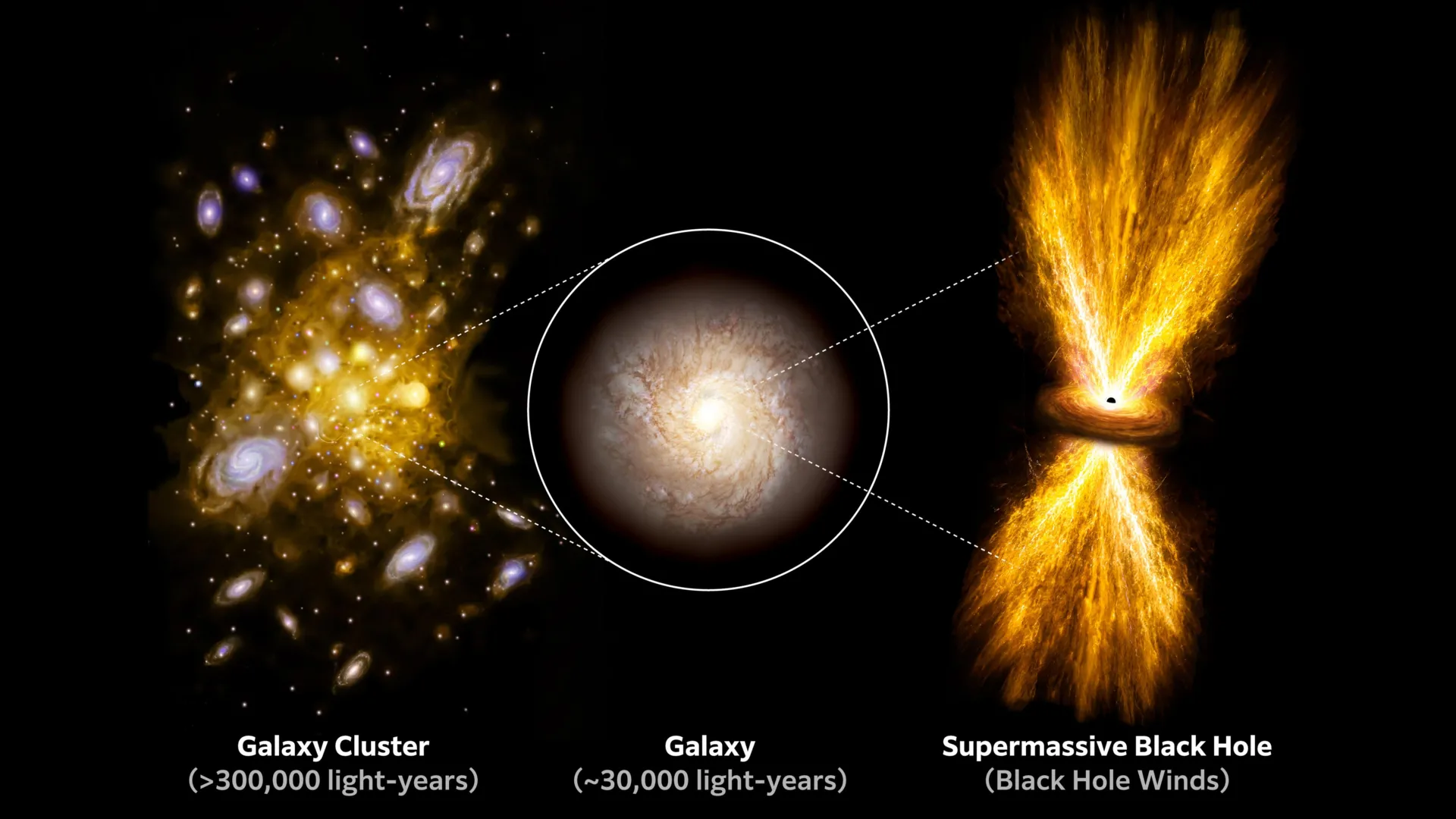
Шинэ судалгаагаар супермассив хар нүхнүүд нь галактикийн хил хязгаараас давсан асар их хэмжээний энергийг сансарт түгээдэг болохыг илрүүллээ.
Тохоку их сургуулийн эрдэмтэн Сатоши Ямада болон түүний баг XRISM сансрын дуран авайг ашиглан Дэлхийгээс 3.4 тэрбум гэрлийн жилийн зайд орших H1821+643 квазарыг судалжээ. Квазар гэдэг нь маш их хэмжээний хийг залгиж буй супермассив хар нүхээр тэжээгддэг, хэт тод гэрэлтдэг сансрын объект юм.
Судлаачид төмрийн ионуудын ялгаруулж буй цацрагт дүн шинжилгээ хийж, хар нүхийг хүрээлэн буй халуун хийн хөдөлгөөнийг хэмжсэн байна. Ингэхэд хар нүхнээс гарч буй хийн салхи нь зөвхөн галактикийн дотор хязгаарлагдахгүй, түүнээс 300,000 гэрлийн жилийн зайд хүрдэг нь тогтоогджээ.
Тус судалгааны үр дүнд эдгээр салхины энерги нь өмнөх тооцооллоос даруй 100 дахин их буюу хэдэн тэрбум супернова дэлбэрэлтийн хүчтэй тэнцэж байгааг эрдэмтэд илрүүлсэн байна. Энэхүү гайхалтай хүчтэй цохилтын долгион нь хар нүхнүүд зөвхөн материйг залгиад зогсохгүй, сансрын өргөн уудам орчныг бүрдүүлэхэд гол үүрэг гүйцэтгэдэг болохыг харуулж байна.
Nature Astronomy сэтгүүлд нийтлэгдсэн энэхүү нээлт нь хар нүхнүүд галактик болон тэдгээрийн бөөгнөрлийн орчныг хэрхэн төлөвшүүлдэг талаарх шинэ ойлголтыг өгч байна. Цаашид хийгдэх ажиглалтууд нь сансрын өөр өөр бүс нутагт матери болон элементүүд хэрхэн шилжиж байгааг илүү тодорхой болгох юм.
Дэлгэрэнгүйг эх сурвалжаас харах
↓Эх сурвалжийг нээх ↓
Supermassive black holes may have a much larger influence on their surroundings than scientists previously realized. New observations suggest that winds driven by these enormous objects can carry energy across roughly 300,000 light-years, reaching far beyond the galaxies that host them.
Researchers found that the energy associated with these winds is about 100 times greater than earlier estimates, revealing that black holes can affect vast regions of space on a truly enormous scale.
“Black holes are largely known for sucking matter in, but they also eject gas in the form of powerful winds,” says Satoshi Yamada, Assistant Professor at Tohoku University’s Frontier Institute for Interdisciplinary Sciences (FRIS). “These winds were thought to be contained within the galaxy, but our study revealed that the force is immensely more powerful than previously understood.”
XRISM Takes a Closer Look at a Distant Quasar
Yamada and his colleagues, including researchers from Kanazawa University and Tokyo Metropolitan University, among others, used the X ray astronomy satellite XRISM to study the quasar H1821+643. The object lies in the constellation Draco, about 3.4 billion light-years from Earth.
Quasars are exceptionally bright cosmic objects powered by supermassive black holes that are actively consuming gas. As material falls toward the black hole, tremendous amounts of energy can be released, making quasars visible across immense distances.
The rapidly growing black hole at the center of H1821+643 sits within a galaxy cluster. There, it stirs the surrounding hot gas, which gives off X-rays. To measure how that gas was moving, the researchers analyzed emission lines produced by iron ions.
Black Hole Turbulence Reaches Far Beyond the Galaxy
XRISM’s high-precision measurements showed that the extremely hot gas around the black hole is far from motionless. Instead, turbulence causes it to spread violently across a broad region.
The team also found that this gas flow extends beyond the black hole’s host galaxy, reaching distances of about 300,000 light-years. Even more striking, the energy contained in the turbulence was approximately 100 times greater than previous estimates.
That amount of energy is comparable to the output of several billion supernova explosions, the powerful blasts produced when certain stars reach the ends of their lives.
“For the first time, we have shown that black holes influence the broader cosmic environment through a shock wave of astonishing power,” adds Yamada. “Black holes are key drivers of gas flows and motion in space, transporting vast amounts of energy to different regions of the cosmos.”
A Bigger Role for Black Holes in the Cosmos
The findings suggest that supermassive black holes do more than consume nearby matter. They can also send energy and gas far into surrounding space, potentially helping shape the environments around galaxies and galaxy clusters.
Details of the research were published in the journal Nature Astronomy.
Future observations are expected to provide a clearer picture of how black holes affect their surroundings and how matter and elements move through different regions of the cosmos.

