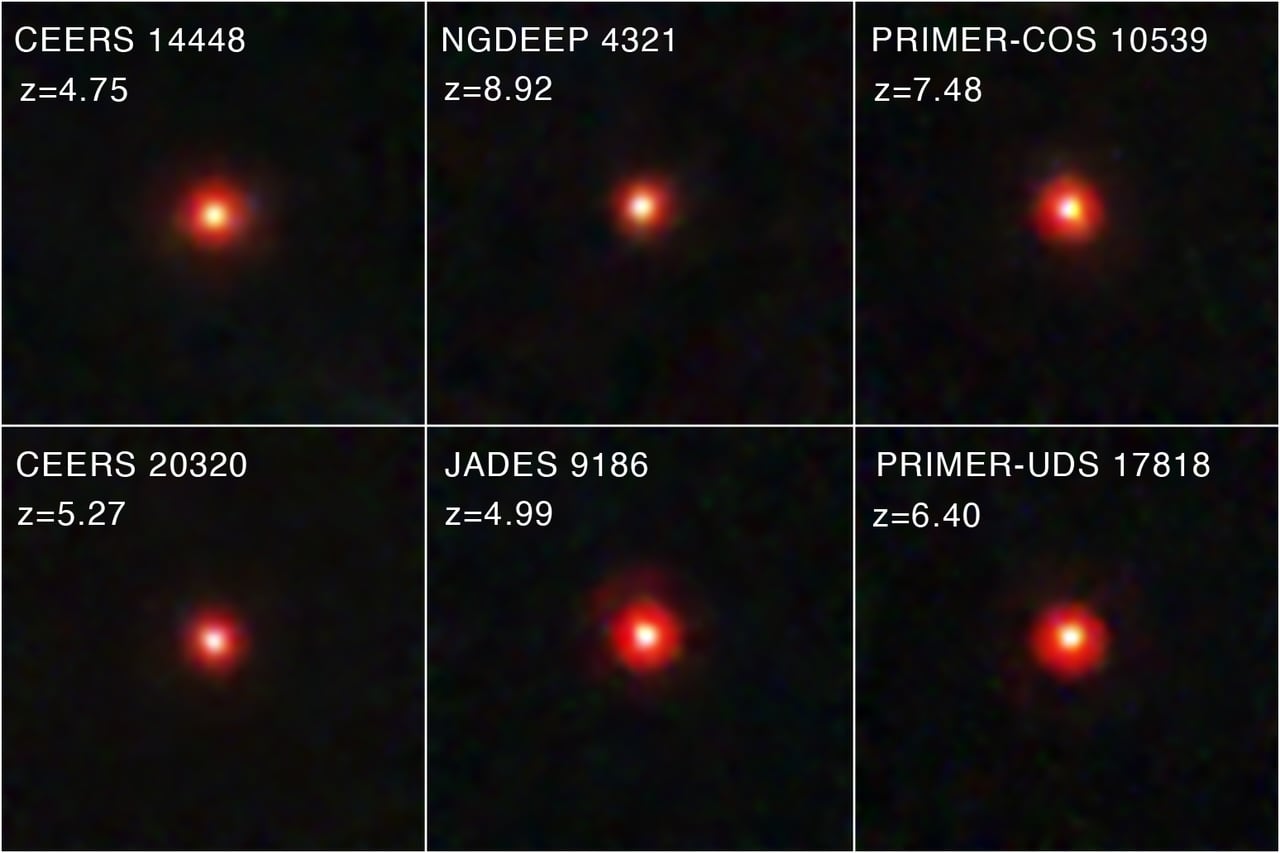
Жэймс Вэбб сансрын дуран авайгаар илрүүлсэн нууцлаг биетүүд нь хэт том хар нүхнүүдийн анхны хэлбэр болохыг шинэ судалгаагаар тогтоожээ.
Жэймс Вэбб сансрын дуран авай (JWST) сансрын хамгийн харанхуй бүсүүдийг ажиглах явцдаа ертөнцийн нэг тэрбум жилийн настай үед хамаарах “Жижиг улаан цэгүүд” (LRD) хэмээх содон биетүүдийг илрүүлжээ. Эрдэмтэд эдгээр биетийг анхны галактикуудын эхлэл эсвэл аварга том од байж магадгүй хэмээн таамаглаж байсан ч тэдгээрийн спектрийн шинж чанар нь ердийн квазарууд болон оддын аль алиных нь шинжийг агуулж байв.
Nature сэтгүүлд нийтлэгдсэн шинэ судалгаагаар эдгээр биетийг эртний ертөнцөд үүссэн, хэт том масстай хар нүхнүүд гэж дүгнэжээ. Компьютер загварчлалын үр дүнгээс үзэхэд, прото-галактик доторх хийн үүлс нь хэт ягаан туяаны хүчтэй нөлөөнд автсанаар од болон хувирахын оронд шууд нурж, хар нүх болон хувирдаг байна.
Эдгээр хар нүх нь анхнаасаа л Нарны массаас сая дахин их хэмжээтэйгээр үүсдэг аж. Эртний ертөнцийн цацраг идэвхт орчин нь хар нүхийг хүчээр хооллох мэт үйлчилж, “Эддингтоны хязгаар” гэгдэх бодисын шингээлтийн хэвийн дээд хэмжээнээс давуулан бодис идэх боломжийг олгодог байна.
Энэхүү хурдацтай өсөлтийн үйл явц нь супермассив хар нүхнүүд ертөнцийн түүхийн маш эрт үед хэрхэн бий болсныг тайлбарлаж байна. Судлаачдын үзэж буйгаар, жижиг улаан цэгүүд нь хожим хүчирхэг квазар болон хувирах галактикийн хар нүхнүүдийн үр хөврөл юм.
Дэлгэрэнгүйг эх сурвалжаас харах
Эх сурвалжийг нээх ↓
When the James Webb Space Telescope (JWST) first looked at the darkest regions of the sky, it was able to see objects fainter and more distant than ever before. It revealed a few surprises about the early cosmos, and one of them was the discovery of Little Red Dots (LRDs).
LRDs are reddish, point-like objects seen when the Universe was only a billion years old. Astronomers had no idea what they were. The obvious idea is that they must be young and powerful active black holes. Perhaps the seeds of the first galaxies. But active black holes generate powerful radio and X-ray light, like quasars, while LRDs do not. Another idea is that they are tremendously large progenitor stars. Powerfully bright stars made only of hydrogen and helium. LRDs have a spectrum similar to models of the first stars, but the spectra also show a strong rotational Doppler shift. LRDs seem to rotate incredibly fast, which would be unusual for the first stars. A new study in Nature argues that they are young, overmassive black holes.
The study is based on computer simulations of the early Universe. The team simulated a proto-galaxy within the environment of the young cosmos and looked at how this affected the evolution of the galaxy. One of the things they found was that gas clouds within the proto-galaxy are bathed in bright ultraviolet light, and this prevents the cloud from becoming a stellar nursery. Instead of fragmenting into protostellar clouds, the giant gas clouds collapse to form a primordial superstar, which then quickly collapses into a black hole.
These black holes have an initial mass on the order of a million Suns. The radiative environment of the early Universe helps push gas toward the black hole, meaning it can consume more matter rapidly. Normally there is a limit to how fast a black hole can grow. As it consumes matter, it generates intense heat and light, which pushes back against infalling matter. The balance point between gravity and pushback is known as the Eddington Limit. But in this case the environmental radiation helps to force-feed the black hole. It can consume material at a super-Eddington rate, thus accelerating its growth.
Simulations of these overmassive black holes predict a spectrum that strongly matches the observed spectra of Little Red Dots. The model helps explain why LRD spectra resemble black holes in some ways and primordial stars in other ways. This work could also explain why supermassive black holes appear so early in the Universe. It seems LRDs are the seeds of galactic black holes and powerful quasars.
Reference: Chon, S., Hirano, S., Ishiyama, T. et al. “Overmassive black holes and little red dots naturally form in simulations.” Nature 657, 621–625 (2026).

