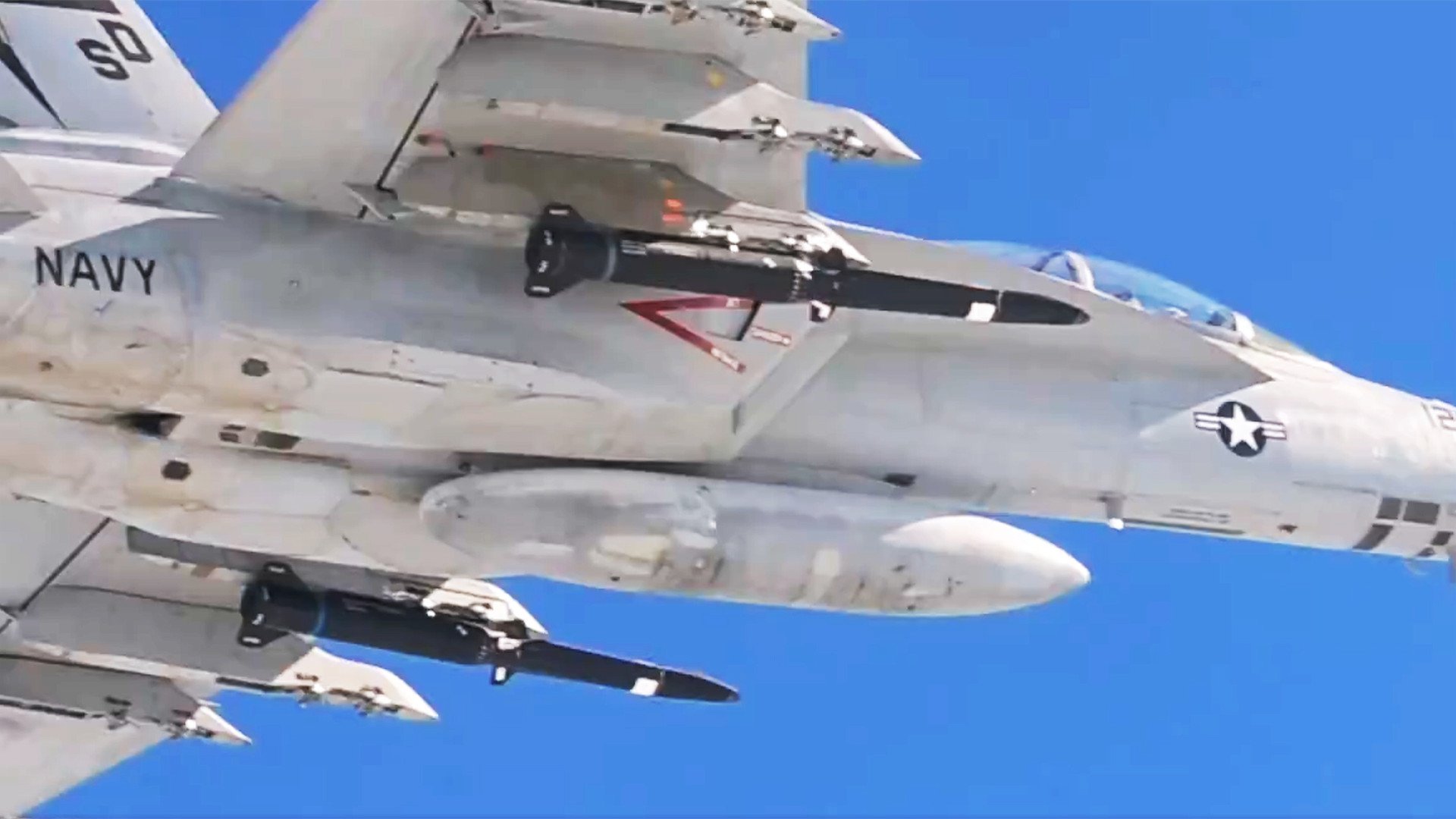
АНУ-ын Тэнгисийн цэргийн хүчин хэт авианы хурдтай, өртөг багатай “Blackbeard” пуужингийн нислэгийн туршилтыг албан ёсоор эхлүүлж, F/A-18E/F Super Hornet сөнөөгч онгоцны далавчин дор суурилуулан туршсан бичлэгийг олон нийтэд танилцууллаа.
АНУ-ын Тэнгисийн цэргийн хүчин “Blackbeard” пуужинг 2028 он гэхэд хязгаарлагдмал хэмжээгээр зэвсэглэлд нэвтрүүлэхээр төлөвлөж байна. Энэхүү зэвсэг нь дайсны хөлөг онгоцыг устгахад чиглэсэн, үйлдвэрлэхэд хялбар бөгөөд хурдан шуурхай ажиллагаатай байхаар бүтээгджээ. Батлан хамгаалахын гарааны Castelion компанитай байгуулсан гэрээний дагуу 444 ширхэг пуужинг үйлдвэрлэж, нийлүүлэхээр ажиллаж байгаа бөгөөд тавдугаар сард Пентагон таван жилийн хугацаанд 12,000 ширхэг “Blackbeard” пуужин худалдан авах ерөнхий хэлэлцээрт хүрсэн байна.
“Blackbeard” пуужин нь баллистик пуужингийн адил хурдатгагч болон хэт авианы хурдаар нисэх хэрэгслээр тоноглогдсон байх магадлалтай гэж шинжээчид үзэж байна. Уг пуужин нь Мах 5-аас дээш хурдтай нисэх чадвартай бөгөөд ойролцоогоор 500 миль хүртэлх зайд байгаа байг онох боломжтой юм. АНУ-ын Тэнгисийн цэргийн хүчин үүнийг “MACE” (Multi-mission Affordable Capacity Effector) хөтөлбөрийн хүрээнд хөгжүүлж байгаа бөгөөд ирээдүйд F-35 сөнөөгч онгоцнуудад ч суурилуулах боломжтой.
Энэхүү пуужингийн хөгжүүлэлт нь АНУ-ын зэвсгийн нөөцийг нэмэгдүүлэх, ялангуяа Номхон далайн бүс нутаг дахь геополитикийн нөхцөл байдал болон бусад мөргөлдөөний үед хурдан шуурхай хариу арга хэмжээ авах чадавхийг сайжруулах зорилготой юм. Хэдийгээр АНУ-ын хэт авианы пуужингийн бусад хөтөлбөрүүд удаашралтай байгаа ч “Blackbeard” нь агаараас харвах төрлийн анхны байлдааны бэлэн пуужин болох төлөвтэй байна. АНУ-ын Арми мөн энэхүү пуужингийн газраас харвах хувилбарыг хөгжүүлж байгаа ажээ.
Дэлгэрэнгүйг эх сурвалжаас харах
Эх сурвалжийг нээх ↓
The U.S. Navy has given us the first look at Blackbeard hypersonic strike missiles under the wings of F/A-18E/F Super Hornets during actual flight testing. The Navy is hoping to have Blackbeard in at least limited service no later than 2028, giving its carrier air wings an all-new fast-flying standoff weapon, particularly for engaging enemy ships. The missile is also being designed to be relatively cheap and quick to manufacture.
The Navy’s Office of the Portfolio Acquisition Executive for Aviation (PAE-A) has released a video montage of Blackbeard undergoing flight testing, seen in the social media post below. The service confirmed that it had at least begun test-loading the missiles onto F/A-18E/F Super Hornets in a presentation at the Tailhook Association’s annual convention last month. Now we know the program has moved ahead substantially from that point.
The company behind Blackbeard, defense start-up Castelion, has received several multi-million-dollar contracts from the Navy just this year explicitly to support integration of the weapon onto the Super Hornet, as well as otherwise accelerating its development. In its daily contracting on September 14, the Pentagon announced the Navy had struck yet another deal with Castelion, valued at $43.65 million, “for the manufacturing, assembly, testing, and delivery of the first production lot of 444 All-Up Rounds (AURs), defined as fully functional tactical missiles packaged within specialized shipping and storage containers.”
In terms of what we know today about Blackbeard’s design and capabilities, as we have previously written:
“A profile photo [seen below] at the company’s headquarters reveals a weapon with a ballistic missile-likebooster, on top of which is mounted what could be an unpowered hypersonic glide vehicle(HGV). A booster brings an HGV to the desired velocity and altitude before releasing it toward its target. The concept is in contrast to air-breathing cruise missiles capable of traveling at hypersonic speeds. Hypersonic speed is generally defined as anything above Mach 5, which larger ballistic missiles also reach in the course of their flights. More precise performance figures for Blackbeard are lacking, but Castelion has previously hinted it could hit targets out to just under 500 miles. Alternatively, the second stage may also have its own motor, allowing it to continue accelerating or sustain high-speed flight. A similar arrangement has been suggested as the propulsion system for the Russian Zircon missile.”
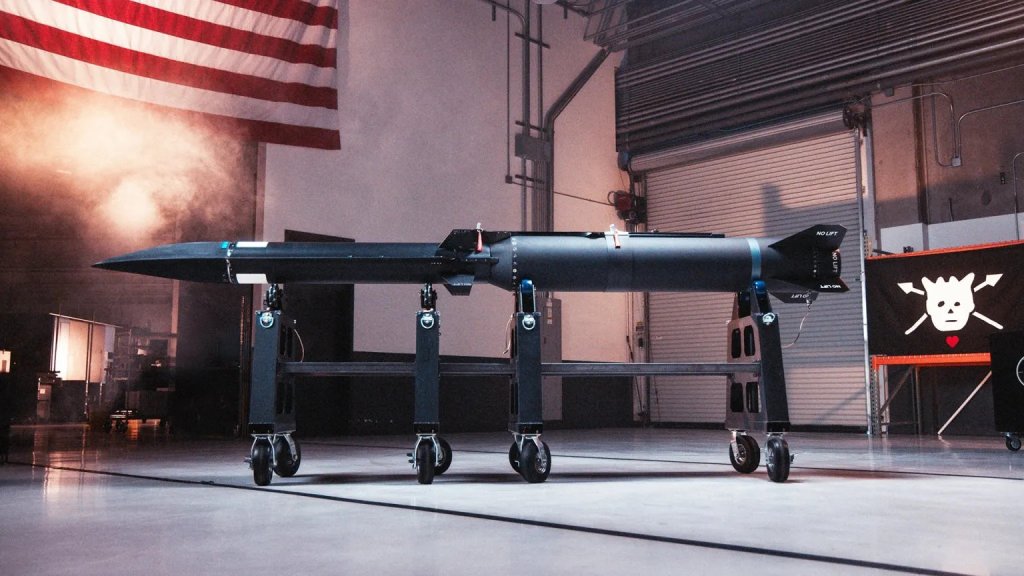
“Both stages of the weapon have cruciform fins, while the upper one features a prominent ‘chine’ line along the length of its body, and a slightly beaklike nose. The trolley on which the weapon is mounted provides some idea of its overall size. The blue stripes seen on each stage normally signify that a munition is an inert, non-explosive round utilized for training or tracking purposes. This would indicate a real (unarmed) missile rather than a dummy or mockup.”
A picture shown at Tailhook had also offered a new look at the front of the missile, exposing what looked to be an aperture on one side of the design’s wedge-shaped nose. As we wrote after that image emerged:
“The apparent apertures are also seen pointed up, but many air-launched munitions do flip down after release.”
“How exactly Blackbeard is guided remains unknown, but a downward-angled aperture at the nose end for a seeker system would make sense for this weapon, which the Navy is pursuing primarily as a new way to target enemy ships. In particular, a wide array of existing anti-ship and land attack missiles, as well as certain anti-air types, have variously shaped apertures in their noses for imaging infrared seekers. Imaging infrared has the benefit of being immune to radio frequency electronic warfare jamming. In addition, it is a passive capability that does not send out signals that can give an opponent advance notice of an incoming attack. Blackbeard’s full guidance package very likely also includes some means of navigating to a target area first, and it could have multiple modes of operation.”
The new flight testing footage released today also underscores the relatively small size of Blackbeard overall. While the Super Hornet is set to be the first operational launch platform, it is very likely to be integrated on other aircraft quickly thereafter. The Navy is acquiring Blackbeard under a program called the Multi-mission Affordable Capacity Effector (MACE).
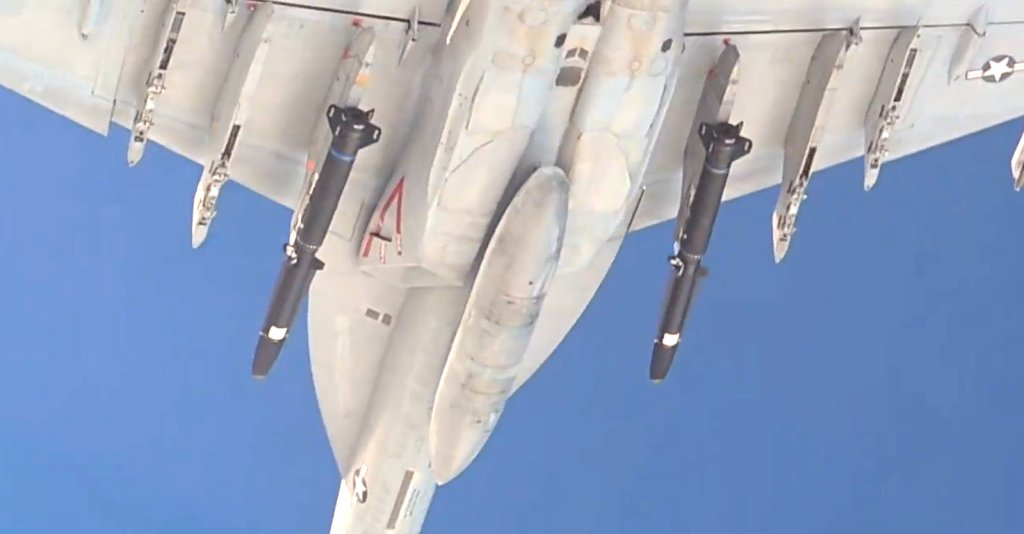
Requirements for MACE that the Navy put out previously explicitly called for a design compact enough for carrier-based F-35C (and land-based F-35A) Joint Strike Fighters to carry four of them internally. Whether that remains a goal in any way is unclear. Still, being able to carry some number of Blackbeards internally would not only give those jets a hypersonic strike weapon, but one that they could carry in the most stealthy configuration. The Navy also notably does operate the F-35A outside of the test and evaluation community, which might point to air-launched Blackbeards entering service elsewhere in the future. As an aside, the U.S. Army is pursuing a ground-launched version of this missile, as well.
Another critical aspect of Blackbeard is the emphasis on lower cost and the ability to produce the missiles readily at scale. The conflict with Iran has fully driven home long-standing concerns about the depth of U.S. stockpiles of various critical munitions, as well as its ability to replenish them quickly. Blackbeard reflects a larger push across America’s armed forces to add more cost-effective weapons that can be acquired on faster timetables to their arsenals. Bringing in new, smaller companies like Castelion to develop and build these munitions has also been a major point of focus. To put this all in immediate context, in May, the Pentagon announced a framework agreement to buy 12,000 Blackbeards over the next five years.
As mentioned, the Navy’s stated goal now is to reach an early operational capability with Blackbeard by 2028, if not sooner. What the exact fielding plan for those missiles might be is unclear. PAE-A did write “Coming soon to a theater near you” in its post on X containing the video montage, and tagged the official accounts for U.S. Central Command (CENTCOM) and U.S. Pacific Command (PACOM). CENTCOM oversees U.S. military activities in and around the Middle East, including ongoing operations against Iran. U.S. military officials have also long touted hypersonic weapons, in general, as key to success in any future conflict in the Pacific, especially a high-end fight against China.
It’s also worth noting here that U.S. military hypersonic missile programs across the services have faced repeated setbacks and delays over the years. This, in turn, has prompted discussion about a worrisome gap emerging in this arena between the United States and its chief global competitors, especially China. It is very possible now that Blackbeard could be the first operational air-launched type in American inventory, depending on how the U.S. Air Force does or does not proceed with its Hypersonic Attack Cruise Missile (HACM) program. The Air Force has said previously that it is aiming for HACM to be operational, at least on a limited level, before the end of Fiscal Year 2027, which begins next month.
If nothing else, we have clear evidence that the air-launched version of Blackbeard is now deep in flight testing for the U.S. Navy.
Contact the author: joe@twz.com
The post Blackbeard Hypersonic Missile Seen Flying On F/A-18 Super Hornet For The First Time appeared first on TWZ.

