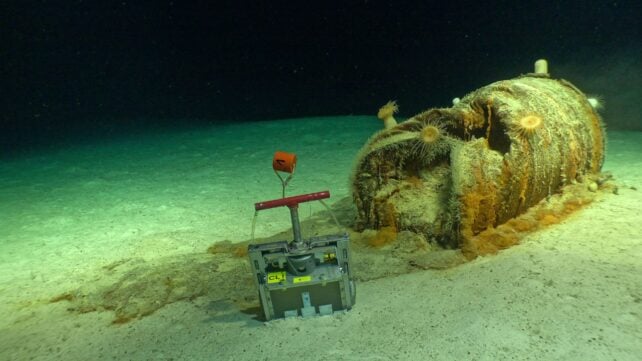
Эрдэмтэд Атлантын далайн ёроолд олон арван жилийн өмнө булсан 200,000 орчим торхтой цацраг идэвхт хаягдлын төлөв байдлыг нарийвчлан судалж, хүрээлэн буй орчинд үзүүлж буй нөлөөг тогтоохоор ажиллаж байна.
Өнгөрсөн зууны хоёрдугаар хагаст Европын орнууд эмнэлэг, лаборатори болон үйлдвэрлэлийн салбарын дунд зэргийн идэвхжилтэй цацраг идэвхт хаягдлуудыг Атлантын далайн хойд хэсгийн гүн рүү хаяж булшилсан түүхтэй. CNRS байгууллагын тэргүүлсэн NODSSUM төслийн хүрээнд 2025 онд UlyX бие даасан хөдөлгөөнт төхөөрөмж ашиглан 3,355 торхыг байршлыг нарийвчлан тогтоосон бол 2026 оны тавдугаар сараас зургадугаар сарын хооронд Pourquoi Pas? судалгааны хөлөг онгоцны багийнхан 4,700 метрээс илүү гүнд Nautile шумбагч ашиглан хээрийн шинжилгээ хийжээ.
Шинжилгээгээр зарим төмөр торх зэвэрч гэмтсэний улмаас доторх цемент, битум зэрэг битүүмжлэгч материал ил гарч, улмаар кобальт-60, ниобий-94 зэрэг радионуклидууд далайн ёроолын хөрсөнд тархсан болохыг илрүүлсэн байна. Мөн цезий-137, америций-241 зэрэг бодисын агууламж агаар мандлын цөмийн туршилт эсвэл өмнөх ослын үеийн суурь төвшнөөс өндөр байгааг тогтоосон ч, нийт цацраг идэвхжил нь нэмэлт хамгаалалтын тусгай арга хэмжээ авах шаардлагагүй хэмжээнд байгаа ажээ.
Далайн ёроолын зөөлөн хөрсөнд хатуу гадаргуу болж буй эдгээр торх нь далайн амьтдын амьдрах орчин болсон нь судалгааны анхаарлыг татаж байна. Эрдэмтэд торхны ойролцоох хөрс, ус болон тэнд нутаглаж буй амьтдаас дээж авч, цацраг идэвхт бодис амьд организмд шингэж буй эсэхийг лабораторийн шинжилгээгээр судалж байна.
Энэхүү судалгаа нь урьд өмнө нь бүрхэг байсан хаягдал хаях үйл ажиллагааны далайн экосистемд үзүүлэх урт хугацааны нөлөөг тодорхойлоход чухал ач холбогдолтой юм. Цацраг идэвхт бодисын тархалт нь эх үүсвэрээсээ холдох тусам огцом буурдаг болохыг өмнөх судалгаанууд харуулсан ч, одоогийн судалгаагаар тухайн бүс нутгийн бодит нөхцөл байдлыг илүү тодорхой болгох зорилготой байна.
Дэлгэрэнгүйг эх сурвалжаас харах
↓Эх сурвалжийг нээх ↓
Nearly five kilometers beneath the Northeast Atlantic, the seafloor is cold, dark, and mostly flat. The lights of the French submersible Nautile reveal rusting metal drums scattered across the sediment, many of them deposited there decades ago as containers for radioactive waste. Some remain recognizable, but others are heavily corroded or damaged enough for cement, bitumen, and other encapsulating materials to become exposed.
Marine life has made use of these unfamiliar structures. Anemones and sponges grow on the barrels, crabs shelter beside them, and fish and sea cucumbers move through the surrounding area. The Thünen Institute describes the drums as rare hard surfaces in an otherwise soft, sediment-covered environment, helping explain why so many organisms have settled on them.
Decades of Waste Beneath the Atlantic
European countries disposed of more than 200,000 barrels of radioactive waste in parts of the Northeast Atlantic during the second half of the twentieth century. Much of the material was classified as low- or intermediate-level waste from hospitals, laboratories, industry, and other nuclear-related activities rather than spent reactor fuel. Many of the containers were deposited thousands of meters below the surface, where their condition remained difficult to assess for decades.
Historical records identified broad disposal zones but offered limited information about individual containers or how the surrounding environment had changed over time. The CNRS-led NODSSUM project, short for Nuclear Ocean Dump Site Survey Monitoring, was created to replace those broad estimates with direct observation, detailed mapping, and environmental sampling. Its work has provided scientists with a much clearer view of the disposal sites than archival records alone could offer.
A major step came in 2025, when the autonomous underwater vehicle UlyX surveyed part of the dumping area using sonar and imaging equipment. The month-long campaign located and mapped 3,355 barrels, giving the research team precise coordinates for later dives. Those mapped targets became the foundation of the follow-up expedition described by CNRS.
Between May and June 2026, around 30 scientists returned aboard the French research vessel Pourquoi Pas? with the deep-diving submersible Nautile. Twenty dives took the crew beyond 4,700 meters, where individual barrels could be inspected and samples of water, sediment, microorganisms, and marine animals collected. Some containers had deteriorated badly, and material from several had already reached the surrounding seabed.
Radioactive Leakage and Marine Life
Measurements from the expedition identified radionuclides associated with the dumped waste. Cobalt-60 and niobium-94 could be linked specifically to the barrels, while cesium-137 and americium-241 appeared at levels above what researchers would normally expect from atmospheric nuclear testing or previous nuclear accidents. Even with those detections, the overall activity remained low enough for the collected samples to be handled without extensive additional radiation-protection procedures.
Finding radionuclides outside the containers does not mean contamination has spread widely through the ocean. Concentrations can fall sharply with distance from a localized source, especially in a large marine environment where dissolved material may disperse quickly. The more important issue is what happens once the released material reaches sediment, seawater, and nearby organisms.

The animals attached directly to the drums make that question especially relevant. Sponges and anemones have colonized metal surfaces, while crabs and other species use the structures and nearby debris as shelter. Researchers are now examining whether radionuclides remain near the barrels or are absorbed by organisms living in direct contact with them.
Samples were taken from five locations containing barrels and from nearby rocky habitats without dumped waste. Comparing those sites should help separate contamination associated with the drums from background radioactivity already present in the environment. Laboratory testing can also show whether specific radionuclides occur in sediments, microorganisms, or larger animals collected close to the containers.

Evidence from other underwater nuclear sites suggests that radioactive contamination can sometimes remain highly localized. Investigations of the wrecked Soviet submarine Komsomolets, for example, recorded very high concentrations close to a leaking source but much lower levels only a short distance away. The Atlantic disposal sites may show a similar pattern, although differences in waste type and environmental conditions mean the comparison cannot provide a definite answer.
What the Researchers Still Need to Determine
The barrels also reflect disposal practices based on assumptions that differ considerably from those used today. Some mid-twentieth-century approaches did not require containers to remain sealed indefinitely, particularly when shorter-lived radionuclides were expected to decay before serious deterioration occurred. Gradual dispersal into the ocean could therefore be treated as part of the disposal process rather than an unexpected failure of containment.
The abundance of life around the drums needs careful interpretation. Animals living on the containers show that the structures have become part of the physical habitat, but their presence does not demonstrate that the surrounding ecosystem is unaffected by radiation. “Low-level waste” also covers a broad range of materials, so the environmental consequences depend on the radionuclides involved, their concentrations, and whether organisms absorb them.

NODSSUM has now given researchers detailed maps, direct observations, radiation measurements, and biological samples from sites that remained poorly studied for decades. Laboratory analysis of material collected during the 2026 expedition should clarify whether radionuclides stay concentrated near individual barrels or move into nearby organisms. The results will help define the ecological significance of a waste-disposal practice whose long-term effects are only now being examined in detail.
Enjoyed this article? Subscribe to our free newsletter for engaging stories, exclusive content, and the latest news.

